The emergence of antibody-drug conjugates (ADCs) has introduced a new era in the treatment of advanced non-small cell lung cancer (NSCLC), offering a strategy that combines targeted tumor recognition with highly potent cytotoxic delivery.
Among these therapies, datopotamab deruxtecan (Dato-DXd), a TROP2-directed antibody-drug conjugate, has demonstrated meaningful clinical activity in patients with advanced NSCLC, including those with previously treated disease. As its clinical use expands, understanding and managing its unique toxicity profile has become an essential part of optimizing patient outcomes.
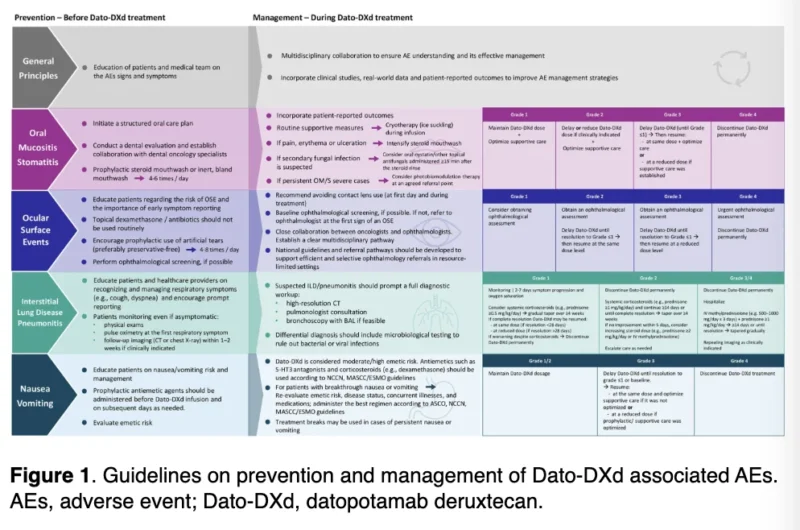
An international multidisciplinary steering committee of lung cancer specialists, ophthalmologists, and pulmonologists has developed consensus recommendations for the prevention, monitoring, and management of Dato-DXd-associated adverse events in patients with advanced/metastatic NSCLC.
The recommendations focus on five clinically important toxicity areas: oral mucositis/stomatitis, ocular surface events, interstitial lung disease (ILD)/pneumonitis, nausea, and vomiting. The expert panel developed 55 consensus statements using available clinical trial data, guidelines, and real-world experience, with all recommendations reaching expert agreement through Delphi methodology.
A New Target in Lung Cancer: Understanding TROP2-Directed Therapy
TROP2 has become an important therapeutic target in lung cancer because of its expression across multiple tumor types. Dato-DXd is designed to deliver a topoisomerase I inhibitor payload directly to TROP2-expressing tumor cells.
The ADC consists of a humanized monoclonal antibody targeting TROP2 linked to deruxtecan, a cytotoxic topoisomerase I inhibitor. After binding to tumor cells, Dato-DXd is internalized and releases its payload, causing DNA damage and tumor cell death. The released drug can also affect nearby tumor cells through a bystander effect.
Clinical studies have shown encouraging activity of Dato-DXd in NSCLC. In previously treated advanced NSCLC, the phase III TROPION-Lung01 study demonstrated improved progression-free survival compared with docetaxel, supporting the continued development of this treatment approach.
The FDA granted accelerated approval to Dato-DXd for adults with locally advanced or metastatic EGFR-mutated NSCLC who previously received EGFR-directed therapy and platinum-based chemotherapy.
Why Managing ADC Toxicities Is Becoming Central to Lung Cancer Care
As ADCs move from clinical trials into routine practice, toxicity management becomes a key component of treatment success.
Unlike traditional chemotherapy, ADC-related adverse events are influenced by both the antibody target and the cytotoxic payload. The expert committee emphasized that successful treatment requires proactive planning before therapy begins, including patient education, baseline assessment, symptom monitoring, and early multidisciplinary intervention.
The committee highlighted that patients and healthcare teams should recognize early signs of toxicity because timely intervention may prevent complications and allow patients to continue benefiting from treatment.
Oral Mucositis: The Most Impactful Quality-of-Life Toxicity
Among Dato-DXd-associated adverse events, oral mucositis/stomatitis represents one of the most clinically important toxicities affecting quality of life.
In the TROPION-Lung01 trial, stomatitis occurred in 55.2% of patients (164/297) receiving Dato-DXd. Most events were mild to moderate, with grade 1 events occurring in 27.6% and grade 2 events in 20.9% of patients. Treatment discontinuation due to stomatitis was uncommon.
The expert recommendations emphasize prevention before symptoms appear. A structured oral care plan, patient education, dental evaluation when feasible, and prophylactic steroid-containing mouthwash should be considered.
Patients should report early symptoms such as mouth pain, redness, or ulceration so supportive treatment can begin promptly. For severe cases, dose delays, reductions, or discontinuation may be required depending on toxicity grade.
Ocular Toxicity: Early Recognition Protects Vision
Ocular surface events are another important toxicity associated with Dato-DXd therapy.
In TROPION-Lung01, ocular surface events occurred in 21.5% of patients, including dry eye, excessive tearing, conjunctivitis, and keratitis. Most events were low grade.
The expert panel recommends educating patients about possible eye symptoms and encouraging early reporting. Preventive strategies include artificial tears, avoiding contact lens use during treatment, and ophthalmologic assessment when symptoms develop.
For grade 2 or higher ocular toxicity, ophthalmologic evaluation and treatment interruption may be required until symptoms improve. Severe grade 4 ocular events require urgent assessment and permanent treatment discontinuation.
ILD and Pneumonitis: A Critical Safety Focus in ADC Therapy
Interstitial lung disease and pneumonitis remain among the most serious potential complications associated with ADC therapy.
In TROPION-Lung01, ILD occurred in 8.8% of patients (26/297) receiving Dato-DXd. Grade ≥3 events occurred in 3.7% of patients, and grade 5 ILD events were reported.
Because respiratory symptoms may be nonspecific, the expert committee emphasized the importance of early detection. Patients should be educated to report symptoms such as cough or shortness of breath, and suspected ILD should prompt immediate evaluation.
Recommended evaluation may include high-resolution CT imaging, pulmonology consultation, and additional diagnostic testing to exclude infections or other causes. Treatment decisions should be based on severity, with permanent discontinuation recommended for grade 2 or higher ILD/pneumonitis.
Managing Nausea and Vomiting to Maintain Treatment Continuity
Nausea and vomiting are common adverse events associated with ADC therapy and can significantly affect patient quality of life.
In TROPION-Lung01, nausea occurred in 34% of patients, although most events were mild or moderate.
The expert committee considers Dato-DXd to have moderate-to-high emetic risk and recommends prophylactic antiemetic strategies based on established oncology guidelines. These may include serotonin receptor antagonists and corticosteroids.
Persistent symptoms require reassessment of treatment-related factors, supportive medications, and potential dose adjustments.
The Future of TROP2-Directed Therapy in Lung Cancer
Dato-DXd represents an important step forward in precision treatment for advanced NSCLC. However, maximizing its clinical benefit requires more than demonstrating antitumor activity.
The international consensus highlights that successful ADC implementation depends on coordinated care involving oncologists, pulmonologists, ophthalmologists, nurses, dental specialists, and pharmacists.
As more patients receive ADC therapies, real-world data will continue to refine prevention strategies and improve toxicity management approaches.
The Bottom Line
Datopotamab deruxtecan is expanding treatment possibilities for patients with advanced NSCLC through TROP2-directed targeted drug delivery.
An international expert consensus provides practical guidance for managing the major toxicities associated with Dato-DXd, including stomatitis, ocular events, ILD/pneumonitis, nausea, and vomiting.
The key message is that ADC success depends not only on tumor response but also on proactive toxicity prevention, early recognition, and multidisciplinary care.
With appropriate monitoring and management strategies, Dato-DXd may become an important component of the evolving lung cancer treatment landscape.
References
- William Nassib William Jr, Daniel Brungs, Emerson Fernandes de Sousa e Castro, et al. Consensus recommendations for the management of Dato-DXd-associated adverse events in patients with advanced/metastatic NSCLC: insights from a multiregional steering committee. Therapeutic Advances in Medical Oncology. 2026;18:1–21.