Lorlatinib continues to deliver exceptional long-term disease control in previously untreated ALK-positive advanced non-small cell lung cancer, but new translational data from CROWN are beginning to clarify why a minority of patients still progress early.
At ESMO Congress 2026, an exploratory circulating tumor DNA analysis from the phase III CROWN trial showed that early progression on lorlatinib was associated with greater baseline genomic complexity, higher blood-based tumor mutational burden, more frequent TP53 alterations, and enrichment of inflammatory-response pathways.
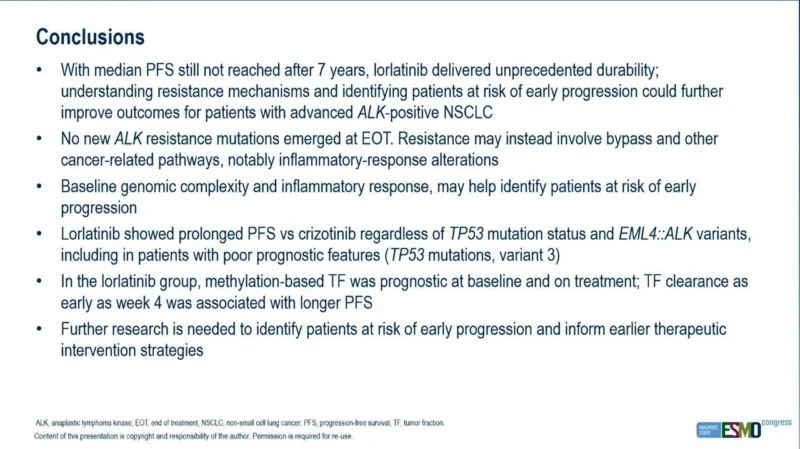
Importantly, paired baseline and end-of-treatment analyses did not identify newly acquired ALK resistance mutations in patients progressing on lorlatinib.
Instead, resistance appeared to involve bypass signaling and other cancer-related pathways, suggesting that failure of first-line lorlatinib may increasingly be driven by ALK-independent biology rather than classic on-target escape.
The findings add biological context to the remarkable seven-year CROWN efficacy results, in which median progression-free survival with lorlatinib remains unreached and approximately 55% of patients remain progression free at seven years.
Seven Years of Disease Control Creates a New Research Question
CROWN randomized 296 previously untreated patients with ALK-positive advanced NSCLC to lorlatinib or crizotinib. At seven years of follow-up, median PFS remained unreached with lorlatinib compared with 9.1 months with crizotinib. The estimated HR was 0.19, corresponding to an 81% reduction in the risk of progression or death.
Seven-year PFS was approximately 55% with lorlatinib versus 3% with crizotinib. Intracranial control has been similarly striking. The risk of intracranial progression was reduced by approximately 94%, and no new intracranial progression events were reported after the first 30 months of lorlatinib treatment.
With outcomes this durable, the clinical question changes. Rather than asking whether lorlatinib is effective, the challenge becomes identifying the minority of patients who do not experience prolonged benefit.
Approximately one in five patients in the lorlatinib arm experienced progression or death within the first year. The ESMO 2026 analysis focused specifically on understanding what differentiates these early progressors from patients who remain progression free for many years.
ctDNA Was Used to Compare Early Progressors and Long-Term Responders
Within the lorlatinib arm, investigators analyzed blood-based genomic data obtained using the Guardant Infinity ctDNA platform. Early progressors were defined as patients who experienced a PFS event within 12 months of beginning treatment.
Long-term responders were defined much more stringently: patients who remained alive without documented disease progression at seven years. Baseline ctDNA was available from 120 lorlatinib-treated patients, while end-of-treatment samples from patients with progression were also evaluated.
The analysis explored baseline genomic alterations, resistance mechanisms at progression, ALK fusion variants, tumor fraction, and molecular features potentially associated with intracranial progression.
Early Progressors Had More Genomically Complex Tumors
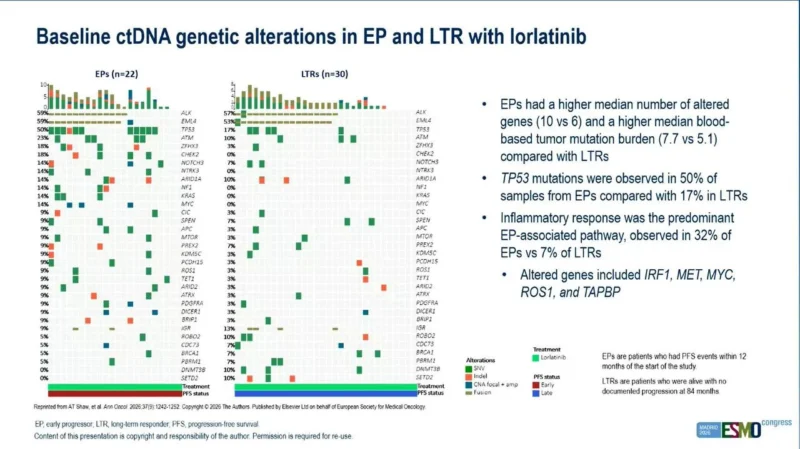
One of the clearest differences involved baseline genomic complexity. Early progressors had a median of 10 altered genes, compared with 6 altered genes among long-term responders. Blood-based tumor mutational burden was also higher, at a median of approximately 7.7 mutations/Mb versus 5.1 mutations/Mb.
These findings suggest that cancers progressing early despite potent ALK inhibition may carry a broader network of oncogenic abnormalities before treatment even begins. Such tumors may therefore be less exclusively dependent on ALK signaling.
This concept is biologically plausible. When a tumor is strongly driven by one dominant oncogenic pathway, highly potent inhibition can produce prolonged disease control. Greater genomic complexity may provide alternative survival pathways that reduce the tumor’s dependence on the original driver.
TP53 Mutations Were Enriched in Early Progression
TP53 provided another strong signal. Baseline TP53 mutations were detected in approximately 50% of early progressors compared with 17% of long-term responders. TP53 alterations have previously been associated with adverse prognosis across multiple oncogene-driven NSCLC subsets, including ALK-positive disease.
The new CROWN analysis reinforces the possibility that TP53 status identifies a biologically more aggressive subgroup even when patients receive one of the most potent available ALK inhibitors. However, TP53 should still be considered a prognostic signal rather than a validated treatment-selection biomarker.
The current data do not establish that patients with TP53-mutated tumors should receive a different first-line treatment. Instead, TP53 may eventually become one component of a broader molecular risk model designed to identify patients less likely to achieve exceptionally durable disease control with lorlatinib alone.
Inflammatory-Response Alterations Were Strongly Enriched in Early Progressors
Perhaps the most intriguing finding involved pathways outside ALK itself. Inflammatory-response alterations were identified in approximately 32% of early progressors compared with only 7% of long-term responders. Altered genes included IRF1, MET, MYC, ROS1, and TAPBP.
This suggests that inflammatory signaling and alternative oncogenic pathways may contribute to primary or early resistance. The finding is particularly interesting because resistance to earlier-generation ALK inhibitors has often been conceptualized through sequential acquisition of ALK kinase-domain mutations.
With lorlatinib, that paradigm may be changing. Potent suppression of ALK may leave bypass pathways, lineage plasticity, inflammatory signaling, and other non-ALK mechanisms as increasingly important routes of escape.
No New ALK Resistance Mutations Emerged at Progression
Paired baseline and end-of-treatment ctDNA analyses provided one of the most important observations from the ESMO presentation. Among evaluable paired samples, investigators detected no new ALK resistance mutations at the end of treatment.
Instead, emerging resistance signals involved pathways such as RTK/RAS/MAPK signaling, inflammatory response, angiogenesis, and other cancer-related processes. This does not mean that ALK-dependent resistance can never occur with lorlatinib.
The paired sample set was small, and ctDNA does not capture every resistance mechanism. But the absence of newly acquired ALK mutations in this analysis is notable.
It supports the idea that once a highly potent, brain-penetrant third-generation ALK inhibitor suppresses a broad spectrum of ALK resistance alterations, subsequent progression may increasingly involve bypass biology. That has major implications for post-lorlatinib drug development.
Future strategies may need to target not only ALK itself but also the cooperating pathways that allow tumor cells to survive despite continued ALK suppression.
Lorlatinib Remained Highly Active Across EML4::ALK Variants
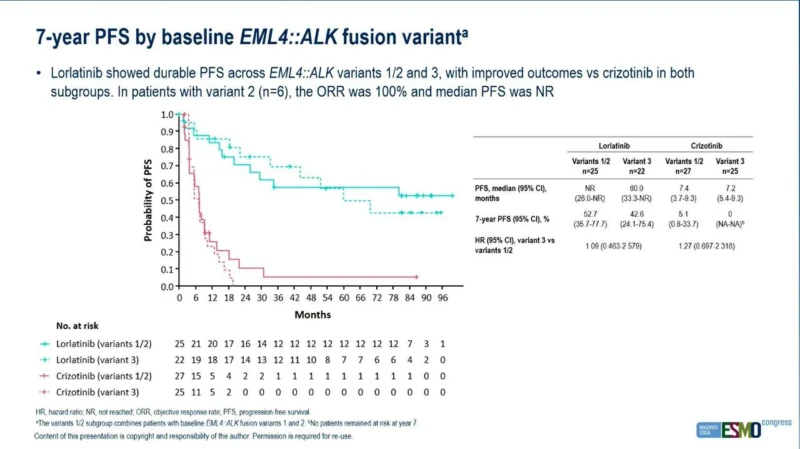
The ESMO presentation also evaluated long-term PFS according to baseline EML4::ALK fusion variant. Lorlatinib maintained substantial efficacy in both the combined variant 1/2 group and variant 3.
Among patients with variants 1 or 2, median PFS remained not reached, and the estimated seven-year PFS rate was 52.7%. Among patients with variant 3, median PFS was approximately 60 months, with a seven-year PFS rate of 42.6%.
By comparison, median PFS with crizotinib was approximately 7.4 months in variants 1/2 and 7.2 months in variant 3, with seven-year PFS rates of approximately 5.1% and 0%, respectively.
The data are particularly relevant because EML4::ALK variant 3 has historically been associated with poorer prognosis and different resistance biology.
Despite this, lorlatinib maintained substantial long-term activity. The analysis therefore suggests that ALK fusion variant alone should not be used to exclude patients from first-line lorlatinib.
Variant 2 Showed Particularly Durable Outcomes
A very small subgroup of six patients had baseline EML4::ALK variant 2. All six achieved objective responses, producing an ORR of 100%, while median PFS remained unreached.
The number of patients is far too small to establish variant 2 as a uniquely sensitive subgroup, but the result adds to the broader observation that lorlatinib activity extends across ALK fusion variants. The more important conclusion is that no major fusion-variant subgroup appeared capable of eliminating the substantial advantage of lorlatinib over crizotinib.
Tumor Fraction May Provide Another Prognostic Signal
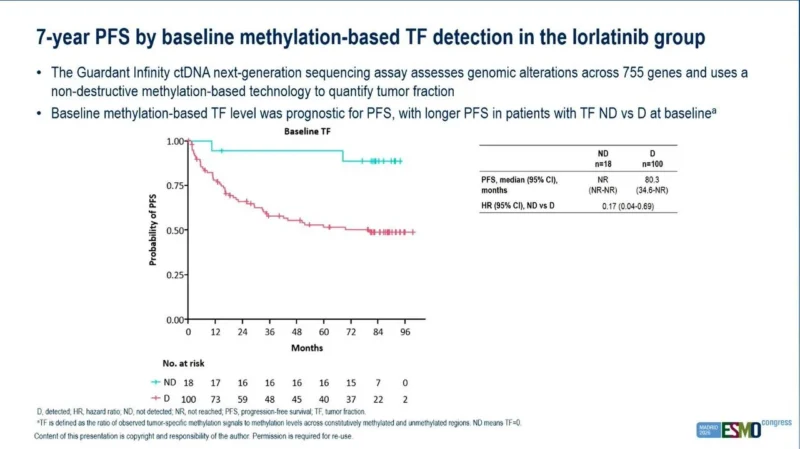
The presentation also evaluated baseline plasma tumor fraction using a methylation-based approach. The Guardant Infinity assay combines genomic profiling with non-destructive methylation analysis to estimate circulating tumor fraction.
Among lorlatinib-treated patients, those with no detectable baseline methylation-based tumor fraction had markedly better PFS than those with detectable tumor fraction. In the presentation, median PFS remained unreached among 18 patients with non-detectable baseline tumor fraction.
Among 100 patients with detectable tumor fraction, median PFS was approximately 80.3 months. The HR for non-detectable versus detectable baseline tumor fraction was approximately 0.17 (95% CI 0.04–0.69).
This suggests that the amount of tumor-derived material circulating in plasma may provide prognostic information beyond individual genomic alterations.
Low or undetectable tumor fraction may reflect lower systemic disease burden, less aggressive biology, or both.
On-Treatment Tumor Fraction May Be Even More Informative
Baseline tumor fraction was not the only relevant molecular measure. The analysis also indicated that reduction or clearance of methylation-based tumor fraction during treatment was associated with longer PFS. Clearance as early as week 4 was linked to more favorable outcomes.
This raises the possibility that serial ctDNA monitoring could eventually identify patients whose disease is responding deeply to ALK inhibition long before conventional imaging demonstrates the full treatment effect.
Unlike the FLAURA2 ctDNA analysis in EGFR-mutated disease, where early molecular clearance was prognostic but did not select patients for chemotherapy intensification, the CROWN analysis was not designed to guide treatment escalation. The immediate value is therefore prognostic rather than therapeutic.
Whether early tumor fraction dynamics should trigger additional therapy in patients at high molecular risk remains unanswered.
Molecular Risk May Eventually Complement Clinical Risk
The emerging CROWN biomarker picture suggests that no single molecular feature will fully explain early lorlatinib progression. Instead, risk may reflect a combination of baseline genomic complexity, TP53 status, inflammatory-response alterations, circulating tumor fraction, and other bypass-pathway events.
A future predictive model could potentially combine these features with clinical variables such as metastatic burden and CNS involvement. Such a model could identify patients who are unlikely to achieve the extraordinary long-term disease control seen in the majority of lorlatinib-treated patients.
Those high-risk patients might then become candidates for intensified strategies or rational combination trials. That concept remains investigational.
At present, none of the reported ctDNA features should be used to withhold lorlatinib or routinely add another systemic treatment.
OncoDaily Takeaway
The ESMO 2026 CROWN ctDNA analysis begins to explain the small group of patients who progress early despite the extraordinary long-term efficacy of lorlatinib. Early progressors had greater baseline genomic complexity, with a median of 10 altered genes versus 6 in long-term responders, and higher blood-based tumor mutational burden.
TP53 mutations were substantially enriched, occurring in 50% of early progressors versus 17% of long-term responders. Inflammatory-response alterations were also more common, at approximately 32% versus 7%.
Most importantly, paired analyses identified no newly acquired ALK resistance mutations at treatment discontinuation, suggesting that resistance to first-line lorlatinib may increasingly depend on bypass and other tumorigenic pathways rather than classic on-target ALK escape. Lorlatinib nevertheless maintained prolonged PFS across EML4::ALK fusion variants, including variant 3.
Methylation-based circulating tumor fraction also emerged as a strong prognostic marker, with particularly prolonged PFS in patients with no detectable baseline tumor fraction and with early on-treatment tumor-fraction clearance.
The message from CROWN is therefore evolving. Lorlatinib has already established unprecedented long-term disease control in ALK-positive advanced NSCLC. The next frontier is identifying the minority of patients whose tumors carry enough molecular complexity to escape that control early.
That may shift the research focus from developing progressively stronger ALK inhibition toward understanding. and eventually targeting, the ALK-independent biology of lorlatinib resistance.
Source
- Solomon BJ, et al. Characterizing resistance mechanisms and predictors of early progression and long-term response to lorlatinib: circulating tumor DNA analyses from the CROWN study. Presented at ESMO Congress 2026, October 24, 2026. Clinical trial identifier NCT03052608.