A recent analysis from Memorial Sloan Kettering Cancer Center has challenged the interpretation of earlier research suggesting that SARS-CoV-2 mRNA vaccines could sensitize tumors to immune checkpoint blockade.
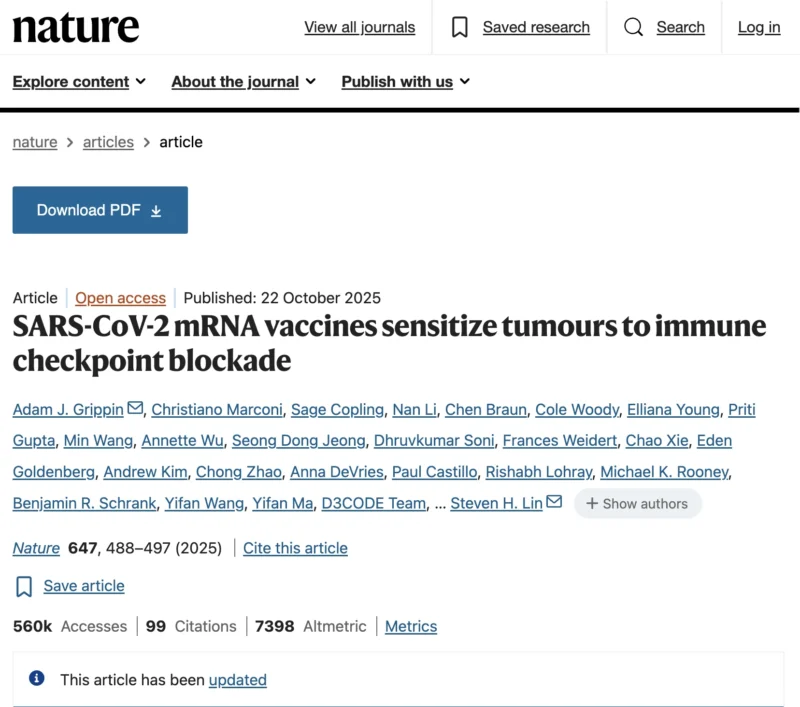
The earlier Nature study reported that patients with cancer who received a COVID-19 mRNA vaccine within 100 days of starting immune checkpoint inhibitor therapy had longer overall survival than unvaccinated patients. In the NSCLC cohort, median overall survival was reported as 37.3 months in vaccinated patients and 20.6 months in unvaccinated patients.
The new analysis does not support the conclusion that COVID-19 mRNA vaccination improves immune checkpoint inhibitor efficacy.
Instead, the authors found that the apparent survival advantage was compatible with selection bias: patients with a more favorable prognosis may have been more likely to receive vaccination, particularly during the early phase of the pandemic.
Why the Earlier Report Received Attention
The original study combined retrospective clinical cohorts with experiments in mouse models and immune profiling in healthy volunteers.
In preclinical models, SARS-CoV-2 spike mRNA lipid nanoparticles increased type I interferon signaling, activated antigen-presenting cells, and enhanced tumor-reactive T-cell responses when combined with PD-1 or PD-L1 blockade.
The clinical analysis included patients with stage III or IV NSCLC treated at MD Anderson Cancer Center. Vaccination within 100 days of immune checkpoint inhibitor initiation was associated with longer overall survival after adjustment for multiple clinical factors.
The authors proposed that mRNA vaccination might transiently increase antitumor immune activity and make immunologically cold tumors more responsive to checkpoint blockade.
However, retrospective associations require careful assessment. A biological explanation can be plausible without proving that the observed clinical effect was caused by the exposure being studied.
What Did the Memorial Sloan Kettering Analysis Examine?
Justin Jee and colleagues analyzed an independent, deeply annotated real-world cohort from Memorial Sloan Kettering Cancer Center. They also re-examined the published framework used in the earlier report.
The MSK cohort included 8,368 patients treated with immune checkpoint inhibitors between 2017 and 2022. Of these patients, 1,410, or 17%, received SARS-CoV-2 vaccination within 100 days of immune checkpoint inhibitor initiation.
When the researchers first applied an approach similar to the original report, they observed an association between peri-ICI vaccination and longer survival.
But additional analyses produced a different interpretation.
The observed survival pattern did not behave like a treatment-specific, biologically driven interaction between mRNA vaccination and immune checkpoint inhibition.
The Association Was Not Specific to Immunotherapy
A central test of the original hypothesis is whether the proposed benefit is specific to immune checkpoint inhibitor treatment.
If SARS-CoV-2 mRNA vaccination truly increased checkpoint inhibitor efficacy through immune priming, a similar survival association would not be expected in patients receiving non-immunotherapy anticancer treatment.
The MSK analysis found that the apparent survival benefit extended beyond immune checkpoint inhibitor-treated patients. Similar patterns were observed among patients receiving non-ICI therapies, including 5-fluorouracil-based chemotherapy.
This finding weakens the argument that the association reflects a specific synergy between vaccination and PD-1 or PD-L1 blockade.
The Signal Changed Over Time
The timing of the association was also important.
The apparent survival benefit was strongest in the early pandemic period and diminished after 2021, when COVID-19 vaccination became widely available.
This pattern was seen in the independent MSK dataset and in the re-analysis of the earlier published cohort.
A true biologic effect of vaccination on checkpoint inhibitor activity would not necessarily be expected to disappear as vaccine access expanded. In contrast, a selection effect is more plausible during a period when access, eligibility, healthcare engagement, treatment continuity, and patient health status may have differed substantially between vaccinated and unvaccinated groups.
During the early vaccine rollout, patients who were sufficiently well to attend appointments, receive vaccination, and continue cancer care may have had better baseline prognostic characteristics than patients who did not receive vaccination.
Not all of these characteristics can be fully measured or corrected in retrospective datasets.
Landmark Analyses Also Changed the Result
The investigators also used landmark analyses designed to reduce bias related to vaccine eligibility.
This matters because a patient must remain alive and sufficiently stable long enough to receive a vaccine after starting treatment. Patients who die or deteriorate early may be classified differently from those who survive long enough to be vaccinated.
This can create immortal time bias or related forms of selection bias.
When the analysis was restricted to periods in which patients had comparable eligibility to receive peri-treatment vaccination, the apparent survival advantage was reduced or no longer observed.
The authors concluded that the original association was largely explained by differences in prognosis between patients who did and did not receive vaccination.
No Clear Progression-Free Survival Signal During High Vaccine Uptake
The MSK study also examined progression-free survival in periods when vaccine uptake was high.
If vaccination were increasing the efficacy of checkpoint blockade, a corresponding improvement in progression-free survival would be expected.
The investigators did not observe longer progression-free survival during periods of high vaccine uptake compared with periods before widespread vaccination.
This does not disprove every possible immunologic effect of mRNA vaccination. But it does not support the clinical claim that COVID-19 vaccination improves the anticancer activity of immune checkpoint inhibitors.
What Does This Mean for the Original Nature Study?
The original study remains important from a mechanistic perspective.
Its preclinical experiments showed that mRNA lipid nanoparticles can activate innate immune pathways, including type I interferon signaling. This remains a relevant area of cancer immunotherapy research.
However, the clinical interpretation requires revision.
The available retrospective evidence does not establish that COVID-19 mRNA vaccines sensitize tumors to immunotherapy in patients.
The MSK analysis shows why replication alone is not sufficient. A survival association can be reproduced in a new dataset and still be explained by the same underlying bias.
The critical question is whether the association remains specific to the proposed treatment mechanism after testing alternative explanations.
In this case, the survival signal was not confined to immune checkpoint inhibitor therapy, varied across pandemic periods, and weakened when analyses accounted for vaccine eligibility.
Why This Matters Beyond COVID-19 Vaccines
This is not only a story about vaccination or immunotherapy.
It is also a reminder about the limitations of retrospective real-world evidence.
Large datasets can identify clinically interesting signals. They can generate hypotheses. They can support the design of prospective studies.
But they are vulnerable to confounding, changes in access to care, treatment selection, calendar-time effects, and differences in baseline prognosis that may not be fully captured in electronic health records.
High-impact publication does not remove those limitations.
The appropriate standard for a claim that a widely available vaccine improves cancer treatment efficacy is high. It would require prospective studies specifically designed to test that question.
What Should Clinicians and Patients Conclude?
An independent re-analysis led by investigators at Memorial Sloan Kettering Cancer Center does not support the conclusion that SARS-CoV-2 mRNA vaccines sensitize tumors to immune checkpoint inhibitors.
Although the earlier report identified a survival association among vaccinated patients, the subsequent analysis found that this pattern was also present in patients receiving non-immunotherapy treatment, was not limited to vaccination close to checkpoint inhibitor initiation, and weakened in analyses designed to address vaccine eligibility and other sources of bias.
These findings are more consistent with selection bias than with a true vaccine-driven improvement in immunotherapy efficacy. COVID-19 vaccination remains important for infection prevention in people with cancer, but current evidence does not support timing vaccination around immune checkpoint inhibitor treatment to improve anticancer outcomes.