Therapeutic cancer vaccination may still have a role in metastatic non-small cell lung cancer after failure of first-line chemoimmunotherapy, according to final phase II results from the Combi-TED trial presented at ESMO Congress 2026.
In HLA-A2-positive metastatic NSCLC with acquired resistance after first-line chemoimmunotherapy, the therapeutic cancer vaccine OSE2101, also known as Tedopi, combined with either docetaxel or nivolumab produced 1-year overall survival rates of 47% and 46%, respectively, compared with 29% with docetaxel alone.
Median overall survival reached 11.9 months with OSE2101 plus docetaxel, 11.3 months with OSE2101 plus nivolumab, and 6.4 months with docetaxel.
The findings are clinically provocative because the OSE2101–nivolumab arm produced no RECIST partial responses among evaluable patients yet still achieved a median OS exceeding 11 months. This suggests that the potential value of vaccine-based immunotherapy may not be captured adequately by conventional response rate alone.
However, Combi-TED requires careful interpretation. Although patients were randomized among three arms, the phase II study was explicitly designed as a non-comparative trial. Its primary statistical question was whether each experimental arm could exceed a predefined historical 1-year OS threshold of 20%, not whether either OSE2101 combination was statistically superior to docetaxel.
The final results therefore support further development of the vaccine strategy but do not establish either combination as a new second-line standard.
A Difficult Setting After First-Line Chemoimmunotherapy
For patients with metastatic NSCLC without an actionable oncogenic driver, first-line platinum chemotherapy combined with PD-1 or PD-L1 inhibition has become a cornerstone of treatment.
Once disease progresses, however, therapeutic options narrow substantially.
Docetaxel remains an important later-line chemotherapy option, while selected patients may receive docetaxel combined with antiangiogenic therapy or other treatments depending on histology, prior therapy, molecular findings and regional approvals.
The prognosis remains poor, particularly among patients whose tumors have already escaped immune checkpoint blockade.
Combi-TED approached this problem by asking whether antigen-specific T-cell stimulation could restore or redirect antitumor immunity after initial chemoimmunotherapy failure.
OSE2101 Uses a Multi-Epitope Vaccine Strategy
OSE2101 is a therapeutic cancer vaccine designed for patients expressing HLA-A2.
The vaccine contains modified epitopes derived from several tumor-associated antigens frequently expressed in lung cancer, including CEA, HER2, MAGE2, MAGE3 and p53, with the objective of generating antigen-specific cytotoxic T-cell responses.
This is fundamentally different from broad immune checkpoint blockade.
PD-1 inhibition removes inhibitory signaling from existing antitumor immune responses. OSE2101 attempts to stimulate T-cell populations directed against defined tumor antigens.
The approach had previously shown evidence of survival activity in the phase III ATALANTE-1 trial. In the subgroup of patients with secondary resistance to immune checkpoint inhibition, OSE2101 monotherapy produced median OS of 11.1 months versus 7.5 months with standard chemotherapy, with an HR of 0.59. PFS and early response measures were not substantially improved, while post-progression survival and quality-of-life outcomes favored OSE2101.
That unusual efficacy pattern provided part of the rationale for Combi-TED: a therapeutic vaccine might generate a survival effect not fully reflected by conventional tumor-shrinkage endpoints.
Combi-TED Tested Two Different OSE2101 Combinations
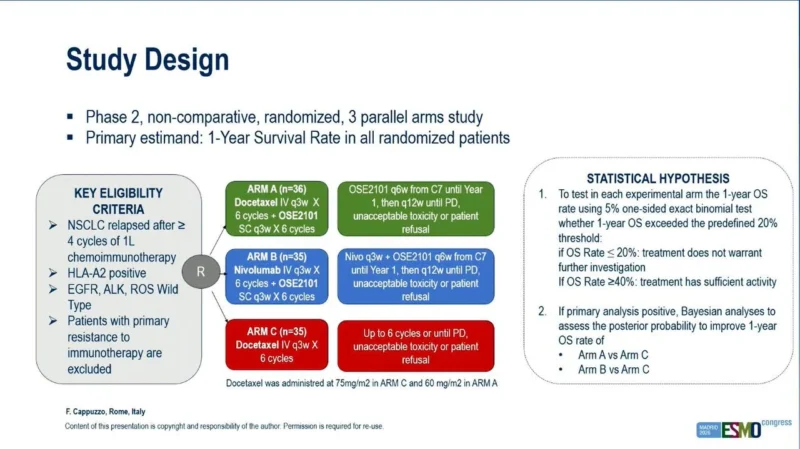
The phase II trial enrolled patients with metastatic or unresectable HLA-A2-positive NSCLC whose disease had relapsed after first-line chemoimmunotherapy.
Patients with actionable EGFR alterations or ALK or ROS1 rearrangements were excluded, and patients with primary resistance to immunotherapy were also excluded. A total of 106 patients were randomized across three parallel groups in the final ESMO presentation.
Thirty-six patients received OSE2101 plus docetaxel, 35 received OSE2101 plus nivolumab, and 35 received docetaxel alone.
OSE2101 was administered subcutaneously every three weeks during the first six cycles and then continued on a less frequent schedule through the first year, followed by every-12-week administration until progression, unacceptable toxicity or treatment discontinuation.
Importantly, docetaxel dosing differed between the two relevant arms. Patients receiving OSE2101 plus docetaxel received docetaxel at 60 mg/m², whereas the control docetaxel arm used 75 mg/m². The trial’s primary estimand was the proportion of randomized patients alive at one year.
Both Experimental Arms Exceeded the Prespecified Survival Threshold
The study was designed to test whether the 1-year OS rate in each experimental arm exceeded a predefined 20% threshold. That threshold represented a level below which further development would not be considered justified.
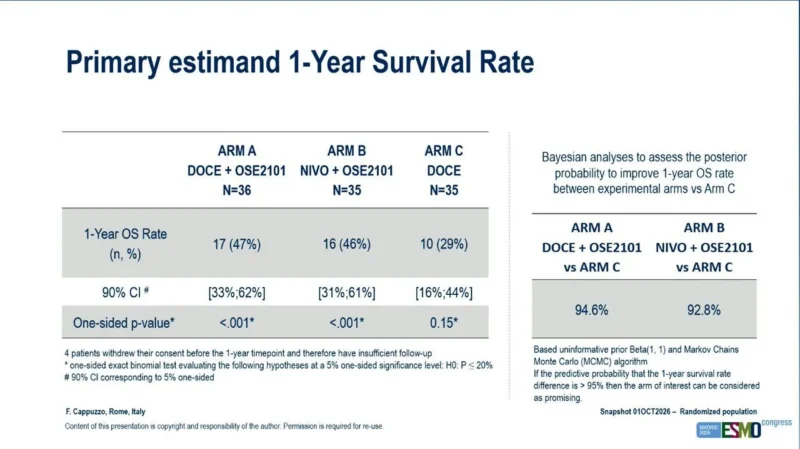
In the final randomized population, 17 of 36 patients receiving OSE2101 plus docetaxel were alive at one year, producing a 1-year OS rate of 47%. In the OSE2101 plus nivolumab arm, 16 of 35 patients were alive at one year, for a rate of 46%.
The corresponding result with docetaxel alone was 10 of 35 patients, or 29%. Both experimental arms significantly exceeded the prespecified 20% historical threshold, with one-sided P values below 0.001.
The docetaxel arm did not meet that statistical criterion.
These updated ESMO presentation results are consistent with the topline 47%, 46% and 29% survival rates reported immediately before the congress.
The Trial Did Not Prove Superiority Over Docetaxel
This distinction is essential. The study included randomized treatment allocation, but it was not powered as a conventional comparative phase II trial.
The primary statistical hypothesis did not directly test OSE2101 combinations against docetaxel. A separate Bayesian analysis estimated the probability that each experimental strategy improved 1-year survival compared with docetaxel.
That probability was 94.6% for OSE2101 plus docetaxel and 92.8% for OSE2101 plus nivolumab. The protocol indicated that a probability above 95% would qualify an experimental arm as promising under that Bayesian comparison.
Neither combination crossed that 95% threshold.
Accordingly, the most accurate interpretation is that both experimental arms met their primary historical benchmark and generated a strong randomized survival signal, but the study did not formally establish superiority over docetaxel.
Median Overall Survival Approximately Doubled Numerically
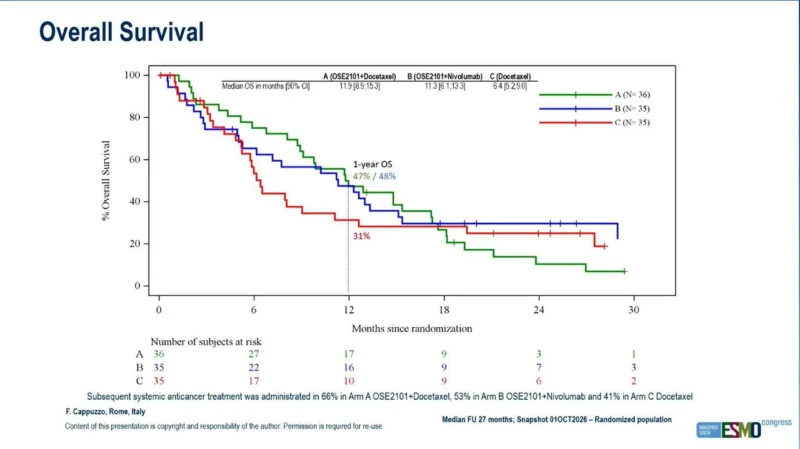
The final survival curves nevertheless showed clinically notable separation. Median OS was 11.9 months with OSE2101 plus docetaxel, with a 90% CI of approximately 8.9 to 15.3 months.
Median OS was 11.3 months with OSE2101 plus nivolumab, with a 90% CI of approximately 6.1 to 13.3 months. With docetaxel alone, median OS was 6.4 months, with a 90% CI of approximately 5.2 to 9.0 months.
Kaplan–Meier estimates of survival at one year were approximately 47%, 48% and 31%, respectively. These estimates differ slightly from the primary binary 1-year survival proportions because they are calculated using time-to-event methods.
The magnitude of the numerical median OS difference is encouraging, but the study design means it should not be described as a proven doubling of survival versus docetaxel.
PFS Was Strongest With OSE2101 Plus Docetaxel
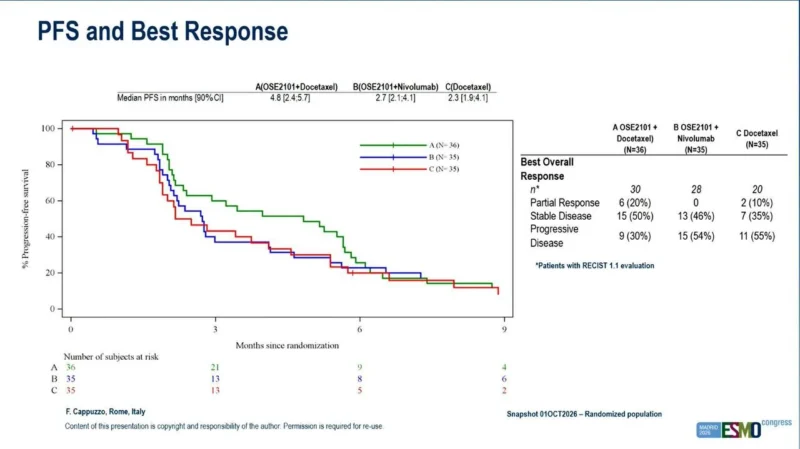
Progression-free survival showed a different pattern. Median PFS was 4.8 months with OSE2101 plus docetaxel, compared with 2.7 months with OSE2101 plus nivolumab and 2.3 months with docetaxel alone. The docetaxel-containing vaccine combination therefore produced the clearest improvement in conventional disease-control kinetics.
Among 30 RECIST-evaluable patients receiving OSE2101 plus docetaxel, six achieved partial responses, corresponding to a 20% response rate. Another 15 patients, or 50%, had stable disease. In the nivolumab plus OSE2101 arm, none of the 28 evaluable patients achieved a partial response, while 46% had stable disease.
In the docetaxel control arm, two of 20 evaluable patients achieved partial responses, for an ORR of 10%, and 35% had stable disease. This creates one of the most interesting observations from Combi-TED.
Survival With OSE2101 Plus Nivolumab Was Not Driven by Tumor Shrinkage
The OSE2101 plus nivolumab arm produced a median PFS of only 2.7 months and no objective responses, yet median OS was 11.3 months and approximately 46% of randomized patients were alive at one year.
That disconnect between response, PFS and OS resembles the pattern previously observed with OSE2101 in ATALANTE-1.
In that earlier trial, OSE2101 did not materially improve response rate or PFS compared with chemotherapy in the secondary-resistance subgroup, but overall survival, post-progression survival and deterioration in performance status favored the vaccine.
One hypothesis is that vaccine-induced immune responses may exert relatively slow or prolonged biological effects that are poorly captured by short-term RECIST measurements.
Another possibility is that patient selection, post-progression therapy or random variation in relatively small groups contributes to the survival pattern. Combi-TED cannot resolve those possibilities.
The findings do, however, reinforce the need to evaluate therapeutic vaccines using endpoints beyond objective response alone.
Subsequent Therapy Could Influence Survival Interpretation
Post-study systemic therapy was given to 66% of patients in the OSE2101 docetaxel arm, 53% in the OSE2101 nivolumab arm, and 41% in the docetaxel arm.
That imbalance deserves attention. Overall survival reflects not only the assigned study treatment but also subsequent therapy. A greater proportion of patients receiving post-progression treatment in the experimental arms could have contributed to the longer observed OS.
It does not explain the entire result, but it reinforces why a larger, appropriately powered comparative trial is required before attributing the survival separation solely to OSE2101.
Safety Did Not Reveal an Unexpected Signal
The available safety analysis showed treatment-related adverse events in 89% with OSE2101 plus docetaxel, 82% with OSE2101 plus nivolumab and 79% with docetaxel. Drug-related serious adverse events were reported in 17%, 24% and 17%, respectively. No unexpected safety signal was identified in the ESMO abstract.
This is relevant because an effective vaccine strategy would ideally offer a different toxicity profile from prolonged cytotoxic chemotherapy.
Further detailed safety reporting will be important, particularly for the combination with nivolumab, where renewed checkpoint inhibition after progression could introduce immune-related toxicity without increasing conventional response rate.
ARTEMIA Will Provide the More Definitive Test
OSE2101 is already being evaluated in the ongoing phase III ARTEMIA trial, which directly compares OSE2101 monotherapy against docetaxel in HLA-A2-positive metastatic NSCLC with secondary resistance to immune checkpoint inhibitors.
The study is randomized 2:1 and has a planned enrollment of approximately 363 patients. As of October 2026, it remains recruiting.
ARTEMIA is therefore more directly positioned to determine whether the survival signal seen with OSE2101 can be confirmed against docetaxel in the contemporary post-immunotherapy setting.
Combi-TED adds another question: if the vaccine works, should it ultimately be used alone, with chemotherapy or with renewed PD-1 blockade? The current phase II results do not yet provide a definitive answer.
OncoDaily Takeaway
Combi-TED revives an important concept in lung cancer immunotherapy: treatment after checkpoint-inhibitor resistance may not need to rely only on stronger cytotoxic therapy or another broad immune checkpoint strategy.
Among HLA-A2-positive patients with metastatic NSCLC progressing after first-line chemoimmunotherapy, OSE2101 plus docetaxel produced a 47% 1-year survival rate and median OS of 11.9 months, while OSE2101 plus nivolumab produced a 46% 1-year survival rate and median OS of 11.3 months. Docetaxel alone produced a 29% 1-year survival rate and median OS of 6.4 months.
The PFS results were less dramatic: 4.8, 2.7 and 2.3 months, respectively. Most intriguingly, the nivolumab combination produced no objective responses among evaluable patients despite its favorable survival signal.
That discordance suggests therapeutic vaccination may have effects not fully captured by traditional radiographic response. But the study should not be overinterpreted.
Combi-TED was randomized but intentionally non-comparative, both experimental arms were primarily tested against a historical 20% survival threshold, and Bayesian probabilities of superiority over docetaxel did not cross the protocol’s >95% threshold. The findings therefore support further investigation rather than establish a new standard.
What they do demonstrate is that antigen-specific therapeutic vaccination remains biologically and clinically relevant even after tumors have escaped first-line checkpoint blockade.
The phase III ARTEMIA trial should provide the more definitive answer about whether that survival signal can translate into a validated treatment strategy.
Source
- Cappuzzo F, et al. Results of a multicenter, phase II, open-label, randomized trial evaluating OSE2101 plus docetaxel or OSE2101 plus nivolumab as second-line therapy in metastatic NSCLC progressing after first-line chemo-immunotherapy. Presented at ESMO Congress 2026, October 25, 2026. Abstract 2661RO. Clinical trial identifier NCT04884282.