In extensive-stage small cell lung cancer, progression after first-line therapy often triggers a move to second-line systemic treatment. But not all progression is biologically the same.
A new Journal of Clinical Oncology editorial argues for a more nuanced approach in one particularly common and clinically difficult scenario: brain-only progression after first-line therapy in extensive-stage small cell lung cancer.
The message is practical: isolated CNS progression should not automatically be treated as global systemic failure. In selected patients, the more rational strategy may be to treat the brain locally and preserve the systemic regimen that is still controlling extracranial disease.
A Common Clinical Problem With Limited Guidance
Extensive-stage small cell lung cancer remains one of the most aggressive thoracic malignancies. First-line platinum-etoposide chemotherapy plus immunotherapy has improved outcomes, supported by IMpower133 and CASPIAN, but CNS progression remains a major challenge.
The brain functions as a sanctuary site. Conventional systemic therapies often have limited intracranial activity, and CNS relapse can occur even when extracranial disease remains controlled.
This creates a difficult clinical question:
Should clinicians switch systemic therapy when only the brain progresses, or should they treat the CNS locally and continue the systemic backbone that still appears active outside the brain?
The Study Behind the Editorial
The editorial discusses a multicenter retrospective cohort study by Lu et al. that included 889 patients with ES-SCLC without baseline brain metastases who received first-line platinum-etoposide with or without immunotherapy.
Among them, 203 patients, or 23%, developed brain-only progression.
Patients were managed with one of three physician-selected strategies:
original systemic therapy continued plus brain radiotherapy,
substitute systemic therapy plus brain radiotherapy,
or substitute systemic therapy alone.
The investigators used propensity score-based inverse probability of treatment weighting to reduce confounding in this nonrandomized cohort.
The Key Finding: Treat the Brain, Preserve the Backbone
The most favorable outcomes were seen in patients who continued their original systemic regimen and received brain radiotherapy.
Median overall survival from second-line initiation was:
14.7 months with continuation of original systemic therapy plus brain radiotherapy
10.2 months with substitute systemic therapy alone
9.8 months with substitute systemic therapy plus brain radiotherapy
The benefit appeared particularly relevant in patients previously treated with immunotherapy and in those with longer initial progression-free survival.
This supports a clinically meaningful reframing: brain-only progression may represent sanctuary-site failure rather than complete systemic resistance.
The Treatment Paradigm
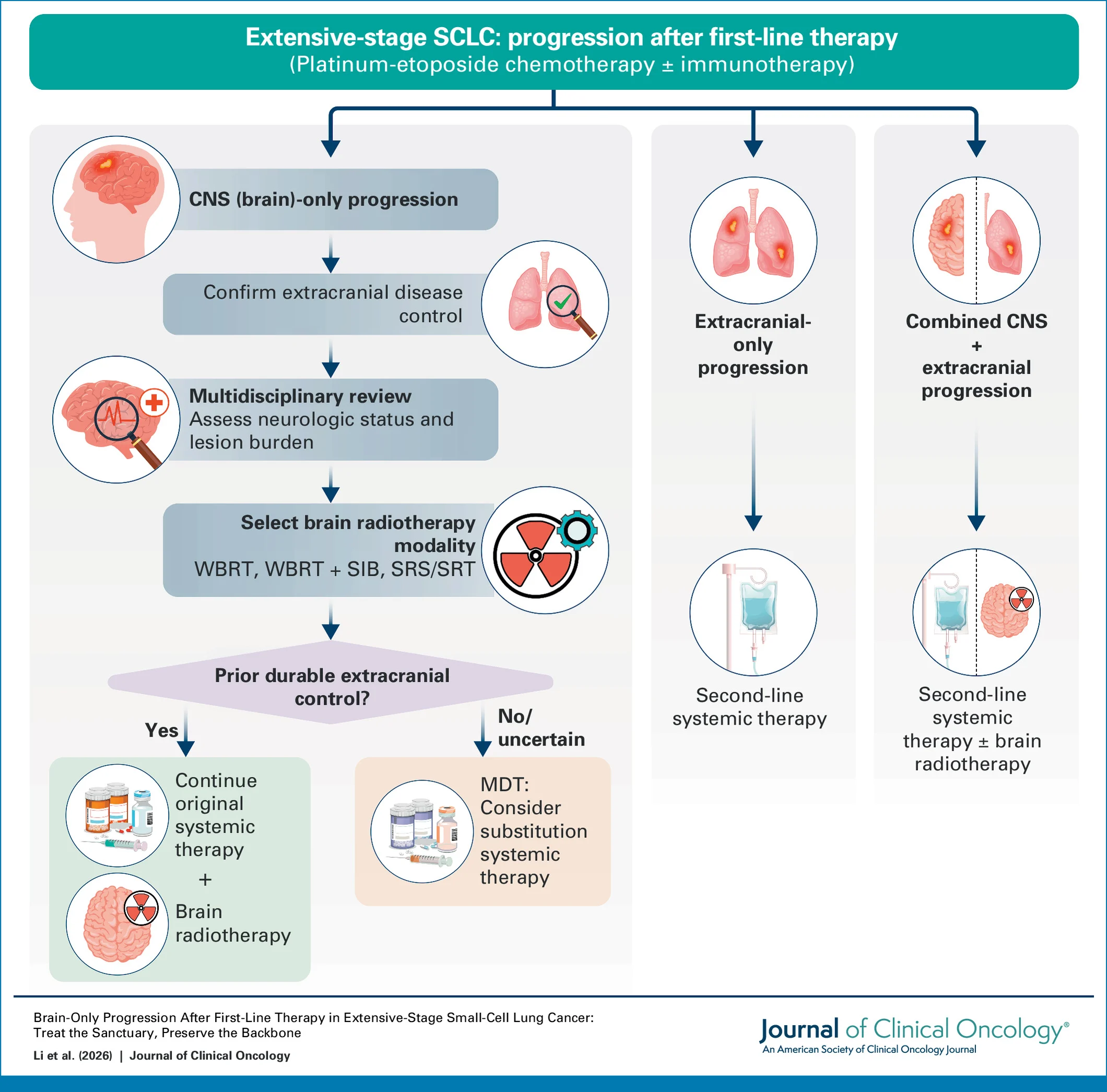
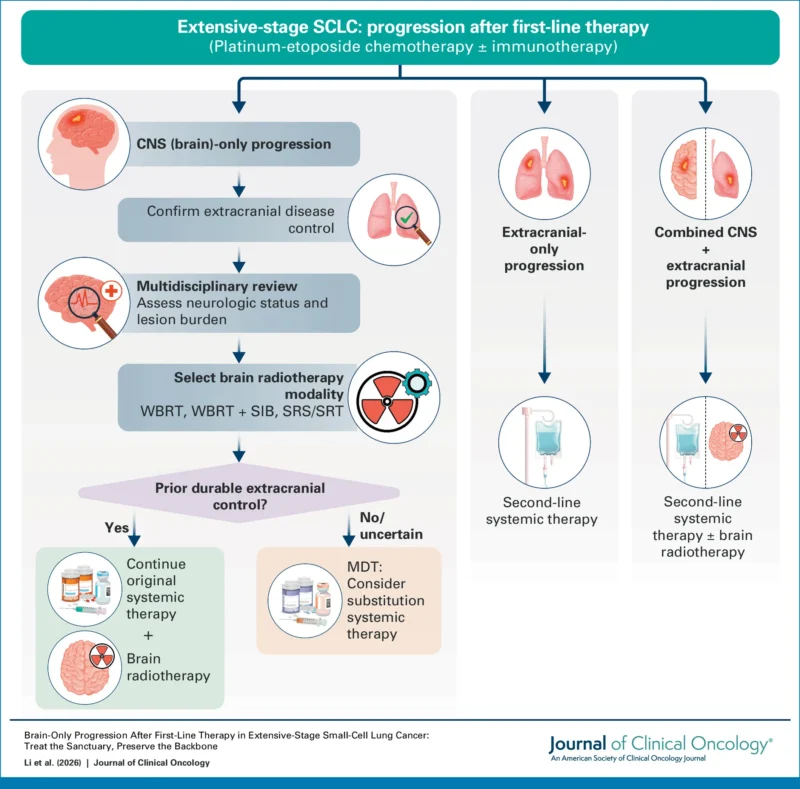
The accompanying figure summarizes a practical decision pathway.
For CNS-only progression, the first step is to confirm extracranial disease control. Patients should then undergo multidisciplinary review, including neurologic status and lesion burden. Brain radiotherapy modality is selected based on clinical context, including WBRT, WBRT plus SIB, or SRS/SBRT.
If prior extracranial control was durable, the pathway supports continuing the original systemic therapy plus brain radiotherapy. If extracranial control was not durable or is uncertain, multidisciplinary review may support substitution of systemic therapy.
For extracranial-only progression, the pathway moves toward second-line systemic therapy. For combined CNS and extracranial progression, second-line systemic therapy plus brain radiotherapy is considered.
Why This Makes Biological Sense
The concept is not new in oncology, but it is underdeveloped in SCLC.
If the extracranial disease remains controlled, the original systemic regimen may still be effective outside the CNS. Brain-only progression may instead reflect limited drug penetration or sanctuary-site biology.
In that setting, switching systemic therapy may remove an active treatment too early.
Brain radiotherapy can function as definitive local salvage for the intracranial compartment, while the systemic treatment continues to suppress extracranial disease.
This logic may be especially relevant in the immunotherapy era, where ongoing extracranial benefit from checkpoint inhibition may persist despite isolated CNS failure.
Important Cautions
This is not a randomized trial, and the editorial is careful to avoid overstatement.
Treatment assignment was based on physician discretion, so residual confounding is likely. Patients selected to continue original therapy may have had better performance status, lower CNS disease burden, fewer symptoms, more favorable disease kinetics, or other unmeasured advantages.
The systemic therapies used in the substitution arms were not fully specified, which limits interpretation across different treatment settings.
The study also did not systematically evaluate neurocognitive outcomes or patient-reported quality of life, both of which are critical when selecting brain radiotherapy strategies.
Therefore, the findings should not be read as a universal rule. They should be read as a strong clinical signal that deserves prospective testing.
The Broader Context Is Changing
Second-line SCLC treatment is also evolving.
The editorial notes that newer systemic therapies, including tarlatamab, antibody-drug conjugates such as ifinatamab deruxtecan and sacituzumab govitecan, and maintenance approaches such as lurbinectedin plus atezolizumab, may reshape the sequencing discussion.
As agents with better systemic or intracranial activity emerge, the question will become more complex: when should clinicians use local therapy alone, when should they switch systemic treatment, and when should both be combined?
Why This Matters for Global Practice
The editorial also highlights relevance for low- and middle-income settings.
Access to novel systemic therapies remains uneven. Brain radiotherapy, however, may be more available and more cost-effective in many health systems.
A strategy that preserves an effective systemic backbone while treating isolated CNS failure locally could therefore be clinically useful and pragmatically feasible across a wide range of resource settings.
The Bottom Line
Brain-only progression in extensive-stage SCLC should not automatically be treated as systemic failure.
The data discussed in this JCO editorial suggest that, in selected patients with controlled extracranial disease, brain radiotherapy with continuation of the original systemic therapy may provide better outcomes than switching immediately to second-line systemic therapy.
The principle is clear:
Treat the sanctuary. Preserve the backbone.
Prospective randomized studies are now needed to define which patients benefit most, how radiotherapy should be selected, and how this strategy should evolve as new systemic therapies enter the SCLC landscape.
References
- Li Y, Faroni L, Moraes FY. Brain-only progression after first-line therapy in extensive-stage small cell lung cancer: treat the sanctuary, preserve the backbone. Journal of Clinical Oncology. 2026. doi:10.1200/JCO-26-01076.
- Lu et al. Multicenter cohort study of original or substitute systemic therapy with or without brain radiotherapy for extensive-stage small cell lung cancer with brain-only progression after first-line treatment. Journal of Clinical Oncology. 2026.
- Horn L, Mansfield AS, Szczęsna A, et al. First-line atezolizumab plus chemotherapy in extensive-stage small-cell lung cancer. New England Journal of Medicine. 2018;379:2220-2229.
- Paz-Ares L, Dvorkin M, Chen Y, et al. Durvalumab plus platinum-etoposide versus platinum-etoposide in first-line extensive-stage small-cell lung cancer: CASPIAN. Lancet. 2019;394:1929-1939.