
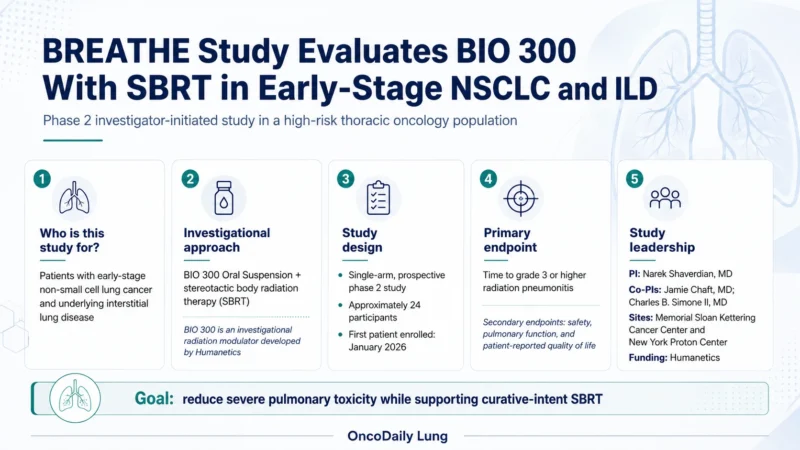
Patients with early-stage non–small cell lung cancer and underlying interstitial lung disease represent a particularly high-risk population for thoracic radiotherapy. Lung function may already be compromised by ILD, while treatment-related pulmonary toxicity can further limit the use of potentially curative radiation.
The investigator-initiated BREATHE phase 2 study is evaluating whether BIO 300 Oral Suspension, an investigational radiation modulator developed by Humanetics Corporation, can reduce severe pulmonary toxicity when combined with stereotactic body radiation therapy in this population.
The study is sponsored by Memorial Sloan Kettering Cancer Center and funded by Humanetics. Narek Shaverdian, MD, Director of Thoracic Radiation Oncology at MSK, is the principal investigator. Jamie Chaft, MD, of MSK Thoracic Oncology, and Charles B. Simone II, MD, of MSK Radiation Oncology, are co-principal investigators.
According to information provided by the study team, the trial is open at Memorial Sloan Kettering Cancer Center and the New York Proton Center.
Addressing a High-Risk Population
Patients with NSCLC and concomitant interstitial lung disease have historically been difficult to treat because pre-existing pulmonary impairment can restrict therapeutic options.
For some patients with early-stage disease, radiation remains a viable curative-intent treatment. However, the underlying ILD places them at increased concern for radiation-related pulmonary toxicity, particularly severe radiation pneumonitis.
“Patients with NSCLC and interstitial lung disease represent a historically high-risk population for standard therapies,” Dr. Shaverdian said.
“This trial aims to develop a new strategy that would allow us to deliver thoracic radiation more safely and effectively through the use of BIO 300, potentially expanding treatment options and improving outcomes for these patients.”
The BREATHE study is therefore focused on a selected but clinically important population whose treatment decisions are often constrained by the balance between curative intent and pulmonary safety.
What Is BIO 300?
BIO 300 Oral Suspension is an investigational radiation modulator developed by Humanetics.
Initial clinical research in patients receiving thoracic radiation for NSCLC reported lower rates of hematologic, pulmonary, and gastrointestinal toxicities compared with historical controls. Across multiple clinical studies, the compound has been reported as safe and well tolerated, with no dose-limiting toxicities identified at the time of the company’s announcement.
Its oral formulation also permits at-home administration by patients.
These findings support the evaluation of BIO 300 as a potential radioprotective strategy, but the compound remains investigational and its clinical benefit in patients with NSCLC and ILD has not yet been established.
What Is the Goal of the BREATHE Study?
The study is designed to determine whether adding BIO 300 to SBRT can reduce the risk of serious pulmonary toxicity in patients with early-stage NSCLC and ILD.
“Our goal is to combine this safe, well-studied radioprotectant BIO 300, with SBRT in these high-risk patients, allowing them to receive curative SBRT with low rates of pulmonary toxicity,”
Dr. Shaverdian explained in comments provided to OncoDaily.
“The hypothesis is that adding BIO 300 will reduce the risk of grade 3 or higher radiation pneumonitis, offering these patients a new strategy that maximizes quality of life while preserving the high efficacy of SBRT.”
The study is therefore evaluating whether normal-tissue protection can improve the safety of curative-intent radiation without compromising the intended therapeutic approach.
How Is the Study Designed?
BREATHE is a single-arm, prospective phase 2 study expected to enroll approximately 24 participants with NSCLC and concomitant ILD.
Participants will receive BIO 300 Oral Suspension in combination with thoracic radiation. Outcomes will be evaluated against historical results rather than a randomized concurrent control group.
The first participant was enrolled in January 2026.
What Is the Primary Endpoint?
The primary endpoint is time to grade 3 or higher pneumonitis, defined as the interval from completion of radiation therapy to the occurrence of grade 3 or higher pneumonitis.
This endpoint directly reflects the central objective of the study: determining whether BIO 300 can reduce serious radiation-related pulmonary toxicity in patients whose baseline lung function is already affected by ILD.
What Other Outcomes Will Be Evaluated?
Secondary endpoints include:
- Overall safety assessments
- Pulmonary function testing
- Patient-reported quality of life
These measures will allow investigators to evaluate the broader clinical effect of the treatment strategy, including tolerability, respiratory function, and the patient experience following radiation.
Why Could the Study Be Clinically Important?
The BREATHE study addresses a treatment challenge for which options remain limited.
The target population is not defined solely by early-stage NSCLC. These patients also have underlying lung disease that can complicate the delivery of curative-intent radiation and increase concern about severe pulmonary toxicity.
By combining an investigational oral radiation modulator with SBRT, the study aims to determine whether treatment can be delivered with a lower risk of grade 3 or higher pneumonitis while maintaining a focus on quality of life.
Because the study is small and single-arm, its findings will require interpretation against the selected historical comparison. The results will provide phase 2 evidence on the safety and potential clinical value of this strategy rather than independently establishing a new standard of care.
The Bottom Line
The MSK-sponsored BREATHE phase 2 study is evaluating BIO 300 Oral Suspension with SBRT in patients with early-stage NSCLC and underlying interstitial lung disease.
The study is led by Narek Shaverdian, MD, with Jamie Chaft, MD, and Charles B. Simone II, MD, serving as co-principal investigators. Humanetics is funding the trial.
Its primary endpoint is time to grade 3 or higher radiation pneumonitis, while secondary assessments include safety, pulmonary function, and patient-reported quality of life.
The study will determine whether adding BIO 300 can reduce serious pulmonary toxicity and support the delivery of curative-intent SBRT in a population with compromised lung function and limited treatment options.