The randomized ASTRIDE trial demonstrated numerically longer overall survival (OS) with serplulimab plus carboplatin and etoposide compared with atezolizumab plus the same chemotherapy backbone in US patients with extensive-stage small cell lung cancer (ES-SCLC). However, the study was designed for descriptive analysis and did not establish statistically significant superiority between the two immunotherapy-based regimens.
Presented by David R. Gandara, MD, at the ESMO Congress 2026 in Madrid, the study evaluated a PD-1 inhibitor against an established PD-L1 inhibitor in a US population, providing additional evidence to support the international clinical development of serplulimab.
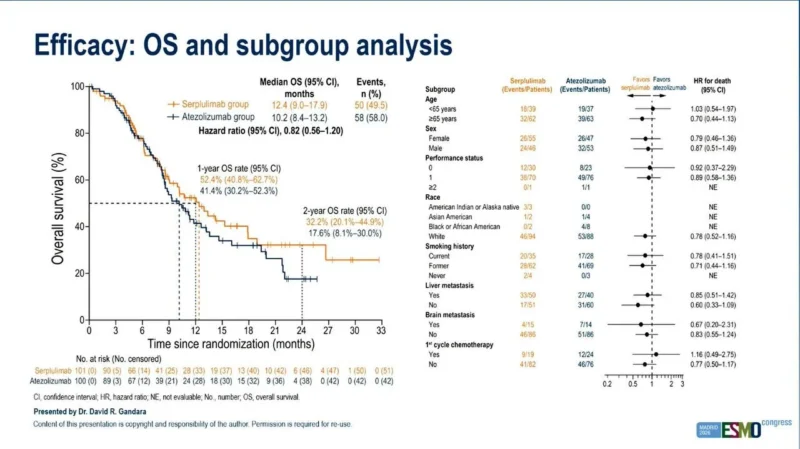
Among 201 randomized patients, median OS was 12.4 months with serplulimab versus 10.2 months with atezolizumab, corresponding to a hazard ratio (HR) of 0.82 (95% CI 0.56–1.20). At 24 months, estimated survival was 32.2% versus 17.6%, respectively, suggesting a potentially favorable longer-term survival pattern with serplulimab.
However, progression-free survival (PFS), objective response rate (ORR), and duration of response (DoR) were broadly comparable between treatment groups. Safety outcomes were also generally similar, without newly identified toxicity signals.
The findings support the activity of serplulimab in a US ES-SCLC population but do not demonstrate that PD-1 inhibition is superior to PD-L1 inhibition in this setting.
Why ASTRIDE Matters: A Head-to-Head Immunotherapy Comparison
Extensive-stage small cell lung cancer remains one of the most aggressive thoracic malignancies, characterized by rapid tumor growth, early metastatic dissemination, and frequent relapse following initial therapy.
The introduction of immune checkpoint inhibitors combined with platinum–etoposide chemotherapy represented a significant advance in first-line management. Atezolizumab plus carboplatin and etoposide established a survival benefit in the phase III IMpower133 trial, while durvalumab-based chemotherapy subsequently demonstrated efficacy in the CASPIAN study.
Nevertheless, long-term outcomes remain poor for many patients, and most eventually experience disease progression. Serplulimab is a humanized monoclonal antibody targeting PD-1, in contrast to atezolizumab, which targets PD-L1.
Earlier evidence from the international phase III ASTRUM-005 trial demonstrated that adding serplulimab to platinum–etoposide significantly improved survival compared with chemotherapy alone.
In updated ASTRUM-005 results, median OS reached 15.8 months with serplulimab plus chemotherapy compared with 11.1 months with chemotherapy alone, with an HR of approximately 0.62. Although these findings established serplulimab’s antitumor activity, its clinical performance in a specifically US population required further evaluation.
ASTRIDE was therefore designed as a bridging study comparing serplulimab against an established US first-line immunotherapy regimen.
The clinical question was not simply whether serplulimab improves outcomes relative to chemotherapy alone, but whether its efficacy and safety profile remained consistent and clinically credible when evaluated against atezolizumab-based treatment in US clinical practice.
Study Design and Patient Population
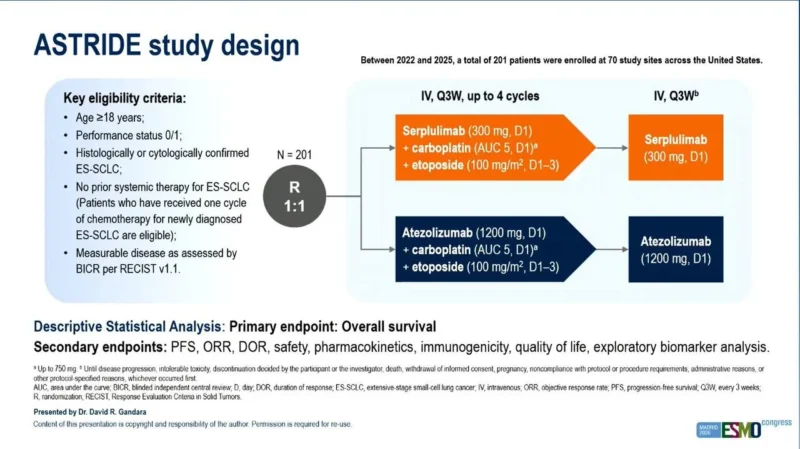
ASTRIDE (NCT05468489) was a randomized US bridging study enrolling adults with histologically or cytologically confirmed ES-SCLC. Between July 2022 and October 2025, 201 patients were randomized 1:1 to receive serplulimab plus chemotherapy (n=101) or atezolizumab plus chemotherapy (n=100).
Eligible patients were at least 18 years old, had ECOG performance status 0–1, and had measurable disease according to RECIST v1.1.
Patients generally had not received previous systemic treatment for ES-SCLC. However, the protocol permitted enrollment after one initial cycle of chemotherapy, reflecting the clinical urgency with which treatment is frequently initiated in this disease.
Patients assigned to serplulimab received 300 mg intravenously on day 1, combined with carboplatin AUC5 on day 1 and etoposide 100 mg/m² on days 1–3, administered every three weeks for up to four cycles. The comparator group received atezolizumab 1,200 mg intravenously every three weeks with the same carboplatin–etoposide backbone.
After completion of induction chemotherapy, patients continued maintenance serplulimab or atezolizumab every three weeks until disease progression, unacceptable toxicity, or another protocol-defined reason for discontinuation.
The primary endpoint was OS. Secondary endpoints included PFS, ORR, DoR, safety, pharmacokinetics, immunogenicity, and quality-of-life outcomes.
Importantly, the statistical analysis was descriptive, reflecting the trial’s bridging objective rather than a formal design powered to establish superiority or noninferiority between the two regimens. At the February 18, 2026 data cutoff, median follow-up was 14.1 months.
Baseline characteristics were generally balanced, although liver metastases were more frequent in the serplulimab group than in the atezolizumab group (49.5% versus 40.0%).
Overall Survival: Numerical Advantage With Serplulimab
ASTRIDE reported numerically longer OS with serplulimab plus chemotherapy than with atezolizumab plus chemotherapy. Median OS was 12.4 months (95% CI 9.0–17.9) with serplulimab compared with 10.2 months (95% CI 8.4–13.2) with atezolizumab.
The HR was 0.82 (95% CI 0.56–1.20), indicating a favorable numerical trend toward a lower hazard of death with serplulimab. By the cutoff, 50 of 101 patients (49.5%) in the serplulimab arm and 58 of 100 patients (58.0%) in the atezolizumab arm had died.
At 12 months, estimated OS was 52.4% (95% CI 40.8–62.7) with serplulimab versus 41.4% (95% CI 30.2–52.3) with atezolizumab. The survival difference appeared more pronounced at 24 months, when estimated OS was 32.2% (95% CI 20.1–44.9) versus 17.6% (95% CI 8.1–30.0), respectively.
These findings suggest a possible longer-term survival advantage with serplulimab, although the estimates remain imprecise because of the relatively small trial population and limited follow-up.
Crucially, the OS confidence interval included 1.0, and the trial was not designed for confirmatory hypothesis testing. The results therefore cannot establish a statistically significant survival improvement, despite the favorable numerical difference in median OS and longer-term survival rates.
The appropriate interpretation is that serplulimab demonstrated clinically encouraging survival outcomes compared with atezolizumab in this US bridging population, warranting consideration alongside the larger ASTRUM-005 evidence base.
Progression-Free Survival: Comparable Disease Control
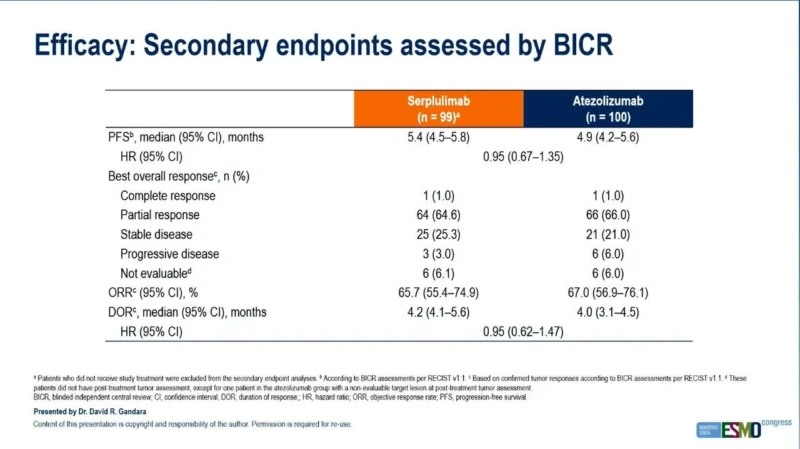
Unlike the numerical difference observed in OS, PFS outcomes were very similar between treatment groups. Median PFS by blinded independent central review was 5.4 months (95% CI 4.5–5.8) with serplulimab and 4.9 months (95% CI 4.2–5.6) with atezolizumab.
The HR was 0.95 (95% CI 0.67–1.35). These findings do not suggest a substantial difference in the risk of disease progression or death during the progression-free interval. This distinction is relevant when interpreting the survival results.
The apparent separation in OS occurred without a corresponding substantial improvement in median PFS, raising questions about whether differences in longer-term disease control, post-progression treatment, patient characteristics, or other factors may have contributed. However, the available data cannot establish the explanation for the observed difference.
In the absence of detailed subsequent-treatment analyses or confirmed differences in later survival outcomes, the numerical OS advantage should not be attributed to a specific biological or treatment mechanism.
Objective Response and Duration of Response
Tumor response outcomes were also broadly comparable. Among patients included in the response analysis, the confirmed ORR was 65.7% with serplulimab versus 67.0% with atezolizumab. Complete responses occurred in 1.0% of patients in each group, while partial responses were reported in 64.6% and 66.0%, respectively.
Stable disease was observed in 25.3% of patients receiving serplulimab and 21.0% receiving atezolizumab. Progressive disease as the best overall response occurred in 3.0% and 6.0%, respectively.
Median DoR was 4.2 months (95% CI 4.1–5.6) with serplulimab compared with 4.0 months (95% CI 3.1–4.5) with atezolizumab. The HR for DoR was 0.95 (95% CI 0.62–1.47). Together, these findings suggest similar initial antitumor activity and response durability.
The absence of a meaningful difference in ORR or DoR reinforces the need for caution when interpreting the numerical OS separation as definitive evidence of greater antitumor efficacy.
Subgroup Outcomes: Liver Metastases and Prior Chemotherapy
Exploratory subgroup analyses provided additional perspective on patients with differing baseline clinical characteristics. Among patients without liver metastases, the OS HR favored serplulimab at 0.60 (95% CI 0.33–1.09). In contrast, among patients with liver metastases, the corresponding HR was 0.85 (95% CI 0.51–1.42).
These findings suggest a potentially more favorable numerical treatment effect among patients without liver involvement. However, neither subgroup result establishes a statistically significant difference, and the trial was not powered to evaluate treatment interactions.
Liver metastases are associated with poorer outcomes in ES-SCLC, making this a clinically important subgroup. Nevertheless, the observed difference cannot be considered evidence that the absence of liver metastases predicts greater benefit from serplulimab.
The study also evaluated patients who had not received a chemotherapy cycle before randomization. Within this subgroup, median OS was 13.4 months with serplulimab versus 10.8 months with atezolizumab, with an HR of 0.77 (95% CI 0.50–1.17).
PFS remained similar at 5.5 versus 5.2 months (HR 0.97; 95% CI 0.65–1.45). These findings were directionally consistent with the overall results but remained descriptive. Taken together, the subgroup analyses do not establish a validated patient population in which serplulimab is superior to atezolizumab.
Safety: Similar Severe Adverse Event Rates
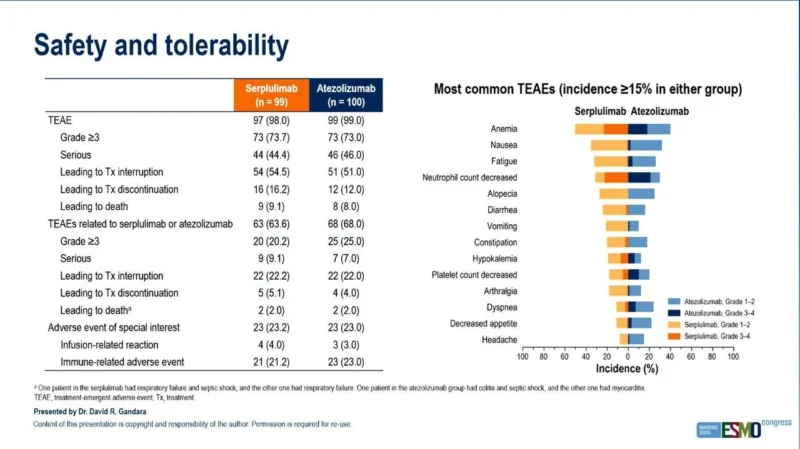
Safety outcomes were generally comparable between the two regimens. Treatment-emergent adverse events (TEAEs) occurred in 98.0% of patients receiving serplulimab and 99.0% receiving atezolizumab. Grade ≥3 TEAEs were reported in 73.7% versus 73.0%, respectively, indicating nearly identical rates of severe all-causality toxicity.
Serious TEAEs occurred in 44.4% and 46.0% of patients, while TEAEs leading to treatment interruption occurred in 54.5% and 51.0%. Treatment discontinuation due to TEAEs occurred in 16.2% of patients in the serplulimab arm compared with 12.0% in the atezolizumab arm.
Treatment-related adverse events attributed to serplulimab or atezolizumab occurred in 63.6% and 68.0% of patients, respectively. Grade ≥3 checkpoint inhibitor-related adverse events were observed in 20.2% with serplulimab and 25.0% with atezolizumab.
Immune-related adverse events occurred in 21.2% and 23.0%, while infusion-related reactions were reported in 4.0% and 3.0%, respectively.
The most common TEAEs included anemia, nausea, fatigue, neutrophil reduction, alopecia, gastrointestinal symptoms, and thrombocytopenia, consistent with the expected effects of platinum–etoposide chemotherapy and immune checkpoint inhibition.
TEAEs leading to death occurred in nine patients (9.1%) receiving serplulimab and eight (8.0%) receiving atezolizumab.
Two deaths (2.0%) in each group were attributed to the checkpoint inhibitor. The serplulimab-associated deaths involved respiratory failure and septic shock in one patient and respiratory failure in another. In the atezolizumab group, the reported causes included colitis with septic shock and myocarditis.
Although no new safety signals were identified, these fatal treatment-related events emphasize the potential seriousness of immunotherapy-associated toxicity. Overall, the findings suggest broadly similar tolerability between the regimens, without evidence of a clear safety advantage for either agent.
Clinical Interpretation: Supporting US Applicability Rather Than Establishing Superiority
ASTRIDE addresses a clinically relevant question regarding the transferability of international serplulimab evidence to US patients with ES-SCLC. The earlier ASTRUM-005 study demonstrated a statistically significant survival benefit for serplulimab plus chemotherapy compared with chemotherapy alone, establishing its efficacy in the first-line setting.
ASTRIDE adds an active comparator and a specifically US patient population, strengthening the external clinical evidence for the regimen. However, the distinction between a bridging study and a superiority trial is fundamental.
Although median OS and 24-month survival numerically favored serplulimab, the trial did not demonstrate superiority over atezolizumab. Furthermore, PFS and response outcomes were similar, suggesting broadly comparable early disease control.
The US treatment landscape has also evolved. In October 2025, the FDA approved lurbinectedin plus atezolizumab as maintenance treatment for eligible patients whose disease has not progressed following atezolizumab, carboplatin, and etoposide induction.
ASTRIDE evaluated checkpoint inhibitor monotherapy during maintenance rather than this newer combination strategy. Its findings therefore do not establish how serplulimab would compare with atezolizumab plus lurbinectedin maintenance.
The results support further consideration of serplulimab as an additional first-line treatment option, but routine US use remains dependent on regulatory authorization.
Limitations and Remaining Questions
Several limitations are important. First, the trial enrolled only 201 patients and was designed for descriptive analysis. It cannot establish superiority, noninferiority, or equivalence between serplulimab and atezolizumab.
Second, median follow-up was 14.1 months, making the 24-month survival estimates relatively uncertain despite their numerical separation. Third, a higher proportion of patients receiving serplulimab had liver metastases at baseline, and other prognostic imbalances may also influence outcomes in a modest-sized randomized population.
Fourth, the study did not provide sufficient evidence to explain why OS numerically favored serplulimab when PFS and response outcomes were similar. Finally, ASTRIDE does not address the comparative effectiveness of newer maintenance strategies or establish whether differences between PD-1 and PD-L1 blockade translate into meaningful clinical superiority in ES-SCLC.
OncoDaily Takeaway
ASTRIDE provides useful US-specific evidence supporting the clinical activity of serplulimab plus carboplatin and etoposide in extensive-stage small cell lung cancer.
Median OS numerically favored serplulimab at 12.4 versus 10.2 months, while estimated 24-month survival reached 32.2% versus 17.6%. These differences are encouraging, particularly in a disease where long-term survival remains uncommon.
However, ASTRIDE should not be interpreted as a positive superiority trial. The OS HR was 0.82 with a confidence interval crossing 1.0, and the statistical design was descriptive. PFS, objective response, and duration of response were similar between treatment groups.
The safety findings were also broadly comparable, with grade ≥3 TEAEs occurring in approximately 73% of patients in both arms. Fatal treatment-related events occurred with each checkpoint inhibitor, reinforcing the importance of toxicity monitoring.
For oncologists, the main significance of ASTRIDE lies in extending the evidence supporting serplulimab to a US clinical population using an active standard-of-care comparator.
ASTRIDE strengthens the case for serplulimab as a potentially useful first-line ES-SCLC option, but it does not establish serplulimab as superior to atezolizumab. Regulatory decisions, longer-term follow-up, and the evolving maintenance treatment landscape will determine its ultimate clinical positioning.
Source
- Gandara DR, et al. Randomized Trial of Serplulimab or Atezolizumab Plus Chemotherapy in USA Patients With Extensive-Stage Small Cell Lung Cancer (ASTRIDE).