
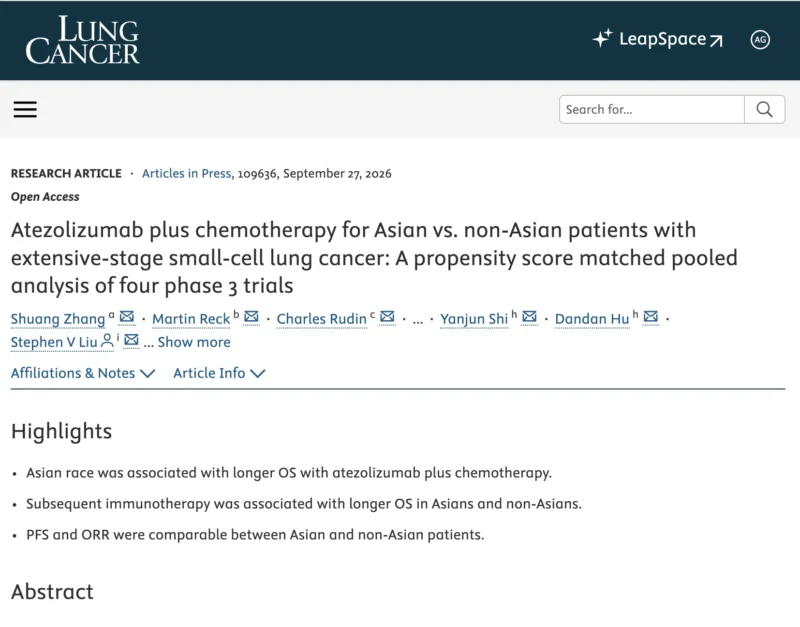
A pooled individual-patient analysis of four phase III trials has found significantly longer overall survival (OS) among Asian patients with extensive-stage small-cell lung cancer (ES-SCLC) treated with first-line atezolizumab plus carboplatin and etoposide, compared with non-Asian patients receiving the same regimen.
Importantly, however, the survival difference was not accompanied by meaningful differences in progression-free survival (PFS) or objective response rate (ORR), raising questions about the potential contribution of post-progression treatment, population characteristics, and other unmeasured factors.
The analysis by Shuang Zhang and colleagues, published in Lung Cancer, pooled patient-level data from the IMpower133, SKYSCRAPER-02, SKYSCRAPER-02C, and BEAT-SC phase III trials.
Why Compare Outcomes Across Populations?
PD-L1 inhibition combined with platinum-etoposide has become an established first-line treatment strategy for ES-SCLC. Atezolizumab plus chemotherapy was established through IMpower133 and subsequently evaluated across additional global and Asian clinical trial populations.
Previous studies had suggested numerically longer survival among Asian populations treated with PD-1/PD-L1-based combinations, but direct comparisons were difficult because of differences in baseline patient characteristics.
To address this issue, the investigators used propensity score matching to create more comparable Asian and non-Asian cohorts.
Four Phase III Trials, 707 Patients
The analysis included patients who had received at least one dose of atezolizumab with carboplatin and etoposide across the four trials.
Overall:
- 707 patients were included
- 363 were Asian
- 344 were non-Asian
After 1:1 propensity score matching, 169 patients remained in each group matching model accounted for age, sex, body mass index, smoking history, ECOG performance status, baseline brain metastases, and baseline liver metastases.
Before matching, significant differences existed between the populations, including sex, BMI, smoking history, ECOG performance status, and the prevalence of liver metastases. These imbalances were eliminated following matching.
Overall Survival Favored Asian Patients
Before propensity score matching, median OS was:
- Asian patients: 15.3 months
- Non-Asian patients: 12.2 months
This corresponded to an HR for death of 0.80 (95% CI, 0.67–0.94; p=0.008).
The difference became more pronounced after matching. Median OS was:
- 16.4 months in Asian patients versus 11.3 months in non-Asian patients.
The HR was 0.70 (95% CI, 0.55–0.89; p=0.004), corresponding to a 30% relative reduction in the hazard of death in the matched analysis. OS subgroup analyses across age, sex, ECOG performance status, brain metastases, smoking history, liver metastases, and prophylactic cranial irradiation were generally consistent with the overall population.
But PFS Was Nearly Identical
Despite the substantial difference in OS, disease-control endpoints did not show the same pattern.
After matching, median PFS was:
- Asian patients: 4.8 months
- Non-Asian patients: 5.1 months
There was no statistically significant difference in PFS:
- HR 1.04; 95% CI, 0.83–1.30; p=0.707
ORR was also broadly similar:
- 63.3% among Asian patients versus 57.4% among non-Asian patients after matching
This separation between OS and earlier efficacy endpoints is one of the study’s most clinically important findings.
Subsequent Treatment May Be Part of the Explanation
Post-progression treatment differed between the two groups. After matching, subsequent anticancer therapy was received by:
- 62.1% of Asian patients versus 50.9% of non-Asian patients.
Asian patients were also more frequently treated with subsequent chemotherapy, immunotherapy, and targeted therapies. Across the matched population, patients who subsequently received immunotherapy had a median OS of 33.2 months, compared with 14.8 months among those receiving subsequent chemotherapy and 17.4 months among those receiving targeted therapy.
The authors therefore cautioned that differences in post-progression treatment may have contributed to the observed OS advantage. The study cannot establish that the OS difference represents a greater intrinsic biological sensitivity to atezolizumab among Asian patients.
Safety Profiles Also Differed
Nearly all patients experienced at least one adverse event, but several differences emerged between the populations. After matching, grade 3–4 adverse events occurred in:
- 82.8% of Asian patients versus 60.9% of non-Asian patients.
The difference was largely driven by abnormal hematologic laboratory findings. Paradoxically, investigator-reported treatment-related adverse events were less frequent among Asian patients:
- 57.4% versus 90.5%.
Asian patients also experienced more adverse events of special interest requiring corticosteroids:
- 29.6% versus 8.3%,
although these events were predominantly low grade. The investigators cautioned that differences in treatment-related toxicity reporting could partly reflect regional variation in investigator assessment rather than true biological differences in toxicity.
What Could Explain the OS Difference?
The analysis was not designed to determine the biological mechanism underlying the survival difference. The authors noted several possible areas for future investigation, including differences in tumor immunogenicity, genomic characteristics, tumor immune microenvironment, and pharmacogenetics across populations.
However, the study also highlights a more immediate methodological issue: patient ethnicity and regional representation can influence outcomes observed in global oncology trials.
Differences in the proportion of Asian patients enrolled across ES-SCLC studies could potentially contribute to variability in reported median OS between trials. The investigators therefore emphasized the importance of adequate population representation, regional stratification, and prespecified subgroup analyses in multinational clinical development programs.
Important Limitations
The findings should be interpreted as hypothesis-generating rather than practice-changing. Although propensity score matching balanced several established prognostic variables, residual and unmeasured confounding cannot be excluded.
The four trials were conducted during different periods and across different geographical regions. In addition, all patients came from interventional clinical trials and may not fully represent real-world ES-SCLC populations.
Most importantly, post-progression therapy was a post-baseline variable and could not be adequately incorporated into the matching strategy. Differences in subsequent immunotherapy and other therapies could therefore have contributed substantially to the observed OS difference.
OncoDaily Takeaway
This pooled analysis adds an important layer to the interpretation of global immunotherapy trials in ES-SCLC. Asian patients receiving first-line atezolizumab plus carboplatin and etoposide had significantly longer OS than matched non-Asian patients – 16.4 versus 11.3 months, while PFS and ORR remained similar.
The absence of a corresponding PFS advantage, together with higher use of subsequent therapy among Asian patients, means the OS difference should not automatically be interpreted as evidence of greater atezolizumab efficacy based on race alone.
Rather, the findings demonstrate how baseline biology, regional practice patterns, access to subsequent treatment, trial population composition, and potentially other unmeasured factors can influence survival outcomes.
As the ES-SCLC treatment landscape continues to evolve, understanding these differences will be increasingly important for interpreting multinational trials and determining how well their results translate across diverse patient populations.
Reference:
- Zhang S, Reck M, Rudin C, et al. Atezolizumab plus chemotherapy for Asian vs. non-Asian patients with extensive-stage small-cell lung cancer: a propensity score matched pooled analysis of four phase 3 trials. Lung Cancer. 2026. doi:10.1016/j.lungcan.2026.109636.