Air pollution is an established environmental risk factor for lung cancer, but the biological processes connecting chronic exposure to carcinogenesis remain incompletely understood. A new prospective metabolomics study published in Nature Communications provides evidence that specific circulating metabolic changes may sit between exposure to ambient air pollutants and subsequent lung cancer risk.
Chow and colleagues analyzed pre-diagnostic plasma from 1,357 participants in two American Cancer Society Cancer Prevention Study cohorts and assessed more than 1,100 circulating metabolites alongside residential exposure to six major air pollutants. Eight metabolites were associated with both pollution exposure and subsequent lung cancer, while four showed statistically significant mediation signals linking particulate matter or ozone exposure with lung cancer risk (Chow et al., 2026).
The findings do not establish that these metabolites directly cause lung cancer. Instead, they provide prospective evidence for biological pathways involving oxidative stress, glutathione metabolism, xenobiotic processing and metabolic reprogramming that could help explain how long-term air pollution contributes to lung carcinogenesis.
Why Does Air Pollution Matter in Lung Cancer?
Long-term exposure to ambient air pollution has been linked to lung cancer across large prospective cohorts, including among people who have never smoked.
The biological challenge is that air pollution is not a single exposure. It is a complex mixture containing particulate matter, combustion products and gaseous pollutants capable of producing oxidative stress, inflammation and DNA damage.
This complexity has made it difficult to identify circulating biomarkers that reflect what happens biologically between environmental exposure and eventual cancer development.
The new Nature Communications study approached the question using high-resolution untargeted metabolomics, allowing the investigators to search broadly for small circulating molecules altered in relation to both air pollution and subsequent lung cancer risk (Chow et al., 2026).
How Was the Study Designed?
The investigators performed a prospective nested case-control study using participants from the Cancer Prevention Study-II Nutrition Cohort and Cancer Prevention Study-3.
All participants were cancer-free when blood was collected.
The final analysis included:
- 1,357 participants
of whom:
- 671 subsequently developed lung cancer
and
- 686 served as cancer-free controls.
Among patients from CPS-II who later developed lung cancer, the median interval between blood collection and diagnosis was 7 years. In CPS-3, the corresponding median interval was 2 years (Chow et al., 2026).
This pre-diagnostic design is important because the metabolic measurements preceded the cancer diagnosis, reducing the likelihood that the detected metabolic patterns simply resulted from established clinical lung cancer.
Which Air Pollutants Were Evaluated?
Residential addresses at the time of blood collection were used to estimate individual exposure to six ambient pollutants:
carbon monoxide (CO), nitrogen dioxide (NO₂), particulate matter less than 10 µm (PM10), fine particulate matter less than 2.5 µm (PM2.5), ozone (O₃) and sulfur dioxide (SO₂).
Pollutant concentrations were assigned using geographic exposure models incorporating regulatory monitoring, land-use information and satellite-based estimates.
For most pollutants, the primary analysis used annual mean exposure during the year of blood collection. For ozone, investigators used the summer-season average of the daily 8-hour maximum because ozone formation is more prominent during warmer months (Chow et al., 2026).
How Many Metabolites Were Studied?
Untargeted plasma metabolomics initially detected 1,401 metabolites.
After quality-control filtering, including removal of poorly detected metabolites and features with insufficient reproducibility, 1,138 metabolites entered the final analysis.
Analytical reproducibility was high, with a median intraclass correlation coefficient of 0.88 among quality-control samples.
The investigators then performed metabolome-wide association studies to determine which circulating metabolites were associated with pollutant exposure and which of these were also associated with subsequent lung cancer (Chow et al., 2026).
How Strongly Did Pollution Affect the Circulating Metabolome?
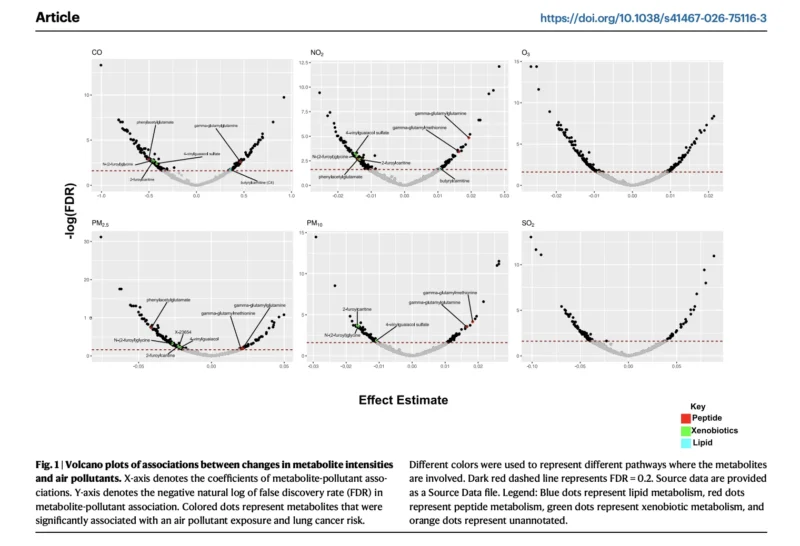
The analysis identified 522 metabolites associated with at least one air pollutant at the study’s false-discovery-rate threshold.
Among 402 metabolites with known identities, the largest metabolic groups were related to:
- lipids – 44%
- xenobiotics – 23%
- amino acids – 18%.
Carbon monoxide showed associations with the largest number of metabolites, at 276, followed closely by PM2.5 with 261 metabolites (Chow et al., 2026).
The volcano plots in Figure 1 on page 5 show the breadth of metabolomic changes associated with the six pollutants and highlight the subset of metabolites that were also linked to lung cancer incidence.
Which Metabolites Were Linked to Both Pollution and Lung Cancer?
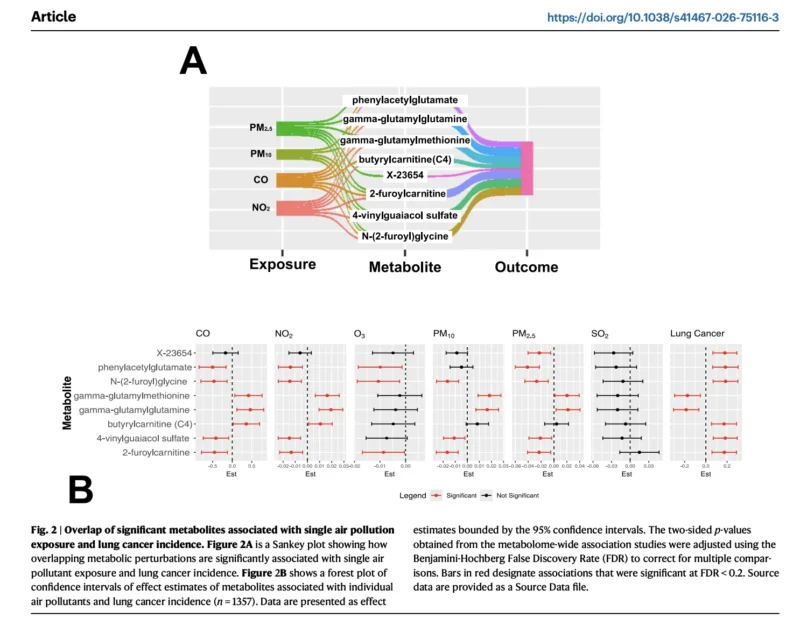
Eight metabolic features were associated with at least one pollutant and subsequent lung cancer risk.
The identified metabolites included:
γ-glutamylglutamine, γ-glutamylmethionine, butyrylcarnitine, N-(2-furoyl)glycine, 4-vinylguaiacol sulfate, phenylacetylglutamate, 2-furoylcarnitine and one unidentified metabolite designated X-23654.
Several were associated with multiple pollutants.
For example, γ-glutamylglutamine was associated with CO, NO₂, PM10 and PM2.5 exposure.
Similarly, N-(2-furoyl)glycine was associated with all four of these pollutants and with subsequent lung cancer risk (Chow et al., 2026).
The complete pollutant–metabolite relationships are presented in Table 2 on page 4 of the study.
Which Metabolites Potentially Mediated the Pollution–Cancer Association?
The investigators then moved beyond identifying overlapping associations and performed high-dimensional mediation analysis.
Four metabolites showed statistically significant mediation signals.
For PM10, two metabolites were identified:
- γ-glutamylglutamine — 21.19% of the total effect
- N-(2-furoyl)glycine — 21.45%.
For PM2.5, the significant mediator was:
- phenylacetylglutamate — 13.08%.
For ozone, the significant mediator was:
- 4-vinylguaiacol glucuronide — 5.60%.
The false discovery rates ranged from 0.001 to 0.006 for these mediation findings (Chow et al., 2026).
These results are summarized in Table 3 on page 6.
Importantly, mediation analysis in an observational study does not prove that these metabolites are causal intermediates. The results instead identify biologically plausible pathways that warrant additional mechanistic investigation.
Why Is Glutathione Metabolism Emerging as an Important Pathway?
One of the strongest biological signals involved γ-glutamyl amino acid metabolism.
Both γ-glutamylglutamine and γ-glutamylmethionine are linked to pathways involved in production and metabolism of glutathione, glutamine and methionine.
Glutathione is a major intracellular antioxidant involved in maintaining redox balance and protecting cells from oxidative injury.
Chronic air pollution exposure can generate oxidative stress. Alterations in glutathione-related metabolism could therefore reflect an attempt by cells to compensate for repeated pollutant-induced oxidative injury.
The study identified γ-glutamylglutamine not only as being associated with multiple pollutants and lung cancer risk but also as a potential mediator of the PM10–lung cancer association (Chow et al., 2026).
The authors therefore propose that disruption of redox homeostasis and antioxidant metabolism could represent one of the biological bridges between pollution exposure and carcinogenesis.
Why Were Some Associations Counterintuitive?
One particularly important point is that the direction of some associations was not straightforward.
For example, greater air pollution exposure was associated with higher γ-glutamylglutamine, but higher concentrations of this metabolite were associated with lower lung cancer risk.
At first glance, that pattern appears contradictory.
The investigators propose that such findings could represent compensatory metabolic responses. In other words, pollution exposure could trigger an antioxidant or inflammatory-response pathway designed to counteract tissue injury.
The authors explicitly characterize this interpretation as speculative.
They also note that mediation analyses involving several interacting metabolites are complex because individual metabolites can influence one another as well as the exposure–outcome relationship (Chow et al., 2026).
This is an important reason not to interpret the identified metabolites simply as “cancer-causing metabolites.”
What Did Xenobiotic Metabolism Reveal?
Several of the identified molecules were related to xenobiotic metabolism, including N-(2-furoyl)glycine and 2-furoylcarnitine.
N-(2-furoyl)glycine is related to metabolism of furan, a compound produced during incomplete combustion of organic matter.
Furan exposure is associated with cigarette smoke but can also occur through traffic emissions, industrial processes and biomass combustion.
The investigators found that associations involving these metabolites remained broadly consistent when smokers and nonsmokers were examined separately.
They also performed an analysis excluding current smokers and again observed generally consistent findings (Chow et al., 2026).
This supports the possibility that the metabolomic pattern reflects broader combustion exposure rather than only cigarette smoke.
However, the authors appropriately caution that many participants were former smokers, meaning residual effects of previous tobacco exposure could still influence circulating metabolic profiles.
Could Air Pollution Promote Cancer Through Several Biological Routes?
The study suggests that this is likely.
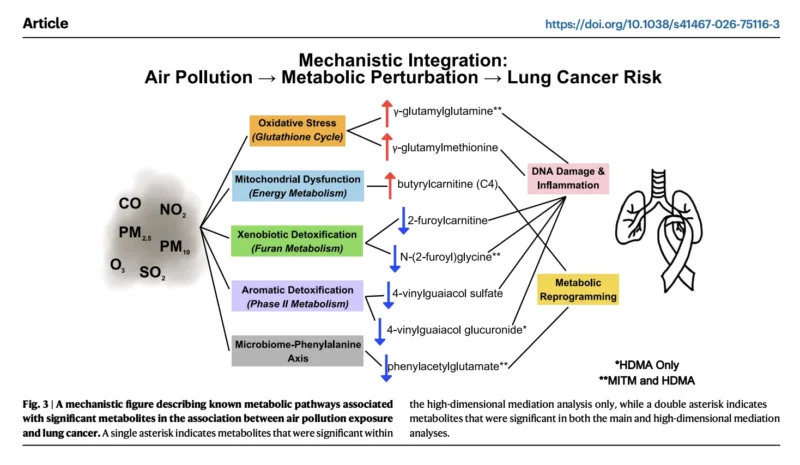
The mechanistic model presented in Figure 3 on page 7 integrates several metabolic pathways identified in the analysis.
The figure links pollution exposure with:
- oxidative stress and the glutathione cycle
- mitochondrial dysfunction and energy metabolism
- xenobiotic detoxification
- aromatic detoxification
- microbiome–phenylalanine metabolism.
These processes converge conceptually on DNA damage, inflammation and metabolic reprogramming, which are proposed as potential pathways connecting chronic exposure with lung carcinogenesis.
This does not establish one linear mechanism. Rather, the metabolomic findings suggest that chronic pollution exposure could affect multiple interconnected biological systems simultaneously (Chow et al., 2026).
Could Metabolomics Help Identify People at Higher Lung Cancer Risk?
Potentially, but the study was not designed to establish a clinical risk test.
One long-term objective of this work is to identify circulating biomarkers capable of capturing biologically meaningful responses to environmental exposure.
Traditional exposure estimates indicate what pollutants a person encounters externally.
Metabolomics can potentially provide another layer of information by showing how the individual’s biology responds internally to that exposure.
Two people exposed to similar PM2.5 concentrations could theoretically experience different degrees of oxidative stress, inflammation or metabolic disturbance.
That raises the possibility that future risk models could integrate environmental exposure with biological-response biomarkers.
However, Chow and colleagues emphasize that the metabolites identified in this study require replication before they can be considered clinically informative biomarkers.
Why Is This Particularly Relevant to Lung Cancer in Never-Smokers?
The study is relevant to the growing effort to understand lung cancer beyond cigarette smoking.
Among participants in the CPS-3 component, 52.5% were never smokers.
The investigators also performed stratified analyses according to smoking status and reported that the main metabolomic findings were generally consistent with the primary analysis.
The study therefore provides a biological framework for investigating environmental contributors to lung cancer among both smokers and nonsmokers (Chow et al., 2026).
However, it does not establish that the identified metabolites specifically explain rising lung cancer incidence among never-smokers.
That would require dedicated studies in populations with minimal tobacco exposure.
What Are the Strengths of the Study?
The prospective design is one of its most important strengths.
Blood samples were obtained when participants were cancer-free, years before lung cancer diagnosis in many cases.
The study also analyzed a broad untargeted metabolome rather than a small predefined panel, with 1,138 metabolites included after quality control.
Exposure estimates came from established environmental models, while the investigators adjusted their primary analyses for numerous potential confounders, including age, sex, BMI, race, smoking, education, alcohol intake, diet, multivitamin use and passive smoke exposure.
Sensitivity analyses incorporating baseline comorbidities, a five-year pollution exposure average and stratification by smoking status, sex, age and family history generally produced results consistent with the primary analysis (Chow et al., 2026).
What Are the Major Limitations?
Several limitations substantially affect interpretation.
First, the primary study relied on one metabolomic blood sample and primarily one exposure estimate corresponding to the year of blood collection. This cannot fully capture changing exposures or metabolic states over many years.
Second, the study evaluated pollutants largely as individual exposures. Real-world air pollution consists of mixtures in which multiple pollutants coexist and interact.
Third, approximately 96% of participants were White, and the study population was relatively old. Generalizability to younger and more ethnically diverse populations therefore remains uncertain.
Fourth, the study used a false discovery rate threshold of 0.20. The authors explain that this is used in exploratory untargeted environmental metabolomics to balance false-positive and false-negative findings, but it also means that the results require independent replication.
Finally, the study is observational.
Even though metabolic measurements preceded cancer diagnosis and high-dimensional mediation methods were applied, the analysis cannot prove that the identified metabolites causally transmit the carcinogenic effect of air pollution (Chow et al., 2026).
Could These Findings Change Lung Cancer Prevention?
Not immediately.
The results do not identify a supplement, drug or metabolic intervention that has been proven to prevent pollution-related lung cancer.
Their immediate importance is mechanistic.
They begin to map how an environmental carcinogen can leave measurable biological signatures in blood years before cancer is diagnosed.
If replicated, these pathways could eventually support more precise environmental risk assessment and provide targets for studies investigating cancer prevention.
But moving from metabolic association → validated biomarker → preventive intervention will require substantially more evidence.
The Bottom Line
The Nature Communications study provides prospective evidence connecting ambient air pollution, circulating metabolism and subsequent lung cancer risk.
Among 1,357 participants, the investigators analyzed 1,138 plasma metabolites and identified 522 associated with at least one pollutant.
Eight metabolites were associated with both pollution exposure and subsequent lung cancer.
Four showed significant mediation signals:
- γ-glutamylglutamine — PM10
- N-(2-furoyl)glycine — PM10
- phenylacetylglutamate — PM2.5
- 4-vinylguaiacol glucuronide — ozone.
The strongest estimated mediation proportions were approximately 21% for γ-glutamylglutamine and N-(2-furoyl)glycine in the relationship between PM10 and lung cancer risk.
The metabolic pathways implicated by the study converge on oxidative stress, glutathione metabolism, xenobiotic processing, mitochondrial function, inflammation and metabolic reprogramming.
The findings remain exploratory and require validation. But they add an important biological layer to the established epidemiologic relationship between air pollution and lung cancer.
The question is increasingly moving beyond whether air pollution increases lung cancer risk toward what biological changes occur between exposure and cancer—and whether those changes can eventually be measured or interrupted before malignancy develops.
References
- Chow SS, Wang Y, Sarnat JA, Diver WR, Deubler EL, Walker DI, Tang Z, Kesarwala AH, Pope CA III, Jerrett M, Turner MC, Liang D. Blood metabolomic signatures linking air pollution to lung cancer in the Cancer Prevention Studies. Nature Communications. 2026;17:7255. doi:10.1038/s41467-026-75116-3.