






For patients with advanced non-small cell lung cancer and high PD-L1 expression, immune-checkpoint inhibitor monotherapy offers a chemotherapy-free first-line option. However, a proportion of patients experience early progression, creating a strong rationale for combinations that may deepen or prolong immune responses.
TIGIT emerged as one of the most closely watched targets in this setting. Because TIGIT and PD-1 can act through overlapping immune-suppressive pathways, simultaneous blockade was expected to strengthen antitumor immunity beyond PD-1 inhibition alone.
The phase 3 AdvanTIG-302 trial tested that hypothesis by comparing the anti-TIGIT antibody ociperlimab plus the anti-PD-1 antibody tislelizumab with pembrolizumab in untreated patients with PD-L1–high advanced NSCLC.
The combination produced a higher response rate, but it did not improve overall survival. The trial was consequently terminated early after meeting the prespecified futility criteria.
Testing Dual TIGIT and PD-1 Blockade
TIGIT is an inhibitory immune-checkpoint receptor expressed on several immune-cell populations, including cytotoxic T cells, regulatory T cells, and natural killer cells. It is frequently co-expressed with PD-1 and can suppress immune activity through interactions involving the costimulatory receptor CD226.
Ociperlimab is a humanized, Fc-intact immunoglobulin G1 monoclonal antibody targeting TIGIT. Tislelizumab is an anti-PD-1 antibody designed to reduce binding to Fc gamma receptors on macrophages, potentially limiting the clearance of activated T cells.
Preclinical findings and early clinical observations supported the possibility that combining the two agents could enhance antitumor activity. In the phase 1/1b AdvanTIG-105 study, ociperlimab plus tislelizumab produced an unconfirmed response rate of 71.4% among patients with metastatic NSCLC and PD-L1 expression of at least 50%.
AdvanTIG-302 was designed to determine whether this early activity could translate into a survival advantage in a randomized phase 3 setting (Socinski et al., 2026).
A Three-Arm Phase 3 Trial
AdvanTIG-302 was a randomized, double-blind, international phase 3 trial enrolling patients with untreated, locally advanced, unresectable, recurrent, or metastatic NSCLC.
Eligible patients had:
PD-L1 expression of at least 50%
No previous systemic therapy for advanced disease
An Eastern Cooperative Oncology Group performance status of 0 or 1
No actionable EGFR-sensitizing mutation, ALK translocation, BRAF V600E mutation, or ROS1 alteration
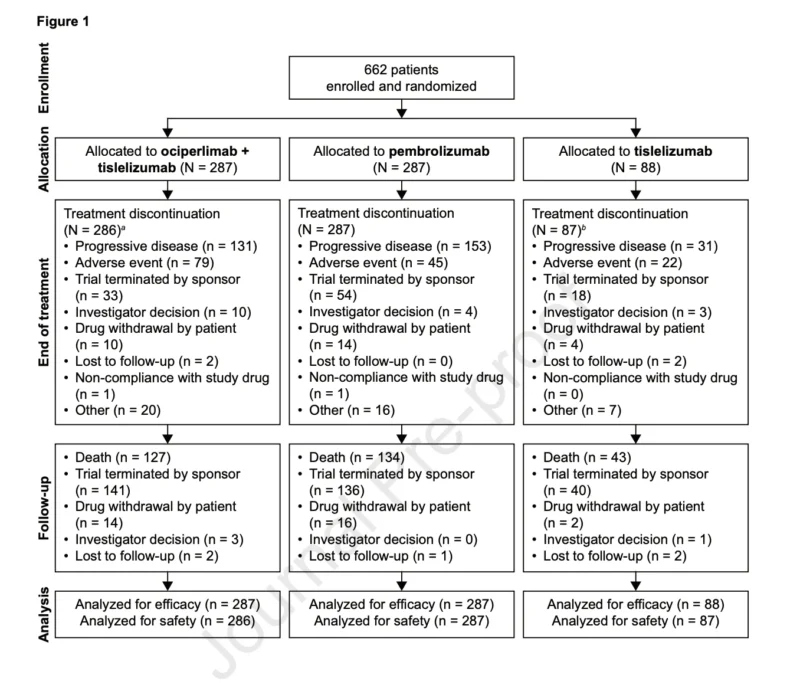
A total of 662 patients were randomized in a 5:5:2 ratio to one of three treatment groups:
Ociperlimab plus tislelizumab: 287 patients
Pembrolizumab: 287 patients
Tislelizumab: 88 patients
Patients received treatment every three weeks. The primary endpoint was overall survival for ociperlimab plus tislelizumab versus pembrolizumab. Key secondary endpoints included progression-free survival, overall response rate, duration of response, and safety.
The tislelizumab monotherapy arm was included to assess the contribution of the individual components and was not powered for formal comparisons.
No Overall Survival Advantage
At the May 30, 2025, data cutoff, median follow-up was approximately 22 months across the treatment groups.
The prespecified interim analysis found that the trial was unlikely to demonstrate superiority for its primary endpoint. AdvanTIG-302 was therefore terminated early for futility, and all efficacy analyses were considered descriptive.
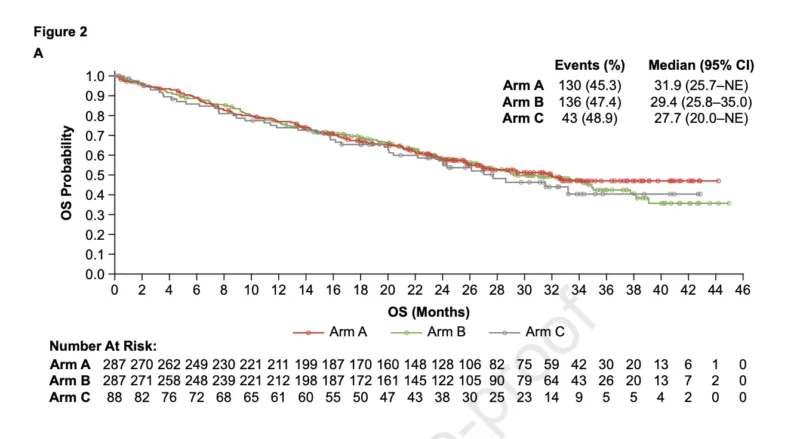
Median overall survival was:
- 31.9 months with ociperlimab plus tislelizumab
- 29.4 months with pembrolizumab
- 27.7 months with tislelizumab
For the primary comparison between ociperlimab plus tislelizumab and pembrolizumab, the stratified hazard ratio for death was 0.97 (95% CI, 0.76–1.23).
The nearly neutral hazard ratio and overlapping confidence interval indicate that adding ociperlimab did not produce a meaningful overall survival improvement.
The overall survival curves presented in Figure 2 of the publication also remained closely aligned throughout follow-up, without evidence of sustained separation in favor of the dual-checkpoint combination.
Higher Response Rate Without a Clear Survival Gain
Ociperlimab plus tislelizumab showed numerical improvements in progression-free survival and objective response rate, but these findings did not translate into improved overall survival.
Median progression-free survival was:
- 14.3 months with ociperlimab plus tislelizumab
- 10.5 months with pembrolizumab
- 16.6 months with tislelizumab
The stratified hazard ratio for progression or death with the combination versus pembrolizumab was 0.94 (95% CI, 0.77–1.15), showing no clear reduction in risk.
The overall response rate was:
- 61.0% with ociperlimab plus tislelizumab
- 48.8% with pembrolizumab
- 55.7% with tislelizumab
Although more patients responded to the combination, responses were not more durable. Median duration of response was 18.6 months with ociperlimab plus tislelizumab, compared with 28.3 months with pembrolizumab.
This distinction is clinically important. A higher response rate alone does not establish superior treatment benefit when the responses are not accompanied by longer progression-free or overall survival.
Could TIGIT Expression Identify a Responsive Subgroup?
The study included an exploratory analysis assessing TIGIT expression on immune cells. Only 182 of 662 patients, or 27.5% of the trial population, were evaluable for this biomarker.
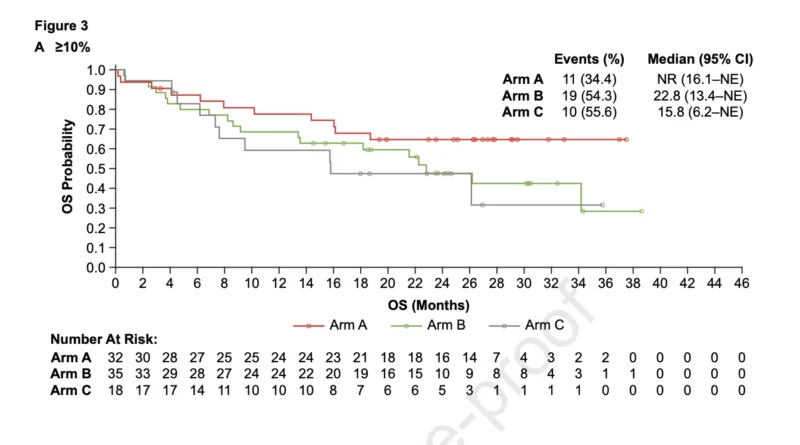
Among patients with TIGIT expression on at least 10% of immune cells, median progression-free survival was:
- 20.8 months with ociperlimab plus tislelizumab
- 6.2 months with pembrolizumab
The response rate in this subgroup was 65.6% with the combination and 34.3% with pembrolizumab.
Median overall survival was not reached with ociperlimab plus tislelizumab and was 22.8 months with pembrolizumab.
By contrast, patients with TIGIT expression below 10% did not show the same pattern. In that subgroup, median progression-free survival was 9.4 months with the combination and 12.2 months with pembrolizumab.
The results raise the possibility that TIGIT expression could help identify patients more likely to benefit from dual TIGIT and PD-1 blockade. However, the biomarker analysis involved a relatively small, retrospectively assessed subset. It was exploratory and cannot establish TIGIT expression as a validated predictive biomarker.
The finding should therefore be considered hypothesis-generating and requires prospective confirmation.
Toxicity Increased With the Combination
The addition of ociperlimab was associated with greater toxicity than pembrolizumab alone.
Treatment-related adverse events occurred in:
- 84.3% of patients receiving ociperlimab plus tislelizumab
- 79.4% receiving pembrolizumab
- 79.3% receiving tislelizumab
Grade 3 or higher treatment-related adverse events occurred in 34.6% of patients in the combination arm, compared with 20.2% in the pembrolizumab arm.
Treatment-related serious adverse events were reported in 26.6% and 15.0%, respectively.
Treatment-related adverse events led to discontinuation in:
- 18.5% with ociperlimab plus tislelizumab
- 10.5% with pembrolizumab
- 14.9% with tislelizumab
Treatment-related deaths occurred in 2.4%, 1.0%, and 1.1% of patients, respectively.
Immune-mediated adverse events were also more frequent with the combination, occurring in 60.5% of patients compared with 43.6% receiving pembrolizumab.
The authors reported no new safety signals, but the increased rates of severe toxicity, serious adverse events, and treatment discontinuation weakened the overall benefit-risk profile of the combination.
Why Did the TIGIT Strategy Fall Short?
AdvanTIG-302 did not confirm the expected additive or synergistic effect of combining TIGIT and PD-1 inhibition.
Several explanations were proposed by the investigators.
The biology of TIGIT may be more complex than initially understood. TIGIT-directed antibodies interact with several immune-cell populations, including CD4-positive and CD8-positive T cells, regulatory T cells, natural killer cells, and myeloid cells. Blocking the receptor may therefore produce effects that vary according to the tumor microenvironment and the functional properties of the antibody.
Increased toxicity may also have reduced treatment exposure. Discontinuation because of treatment-related adverse events was almost twice as common with ociperlimab plus tislelizumab as with pembrolizumab.
Patient selection represents another challenge. PD-L1 expression of at least 50% may identify patients suitable for immunotherapy monotherapy, but it may not be sufficient to predict benefit from adding an anti-TIGIT agent. The exploratory TIGIT immune-cell findings support the need for a more specific biomarker strategy.
What AdvanTIG-302 Means for Clinical Practice
The results do not support replacing pembrolizumab with ociperlimab plus tislelizumab as routine first-line treatment for PD-L1–high advanced NSCLC.
Although the combination increased the proportion of patients achieving a response, it did not improve overall survival or clearly reduce the risk of progression. It also produced more grade 3 or higher toxicity, serious adverse events, immune-mediated events, and treatment discontinuations.
The study reinforces an important principle in immunotherapy development: adding another checkpoint inhibitor must provide more than an early response signal. A successful combination should deliver a clinically meaningful and durable survival benefit with an acceptable increase in toxicity.
The exploratory results in patients with higher TIGIT expression remain scientifically relevant. They suggest that TIGIT inhibition may not be ineffective in every patient, but that broad selection based only on high PD-L1 expression may be inadequate.
The Bottom Line
In the phase 3 AdvanTIG-302 trial, adding ociperlimab to tislelizumab did not improve overall survival compared with pembrolizumab in untreated patients with PD-L1–high, locally advanced or metastatic NSCLC.
Median overall survival was 31.9 months with the combination and 29.4 months with pembrolizumab, with a hazard ratio of 0.97. Despite a higher response rate, the combination did not provide a meaningful progression-free survival advantage and was associated with greater toxicity.
For now, the findings do not support routine dual TIGIT and PD-1 blockade in this population. The future of the strategy may depend on identifying a biomarker-defined subgroup in which the biological benefit is sufficiently strong to justify the additional treatment burden.
References
- Socinski, M. A., Reck, M., Paz-Ares, L., Nishio, M., Spira, A. I., Yu, X., et al. (2026). AdvanTIG-302: Phase 3 study of ociperlimab plus tislelizumab versus pembrolizumab in untreated, locally advanced, unresectable, or metastatic non-small cell lung cancer with PD-L1 ≥50%. Journal of Thoracic Oncology. Advance online publication. https://doi.org/10.1016/j.jtho.2026.104089.
- Banta, K. L., Xu, X., Chitre, A. S., et al. (2022). Mechanistic convergence of the TIGIT and PD-1 inhibitory pathways necessitates co-blockade to optimize antitumor CD8-positive T-cell responses. Immunity, 55, 512–526.e19.
- Reck, M., Rodríguez-Abreu, D., Robinson, A. G., et al. (2016). Pembrolizumab versus chemotherapy for PD-L1-positive non-small-cell lung cancer. The New England Journal of Medicine, 375, 1823–1833.
