
Adjuvant immune checkpoint inhibition has become an important part of the treatment landscape for selected patients with completely resected non-small cell lung cancer (NSCLC). Much of the evidence supporting postoperative PD-1 or PD-L1 blockade, however, has traditionally been communicated through hazard ratios, which describe relative differences between treatment groups but do not always make the magnitude of benefit easy to translate into an individual patient discussion. A new systematic review published in Lung Cancer takes a different approach.
Rather than asking only whether postoperative immunotherapy reduces the relative risk of recurrence or death, Zhiheng Yao and colleagues reconstructed data from randomized phase III trials to estimate the absolute disease-free survival benefit through 36 months for individual adjuvant immunotherapy strategies (Yao et al., 2026).
Their conclusion is important for clinical interpretation: the absolute DFS gains were real on average, but modest in magnitude, varied across trials, and remained statistically uncertain in several analyses. Mature overall survival benefit was also not established. For postoperative NSCLC, this shifts the conversation from a simple question
“Does adjuvant immunotherapy work?” to a more clinically relevant one:
“How much additional disease-free time does it provide, for which patients, and at what cost in toxicity?”
Why Relative Effects Can Be Difficult to Translate Into the Clinic
Randomized oncology trials frequently report treatment effects using hazard ratios. A hazard ratio below 1 indicates that the treatment group experiences fewer events over time than the control group. But the hazard ratio does not directly tell a patient how much longer they are expected to remain disease free, nor how many additional patients may avoid a recurrence event over a fixed period.
That distinction becomes particularly important in the adjuvant setting. After complete surgical resection, many patients have no visible disease. Treatment is therefore being given to reduce the probability of a future recurrence rather than to shrink measurable cancer. In this setting, even a statistically significant relative reduction in recurrence risk may translate into a relatively small absolute difference if the baseline risk is already modest.
Yao and colleagues therefore focused on restricted mean survival time, or RMST, and absolute DFS probability differences through 36 months, aiming to complement, not replace, the original trial analyses (Yao et al., 2026).
Four Phase III Trial Policies, 4,336 Patients
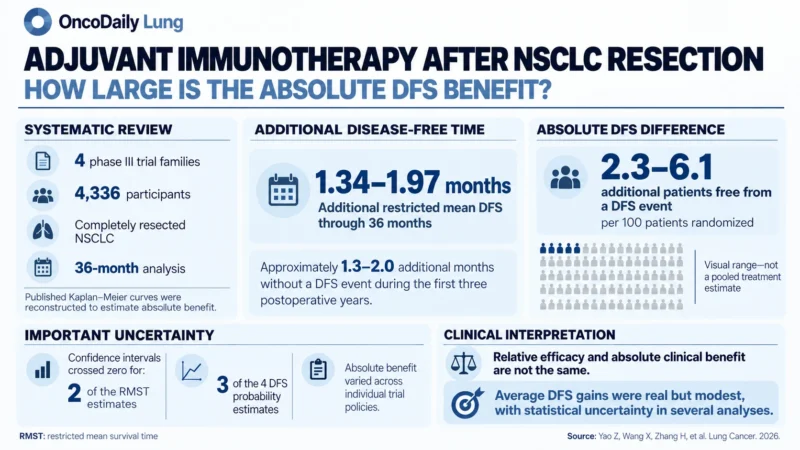
The systematic review evaluated four completed randomized phase III trial families involving a total of 4,336 participants. The investigators reconstructed published Kaplan–Meier curves and estimated two clinically intuitive outcomes at 36 months: the difference in restricted mean disease-free survival time, and the difference in the proportion of patients remaining free from a trial-defined DFS event.
They used 2,000 arm-stratified bootstrap replicates for the primary confidence intervals and performed multiple sensitivity analyses examining reconstruction methods and alternative time horizons. Overall survival reconstruction was exploratory, while safety was described separately for each trial rather than pooled because definitions and follow-up differed between studies (Yao et al., 2026).
This trial-specific approach is important. The authors deliberately avoided treating every postoperative checkpoint inhibitor strategy as if it represented a single interchangeable class effect.
How Much Disease-Free Time Was Actually Gained?
Across the four trial policies, the estimated improvement in 36-month restricted mean DFS ranged from:
- 1.34 to 1.97 months.
In practical terms, patients assigned to postoperative PD-1 or PD-L1 blockade experienced, on average, approximately 1.3 to 2.0 additional months free from a DFS event during the first three years compared with the corresponding control groups. The absolute difference in 36-month DFS probability translated into approximately:
- 2.3 to 6.1 additional patients without a DFS event per 100 patients randomized.
However, statistical uncertainty was substantial. Confidence intervals crossed zero for two of the RMST estimates and for three of the four DFS probability estimates. That does not mean the original randomized trials were necessarily negative.
It means that when the results are expressed as absolute benefit at a fixed three-year horizon, rather than as relative hazard ratios over the entire follow-up period, the precision and clinical magnitude of benefit can look different.
A Different Way to Think About Adjuvant Benefit
The analysis provides a useful illustration of the difference between relative efficacy and absolute clinical benefit. A hazard ratio can demonstrate that recurrence risk is lower over time with immunotherapy. But the absolute number of additional patients who remain disease free depends on the underlying risk of recurrence in the study population.
That matters because postoperative NSCLC is highly heterogeneous. A patient with biologically aggressive stage III disease and a high baseline recurrence risk may have considerably more to gain from adjuvant systemic therapy than a patient with lower-risk resected disease. The same relative treatment effect can therefore generate very different absolute benefits depending on the population in which the drug is used.
This is one reason why stage, nodal involvement, PD-L1 expression where relevant, molecular drivers, prior chemotherapy, pathologic features, comorbidities, and competing risks must remain part of the treatment discussion.
KEYNOTE-091 Illustrates the Uncertainty of Reconstruction
The authors specifically note that the 36-month DFS probability confidence interval for KEYNOTE-091 crossed zero under an alternative reconstruction method, although the interpretation of the corresponding RMST estimate did not change (Yao et al., 2026).
This is an important methodological point. The study did not have access to individual patient-level data from the original randomized trials. Instead, event-time data were reconstructed from published Kaplan–Meier curves. That technique is widely used and can provide clinically meaningful estimates, but it cannot perfectly reproduce the original dataset.
The authors therefore appropriately frame their results as complementary estimates, not replacements for the original trial outcomes.
Why RMST Can Be Useful in Immunotherapy Trials
Immunotherapy survival curves can behave differently from those of conventional cytotoxic therapy. Treatment effects may emerge late, curves may separate gradually, and proportional-hazards assumptions may not always hold. Restricted mean survival time offers another way to express the difference between groups without relying solely on the proportional-hazards assumption.
Conceptually, RMST measures the average amount of event-free time accumulated during a defined period. In this review, that period was 36 months. Instead of saying that one treatment reduced the hazard of a DFS event by a certain percentage, clinicians could also say that within the first three postoperative years, the randomized treatment strategy produced approximately one to two additional months of average disease-free survival, depending on the trial.
Those two statements describe the same evidence from different perspectives. The second may sometimes be easier for patients to interpret.
Overall Survival Remains an Unfinished Question
One of the most important limitations of the current postoperative immunotherapy literature is that mature overall survival benefit has not been consistently established. The authors performed exploratory 36-month OS reconstructions for three of the included trials. The resulting confidence intervals were sufficiently wide to allow the possibility of both benefit and harm (Yao et al., 2026).
This should not be interpreted as evidence that adjuvant checkpoint blockade worsens survival. Rather, it means that the available follow-up and reconstructed data are not yet precise enough to demonstrate a definitive overall survival effect across these individual postoperative strategies.
That distinction is particularly important in curative-intent treatment. DFS is a clinically meaningful endpoint, but the ultimate goal of adjuvant therapy is not merely to postpone recurrence, it is to increase the probability that a patient remains alive and cancer free. Longer follow-up will therefore remain essential.
Toxicity Matters More When Patients Are Potentially Already Cured
The risk–benefit calculation in the postoperative setting is fundamentally different from metastatic disease. After complete resection, some patients would never have experienced recurrence even without additional systemic treatment. Every patient who receives adjuvant therapy, however, is exposed to its potential toxicity. The review therefore deliberately examined harms within individual trials rather than pooling them, because adverse-event definitions and follow-up differed.
Among the three trials with available between-group safety data, severe and serious adverse events occurred more frequently with checkpoint blockade (Yao et al., 2026). Immune-related toxicities can occasionally become chronic or irreversible, including endocrinopathies and other organ-specific inflammatory toxicities.
This makes absolute-benefit communication particularly important. For a patient considering postoperative immunotherapy, the clinically relevant discussion is not only whether the hazard ratio favors treatment. It is whether the individual probability of recurrence reduction is sufficiently large to justify treatment burden and potential immune toxicity.
The Results Do Not Establish a Class Effect
One of the most important conclusions from Yao and colleagues is also one of the easiest to overlook. The analysis does not establish a class-wide effect of adjuvant PD-1/PD-L1 blockade. Nor does it establish a ranking between drugs.
Each randomized trial evaluated a particular trial policy, a specific population, treatment, comparator, endpoint definition, and statistical hierarchy. The authors therefore argue that the absolute estimates should be interpreted at the level of the individual trial rather than pooled into the assumption that all postoperative checkpoint inhibitors provide an identical benefit (Yao et al., 2026). That distinction becomes increasingly important as resectable NSCLC treatment becomes more complex.
Adjuvant-Only Therapy Is No Longer the Only Strategy
The postoperative checkpoint inhibitor trials were developed during an era when surgery followed by adjuvant systemic therapy represented the dominant immunotherapy strategy. The field is now moving rapidly toward neoadjuvant and perioperative immunotherapy, where checkpoint inhibition begins before surgery and may continue afterward.
This evolution creates a new challenge for interpreting the older adjuvant-only trials. The clinically relevant question is no longer simply, immunotherapy versus no immunotherapy after surgery. Increasingly, it is: Which patients should receive immunotherapy before surgery, after surgery, or both?
The systematic review does not compare adjuvant-only strategies with modern perioperative regimens, and the authors explicitly caution that their reconstructed estimates should not be used to establish treatment rankings (Yao et al., 2026). That limitation should be kept in mind when placing these findings within contemporary practice.
Absolute Benefit May Become More Important as Treatment Becomes More Personalized
The future of resectable NSCLC is likely to involve increasingly individualized postoperative decisions. Not every patient carries the same residual risk after surgery. Not every tumor has the same probability of responding to immunotherapy. And not every patient has the same tolerance for a potentially modest reduction in recurrence risk accompanied by months of therapy and the possibility of immune-mediated toxicity.
Absolute-effect measures may therefore become particularly useful when combined with emerging tools for postoperative risk stratification. Pathologic stage, molecular genotype, PD-L1 expression, nodal disease, surgical findings, response to neoadjuvant therapy, and potentially circulating tumor DNA could eventually help estimate a patient’s baseline recurrence risk more accurately.
Once baseline risk becomes more individualized, the same relative treatment effect can be translated into a much more meaningful personal absolute benefit. That is ultimately where analyses such as this one may have their greatest clinical value.
The Bottom Line
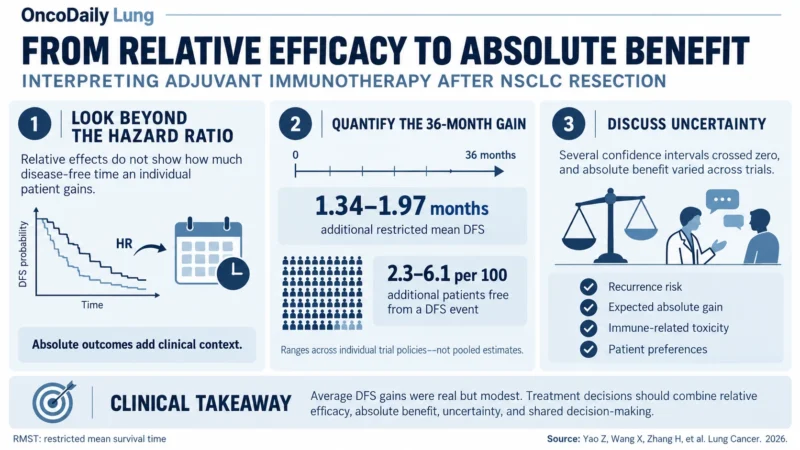
Adjuvant PD-1/PD-L1 blockade has demonstrated disease-free survival benefit in selected populations with completely resected NSCLC. But the new systematic review from Yao and colleagues asks clinicians to look beyond relative hazard ratios.
Across four randomized phase III trial families including 4,336 patients, estimated 36-month absolute benefit corresponded to:
- 1.34–1.97 additional months of restricted mean DFS
and approximately
- 2.3–6.1 additional patients free from a DFS event per 100 randomized.
Several confidence intervals crossed zero, mature overall survival benefit was not established, and severe or serious adverse events were more common with checkpoint blockade in the trials with comparative safety data (Yao et al., 2026). The study therefore does not argue against adjuvant immunotherapy.
Instead, it provides a more nuanced way to discuss what treatment may actually deliver. For patients facing a postoperative treatment decision, relative risk reduction tells only part of the story. The increasingly important question is: How much benefit does this patient stand to gain in absolute terms, and is that benefit worth the treatment burden and risk?
Reference
- Yao, Z., Wang, X., Zhang, H., et al. (2026). Trial-specific absolute disease-free survival effects of postoperative PD-1/PD-L1 blockade after complete resection of NSCLC: A systematic review: Absolute DFS with adjuvant PD-1/PD-L1 blockade. Lung Cancer, Article 109642.