
Long-term follow-up from the phase III ADAURA trial presented at the 2026 World Conference on Lung Cancer provides one of the clearest demonstrations to date that adjuvant molecularly targeted therapy can translate early recurrence prevention into a durable overall-survival advantage in resected EGFR-mutated non–small cell lung cancer.
At the exploratory 8-year landmark analysis, adjuvant osimertinib continued to improve overall survival compared with placebo in patients with completely resected stage IB–IIIA EGFR-mutated NSCLC. In the overall population, the estimated 8-year OS rate was 79% with osimertinib versus 64% with placebo, corresponding to an absolute difference of 15 percentage points and an OS hazard ratio of 0.52. In the prespecified primary stage II–IIIA population, 8-year survival was 74% versus 58%, with an HR of 0.53.
The updated analysis, presented during WCLC 2026 in Seoul and reported in the Journal of Thoracic Oncology, extends one of the most influential stories in early-stage precision lung cancer. ADAURA had already established a profound disease-free survival benefit and subsequently demonstrated a statistically significant OS advantage. The new results show that the survival curves remain separated long after many patients have completed the planned three years of adjuvant osimertinib.
The question is therefore no longer whether osimertinib delays recurrence. At eight years, ADAURA provides increasingly mature evidence that preventing recurrence with adjuvant EGFR inhibition can alter long-term survival after surgery.
ADAURA Changed the Role of Molecular Testing in Early NSCLC
Historically, curative-intent systemic treatment after complete NSCLC resection relied primarily on platinum-based chemotherapy. The survival benefit was important but relatively modest, with cisplatin-based adjuvant chemotherapy producing an approximately 5% reduction in the risk of death at five years. ADAURA introduced a fundamentally different treatment concept.
Patients with completely resected stage IB–IIIA NSCLC harboring an EGFR exon 19 deletion or L858R mutation were randomized to osimertinib 80 mg once daily or placebo for up to three years following surgery, with adjuvant chemotherapy permitted when clinically indicated.
A total of 682 patients entered the trial. The initial analysis demonstrated a dramatic reduction in recurrence risk, with a DFS hazard ratio of 0.20 in the stage II–IIIA population. With additional follow-up, the DFS benefit remained substantial, and the protocol-defined final OS analysis subsequently demonstrated an OS HR of 0.49.
These findings helped establish molecular testing as an essential component of early-stage NSCLC management. EGFR status was no longer relevant only after metastatic recurrence; it became information needed shortly after resection to determine potentially curative systemic treatment. The 8-year analysis strengthens that principle.
Eight-Year Survival Reaches 79% With Osimertinib
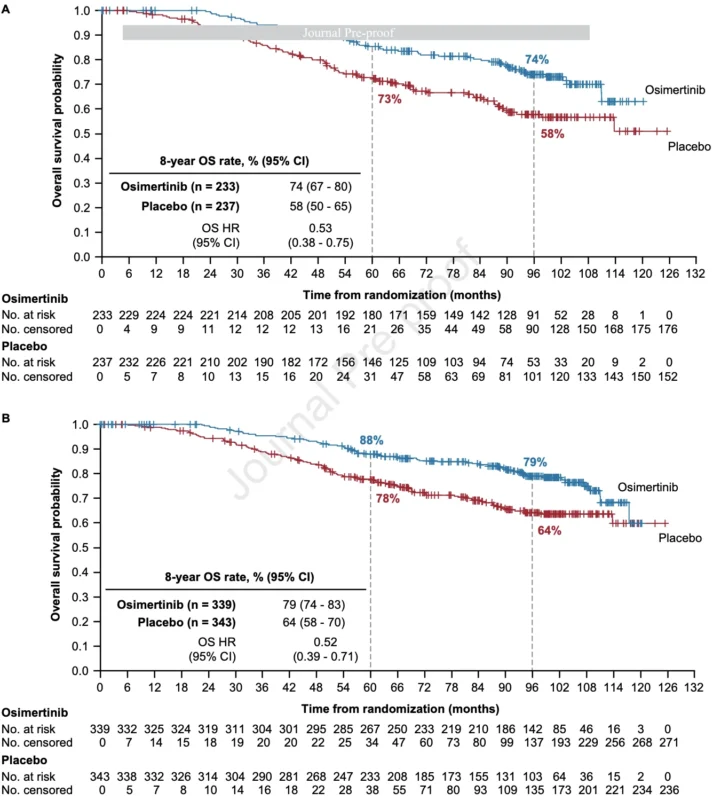
The updated data cutoff was May 4, 2026. In the overall stage IB–IIIA population, there had been 175 deaths: 68 among patients assigned to osimertinib and 107 among patients assigned to placebo. The OS hazard ratio was 0.52 (95% CI, 0.39–0.71). At eight years, estimated overall survival was 79% with osimertinib versus 64% with placebo.
The absolute difference of 15 percentage points is particularly notable for a curative-intent adjuvant intervention. Median OS follow-up was 93.3 months for the osimertinib arm and 79.6 months for placebo. The Kaplan–Meier curve shown at WCLC illustrates continued separation well beyond the original three-year treatment period. The 5-year OS rates were 88% versus 78%, while the updated 8-year rates remained separated at 79% and 64%.
This persistence after treatment completion is clinically important.
One of the central concerns with adjuvant targeted therapy has always been whether treatment merely delays recurrence while the drug is being administered or whether it changes the patient’s long-term probability of survival. The ADAURA curves increasingly support the latter interpretation.
The Higher-Risk Stage II–IIIA Population Shows a Similar Effect
The survival advantage remained pronounced in the primary stage II–IIIA population. At the May 2026 cutoff, 142 deaths had occurred: 57 in the osimertinib arm and 85 with placebo. The OS hazard ratio was 0.53 (95% CI, 0.38–0.75).
Eight-year survival was 74% with osimertinib versus 58% with placebo, representing an absolute difference of 16 percentage points. The WCLC slide also places these data beside the earlier 5-year landmark, when survival was 85% with osimertinib and 73% with placebo.
The important observation is therefore not simply the absolute survival rate at eight years. It is the durability of the difference between the randomized groups.
Benefit Extends Across Disease Stages
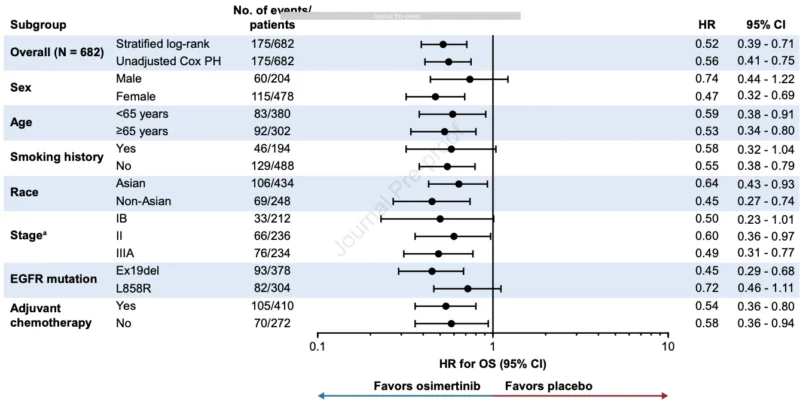
The stage-specific results presented at WCLC provide additional context. At eight years, estimated OS with osimertinib versus placebo was:
- Stage IB: 91% vs 77%
- Stage II: 78% vs 63%
- Stage IIIA: 70% vs 52%.
The corresponding exploratory OS hazard ratios were approximately 0.50 for stage IB, 0.60 for stage II, and 0.49 for stage IIIA. The absolute survival differences become particularly striking in stage IIIA disease, where 70% of patients assigned to osimertinib were alive at eight years compared with 52% assigned to placebo.
The stage IB confidence interval is wider and includes 1, reflecting fewer events rather than evidence that the treatment effect is absent. Subgroup estimates should not be interpreted as independently powered comparisons. Taken together, however, the direction of treatment effect remained consistently favorable across stage IB, II, and IIIA disease.
Exon 19 Deletion and L858R Remain Clinically Distinct Subgroups
The mutation-specific analysis deserves careful interpretation. For patients with EGFR exon 19 deletion, the OS HR was 0.45 (95% CI, 0.29–0.68). For those with L858R, the HR was 0.72 (95% CI, 0.46–1.11).
The confidence interval for L858R crosses 1, but this exploratory subgroup was not independently powered to establish statistical significance. It would therefore be inappropriate to conclude that adjuvant osimertinib does not benefit patients with L858R disease.
The finding does, however, reinforce a recurring observation across EGFR-mutated NSCLC: exon 19 deletion and L858R are not necessarily biologically interchangeable, and long-term outcomes may differ according to EGFR genotype. Future adjuvant studies may increasingly need to treat mutation subtype as more than a simple stratification variable.
The Benefit Was Seen With or Without Adjuvant Chemotherapy
The WCLC subgroup analysis also showed a favorable direction for osimertinib irrespective of previous adjuvant chemotherapy. The OS HR was approximately 0.54 among patients who received chemotherapy and 0.58 among those who did not. This does not mean that osimertinib replaces chemotherapy.
ADAURA was neither designed nor statistically powered to determine the contribution of adjuvant chemotherapy, and chemotherapy use differed according to disease stage and clinical characteristics. The investigators explicitly caution that evaluating chemotherapy’s effect on OS would require a prospectively designed comparison.
The clinically appropriate interpretation remains that osimertinib provides benefit after complete resection, with chemotherapy incorporated when indicated according to the patient’s stage and clinical context.
ADAURA Is Different From Earlier Adjuvant EGFR-TKI Trials
The long-term survival finding becomes particularly meaningful when placed in historical context. Earlier trials of adjuvant EGFR TKIs, including CTONG1104 and IMPACT with gefitinib and Alliance A081105 with erlotinib, demonstrated improvements in disease-free survival but did not establish statistically significant overall-survival gains.
ADAURA is different. The updated trial remains the most mature global phase III evidence demonstrating that adjuvant EGFR-directed treatment can provide both major reductions in recurrence risk and a durable OS advantage following complete resection.
That distinction addresses one of the central debates surrounding adjuvant targeted therapy. DFS improvement matters because preventing or postponing recurrence is clinically valuable. But in a potentially curable population receiving years of therapy, demonstrating that this strategy ultimately allows more patients to remain alive many years later provides a stronger level of validation.
The Three-Year Treatment Course Raises a Longer-Term Question
Patients in ADAURA received osimertinib for a planned duration of three years. Yet the updated survival advantage remains visible approximately eight years after randomization. This creates a fascinating biological question: how much residual disease is eradicated during those three years, and how much is simply suppressed long enough to alter subsequent disease evolution?
ADAURA itself cannot fully answer that question. Several studies are now exploring the boundaries of treatment duration and timing. These include ADAURA2 in smaller stage IA2–IA3 tumors, TARGET evaluating five years of adjuvant osimertinib, and NeoADAURA examining osimertinib in the neoadjuvant setting.
The next generation of trials will therefore move beyond asking whether adjuvant EGFR inhibition works and instead ask who requires it, how early it should begin, and how long it should continue.
MRD Could Eventually Change the Fixed-Duration Model
One of the most important future directions identified by the investigators is molecular residual disease. Current adjuvant osimertinib treatment is largely determined by pathological stage and EGFR genotype. Every eligible patient receives a predefined treatment strategy irrespective of whether residual molecular disease is demonstrable after surgery.
ctDNA-based MRD testing could eventually make this strategy more adaptive. The authors specifically identify MRD monitoring as a potential tool for treatment intensification or de-escalation, alongside research into mechanisms of resistance emerging during or after adjuvant therapy.
A future model could therefore move from:
- resection → EGFR mutation → fixed-duration osimertinib
toward:
- resection → EGFR mutation → longitudinal MRD monitoring → risk-adapted duration or intensity of targeted therapy.
That remains investigational, but it may become one of the most important questions generated by ADAURA’s success.
The 8-Year Analysis Has Important Methodologic Limitations
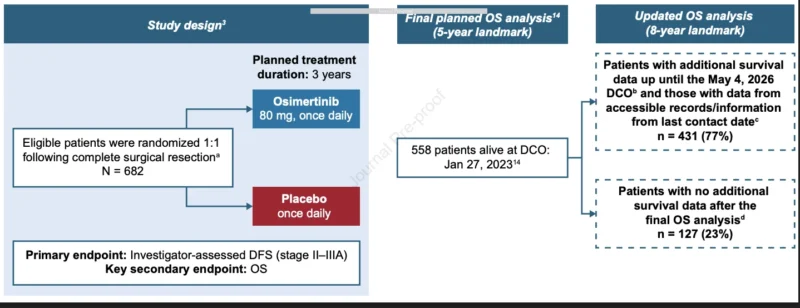
The durability of the survival benefit is compelling, but this update is a post hoc exploratory long-term analysis, not another protocol-defined confirmatory OS analysis. At the planned final OS analysis in January 2023, 558 of the 682 randomized patients remained alive. Updated survival information through May 2026 was obtained for 431 of those 558 patients, or 77%.
For the remaining 127 patients—23% of those alive at the previous cutoff—no additional survival information was available, and their survival time remained censored at the earlier known date. The number of additional deaths since the formal final OS analysis was also relatively small.
There were imbalances among patients with and without additional follow-up, particularly in the placebo group. The investigators acknowledge that these could influence the exact estimated 8-year survival rates. Their analysis suggests that the imbalance may actually have favored the placebo group, potentially making the observed treatment difference conservative, but this remains part of the uncertainty inherent in extended post-trial follow-up.
Accordingly, the exact 8-year percentages should be interpreted as exploratory landmark estimates. What is much harder to dismiss is the continuing separation of the randomized survival curves and the consistency of the hazard ratio with the previously established OS benefit.
Subsequent Therapy Also Complicates the Survival Story
Another important consideration is what happened after recurrence. Eligible patients from both treatment groups could subsequently receive effective therapies, including open-label osimertinib. Such crossover or postrecurrence treatment would be expected to reduce the survival difference attributable to the original randomization rather than exaggerate it.
The investigators note that the relatively favorable long-term survival of patients initially assigned to placebo may partly reflect access to effective subsequent therapy after recurrence. Detailed information on postrecurrence treatments was not collected beyond January 2023.
This makes the persistent 15–16 percentage-point survival difference arguably even more clinically meaningful. Adjuvant osimertinib is demonstrating benefit despite the fact that patients initially assigned to placebo were not denied effective EGFR-targeted treatment indefinitely.
ADAURA Has Changed the Meaning of “Early” Precision Oncology
Perhaps the broader legacy of ADAURA is that it changed where precision oncology begins in lung cancer. Molecular testing was once primarily associated with advanced NSCLC, where identification of EGFR, ALK, ROS1, and other drivers determines systemic therapy after metastatic diagnosis. ADAURA demonstrated that waiting for metastatic recurrence forfeits an opportunity.
For a patient with completely resected EGFR-mutated NSCLC, molecular information can determine treatment while the patient has no radiographically visible disease, with the objective of preventing microscopic residual cancer from ever becoming clinically apparent.
The 8-year WCLC data validate that strategy at the level patients care about most: long-term survival.
The Bottom Line
The WCLC 2026 ADAURA update provides the longest OS follow-up yet reported from a global phase III adjuvant trial in EGFR-mutated NSCLC.
In the overall stage IB–IIIA population, 8-year OS was 79% with adjuvant osimertinib versus 64% with placebo, with an OS HR of 0.52. In stage II–IIIA disease, survival was 74% versus 58%, with an HR of 0.53. Survival favored osimertinib across disease stages, with 8-year OS rates of 91%, 78%, and 70% for stage IB, II, and IIIA disease, respectively.
The update does not establish a new standard, ADAURA already did that. Instead, it answers a more important long-term question: does the benefit persist after adjuvant treatment ends? Eight years after randomization, the answer remains strongly favorable.
For early-stage EGFR-mutated NSCLC, osimertinib is no longer simply a therapy that postpones recurrence. ADAURA increasingly supports the conclusion that three years of adjuvant molecular therapy can produce a durable alteration in the long-term survival trajectory after curative-intent surgery.
The next frontier will be personalization within that successful strategy: determining who needs longer treatment, who may need less, how MRD can guide those decisions, and how resistance should be managed if recurrence ultimately develops.
Reference
- Wu Y-L, Majem M, John T, Grohé C, Wang J, Goldman JW, et al. Adjuvant Osimertinib in Resected EGFR-Mutated Stage IB–IIIA Non-Small Cell Lung Cancer: Exploratory 8-year Overall Survival Landmark Update from the ADAURA Trial. Journal of Thoracic Oncology. 2026. doi:10.1016/j.jtho.2026.104179.