



Metastatic castration-resistant prostate cancer (mCRPC) remains challenging to treat once the disease progresses despite androgen receptor pathway inhibitors and chemotherapy. Although treatment options have expanded, resistance to successive therapies continues to drive the search for new therapeutic approaches capable of achieving more durable disease control.
Immunotherapy has historically shown limited efficacy in unselected prostate cancer. Its relatively low tumor mutational burden, limited neoantigen availability, sparse T-cell infiltration, and immunosuppressive tumor microenvironment can restrict the development of effective antitumor immune responses. These characteristics have made it difficult for conventional immune checkpoint inhibitors to produce meaningful and durable responses in most patients.
An emerging strategy is to redirect T cells toward specific proteins expressed on prostate cancer cells. T-cell engagers offer a different approach by physically connecting immune cells to tumor cells, rather than relying entirely on an existing antitumor immune response.
Two investigational agents, Xaluritamig and Pasritamig, are advancing this strategy through different tumor-associated targets: six-transmembrane epithelial antigen of the prostate 1 (STEAP1) and human kallikrein 2 (KLK2), respectively. Their development has progressed from preclinical research and early clinical activity to three Phase III trials designed to evaluate their potential role in advanced prostate cancer.

10 Ongoing Clinical Trials on Immunotherapy in Prostate Cancer
How Do T-Cell Engagers Work?
T-cell engagers are engineered bispecific antibodies designed to bind two targets simultaneously: CD3 on T cells and a tumor-associated antigen on cancer cells. By bringing these cells into close proximity, the antibody promotes the formation of an immune synapse that activates T cells. Following CD3 engagement, intracellular signaling triggers T-cell activation and the release of cytotoxic molecules, including perforin and granzymes, which induce tumor-cell death.
Unlike conventional T-cell recognition, which depends on the presentation of tumor-derived peptides through major histocompatibility complex (MHC) molecules, this approach can redirect T cells toward target-expressing cancer cells independently of conventional antigen presentation. This mechanism is particularly relevant in prostate cancer, where impaired antigen presentation and limited spontaneous immune activation can contribute to resistance to immunotherapy.
However, successful T-cell engagement depends on more than immune activation. The selected antigen must be sufficiently expressed and accessible on cancer cells, while the surrounding tumor microenvironment must support effective and sustained T-cell activity.
Why STEAP1 and KLK2?
The selection of an appropriate tumor-associated antigen is central to developing T-cell engagers for solid tumors. STEAP1 and KLK2 have attracted attention because of their expression patterns in prostate cancer and their potential accessibility to antibody-based therapies.
STEAP1 (six-transmembrane epithelial antigen of the prostate 1) is a cell-surface protein expressed in most prostate tumors, with increased expression reported in metastatic castration-resistant disease.
In preclinical research published in Cancer Discovery, Nolan-Stevaux and colleagues demonstrated that AMG 509, now known as Xaluritamig, induced T-cell-dependent killing of prostate cancer cells and tumor regression in experimental models. The investigators also reported avidity-dependent activity, suggesting that the molecule’s design could favor activity against cells expressing higher levels of STEAP1 compared with normal cells. These findings established a biological rationale for targeting STEAP1 through T-cell redirection.
KLK2 (human kallikrein 2) is an androgen-regulated serine protease associated with prostate tissue and closely related to prostate-specific antigen (PSA). Although traditionally characterized as a secreted protein, its presence on the surface of prostate cancer cells has established its potential as a therapeutic target for antibody-based approaches.
In Human Kallikrein 2: A Novel Lineage-Specific Surface Target in Prostate Cancer, published in Clinical Cancer Research, Shen and colleagues demonstrated cell-surface KLK2 expression in prostate cancer cell lines and patient-derived tumors. Their findings also showed relatively homogeneous expression in localized prostate cancer and metastatic hormone-sensitive disease, while greater heterogeneity was observed in visceral lesions from patients with mCRPC.
This distinction is clinically important because variation in KLK2 expression between metastatic sites could limit the effectiveness of antigen-directed therapy. Some tumor deposits may express sufficient target antigen for T-cell engagement, while others may remain less susceptible to treatment.
Together, STEAP1 and KLK2 provide two distinct biological approaches to redirecting T cells against prostate cancer. Their ongoing clinical development is now evaluating whether these mechanisms can translate into meaningful improvements in patient outcomes.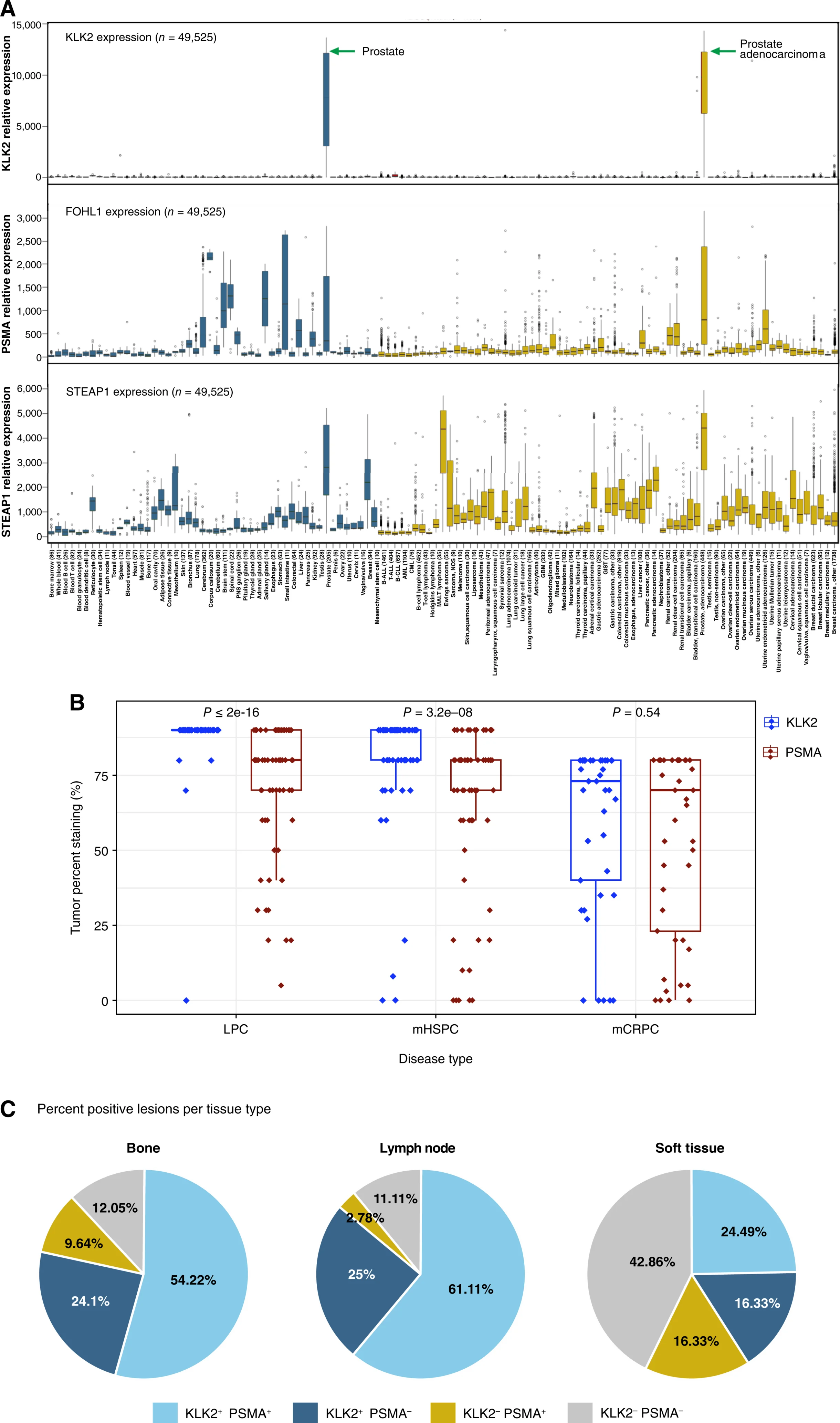
Recent Clinical Trials: Where Are STEAP1- and KLK2-Directed Therapies Moving Next?
Xaluritamig: Targeting STEAP1
Xaluritamig, also known as AMG 509, is an engineered STEAP1 × CD3 T-cell engager designed to redirect T cells toward STEAP1-expressing prostate cancer cells.
In the first-in-human Phase I study, Xaluritamig, a STEAP1 × CD3 XmAb 2+1 Immune Therapy for Metastatic Castration-Resistant Prostate Cancer: Results from Dose Exploration in a First-in-Human Study, published in Cancer Discovery, Kelly and colleagues evaluated Xaluritamig in patients with mCRPC. The study included 97 treated patients.
Among the 87 patients evaluable for PSA response, 43 (49%) achieved a confirmed PSA reduction of at least 50% from baseline (PSA50). Radiographic assessment also demonstrated antitumor activity: among 67 patients evaluable according to RECIST criteria, 16 (24%) achieved a confirmed partial response. The median duration of radiographic response among responders was 9.2 months.
These findings provided early evidence of both biochemical and radiographic activity in a heavily pretreated population. However, the study was not designed to determine whether Xaluritamig improves survival compared with established treatment options.
Safety was another important consideration. Cytokine release syndrome (CRS), a systemic inflammatory reaction caused by rapid immune activation and cytokine release, occurred in 72% of treated patients. Fatigue and myalgia were also common treatment-related adverse events. CRS occurred predominantly during the first treatment cycle, and the investigators explored step-up dosing and premedication strategies to improve tolerability.
XALute: Testing Xaluritamig Against Available Treatment
The Phase III XALute trial (NCT06691984) compares Xaluritamig with investigator-selected cabazitaxel or a second androgen receptor-directed therapy in patients with mCRPC previously treated with chemotherapy. Its primary endpoint is overall survival (OS), evaluating whether Xaluritamig can improve survival compared with available treatment options.
According to the ClinicalTrials.gov record, the estimated enrollment is 707 participants, with estimated primary completion on January 2, 2029. XALute represents an important step beyond early clinical findings, as the trial is designed to determine whether STEAP1-directed T-cell engagement can translate PSA reductions and tumor responses into a meaningful survival benefit.
Pasritamig: Targeting KLK2
Pasritamig, also known as JNJ-78278343, is a KLK2 × CD3 bispecific T-cell engager designed to connect T cells with KLK2-expressing prostate cancer cells.
In the first-in-human Phase I study, Pasritamig, a First-in-Class, Bispecific T-Cell Engager Targeting Human Kallikrein 2, in Metastatic Castration-Resistant Prostate Cancer: A Phase I Study, published in the Journal of Clinical Oncology, Stein and colleagues evaluated Pasritamig in patients with previously treated mCRPC.
At the recommended Phase II dose (RP2D), the efficacy population included 33 patients. Of these, 14 (42.4%) achieved a PSA reduction of at least 50% at any time, while 12 (36.4%) achieved a confirmed PSA50 response. Median radiographic progression-free survival (rPFS) was 7.85 months.
In the corresponding RP2D safety population of 45 patients, CRS occurred in four (8.9%), with all reported cases classified as grade 1. These findings provided preliminary evidence of antitumor activity and supported further investigation of KLK2-directed T-cell engagement.
Importantly, the PSA50 results reflect the 33-patient RP2D efficacy population rather than the entire study population. The distinction between a PSA50 response at any time and a confirmed PSA50 response is also important when interpreting the findings.
Although the reported CRS incidence was lower than that observed in the early Xaluritamig study, these results should not be directly compared. Differences in study design, patient populations, dosing, and safety assessments prevent conclusions about the relative efficacy or tolerability of the two agents.
Two Phase III trials are now evaluating Pasritamig in different treatment settings.
KLK2-PASenger: Adding Pasritamig to Docetaxel
The Phase III KLK2-PASenger trial (NCT07225946) compares Pasritamig plus docetaxel with docetaxel alone in patients with mCRPC. Its primary endpoint is radiographic progression-free survival (rPFS), which evaluates the time until radiographic disease progression or death according to the trial’s endpoint definition.
According to the ClinicalTrials.gov record, the estimated enrollment is 800 participants, with estimated primary completion on November 19, 2027. Rather than evaluating Pasritamig as a standalone treatment, the trial investigates whether adding KLK2-directed T-cell engagement to docetaxel can improve disease control compared with chemotherapy alone, while establishing the clinical contribution of Pasritamig to the combination.
KLK2-comPAS: Evaluating Pasritamig-Based Strategies
The Phase III KLK2-comPAS trial (NCT07164443) evaluates Pasritamig-based treatment strategies in later-line mCRPC, with overall survival as its primary endpoint. According to the ClinicalTrials.gov record, the estimated enrollment is 1,203 participants, with estimated primary completion on August 18, 2028.
The trial is structured in two parts. Part 1 compares Pasritamig plus best supportive care with placebo plus best supportive care. Part 2 evaluates three treatment strategies: Pasritamig plus best supportive care, Pasritamig combined with JNJ-87189401 plus best supportive care, and placebo plus best supportive care.
JNJ-87189401 is an investigational PSMA-targeted CD28 costimulatory agent designed to provide an additional immune-activating signal. By evaluating Pasritamig alone and in combination with additional immune costimulation, the trial aims to determine whether KLK2-directed T-cell engagement can improve survival in later-line mCRPC and whether enhanced T-cell activation may provide further clinical benefit.
Together, XALute, KLK2-PASenger, and KLK2-comPAS represent distinct clinical investigations rather than direct comparisons between Xaluritamig and Pasritamig. Their different treatment settings, comparators, combinations, and endpoints reflect separate questions about how T-cell engagers might be incorporated into advanced prostate cancer treatment.
The estimated primary completion dates provide an indication of anticipated trial timelines but should not be interpreted as confirmed data-readout or publication dates. Their potential implications for clinical practice will depend on trial completion, adequate follow-up, and subsequent reporting.
What Could Limit the Benefit of T-Cell Engagers?
Although STEAP1 and KLK2 offer promising targets, antigen-directed therapies face several biological challenges that may influence the depth and durability of treatment responses.
One important concern is antigen heterogeneity, as not all tumor cells or metastatic lesions necessarily express the target at the same level. Tumor cells with low or absent antigen expression may escape recognition, potentially contributing to incomplete responses or treatment resistance. The variation in KLK2 expression across metastatic sites reported by Shen and colleagues illustrates this challenge, as targeting one antigen may effectively eliminate some tumor populations while leaving others less susceptible to treatment.
T-cell exhaustion represents another potential limitation. Persistent antigen stimulation and prolonged immune activation can progressively impair T-cell function, potentially reducing the durability of tumor-cell killing. Additionally, the immunosuppressive tumor microenvironment may restrict T-cell activity through suppressive immune-cell populations, inhibitory signaling pathways, and other mechanisms that interfere with effective immune responses.
These processes represent plausible routes of resistance to T-cell engagement, although their specific contributions to resistance against Xaluritamig and Pasritamig remain to be established. Understanding these limitations will be important for developing future combination strategies and identifying patients most likely to benefit from treatment.
Could Biomarkers Help Guide Patient Selection?
The expression of STEAP1 and KLK2 provides a potential starting point for biomarker-driven patient selection. Assessing target expression in tumor tissue could help identify patients whose disease may be more susceptible to antigen-directed T-cell engagement. However, a single tissue sample may not accurately represent antigen expression across all metastatic sites, particularly in patients with heterogeneous disease.
For STEAP1, further research could clarify whether antigen density is associated with treatment response and whether specific expression thresholds can help identify patients most likely to benefit from Xaluritamig. For KLK2, the variation observed in visceral metastases highlights the potential importance of evaluating expression across different disease sites and stages.
Beyond antigen expression, future research may also investigate whether T-cell characteristics, immune activation signatures, and features of the tumor microenvironment influence treatment response or resistance.
At present, neither STEAP1 nor KLK2 expression has an established, clinically validated predictive threshold for selecting patients for these investigational agents. Prospective studies will be necessary to determine whether biomarker-based testing can reliably guide treatment decisions.
Conclusion
Xaluritamig and Pasritamig represent two emerging approaches to redirecting T cells against advanced prostate cancer through STEAP1 and KLK2. Their early clinical findings provide evidence of antitumor activity, while ongoing Phase III programs are designed to determine whether this activity translates into meaningful clinical benefits.
These agents are particularly relevant in a disease where conventional immune checkpoint blockade has demonstrated limited efficacy in most unselected patients. By redirecting T cells toward prostate cancer-associated antigens, they offer a different strategy for overcoming some of the barriers that have historically limited immunotherapy.
However, their future role will depend on demonstrating clinically meaningful benefits while addressing challenges related to treatment toxicity, antigen heterogeneity, and resistance. The central question is whether the responses observed in early studies will translate into improved radiographic progression-free survival or overall survival in randomized Phase III trials, ultimately determining whether STEAP1- and KLK2-directed T-cell engagers can become meaningful additions to the treatment landscape for advanced prostate cancer.
Written by Mane Sayian, PharmD