Stereotactic body radiation therapy (SBRT) provides high rates of local tumor control and remains the standard treatment for patients with early-stage non-small-cell lung cancer (NSCLC) who are medically inoperable. Regional and distant recurrence nevertheless remains a clinically relevant problem, creating interest in whether systemic therapy could improve outcomes after definitive SBRT. Immune checkpoint inhibition has been particularly attractive in this setting because preclinical studies have described several potential interactions between ablative radiation and antitumor immunity, including effects on antigen presentation, PD-L1 expression, tumor vasculature, and cytokine signaling.
The randomized phase III SWOG/NRG S1914 trial tested this concept by adding atezolizumab before, during, and after SBRT in patients with early-stage NSCLC considered at increased risk of recurrence. The results were negative: atezolizumab did not improve progression-free survival (PFS) or overall survival (OS), while treatment-related toxicity increased. Together with the negative KEYNOTE-867 trial, the findings provide phase III evidence against routine incorporation of immune checkpoint inhibitors into SBRT for unselected patients with early-stage inoperable NSCLC.
S1914: Testing PD-L1 Blockade Across the SBRT Treatment Course
S1914 was a multicenter, open-label, randomized phase III trial conducted through the US National Cancer Institute National Clinical Trials Network. Patients had histologically or cytologically confirmed stage I–IIA or limited T3N0M0 NSCLC according to AJCC eighth edition, with tumors ≤7 cm. They were medically inoperable or had declined surgery and were required to have at least one predefined feature associated with increased recurrence risk: tumor diameter ≥2 cm, FDG-PET SUVmax ≥6.2, or moderately, poorly, or undifferentiated histology.
Patients were randomized 1:1 to SBRT alone or atezolizumab plus SBRT. Atezolizumab was administered at 1200 mg intravenously every 21 days for up to eight cycles, and SBRT was initiated with cycle three, thereby incorporating PD-L1 blockade in the neoadjuvant, concurrent, and post-SBRT periods. SBRT consisted of 48–60 Gy delivered in three to eight fractions, using regimens with a biologically effective dose of at least 100 Gy, assuming an α/β ratio of 10 for lung tumors.
The primary endpoint was OS. Secondary endpoints included investigator-assessed PFS, local, locoregional and distant failure, toxicity, and other outcomes. The trial had a group-sequential design with four planned interim analyses and was intended to enroll 480 patients, with 432 expected to be eligible.
Importantly, neither PD-L1 expression nor molecular testing for actionable oncogenic alterations was required for enrollment. This reflected clinical practice when the trial was designed but subsequently became relevant to interpretation of the results.
The Trial Closed Early for Futility
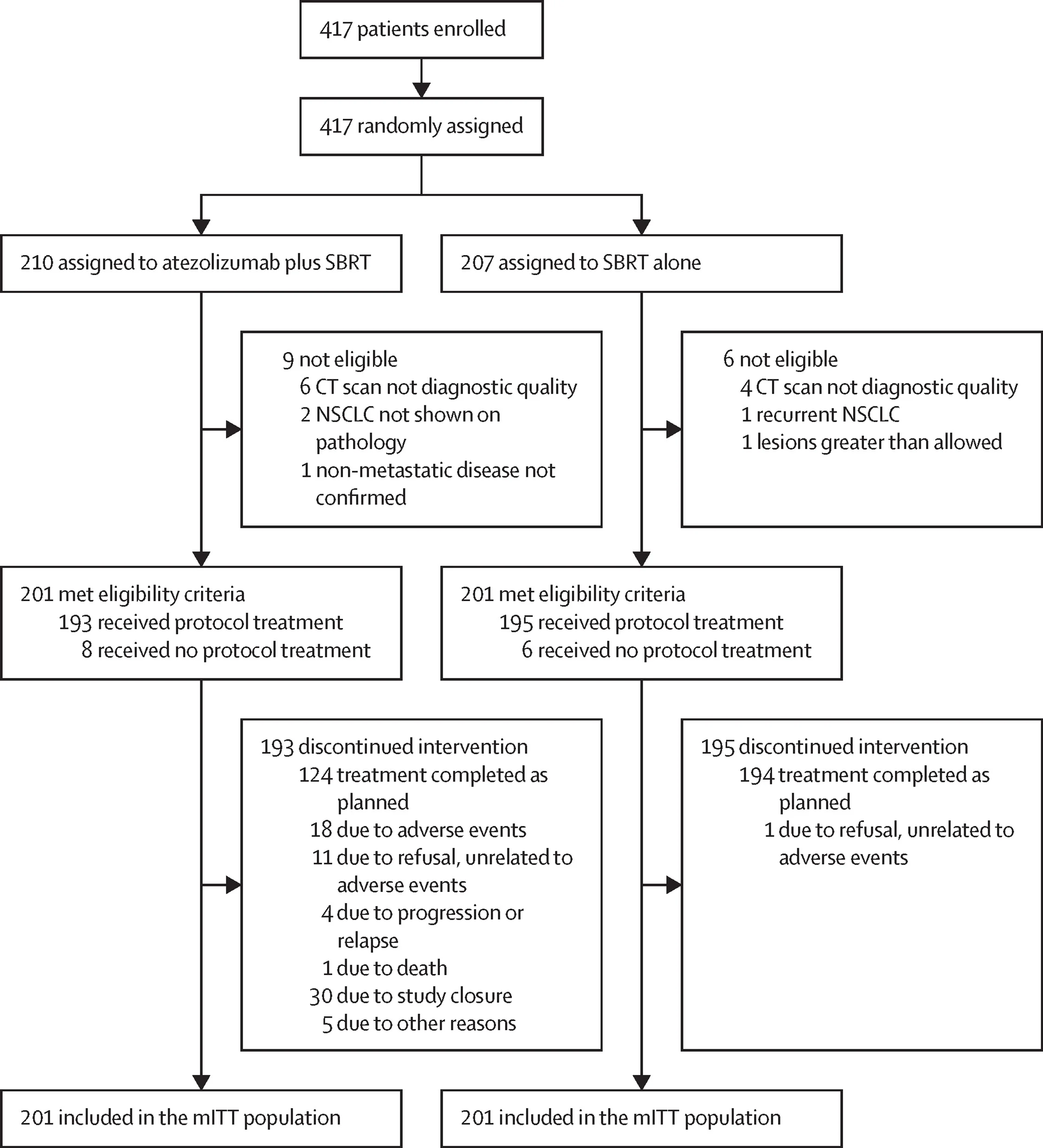
Between March 25, 2020, and September 9, 2024, 417 patients from 146 US institutions were randomized to atezolizumab plus SBRT or SBRT alone. After eligibility assessment, 402 patients formed the modified intention-to-treat population, with 201 patients in each group.
The median age was 72.8 years, and 89% had a performance status of 0–1. Median tumor diameter was 2.3 cm, and 86% of patients had tumors smaller than 4 cm. Forty percent had only one of the predefined high-risk features, 38% had two, and 22% had all three.
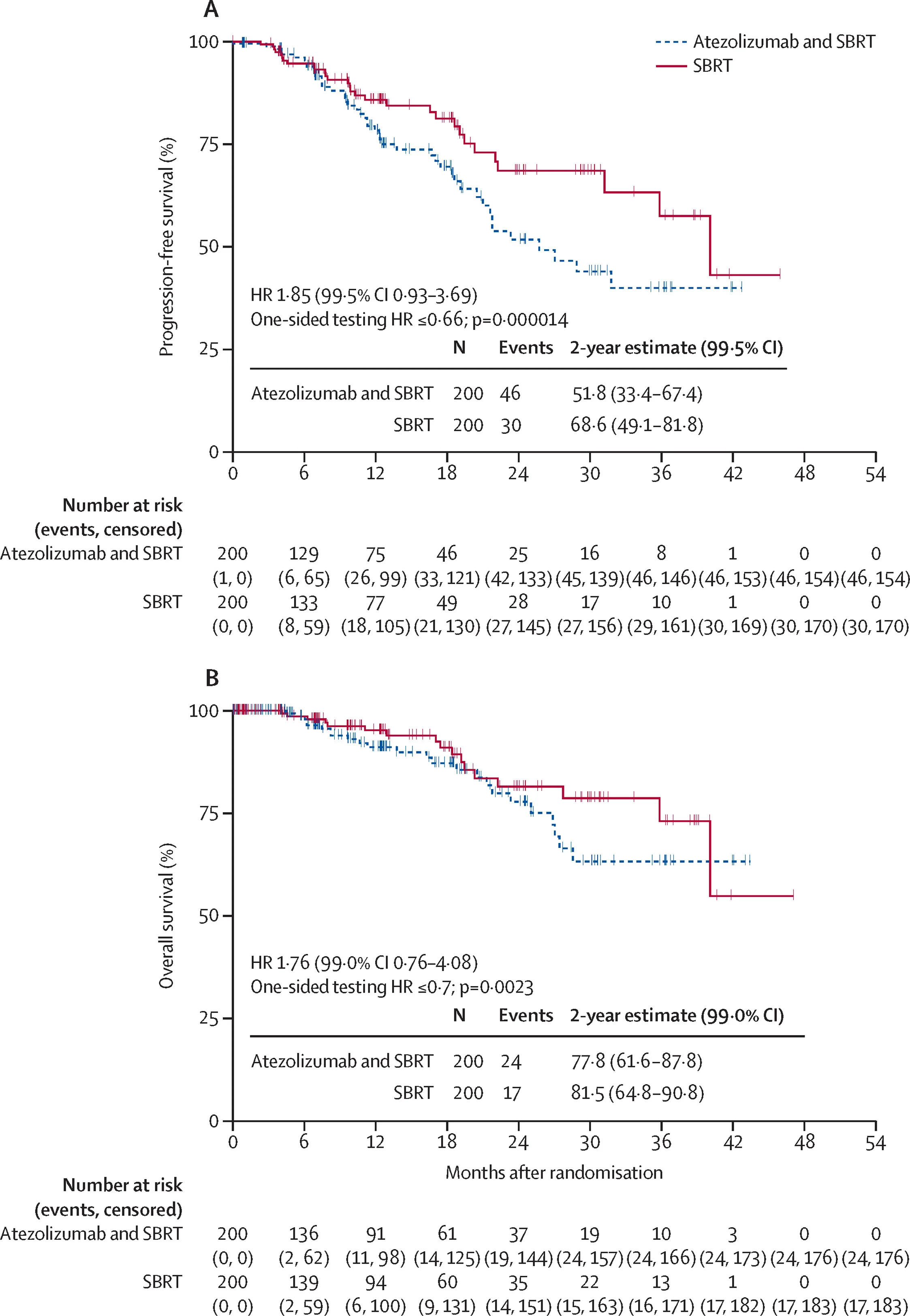
At the first interim analysis, the prespecified futility criteria were met for both PFS and OS, and accrual was discontinued. The interim estimates appeared unfavorable to the experimental strategy, with a PFS HR of 1.85 and an OS HR of 1.76, although these early estimates were based on relatively few events. The investigators appropriately caution against interpreting their magnitude as evidence that atezolizumab was detrimental, because effect estimates triggering early stopping can be unstable and move substantially as additional events accumulate.
That is exactly what occurred with longer follow-up.
At the updated analysis, with a March 6, 2026 data cutoff, there were 140 PFS events and 92 deaths. The PFS HR was 0.93 (95% CI 0.66–1.31; one-sided p=0.34), and the OS HR was 1.04 (95% CI 0.69–1.58; one-sided p=0.58). Two-year PFS was 66% with atezolizumab plus SBRT and 67% with SBRT alone, while 2-year OS was 82% in both groups. Median follow-up among surviving patients was 24.8 months.
The mature interpretation is therefore not that atezolizumab worsened survival, but that the trial failed to demonstrate the clinically meaningful improvement in PFS or OS it had been designed to detect.
Recurrence Patterns Were Also Similar
The addition of atezolizumab did not produce a clear reduction in local, regional, or distant recurrence.
At two years, local recurrence rates were 12.2% with atezolizumab plus SBRT versus 11.8% with SBRT alone. Regional recurrence occurred in 7.1% versus 8.8%, and distant recurrence in 5.1% versus 8.7%, respectively. The investigators reported that the cumulative incidence patterns for local, regional, and distant progression were similar over time.
This finding is relevant because one of the principal reasons for adding systemic therapy to SBRT is to reduce recurrence outside the irradiated primary tumor. S1914 did not demonstrate a statistically established improvement in that objective with atezolizumab.
SBRT Alone Performed Better Than Anticipated
A major consideration in interpreting S1914 is the unexpectedly favorable outcome of the control group.
The trial was designed assuming an estimated 2-year OS rate of 68% with SBRT. Instead, observed 2-year survival with SBRT alone was approximately 81–82%. The enrolled population also had relatively small tumors: median diameter was 2.3 cm, approximately 85% were <4 cm, and 40% of patients met only one predefined high-risk criterion.
The distant recurrence rate in the control group was also lower than reported in several earlier SBRT studies. The authors cite distant recurrence rates of 18.6% in RTOG 0236 and 16% in I-SABR, compared with 9.8% in S1914. They therefore conclude that the enrolled population was probably lower risk than intended and that excellent outcomes with contemporary SBRT created a high threshold for demonstrating additional benefit from immunotherapy.
This is an important trial-design lesson. Clinicopathological enrichment based on tumor size, SUVmax, and histologic grade did not ultimately identify a population with the expected event rate. For future studies evaluating systemic intensification after SBRT, more precise identification of patients at substantial risk of recurrence may be necessary.
Lack of Biomarker Selection May Also Be Relevant
S1914 was not designed as a biomarker-selected immunotherapy trial. PD-L1 testing was not mandatory, and patients were not required to undergo single-gene testing or next-generation sequencing for oncogenic drivers.
The investigators specifically discuss this as a possible contributor to the negative result. Certain oncogenic alterations, particularly EGFR and ALK, are associated with reduced sensitivity to immune checkpoint inhibitors, and inclusion of such tumors could potentially dilute treatment benefit. Similarly, because PD-L1 expression was not available as an enrollment criterion, the study could not prospectively enrich for tumors more likely to respond to PD-L1 blockade.
The study’s exploratory analyses offer hypotheses rather than evidence for changing practice. Among patients with tumors ≥4 cm, the PFS HR was 0.68 (95% CI 0.32–1.46), compared with 0.99 (95% CI 0.67–1.46) for tumors <4 cm. Current or recent smokers had a PFS HR of 0.60 (95% CI 0.34–1.03; p=0.06), whereas former or never smokers had a PFS HR of 1.36 (95% CI 0.85–2.16). None of these exploratory findings establishes a subgroup that benefits from atezolizumab, particularly because the analyses were post hoc, underpowered, and subject to multiplicity.
The authors suggest that future trials could consider populations selected by PD-L1 expression, absence of oncogenic drivers, and larger tumor size. These should be regarded as proposals for future investigation rather than evidence supporting immunotherapy in those subgroups today.
A Strong Biological Rationale Was Not Enough
Radiation–immunotherapy combinations have attracted substantial interest because of evidence that radiation can influence several components of antitumor immunity. The S1914 investigators cite preclinical data involving increased PD-L1 expression, improved antigen presentation, vascular normalization, and cytokine secretion following ablative radiation. These observations provided a mechanistic rationale for combining SBRT with PD-L1 blockade. Вставленный текст
The trial was also designed to address the unresolved question of sequencing. Based on preclinical evidence suggesting that initiation of checkpoint inhibition only after radiotherapy might be suboptimal, atezolizumab was deliberately administered before SBRT, continued during radiation, and maintained afterward.
Despite this approach, no clinical advantage emerged. S1914 therefore demonstrates an important distinction between biological interaction and therapeutic benefit. Evidence that radiation can modify immune pathways does not establish that adding checkpoint inhibition will improve survival in every disease stage, radiation context, or patient population. Clinical benefit remains dependent on factors such as baseline recurrence risk, tumor biology, patient selection, treatment-related toxicity, and the efficacy of the existing local standard.
Increased Toxicity Without Demonstrated Benefit
The safety findings further influence the clinical interpretation.
Among 387 toxicity-evaluable patients, grade 3–5 treatment-related adverse events occurred in 24 of 193 patients (12%) receiving atezolizumab plus SBRT and 5 of 194 patients (3%) receiving SBRT alone, corresponding to a risk difference of 9.9% (95% CI 4.7–15.0; p<0.001). Grade 2–5 treatment-related adverse events occurred in 46% versus 11%, respectively.
Respiratory adverse events deserve particular attention in this population. Grade ≥2 pneumonitis occurred in three patients receiving atezolizumab plus SBRT, including two grade 3 cases, whereas no grade ≥2 pneumonitis was reported with SBRT alone. Two grade 5 respiratory events occurred in the atezolizumab group and were conservatively classified as possibly treatment-related.
These results are particularly relevant in medically inoperable patients, who are frequently older and may have significant pulmonary or other comorbidities. When the addition of systemic therapy does not improve disease control or survival, even a moderate increase in serious toxicity becomes difficult to justify.
Why the I-SABR Signal Did Not Translate
The phase III result contrasts with the earlier randomized phase II I-SABR trial, which had reported improved 4-year event-free survival with the addition of nivolumab to SABR: 77% versus 53%, HR 0.38 (95% CI 0.19–0.75; p=0.0056).
The S1914 investigators discuss several possible explanations for the discordant findings. I-SABR was conducted across three experienced academic centers and permitted enrollment of patients with parenchymal recurrences, whereas S1914 was a large cooperative-group study involving 146 institutions. Differences in patient selection and treatment duration could therefore have contributed. The authors do not consider the timing of immunotherapy alone to be a convincing explanation.
The discrepancy is also a reminder of the uncertainty surrounding effect estimates from relatively small randomized phase II studies. Positive early signals can provide the rationale for phase III testing but should not be assumed to represent the magnitude of benefit that will be reproduced in a larger and more heterogeneous population.
KEYNOTE-867 Adds to the Negative Phase III Evidence
S1914 is not the only phase III study to question routine immunotherapy with SBRT in this setting.
KEYNOTE-867 randomized 448 patients to SBRT plus placebo or SBRT with concurrent and adjuvant pembrolizumab for up to 12 months. According to the S1914 report, KEYNOTE-867 also closed early for futility, with no clinical benefit and increased toxicity in the pembrolizumab group. Grade ≥3 treatment-related adverse events were reported in 20.4% of patients receiving pembrolizumab, compared with 12% in the atezolizumab arm of S1914.
PACIFIC-4, which evaluates durvalumab with SBRT, has completed accrual, but its results were still pending at the time of the S1914 publication. The investigators therefore conclude that the currently available evidence from S1914 and KEYNOTE-867 does not support routine incorporation of immune checkpoint inhibition with SBRT for early-stage NSCLC.
What S1914 Means for Current Practice
S1914 provides the first fully reported phase III evidence evaluating checkpoint inhibition with SBRT in early-stage inoperable NSCLC. Its findings are clinically consistent across the major endpoints: atezolizumab did not significantly improve PFS or OS, did not clearly alter patterns of recurrence, and increased treatment-related adverse events.
There are limitations to the analysis. The trial closed before reaching its planned enrollment and before accumulating the originally planned 245 deaths, leaving only 92 deaths in the updated OS analysis. The study was open-label, the enrolled population was lower risk than anticipated, PD-L1 and molecular profiling were not mandated, and central imaging review of progression was not available in real time. Quality-of-life analysis also became infeasible after early closure.
These limitations warrant caution about the precision of individual effect estimates and exploratory subgroup findings, but they do not reverse the primary clinical conclusion. The trial met prespecified futility criteria, and the subsequent updated analysis continued to show no evidence of the clinically meaningful PFS or OS improvement the study was designed to detect.
Read Full Article Here