





For more than two decades, the treatment of locally advanced head and neck squamous cell carcinoma (LA-HNSCC)has changed very little. Surgery followed by risk-adapted radiotherapy or chemoradiotherapy has remained the cornerstone of curative treatment, yet long-term outcomes have improved only modestly. Although immune checkpoint inhibitors revolutionized the management of recurrent and metastatic disease, multiple attempts to introduce immunotherapy into definitive or adjuvant treatment previously failed.
A new position paper, “Perioperative Immunotherapy in Locally Advanced Head and Neck Squamous Cell Carcinoma: an Austrian Consensus-Based Treatment Algorithm” by Teresa Magnes, Martin Burian, Dietmar Thurnher, Florian Kocher, Wolfgang Eisterer, Birgit Gruenberger, Josef Singer, Petra Georg, Markus Brunner, Falk Roeder, Frank Wolf, Ute Ganswindt, Benjamin Walch, Anton Kugler, Thomas Winder, Fabian Sommer, Lukas Poyntner, Benedikt Hofauer, Thomas Melchardt, Alexander Egle, and Thorsten Fuereder, translates the latest phase III evidence into a practical clinical algorithm for routine practice.
Why Is This Consensus Important?
The publication reflects a major shift in the curative management of LA-HNSCC. Instead of viewing immunotherapy only as a treatment for recurrent disease, the authors describe how immune checkpoint inhibitors can now be integrated before and after surgery, based on the positive results of the KEYNOTE-689 and NIVOPOSTOP phase III trials.
Importantly, this is not a new clinical trial but a national Austrian multidisciplinary consensus, developed by experts in medical oncology, radiation oncology, head and neck surgery, oral and maxillofacial surgery, and pathology to help clinicians safely implement perioperative immunotherapy in everyday practice.
From Negative Trials to a New Era
For years, randomized studies evaluating checkpoint inhibitors alongside definitive chemoradiotherapy or as postoperative therapy failed to improve clinical outcomes.
The authors explain that a key lesson from those studies is that timing matters. Neoadjuvant immunotherapy is biologically different because the primary tumor remains present during treatment, providing a continuous source of tumor antigens capable of priming the immune system. This may generate a broader and more durable systemic antitumor response before surgery removes the tumor.
The Evidence That Changed Clinical Practice
Two landmark phase III studies fundamentally changed the treatment landscape.
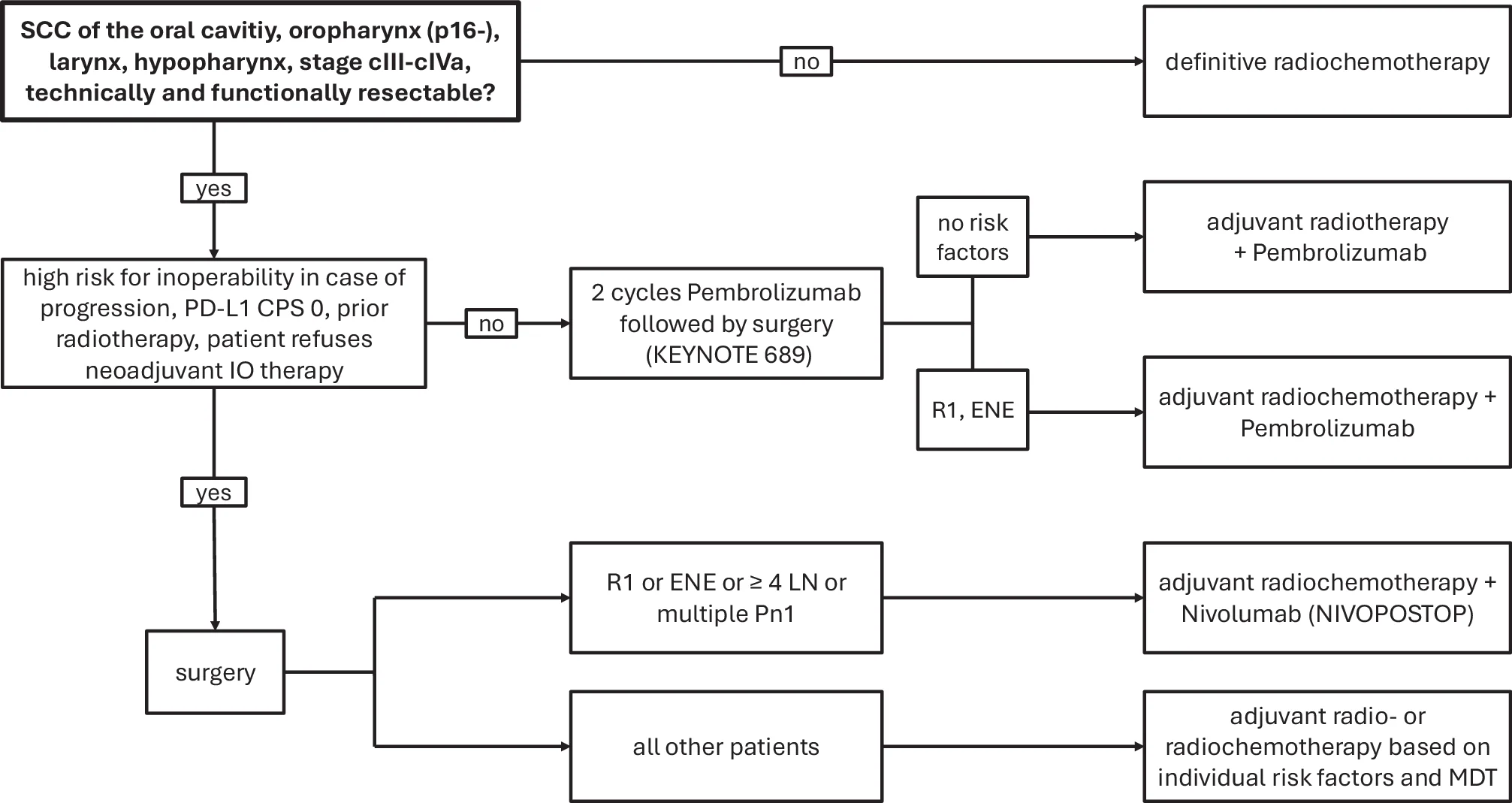
The KEYNOTE-689 trial demonstrated that perioperative pembrolizumab, administered before surgery and continued after surgery alongside standard adjuvant therapy, significantly improved event-free survival compared with standard treatment alone without compromising surgical timing or feasibility.
The NIVOPOSTOP trial showed that adding nivolumab to postoperative cisplatin-based chemoradiotherapy significantly improved disease-free survival in patients with high-risk resected disease.
Although overall survival data remain immature, both studies have demonstrated favorable trends, providing the first robust evidence that immunotherapy can improve outcomes in the curative setting of LA-HNSCC.
Which Patients Should Receive Perioperative Immunotherapy?
The consensus emphasizes that patient selection is critical.
The proposed algorithm applies to patients with resectable stage III–IVA disease involving:
- Oral cavity
- p16-negative oropharynx
- Larynx
- Hypopharynx
Patients with HPV-associated (p16-positive) oropharyngeal cancer are generally excluded because they are usually treated with definitive chemoradiotherapy rather than surgery, and these tumors were only minimally represented in the pivotal phase III trials.

10 ongoing Clinical Trials on Immunotherapy in Head and Neck cancer
PD-L1 Testing Becomes Essential
One of the most practical recommendations concerns biomarker testing.
Although KEYNOTE-689 enrolled patients regardless of PD-L1 status, very few had PD-L1–negative tumors. Furthermore, increasing clinical benefit was observed with higher PD-L1 Combined Positive Score (CPS).
For this reason, the Austrian consensus recommends perioperative immunotherapy only in patients with PD-L1 CPS ≥1, in line with current FDA and EMA approvals.
The authors therefore recommend obtaining PD-L1 CPS and p16 status from the initial diagnostic biopsy, allowing treatment decisions to be made early without delaying surgery.
Surgery Should Never Be Delayed
A central message throughout the paper is that immunotherapy must not compromise curative surgery.
Once the multidisciplinary team selects a perioperative approach, surgery should already be scheduled before neoadjuvant treatment begins. The consensus recommends performing surgery approximately 4–6 weeks after the first pembrolizumab dose, with continuous surgical assessment and repeat imaging to confirm that the tumor remains resectable throughout treatment.
When Should Patients Proceed Directly to Surgery?
Not every patient is an appropriate candidate for neoadjuvant immunotherapy.
The authors recommend immediate surgery for patients who have:
- contraindications to checkpoint inhibitors,
- previous head and neck radiotherapy preventing standard postoperative treatment,
- tumors at high risk of becoming unresectable if early progression occurs,
- or those who decline perioperative immunotherapy.
Following surgery, adjuvant treatment should continue to be determined according to established pathological risk factors, including positive surgical margins and extranodal extension.
Why This Consensus Matters
This publication is more than a summary of recent clinical trials. It provides one of the first detailed national frameworks for integrating perioperative immunotherapy into routine clinical practice.
The authors emphasize that successful implementation depends not only on selecting the right drug but also on multidisciplinary coordination, biomarker assessment, careful treatment sequencing, and strict adherence to surgical timelines.
As perioperative immunotherapy enters routine care, standardized treatment algorithms such as this may help ensure that patients receive the benefits observed in KEYNOTE-689 and NIVOPOSTOP while avoiding unnecessary delays or inappropriate patient selection.
Read Full Article Here