A randomized phase II trial published in Nature Medicine suggests that combining immune-modulating stereotactic body radiotherapy (iSBRT) with PD-L1 blockade may reshape the tumor microenvironment and improve pathological responses in patients with high-risk ER-positive, HER2-negative early breast cancer—particularly those with PD-L1-negative tumors.

10 ongoing Clinical Trials on Immunotherapy in Breast Cancer
Why This Study Matters
Approximately 70% of breast cancers are ER-positive/HER2-negative, yet this subtype has historically shown limited sensitivity to immune checkpoint inhibitors. Unlike triple-negative breast cancer, ER+/HER2− tumors are typically characterized by an immune-cold tumor microenvironment, with low levels of tumor-infiltrating lymphocytes (TILs) and limited PD-L1 expression, reducing the effectiveness of immunotherapy.
Previous phase III trials, including KEYNOTE-756 and CheckMate 7FL, demonstrated only modest improvements in pathological complete response (pCR) with checkpoint blockade in this population. The Neo-CheckRay investigators asked a different question: Could targeted radiotherapy reprogram immune-cold tumors into immune-responsive tumors?
The Biological Rationale
Radiotherapy is increasingly recognized as more than a local treatment. Beyond direct tumor cell killing, stereotactic body radiotherapy (SBRT) can induce immunogenic cell death, increase antigen presentation, enhance interferon signaling, and recruit immune cells into the tumor microenvironment.
However, radiation also activates compensatory immunosuppressive pathways, including CD73-mediated adenosine production, which may dampen antitumor immunity. Therefore, combining anti-PD-L1 therapy (durvalumab) with anti-CD73 therapy (oleclumab) could theoretically maximize immune activation while limiting adaptive immune resistance.
Study Design
Neo-CheckRay was a multicenter, randomized, open-label phase II trial enrolling 147 women with high-risk ER+/HER2− early breast cancer.
Patients were randomized to receive:
- iSBRT + neoadjuvant chemotherapy
- iSBRT + chemotherapy + durvalumab
- iSBRT + chemotherapy + durvalumab + oleclumab
All patients received three fractions of 8 Gy SBRT directed exclusively at the primary breast tumor before surgery. The study evaluated whether adding immunotherapy could improve pathological responses while simultaneously investigating dynamic changes within the tumor microenvironment.
Primary Endpoint
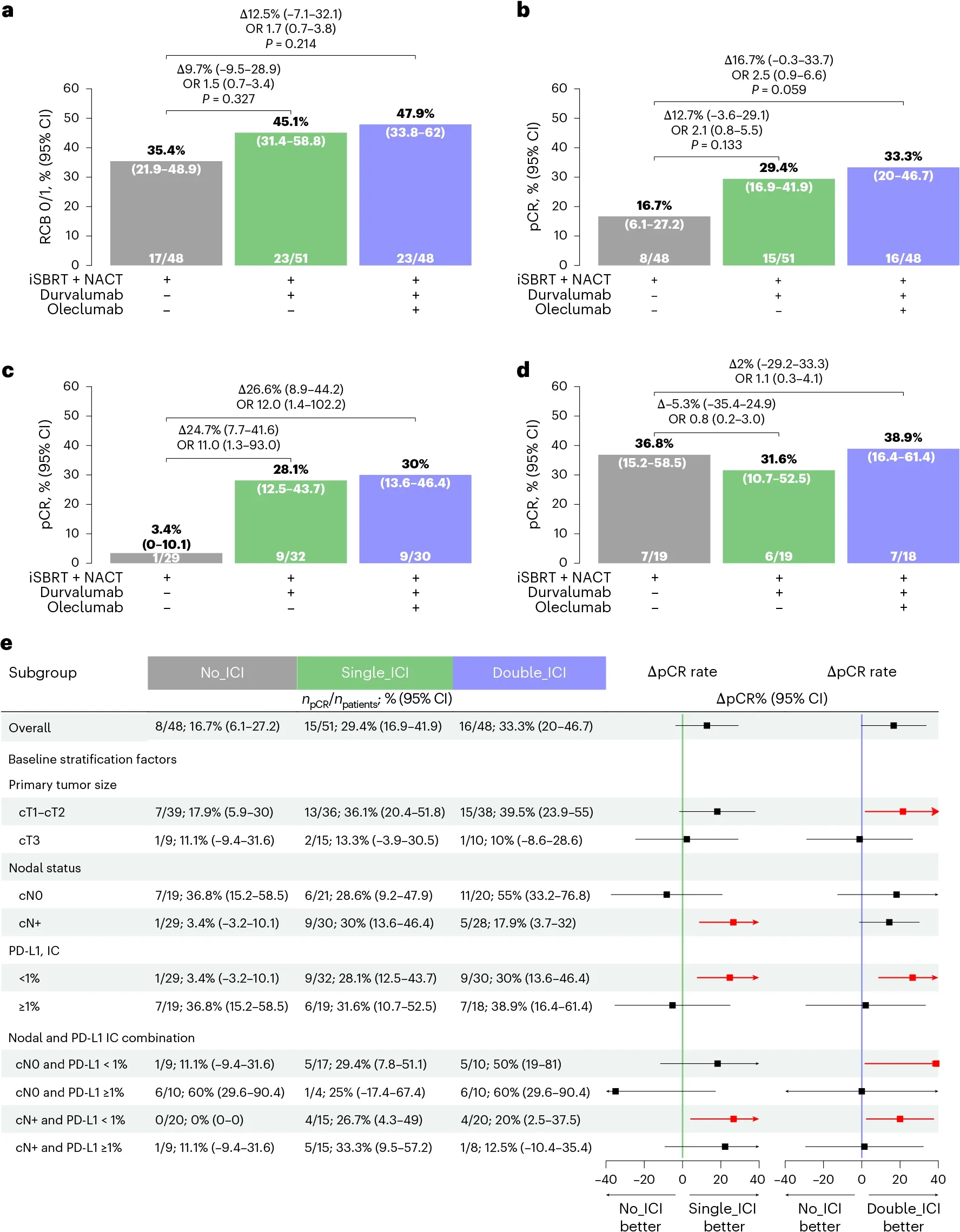
The primary endpoint was the Residual Cancer Burden (RCB) 0/1 rate at surgery.
Although numerically higher in both immunotherapy arms, the improvement did not reach statistical significance:
- 35.4% with iSBRT alone
- 45.1% with durvalumab
- 47.9% with durvalumab plus oleclumab
The difference between the control and dual-immunotherapy arms did not meet the predefined significance threshold.
Pathological Complete Response
The secondary endpoint showed a more encouraging signal.
Pathological complete response increased from 16.7% with iSBRT alone to:
- 29.4% with durvalumab
- 33.3% with durvalumab plus oleclumab
In the predefined MammaPrint High-Risk population, the improvement became statistically significant, with pCR increasing to 35.6% in the dual-immunotherapy arm.
The Most Interesting Finding: PD-L1-Negative Tumors
Perhaps the most striking observation emerged from patients whose tumors lacked PD-L1 expression.
Among PD-L1-negative tumors, pCR rates were:
- 3.4% with iSBRT alone
- 28.1% with durvalumab
- 30.0% with durvalumab plus oleclumab
Interestingly, this benefit was not observed in PD-L1-positive tumors, suggesting that radiotherapy may preferentially sensitize immunologically “cold” tumors to PD-L1 blockade rather than simply enhancing responses in already inflamed cancers.
Evidence of Tumor Microenvironment Reprogramming
One of the most compelling aspects of the Neo-CheckRay trial was its comprehensive translational research program, which included paired tumor biopsies obtained at baseline and again one week after stereotactic body radiotherapy. This unique design allowed investigators to directly observe how treatment altered the tumor immune microenvironment before surgery.
The analyses demonstrated that combining iSBRT with PD-L1 blockade induced profound immunologic changes, particularly in tumors that were initially PD-L1 negative. Transcriptomic profiling revealed activation of interferon signaling pathways, increased expression of the T-cell–recruiting chemokines CXCL9 and CXCL13, and expansion of effector T-cell programs. At the same time, tumors showed increased MHC class I expression, enhancing their capacity for antigen presentation, alongside upregulation of PD-L1, reflecting an adaptive immune response. Investigators also observed a reduction in stromal CD73 expression, suggesting attenuation of the immunosuppressive adenosine pathway.
Together, these findings provide compelling biological evidence that iSBRT can reprogram an immune-cold ER+/HER2− tumor microenvironment into a more inflamed and immunologically active state. This immune remodeling offers a plausible mechanistic explanation for the markedly improved pathological responses observed in patients with PD-L1-negative disease, indicating that radiotherapy may sensitize tumors that are traditionally considered poor candidates for immune checkpoint blockade.
Did CD73 Blockade Add Benefit?
Although oleclumab was included to inhibit the immunosuppressive adenosine pathway, adding anti-CD73 therapy did not produce a clear efficacy advantage over durvalumab alone.
While preclinical studies strongly supported this strategy, Neo-CheckRay suggests that further work is needed to identify which patients are most likely to benefit from CD73 inhibition.
Safety
No unexpected safety signals emerged.
Immune-related adverse events increased with checkpoint inhibition, as expected, while radiotherapy itself produced no grade ≥3 toxicities. The multimodal treatment remained feasible without compromising surgery or breast conservation rates.
Clinical Perspective
Neo-CheckRay does not immediately establish a new standard of care. The primary endpoint was not statistically met, and longer follow-up is needed to determine whether improved pathological responses translate into better event-free survival.
Nevertheless, the study provides compelling mechanistic evidence that local radiotherapy can reshape systemic antitumor immunity. Rather than using PD-L1 solely as a static predictive biomarker, Neo-CheckRay raises the possibility that tumor immunogenicity itself can be therapeutically modified.
If confirmed in larger trials, this strategy could redefine immunotherapy for ER+/HER2− breast cancer by demonstrating that immune-cold tumors are not necessarily immune-resistant—they may simply require immune priming before checkpoint blockade can achieve its full potential.
Read Full Article Here