
Title: Prediction of immunotherapy response using live tumor fragments from routine clinical biopsies
Authors: David Braun, Nicholas Dana, Hilary R. Hernan, Shalini Sahni, Christina M. Scribano, Christin Johnson, Lindsey Vedder, Erika von Euw, Julie Zweng, Ellen Wargowski, Aishwarya Sunil, Deepa Sharma, Josh Routh, Katherine Rexroad, Amreen Nasreen, Payton McDonnell, Victor Jergens, Catarina Costa, Richard Zuniga, Giuseppe V. Toia, Paras M. Patel, Stephanie McGregor, Robert C.G. Martin II, Umair Majeed, Debabrata Mukhopadhyay, Yanyan Lou, Nima Kokabi, James W. Jakub, David Hays, Andrew K. Godwin, Victoria Giffi, Alexander Gelbard, Andreas Friedl, Emma Kate Duimstra, Roxana S. Dronca, Ruqin Chen, Heather Chalfin, Santanu Bhattacharya, Barbara Broome, Hani M. Babiker, Tarun Chandra, Sean Caenepeel, Laura C.F. Hrycyniak, Chetan Sood, Hilario Ramos, Premal Patel, Pooja Advani, Hinco J. Gierman, Janis Taube.
Background
Immune checkpoint inhibitors have transformed the treatment of multiple solid tumors, but predicting which patients will benefit remains a major challenge. Current biomarkers, including PD-L1 expression, tumor mutational burden (TMB), mismatch repair (MMR) status, and microsatellite instability (MSI), provide clinically useful information in selected settings but have limited predictive accuracy.
One important limitation is that these biomarkers provide a largely static picture of the tumor before treatment. They do not directly measure how the living tumor microenvironment responds when exposed to immune checkpoint blockade.
Functional ex vivo testing offers a different strategy: preserve live tumor tissue, expose it to an immune checkpoint inhibitor, and measure the resulting immune response. Previous live tumor fragment approaches have shown promise but often required large surgical specimens and specialized processing, limiting their scalability.
This study evaluated whether a functional assay using routine core needle and forceps biopsies could predict response to immune checkpoint inhibitors.
Methods
Fresh tumor tissue was collected from 228 patients with suspected malignancies across prospective multicenter observational studies.
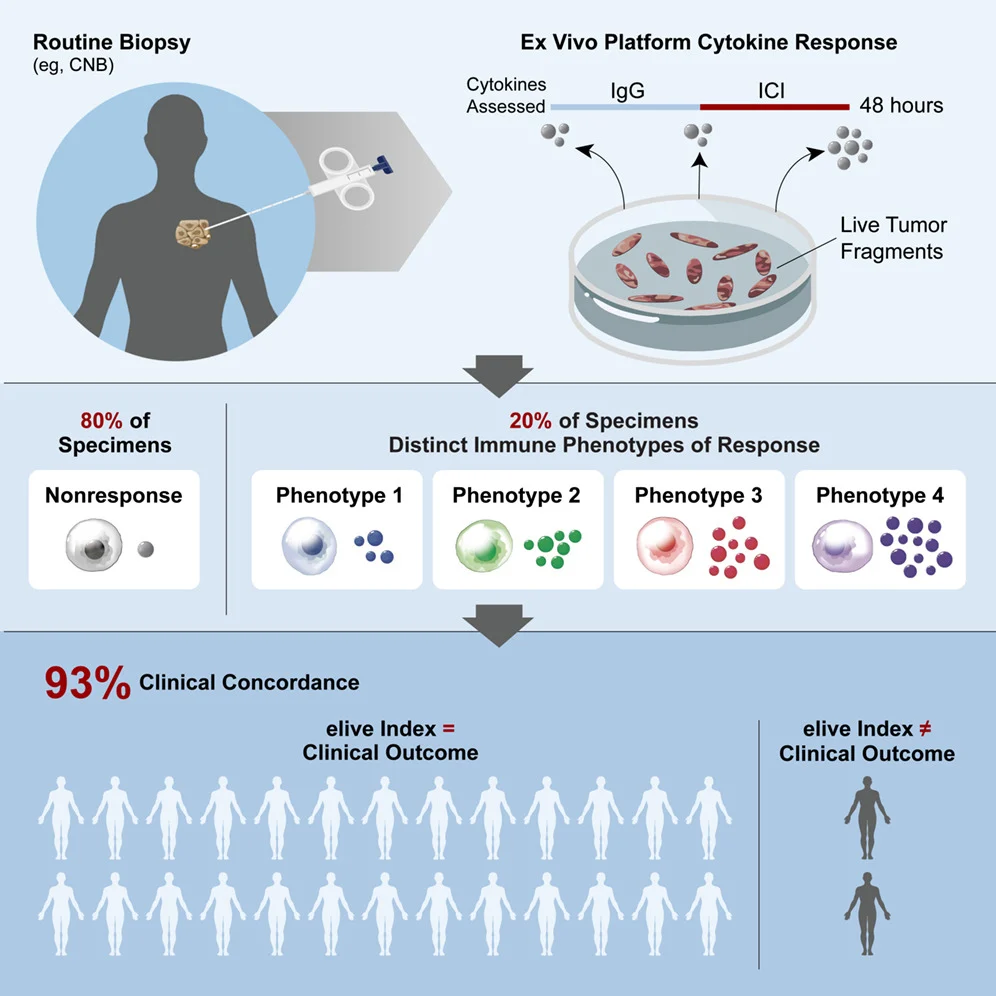
The platform generated live tumor fragments from standard-of-care core needle or forceps biopsies while preserving components of the native tumor microenvironment. Tumor fragments were sequentially exposed to an IgG control followed by immune checkpoint inhibition, and changes in cytokine secretion were measured to assess treatment-induced immune activity.
Unsupervised hierarchical clustering of cytokine responses identified two major groups: a cytokine-response cluster and a nonresponse cluster. The responding samples showed induction of immune activation markers including IFN-γ and CXCL10.
Investigators subsequently developed an eight-cytokine classifier, the elive index, incorporating:
IFN-γ, CCL22, CXCL10, lymphotoxin-α, TNF-α, CCL17, granzyme B, and IL-10.
Study Design
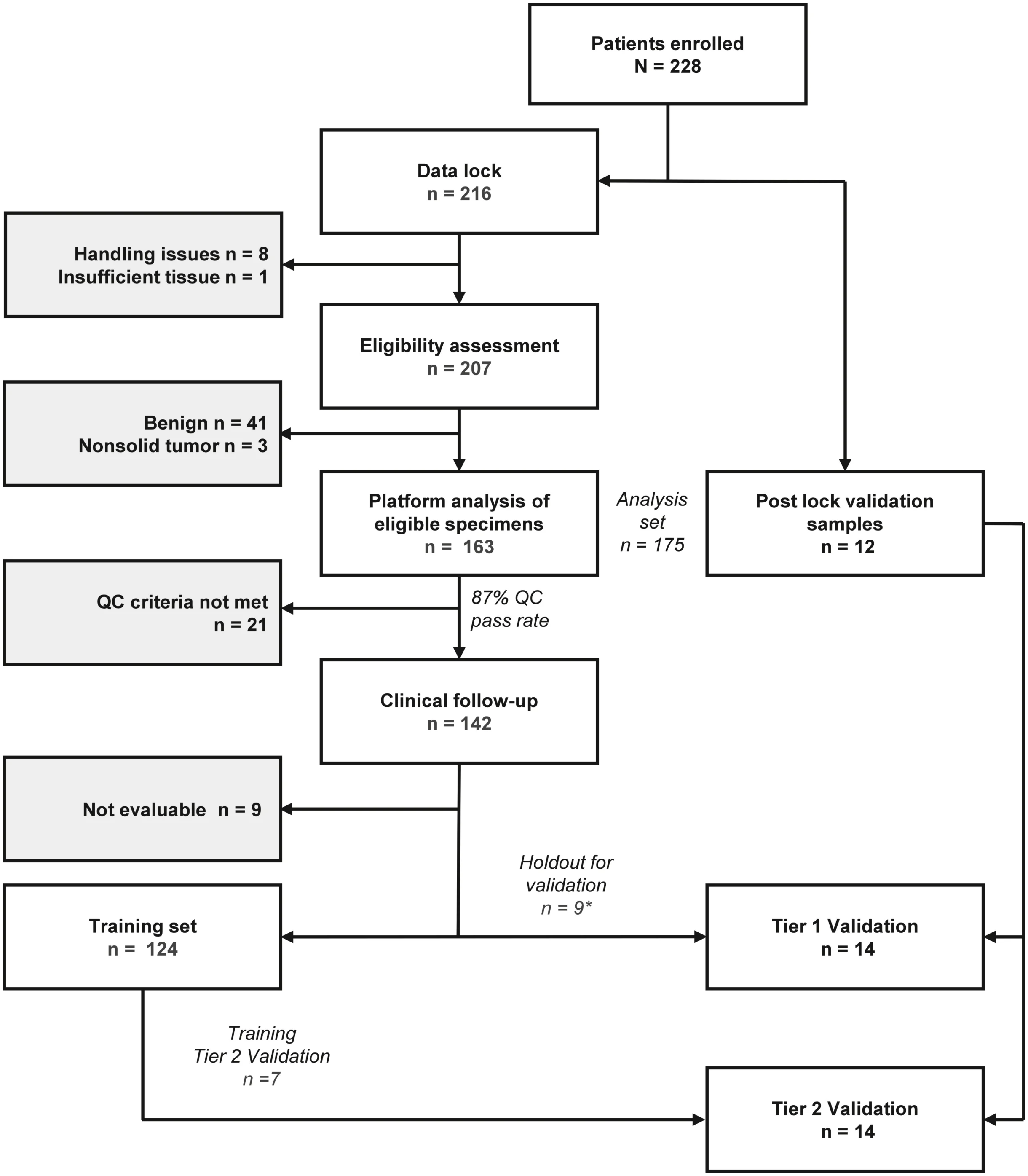
Of the specimens processed on the platform, 124 patients were included in development of the elive index.
Clinical validation was subsequently performed in 28 patients divided into two 14-patient validation cohorts. Patients represented multiple solid tumor types and received different ICI-containing treatment regimens.
NSCLC was the most frequently represented malignancy in the broader analysis population, accounting for 40% of patients. Other cancers included kidney, head and neck, bladder, skin, triple-negative breast, hepatobiliary, colorectal, and endometrial cancers.
Results
The elive index achieved an AUROC of 0.99 for distinguishing the ex vivo cytokine-defined response and nonresponse clusters. It correctly classified 96.2% of samples, with a sensitivity of 0.90 and specificity of 0.98 for predicting cluster assignment.
Importantly, this AUC reflects prediction of the ex vivo cytokine cluster, rather than prediction of clinical response.
When the assay was evaluated against clinical outcomes in the 28-patient validation cohort, the elive index was concordant with disease control in 26 of 28 patients (93%).
All 17 patients classified as elive responders achieved disease control with ICI-containing therapy. Clinical outcomes included complete responses, pathological complete responses, partial responses, and stable disease.
Among the 11 predicted nonresponders, 9 (82%) experienced progressive disease, with most progressing within the first four months of treatment.
The assay also identified 10 of 12 objective responders (83%).
What Happened in Biomarker-Negative Tumors?
One of the most interesting findings was the discordance between functional testing and established ICI biomarkers.
Across specimens with available biomarker information, there was 44% discordance between conventional biomarker status and the elive index.
Notably, 15% of patients were negative by established ICI biomarkers but classified as elive responders, suggesting that functional profiling may identify potentially responsive tumors that could be missed by conventional biomarker strategies.
The findings do not demonstrate that the elive index should replace PD-L1, TMB, MSI, or MMR testing. Instead, they raise the possibility that functional testing could eventually complement existing biomarkers by directly measuring treatment-induced immune activity.
Clinical Feasibility
A particularly relevant feature of the platform is its compatibility with routine clinical biopsies rather than large surgical specimens.
The assay can be performed using core needle and forceps biopsies, and the experimental workflow can be completed within approximately 48 hours. More than 200 specimens from geographically distributed clinical sites were processed, with a quality-control pass rate above 87%.
However, the assay requires fresh viable tissue and cannot be performed on standard formalin-fixed, paraffin-embedded specimens.
Key Findings
- A functional ex vivo assay was successfully performed using routine clinical tumor biopsies.
- The eight-cytokine elive index showed 93% concordance with disease control in 28 validation patients.
- The assay identified 83% of objective responders.
- Functional testing showed substantial discordance with established ICI biomarkers.
- Some biomarker-negative tumors were classified as functional responders.
- The platform can potentially provide results within a clinically relevant timeframe using routine biopsy material.
Limitations
The clinical validation cohort included only 28 patients and was heterogeneous in tumor type, treatment regimen, line of therapy, and biopsy site.
Many patients received ICIs in combination with chemotherapy, targeted therapy, or other immunomodulatory agents, making it difficult to isolate the contribution of checkpoint inhibition to the observed clinical outcome.
The elive index was also developed from ex vivo molecular response patterns rather than clinical outcomes, and the study was observational rather than a prospective biomarker-guided treatment trial. Larger tumor-specific prospective studies will therefore be required before the assay can be considered a clinically validated predictive biomarker.
Conclusion
This study introduces a different approach to immunotherapy biomarker development: instead of relying exclusively on static molecular or histological characteristics, it asks whether the living tumor microenvironment functionally responds when exposed to checkpoint blockade.
The 93% concordance with disease control in the small validation cohort is encouraging, particularly because functional responders were identified among patients negative for established ICI biomarkers. However, these results remain hypothesis-generating and require prospective validation in larger, tumor-specific cohorts.
If validated, functional ex vivo testing could complement PD-L1, TMB, and MSI/MMR by adding another layer to precision immuno-oncology: measuring what the tumor–immune ecosystem actually does in response to treatment, rather than predicting that response from baseline characteristics alone.
Read the full paper