
The addition of immune checkpoint inhibition to gemcitabine and cisplatin has changed first-line treatment for advanced biliary tract cancer (BTC). Longer follow-up from the phase III KEYNOTE-966 trial now shows that the survival benefit established with pembrolizumab is maintained after approximately three years, without new safety signals.
The update also provides a more nuanced view of how pembrolizumab contributes to disease control. Objective response rates were identical with and without pembrolizumab, yet responses were more durable in the immunotherapy arm. This divergence between response frequency and response duration may be one of the most informative observations from the extended analysis.
From the Primary Analysis to Longer-Term Follow-Up
KEYNOTE-966 was a global, randomized, double-blind phase III trial that enrolled 1,069 patients with previously untreated unresectable locally advanced or metastatic biliary tract cancer, including intrahepatic and extrahepatic cholangiocarcinoma and gallbladder cancer.
Patients received pembrolizumab 200 mg every three weeks or placebo in combination with gemcitabine 1,000 mg/m² and cisplatin 25 mg/m² on days 1 and 8 of each three-week cycle. Pembrolizumab or placebo could continue for up to 35 cycles, cisplatin was limited to eight cycles, while gemcitabine could continue until progression or unacceptable toxicity.
At the protocol-specified final analysis, with a median follow-up of 25.6 months, KEYNOTE-966 met its primary endpoint. Median overall survival was 12.7 months with pembrolizumab plus gemcitabine/cisplatin compared with 10.9 months with chemotherapy alone, corresponding to an HR of 0.83 (95% CI 0.72–0.95; p=0.0034).
The new analysis extends median follow-up to 36.6 months, providing approximately 11 additional months of observation.
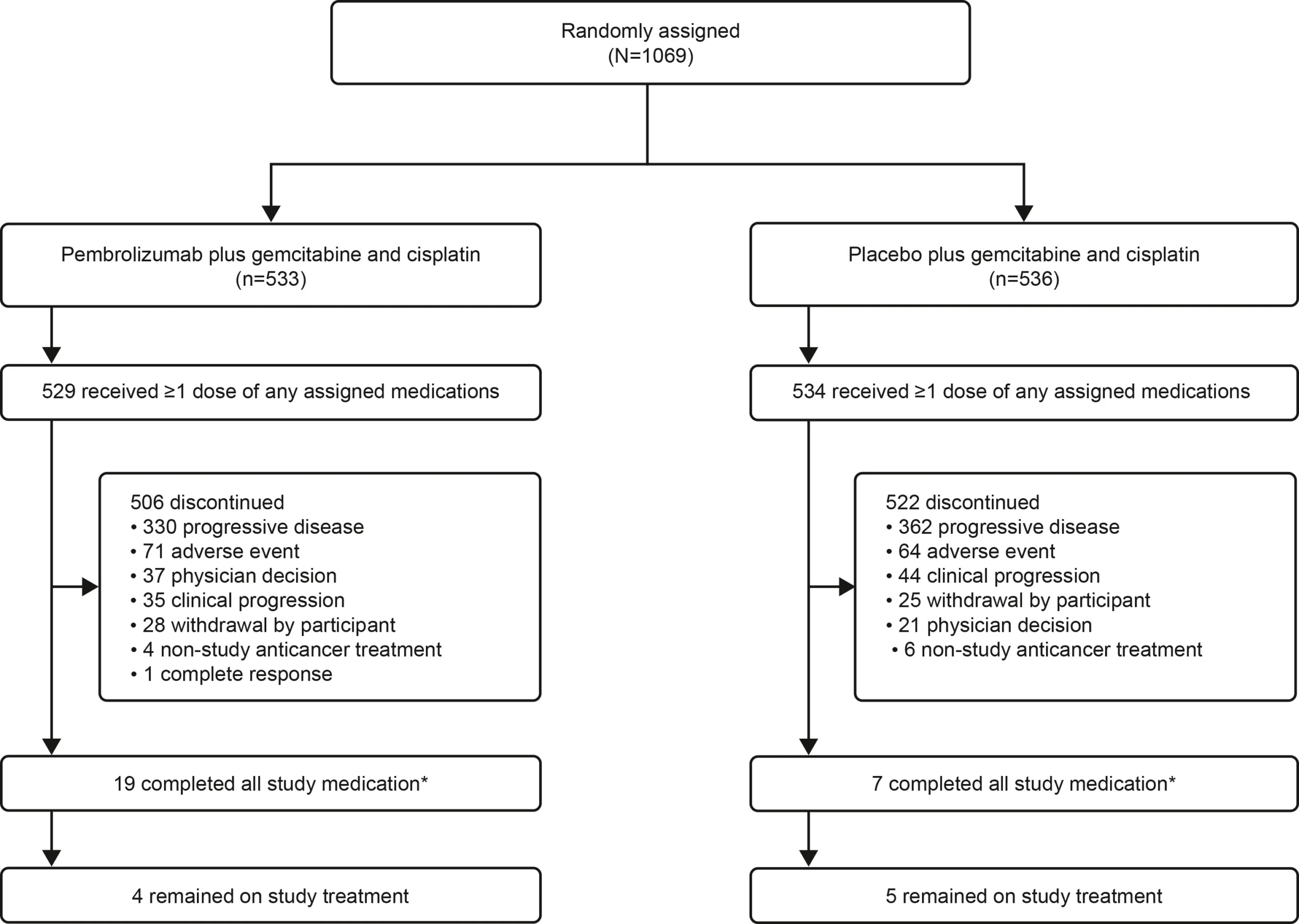
The Overall Survival Benefit Persists
With longer follow-up, median OS remained 12.7 months with pembrolizumab versus 10.9 months with placebo, with an updated HR of 0.86 (95% CI 0.75–0.98).
At two years, estimated OS was 25% with pembrolizumab and 19% with placebo. At three years, the corresponding estimates were 13% and 11%. The OS effect remained generally consistent across most prespecified subgroups.
These results should be interpreted as confirmation of durability rather than a new efficacy test. Because KEYNOTE-966 had already met its primary OS endpoint at the protocol-specified final analysis, no alpha was allocated to the updated analysis and no additional formal hypothesis testing was performed. The longer-term analyses are therefore descriptive and exploratory.
That statistical distinction matters. The new publication does not establish a larger treatment effect than previously reported; it shows that the previously demonstrated survival advantage has not disappeared with additional follow-up.
Same Response Rate, Different Response Durability
Perhaps the most interesting finding emerges when response rate and response duration are considered together.
The objective response rate was 28.7% in both arms. Disease control rates were similarly close: 74.9% with pembrolizumab and 75.6% with placebo. Pembrolizumab therefore did not increase the overall proportion of patients achieving radiographic tumor shrinkage.
The duration of those responses, however, differed.
Median duration of response was 8.3 months with pembrolizumab versus 6.9 months with placebo. At 12 months, 38% of responders in the pembrolizumab arm were estimated to remain in response compared with 29% in the control arm. At 24 months, the difference was 18% versus 7%.
This pattern should not be interpreted as proof of a specific immunological mechanism. Nevertheless, it provides a clinically relevant distinction: the contribution of pembrolizumab was not reflected in a higher probability of initial objective response, but longer disease control among responders contributed another dimension to the treatment effect.
The investigators also note that more patients in the pembrolizumab arm completed all 35 cycles, approximately two years, of study treatment during extended follow-up, whereas no corresponding increase occurred in the placebo group.
PFS: A Signal That Requires Statistical Context
Median progression-free survival was 6.5 months with pembrolizumab and 5.6 months with placebo, with an updated HR of 0.85 (95% CI 0.75–0.97). Estimated 24-month PFS was 10% versus 6%, respectively.
The confidence interval in the updated analysis should not be mistaken for a new positive statistical test. PFS superiority did not meet its prespecified statistical significance criterion at the original final analysis, and the current update is exploratory.
There is also a clinical complication specific to BTC. The investigators note that progression may be influenced by factors not fully represented by RECIST 1.1, including biliary obstruction, deterioration in liver function, and changes in CA19-9. Radiographic PFS alone may therefore incompletely capture clinical progression in this disease.
For that reason, the mature OS result remains the more important evidence supporting the treatment strategy.
Does KEYNOTE-966 Show an Immunotherapy “Long Tail”?
Longer follow-up naturally raises the question of whether a subgroup of patients is achieving unusually prolonged survival.
Approximately 15% of participants across both treatment groups remained alive beyond three years. However, the investigators specifically caution against overinterpreting the later portions of the Kaplan–Meier curves because relatively few patients remain at risk. Although the curves appear to converge at later time points, the resulting estimates become increasingly imprecise.
Therefore, KEYNOTE-966 should not be used to claim that pembrolizumab has established a clear late survival plateau in BTC.
The observation nevertheless raises an important translational question. The study did not specifically investigate the biological characteristics of long-term survivors, and the authors note that factors such as underlying tumor biology, molecular characteristics, disease burden, subsequent treatment, and patient characteristics could contribute.
Identifying those factors may ultimately be more informative than focusing only on the average survival improvement across the entire trial population.
Biomarkers Remain an Unresolved Part of the Story
KEYNOTE-966 demonstrated a population-level OS benefit without selecting patients according to an established immunotherapy biomarker.
Only approximately 1% of patients were MSI-high, while around 80% had microsatellite-stable disease. PD-L1 CPS ≥1 was present in 68% of patients in each treatment group.
The study therefore supports pembrolizumab-based treatment across a broadly selected advanced BTC population rather than limiting the strategy to the small MSI-high subgroup.
But the longer-term data make the biomarker question more interesting, not less. If the overall response rate is unchanged while a subset of responses becomes considerably more durable, conventional measures such as early tumor shrinkage may be insufficient to identify the patients receiving the greatest benefit from checkpoint blockade.
Future translational analyses will need to determine whether molecular subtype, immune contexture, genomic alterations, circulating biomarkers, or combinations of these factors can identify patients more likely to experience durable disease control.
Safety Remains Stable With Longer Observation
No new safety signal emerged with extended follow-up.
Grade 3–4 treatment-related adverse events occurred in 70% of patients receiving pembrolizumab plus chemotherapy and 69% receiving placebo plus chemotherapy. Neutrophil count decrease and anemia remained among the most common treatment-related events, reflecting the substantial toxicity contribution of the chemotherapy backbone.
As expected, immune-mediated adverse events and infusion reactions were more frequent with pembrolizumab: 25% versus 15% overall and 8% versus 4% for grade 3–4 events. Hypothyroidism occurred in 9% versus 3%, while pneumonitis occurred in 5% versus 2%. No additional treatment-related deaths were reported in the pembrolizumab group after the previous final analysis.
Previously reported health-related quality-of-life analyses also found no clinically meaningful deterioration associated with adding pembrolizumab, although the investigators emphasize that no new patient-reported outcome data were collected during this extended follow-up.
10 Gastroesophageal Cancer Trials to Watch at ESMO 2026
KEYNOTE-966 and TOPAZ-1: Complementary Evidence, Not a Head-to-Head Comparison
The longer-term KEYNOTE-966 results reinforce a treatment landscape already shaped by TOPAZ-1, which established durvalumab plus gemcitabine/cisplatin as another first-line chemoimmunotherapy strategy in advanced BTC.
Updated TOPAZ-1 data cited in the KEYNOTE-966 publication showed median OS of 12.9 months with durvalumab plus gemcitabine/cisplatin versus 11.3 months with chemotherapy alone, with an HR of 0.74 after a median follow-up of 41.3 months.
The numerical hazard ratios from KEYNOTE-966 and TOPAZ-1 should not be used to infer superiority of one checkpoint inhibitor over another. The studies enrolled different populations and differed in treatment delivery and other design characteristics. Notably, gemcitabine was limited to eight cycles in TOPAZ-1 but could continue until progression or unacceptable toxicity in KEYNOTE-966. KEYNOTE-966 also enrolled 1,069 patients compared with 685 in TOPAZ-1 and included a larger non-Asian population.
Together, the trials provide independent phase III evidence that adding PD-1/PD-L1 blockade to gemcitabine/cisplatin improves outcomes in previously untreated advanced BTC. They do not establish whether pembrolizumab or durvalumab is the preferable checkpoint inhibitor.
Read Full Article Here