
Autologous chimeric antigen receptor (CAR) T-cell therapy produces durable remissions in B-cell malignancies, yet most medically eligible patients never receive it. The rate-limiting steps are structural rather than biological: apheresis, centralized manufacturing, vein-to-vein intervals measured in weeks, lymphodepleting chemotherapy, and a cost base that few healthcare systems can absorb at scale.
In vivo CAR-T has emerged as a fundamentally different approach. Instead of collecting a patient’s immune cells, genetically modifying them outside the body, and reinfusing them, the CAR transgene is delivered directly to circulating immune cells, allowing cellular reprogramming to occur inside the patient. In principle, this converts a bespoke manufactured cell product into an off-the-shelf infused biologic.
Between 2024 and mid-2026, the field moved from concept to early human data. Two architectures now dominate: surface-engineered lentiviral particles that integrate a CAR cassette into T cells, and targeted lipid nanoparticles carrying linear or circular RNA that generate transient CAR expression without genomic modification.
Early Phase 1 datasets across both approaches have demonstrated objective responses without lymphodepleting chemotherapy. However, the emerging safety profile is neither uniformly benign nor easily generalized across platforms. At the same time, substantial pharmaceutical investment has accelerated development, while machine learning is increasingly being incorporated into ionizable lipid discovery, targeting-ligand design, payload engineering, and translational prediction.
This review examines the emerging clinical evidence, unresolved safety and control questions, commercial landscape, and growing role of artificial intelligence across the in vivo CAR-T value chain.
Introduction: Why In Vivo CAR-T?
Six autologous CAR-T products are currently approved across large B-cell lymphoma, follicular lymphoma, mantle cell lymphoma, acute lymphoblastic leukemia, and multiple myeloma. Their clinical value is established. Their delivery model, however, remains challenging.
Each treatment requires leukapheresis, cryopreserved shipment to a licensed manufacturing facility, viral transduction and expansion under GMP conditions, release testing, return shipment, and administration at an accredited center after conditioning chemotherapy. Manufacturing slots, product failure in heavily pretreated patients, patient deterioration during the waiting period, and prices in the mid-six-figure range each independently restrict access.
In vivo CAR-T reverses this sequence. Rather than removing lymphocytes, modifying them outside the body, and returning them to the patient, the engineering reagent itself is administered and cellular reprogramming occurs in situ. What arrives at the pharmacy is therefore a vialed biologic with a defined shelf life rather than an individualized cell product requiring a patient-specific chain of identity.
The potential advantages are substantial: no apheresis, no centralized manufacturing slot, no cryogenic chain, and—in principle—administration in any center capable of managing immune-related toxicities. Some platforms may also permit repeat dosing.
However, this simplification introduces a different challenge. With conventional CAR-T, the final cellular product can be tested before infusion. With in vivo CAR-T, transduction efficiency, cell-type specificity, vector copy number, and subsequent cellular expansion are determined inside the patient and can only be assessed after administration.
The field is therefore trading manufacturing complexity for pharmacological uncertainty. Whether that trade proves favorable will depend on the safety, control, durability, scalability, and clinical efficacy of the emerging platforms.
The Two Main In Vivo CAR-T Architectures
Targeted Lipid Nanoparticles With RNA Payloads
The non-viral branch of in vivo CAR-T uses messenger RNA or circular RNA encoding a CAR, packaged within a lipid nanoparticle whose surface is engineered to recognize a specific lymphocyte marker.
Building on earlier demonstrations that CD5- and CD4-targeted lipid nanoparticles can transfect T cells in vivo, Capstan Therapeutics developed one of the most clinically advanced approaches in this category. Its platform uses a targeted lipid nanoparticle carrying an anti-CD19 CAR mRNA and an anti-CD8 targeting binder, together with hepatic de-targeting intended to divert the payload away from the liver.
Preclinical studies demonstrated CAR expression restricted to CD8-positive T cells, rapid B-cell clearance from blood and tissues in humanized models, and subsequent repopulation dominated by naïve B cells in non-human primates.
A defining feature of RNA-based in vivo CAR-T is transience. Because RNA does not integrate into the genome, CAR expression rises and then declines over a period of days.
This provides two potential advantages. First, toxicity may be more self-limiting and dose-titratable. Second, insertional mutagenesis and secondary T-cell malignancy risks associated with genomic integration are avoided by design.
However, transient expression also changes the therapeutic objective. Instead of establishing persistent CAR-T surveillance, treatment may create a defined period of B-cell depletion followed by immune reconstitution. This is particularly attractive in autoimmune disease, where the goal may be an immune “reset” rather than lifelong tumor surveillance.
Orbital Therapeutics and Orna Therapeutics have extended this concept through circular RNA platforms. The covalently closed RNA structure is intended to resist exonuclease degradation and may sustain translation longer than conventional linear mRNA.
Surface-Engineered Lentiviral Particles
The second major architecture uses integrating lentiviral vectors.
Rather than relying on conventional lentiviral tropism, these particles are engineered so that their envelopes preferentially target lymphocytes and simultaneously provide the activation signals necessary for transduction.
Umoja Biopharma’s VivoVec platform, for example, combines a fusion glycoprotein with a membrane-anchored multidomain fusion protein containing CD58, CD80, and an anti-CD3 single-chain fragment. Binding, costimulation, and transduction can therefore occur during the same interaction.
Its transgene combines an anti-CD19 CAR with a rapamycin-activated cytokine receptor designed to provide pharmacological control over subsequent engineered-cell expansion.
Interius BioTherapeutics has taken a different approach, using an anti-CD7 targeting binder to deliver a CD20 CAR into both T cells and natural killer cells, potentially generating mixed CAR-T and CAR-NK populations after a single infusion.
Integration offers an obvious advantage: durability. A single administration may establish a persistent, potentially self-renewing population of engineered immune cells.
But durability also creates corresponding liabilities. Integration is irreversible, introduces integration-site risk, may complicate repeat administration through anti-vector immunity, and carries the long-term regulatory obligations associated with integrating gene therapies.
Choosing the Effector Cell: T Cells, NK Cells, or Myeloid Cells?
T cells are not the only possible target.
Most current programs engineer T cells either broadly or within selected compartments such as CD8-positive cells. CREATE Medicines, formerly Myeloid Therapeutics, has instead explored direct programming of myeloid cells.
Its approach uses a CD89-fused construct designed so that a functional receptor assembles selectively in cells expressing the appropriate Fc receptor gamma signaling subunit.
This strategy is particularly relevant to solid tumors, where abundant myeloid infiltration and T-cell exclusion represent major barriers to conventional cellular immunotherapy.
The broader implication is that in vivo cell engineering may eventually extend beyond reproducing conventional CAR-T inside the patient. Different immune-cell populations could potentially be programmed according to the biology and immune architecture of individual tumors.
The Emerging Clinical Evidence
The clinical evidence remains early. Cohorts are small, follow-up is limited, and much of the available evidence comes from company disclosures and congress presentations.
Nevertheless, several programs have now provided the first evidence that therapeutically active CAR-engineered immune cells can be generated directly inside patients.
Integrating In Vivo CAR-T in Hematologic Malignancies
The most mature efficacy signals to date come from lentiviral programs targeting hematologic cancers.
Kelonia’s anti-BCMA candidate KLN-1010 has generated one of the largest disclosed datasets. At ASCO 2026, 18 patients with relapsed or refractory multiple myeloma had been treated.
The sponsor reported objective responses and marrow MRD negativity at one month in all evaluable patients, although the denominator of evaluable patients was not disclosed in the sponsor release. The first treated patient remained in an ongoing MRD-negative response beyond 10 months.
Importantly, treatment was administered without lymphodepleting conditioning.
Safety findings included infusion-related reactions in 78% of patients and cytokine release syndrome in 83%. Grade 3 CRS occurred in 17%, with no grade 4 or 5 CRS reported. Two dose-limiting toxicities were described, including one grade 3 CRS event and one case of grade 4 thrombocytopenia lasting more than seven days. One grade 1 ICANS event was reported, with no treatment-related deaths.
Legend Biotech’s LB2501, a dual CD19/CD20-targeting in vivo CAR, has also produced encouraging early results in relapsed or refractory B-cell non-Hodgkin lymphoma.
Among 12 treated patients, the higher-dose cohort achieved:
- Objective response rate: 100% (6/6)
- Complete response rate: 83.3% (5/6)
All responses were ongoing at the April 2026 cutoff, although median follow-up was only 2.2 months.
No dose-limiting toxicities, serious adverse events, ICANS, or deaths were reported. Infusion-related reactions occurred in 75% and cytokine release syndrome in 66.7%, but all events were grade 2 or lower and none required glucocorticoids.
Engineered CAR-T cells remained detectable for as long as 116 days in the longest-followed patient after a single infusion without lymphodepletion.
The dual-antigen design is also clinically relevant because targeting both CD19 and CD20 could potentially reduce antigen escape, one of the recognized mechanisms of relapse following CD19-directed cellular therapy.
Non-Integrating CAR-T and the Emerging Autoimmune Opportunity
RNA-based platforms have increasingly concentrated on B-cell-mediated autoimmune diseases.
The therapeutic objective differs from oncology. Instead of requiring years of persistent tumor surveillance, autoimmune treatment may require a sufficiently deep but temporary period of B-cell depletion followed by immune reconstitution.
Capstan’s CPTX2309, subsequently designated ABBV-619 following AbbVie’s acquisition of Capstan, entered Phase 1 testing in healthy volunteers. The study uses peripheral B-cell depletion and recovery as pharmacodynamic endpoints and does not require lymphodepletion or permanent genomic modification.
Early clinical proof of concept for the broader RNA architecture has also emerged independently. In five patients with refractory systemic lupus erythematosus, including four with lupus nephritis, a CD8-targeted lipid nanoparticle delivering CD19 CAR mRNA was administered intravenously without lymphodepletion.
CAR-positive CD8 T cells were generated in vivo, circulating B cells were depleted, and disease activity decreased, without reported neurotoxicity or severe adverse events.
Programming Myeloid Cells Inside the Patient
CREATE Medicines is exploring a different strategy for solid tumors.
Rather than forcing conventional CAR-T cells into tumors where T-cell infiltration is poor, its platform attempts to reprogram myeloid cells that naturally populate the tumor microenvironment.
Here, the evidence is currently mechanistic rather than efficacy-based.
Single-cell sequencing of on-treatment biopsies demonstrated CAR expression restricted to myeloid cells after systemic administration, accompanied by increased pro-inflammatory transcriptional signatures within the tumor. Repeat RNA-LNP administration was also reported to be feasible.
The program has subsequently moved into frontline hepatocellular carcinoma in combination with atezolizumab and bevacizumab.
Whether myeloid reprogramming will ultimately translate into meaningful tumor control remains unknown. Nevertheless, demonstrating that a systemically administered RNA-LNP can alter the human tumor microenvironment represents an important proof of biological activity.
Safety and Control: The Central Challenge
The promise of eliminating ex vivo manufacturing does not eliminate the biological risks of CAR-T therapy—and may introduce new ones.
One of the most important cautionary datasets comes from ESO-T01, a BCMA-directed lentiviral candidate.
Among five treated patients, four achieved objective responses, including three stringent complete remissions. All evaluable responders were MRD-negative by day 60.
However:
- Grade ≥3 adverse events occurred in all five patients
- Cytokine release syndrome occurred in four patients
- Grade 3 CRS occurred in three patients
- One patient died on study on day 19 from spinal cord compression caused by an extramedullary myeloma lesion
An especially important observation was the timing of inflammatory activation. An inflammatory surge appeared within 24 hours of infusion, before engineered CAR-T cells were detectable.
This raises the possibility that, in this program, early inflammation was driven by the vector particle itself rather than by subsequent CAR-T expansion.
However, this finding should not automatically be interpreted as a class effect.
Legend’s lentiviral program reported no serious adverse events in its 12-patient dataset, together with rapid vector clearance and no evidence of nonspecific transduction. The platforms differ in vector design, envelope, dose, antigen, and patient population, making direct comparisons inappropriate.
These contrasting datasets demonstrate that the innate immune response to systemically administered vectors is likely to become a central design variable for in vivo CAR-T rather than a secondary tolerability issue.
The In Vivo Equivalent of Release Testing
In vivo CAR-T introduces a fundamental manufacturing and regulatory question.
With conventional CAR-T, the final cellular product can be characterized before infusion for identity, purity, potency, and vector copy number.
With in vivo CAR-T, the engineered cellular product does not exist until after the patient has been treated.
The vector or nanoparticle can undergo conventional manufacturing release testing, but the resulting CAR-positive immune-cell population cannot be characterized beforehand.
Regulators may therefore eventually require pharmacodynamic measures that function as an in vivo equivalent of product release testing—potentially incorporating engineered-cell frequency, vector copy number, cellular expansion, and depth of target-cell depletion.
Dose control is similarly different. Ex vivo CAR-T specifies the number of CAR-positive cells administered. In vivo therapy specifies the amount of vector or nanoparticle administered, while the number of engineered effector cells that ultimately emerges becomes a biological output influenced by lymphocyte count, activation state, disease burden, and prior therapy.
The Comparator Is Not Only Autologous CAR-T
In vivo CAR-T is often presented as a solution to the logistical limitations of autologous CAR-T. But approved bispecific T-cell engagers are already off-the-shelf, can be administered without lymphodepletion, and are supported by randomized clinical evidence in multiple hematologic malignancies.
The question is therefore not simply whether in vivo CAR-T is easier to deliver than autologous CAR-T.
It may ultimately need to demonstrate deeper or more durable responses than bispecific antibodies, a substantially lower treatment and monitoring burden, or both.
The potential distinction between a single in vivo CAR-T administration and prolonged or continuous bispecific-antibody dosing may become particularly important.
The Commercial Landscape
Scientific progress has been accompanied by substantial pharmaceutical investment.
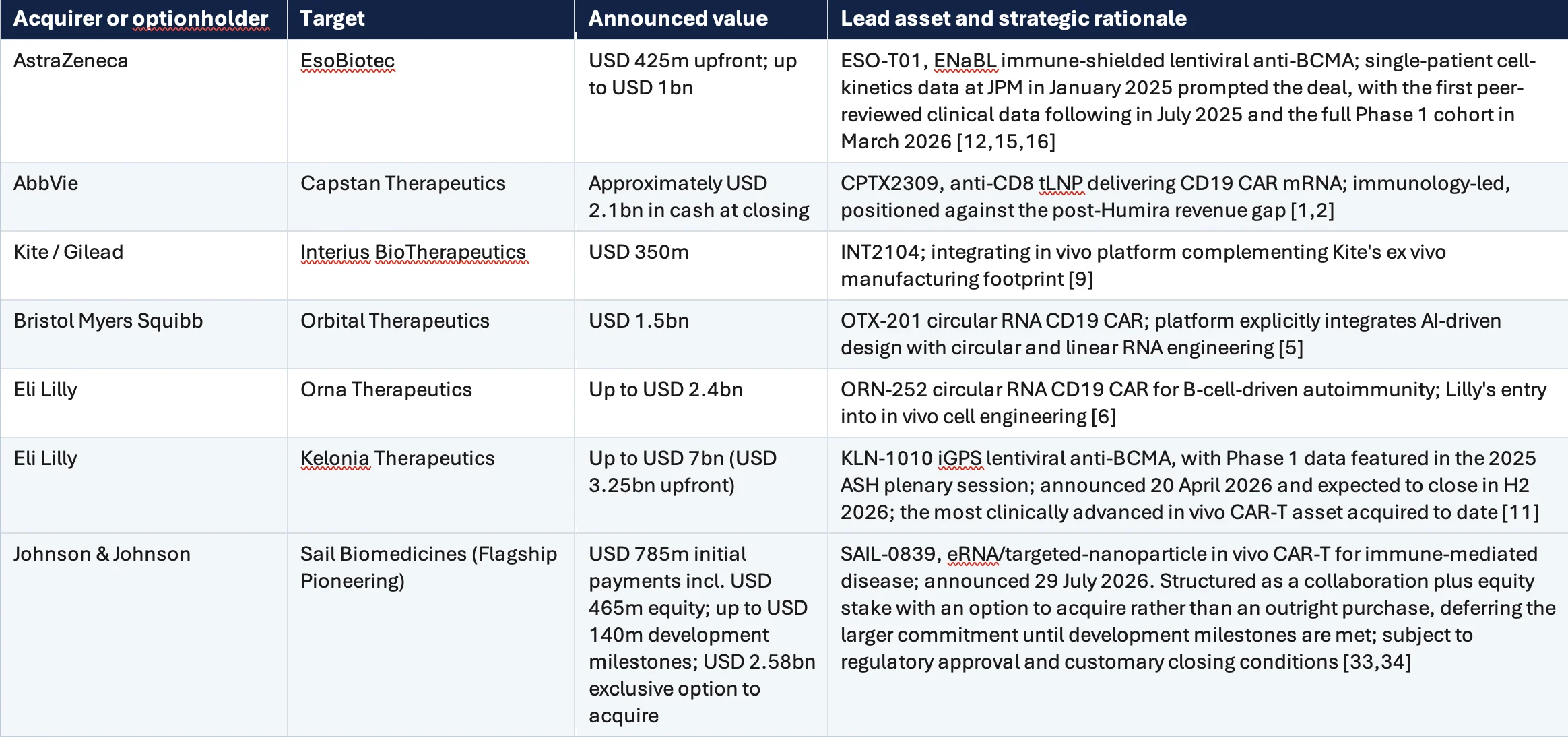
Between March 2025 and April 2026, five major pharmaceutical companies acquired in vivo CAR-T platforms across six transactions, with Eli Lilly accounting for two. The announced aggregate value reached approximately $14.4 billion, including contingent milestones.
Johnson & Johnson subsequently entered the field through its July 2026 agreement with Sail Biomedicines, involving $785 million in initial payments—including a $465 million equity investment—up to $140 million in development milestones, and an exclusive option to acquire the company for an additional $2.58 billion.
If exercised, the aggregate announced transaction value across the sector would approach $17.9 billion.
The structure of these transactions provides insight into how pharmaceutical companies are evaluating the field. Autoimmune-directed RNA platforms have commanded particularly high valuations despite several oncology-directed viral platforms having more mature clinical data.
This suggests that commercial expectations are being shaped not only by clinical maturity but also by the potentially much larger autoimmune populations and the possibility of delivering treatment without conditioning chemotherapy in broader clinical settings.
Another notable development is that several pharmaceutical companies are avoiding a single-platform bet.
AbbVie has exposure to both approaches through its acquisition of Capstan’s targeted LNP platform and its option relationship with Umoja’s lentiviral programs. Eli Lilly similarly acquired Orna Therapeutics and Kelonia Therapeutics, gaining positions in both circular RNA and integrating lentiviral architectures.
The field is also geographically distributed. Early ESO-T01 data originated in China, Interius first dosed patients in Australia before receiving European clearance, and Capstan similarly initiated its first-in-human program in Australia.
Trial geography is therefore increasingly being shaped by regulatory speed as well as patient availability.
Where Artificial Intelligence Enters the In Vivo CAR-T Pipeline
In vivo CAR-T may be particularly suited to machine-learning-assisted development because many of its central challenges are molecular design problems.
Unlike ex vivo CAR-T, where optimization depends heavily on cellular manufacturing and process engineering, in vivo platforms require selection of ionizable lipids, targeting ligands, vector envelopes, untranslated regions, and other molecular components from enormous chemical and sequence spaces.
Each design can generate measurable biological outputs, creating the type of datasets on which predictive models can potentially be trained.
Commercial strategies are beginning to reflect this convergence. Bristol Myers Squibb explicitly identified AI-driven design as one of the defining components of Orbital Therapeutics’ platform alongside RNA engineering and lipid nanoparticle delivery.
Ionizable Lipid Discovery
Ionizable lipids are among the most important components of an LNP and historically among the most difficult to optimize.
The relationship between chemical structure, nanoparticle behavior, biodistribution, cellular uptake, and biological activity is highly nonlinear.
The review describes a directed message-passing neural network trained on more than 9,000 LNP activity measurementsthat was subsequently used to computationally evaluate 1.6 million candidate lipids and identify structures capable of effective RNA delivery in vivo.
Other approaches are incorporating molecular dynamics and physical conformation into predictive modeling, including identification of lipid structures associated with spleen-directed mRNA delivery.
For in vivo CAR-T, this is particularly relevant because successful delivery requires reaching lymphocytes in lymphoid tissues while minimizing hepatic sequestration.
Targeting Ligands and CAR Binders
Targeted in vivo CAR platforms depend on multiple protein-binding interactions.
The nanoparticle may require an anti-CD8 or anti-CD7 binder to identify the appropriate immune cell. A viral particle may require an engineered targeting or activation domain. And the CAR itself requires an antigen-recognition domain capable of selectively binding the tumor target.
Protein language models and structure-based generative approaches are increasingly being used to accelerate these discovery processes.
For in vivo CAR-T, the challenge is inherently multi-parametric. A targeting ligand must bind its lymphocyte receptor strongly enough to enable delivery while avoiding inappropriate receptor activation, maintaining function after conjugation to the particle, minimizing immunogenicity, and potentially allowing repeat dosing.
Machine-learning approaches capable of optimizing multiple biological properties simultaneously may therefore become particularly valuable.
Payload and Construct Engineering
RNA payload optimization presents another high-dimensional design problem.
Codon usage, untranslated regions, nucleoside modifications, RNA secondary structure, and—for circular RNA—internal ribosome entry sites and splicing elements can all influence translation, stability, duration of CAR expression, and innate immune recognition.
The growing commercial interest in circular RNA makes this especially relevant. Circular constructs may provide longer expression than conventional linear mRNA but occupy a design space with less accumulated experimental knowledge, potentially increasing the value of predictive modeling.
Similar computational approaches could also contribute to viral envelope engineering, where receptor specificity, serum stability, complement resistance, and susceptibility to neutralizing antibodies may influence both initial treatment and the possibility of redosing.
Predicting Tropism and Toxicity
Perhaps the most clinically important future application is prediction of innate immune activation.
The ESO-T01 experience, where inflammatory activation preceded detectable engineered-cell expansion, illustrates a type of toxicity that conventional preclinical models may not reliably predict.
Combining pooled in vivo screening, barcoding, single-cell sequencing, biodistribution analysis, and machine learning could eventually allow developers to model not simply where a nanoparticle travels, but which cells it enters and what inflammatory program it activates.
The same concept may ultimately extend to predicting CAR-T expansion after dosing. Because the final engineered-cell dose is a biological output rather than a predefined input, baseline lymphocyte phenotype, previous therapies, disease burden, cytokine responses, and early cellular kinetics may eventually become variables in predictive models.
What AI Cannot Yet Do
The potential of artificial intelligence should not be overstated.
Available datasets remain relatively small and heterogeneous, and many LNP datasets were generated using hepatocyte delivery or reporter-gene endpoints rather than lymphocyte-specific transduction and functional CAR expression.
More importantly, there is currently no published demonstration that computational methods have successfully predicted the clinical efficacy or clinical toxicity of an in vivo CAR-T candidate.
Computationally designed components also receive no regulatory shortcut. A newly generated ionizable lipid remains a new chemical entity requiring appropriate toxicology, manufacturing, and regulatory evaluation.
For now, the most realistic contribution of machine learning is therefore to compress discovery timelines and improve candidate selection—not replace clinical evidence.
Five Questions That Could Define the Future of In Vivo CAR-T
Can the delivery vehicle itself be made predictably safe?
The differences in inflammatory toxicity between early programs require mechanistic explanation. Understanding how vector envelope composition, particle dose, infusion kinetics, and complement activation influence innate immunity will be critical.
What will replace conventional CAR-T release testing?
An in vivo equivalent of potency testing may be required. Engineered-cell frequency, vector copy number, kinetics of expansion, and depth of target-cell depletion are among the potential pharmacodynamic measures.
Can in vivo CAR-T be redosed?
Repeat administration is one of the potential advantages of converting CAR-T into an infused biologic. However, neutralizing antibodies against lentiviral envelopes or nanoparticle-associated targeting proteins could limit redosing.
Will transient or integrating CAR expression win?
The answer may differ by disease.
A short period of CAR expression may be sufficient to produce durable immune resetting in autoimmune disease, while persistent genomic integration may prove necessary for durable tumor control in oncology. Current clinical cohorts should begin to clarify this distinction.
Will in vivo CAR-T actually improve access?
Access is one of the modality’s central promises and should therefore become a measurable clinical-development endpoint.
Future trials could evaluate the interval from treatment decision to administration, the proportion of screened patients who successfully receive therapy, and whether treatment can safely move beyond highly specialized cellular-therapy centers.
Where to Train in CAR-T Therapy: Top Programs in Cellular Immunotherapy
Looking Ahead
In vivo CAR-T has crossed an important threshold. It is no longer simply a theoretical alternative to ex vivo cellular engineering.
CAR-T cells can now be generated directly inside patients, and objective responses have been reported in myeloma and lymphoma without lymphodepleting chemotherapy. The central questions have therefore changed.
The issue is no longer simply whether CAR-T cells can be generated in vivo, but whether they can be generated with predictable potency, acceptable innate tolerability, appropriate cell-type specificity, and sufficient pharmacological control to substitute for the quality systems provided by ex vivo manufacturing.
At the same time, transient RNA platforms are expanding the concept beyond oncology toward immune resetting in autoimmune disease, while myeloid programming raises the possibility that in vivo engineering could eventually target immune compartments that conventional CAR-T has struggled to exploit.
Artificial intelligence is entering this field unusually early in its development, particularly in lipid discovery, binder design, and payload engineering. Its contribution is potentially meaningful but remains bounded: no computational approach has yet replaced the need for clinical validation.
The next phase of in vivo CAR-T will therefore be defined not simply by whether the technology works, but by which delivery architecture provides the optimal balance of efficacy, durability, safety, controllability, scalability, and access.
If those questions can be answered, in vivo CAR-T may represent more than a simplified version of existing cellular therapy. It could redefine how engineered immunity itself is delivered.
Written by Awanish Kumar Pandey, Research & Strategy, SPER Market Research Pvt Ltd