
The addition of immunotherapy has been a major leap forward in managing squamous cell carcinoma of the head and neck. Currently, immunotherapy is a viable option for metastatic and recurrent disease with new indications emerging, such as perioperative regimens for locally-advanced tumors. Squamous cell head and neck tumors often demonstrate PD-L1 positivity, which is the most important predictive factor for response to immunotherapy to date.
PD-L1 or tumor programmed death-ligand 1 is a protein expressed on the surface of immune cells and tumor cells. Different biomarkers measuring PD-L1 expression have been developed, such as the tumor proportion score (TPS) and combined positive score (CPS) TPS measures the amount of tumor cells with PD-L1 expression, whereas CPS demonstrates the PD-L1 expression of all cells in the tumor microenvironment. PD-L1 positivity, defined as ≥1% both for TPS and CPS, is a validated predictive factor for response to immune checkpoint inhibitors, with higher PD-L1 positivity generally being linked to a better response.
However, while TPS and CPS might show a correlation in some studies, it is generally not recommended to use them interchangeably when determining the most appropriate treatment option. Most studies in the current ESMO recommendations have implemented PD-L1 CPS expression as a prerequisite for drug prescription.

10 ongoing Clinical Trials on Immunotherapy in Head and Neck cancer
Metastatic and Recurrent Disease: How Immunotherapy Reshaped the Standard of Care
The management of recurrent, persistent, and metastatic head and neck squamous cell carcinoma (HNSCC) has undergone a major transformation with the introduction of immune checkpoint inhibitors. According to current ESMO recommendations, treatment selection is primarily guided by prior exposure to platinum-based chemotherapy and PD-L1 combined positive score (CPS) expression.
For patients with immunotherapy-naïve disease and PD-L1 CPS ≥1, pembrolizumab has become a cornerstone of first-line treatment. It may be administered as monotherapy in selected patients or combined with platinum-based chemotherapy and 5-fluorouracil when a more rapid or robust response is required. However, this approach is generally reserved for patients who have not received platinum-based therapy within the previous six months.
For patients whose disease progresses within six months of platinum treatment and who have not previously received immunotherapy, immune checkpoint blockade remains an important option, with nivolumab and pembrolizumab demonstrating meaningful clinical benefit in this setting. When immunotherapy or platinum-based treatment is not appropriate, alternative systemic options include single-agent taxanes, methotrexate, or cetuximab. In patients with PD-L1–negative tumors, cetuximab-based combinations continue to represent a valuable therapeutic strategy.
The pivotal phase 3 KEYNOTE-048 trial fundamentally changed the treatment landscape by comparing pembrolizumab alone or in combination with chemotherapy against the historical EXTREME regimen, which combined cetuximab with platinum-based chemotherapy and 5-fluorouracil. Patients were stratified according to PD-L1 expression, p16 status in oropharyngeal cancer, and ECOG performance status.
Long-term results confirmed a significant overall survival advantage for pembrolizumab monotherapy in PD-L1–positive disease. Among patients with CPS ≥20, median overall survival reached 14.9 months compared with 10.8 months for cetuximab plus chemotherapy (HR 0.61). Similarly, in the broader CPS ≥1 population, median overall survival was 12.3 months versus 10.4 months, respectively (HR 0.74). Importantly, the addition of pembrolizumab to chemotherapy also improved outcomes. In patients with CPS ≥20, median overall survival was 14.7 months compared with 11.1 months with the EXTREME regimen (HR 0.60). In the CPS ≥1 population, overall survival improved from 10.4 months to 13.6 months (HR 0.65).
These findings established pembrolizumab-based therapy as the current standard of care for recurrent and metastatic HNSCC, marking a shift away from cetuximab-centered treatment approaches and highlighting the growing importance of biomarker-driven immunotherapy in clinical practice.
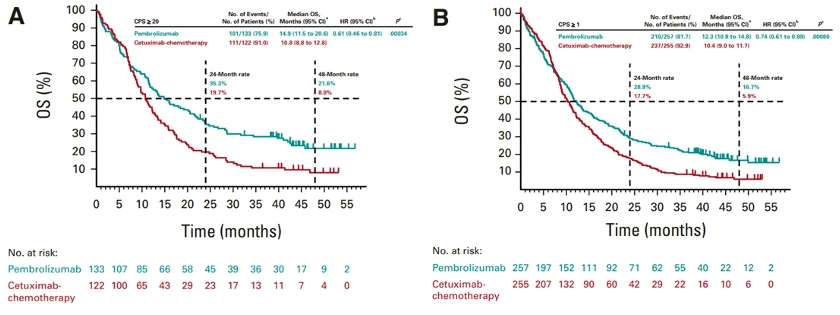
Figure A and B: Data on OS in the CPS ≥20 and CPS ≥1 population with pembrolizumab compared with cetuximab and chemotherapy according to the final analysis of the KEYNOTE-048 trial
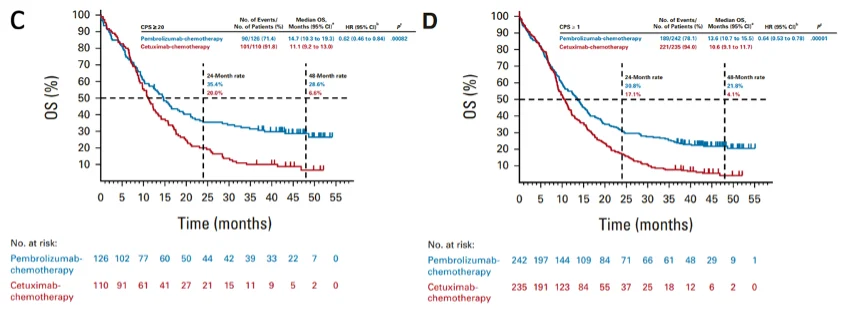
Figure C and D: Data on OS in the CPS ≥20 and CPS ≥1 population with pembrolizumab and chemotherapy compared with cetuximab and chemotherapy according to the final analysis of the KEYNOTE-048 trial
A hallmark feature of immunotherapy was observed in KEYNOTE-048. Regardless of PD-L1 CPS expression, the overall survival curves initially overlapped during the first 10 months of treatment, with a trend toward slightly worse outcomes among patients receiving pembrolizumab monotherapy. However, after approximately 10 months, the curves began to separate in favor of pembrolizumab, resulting in the characteristic immunotherapy “tail” that reflects durable long-term benefit in a subset of patients.
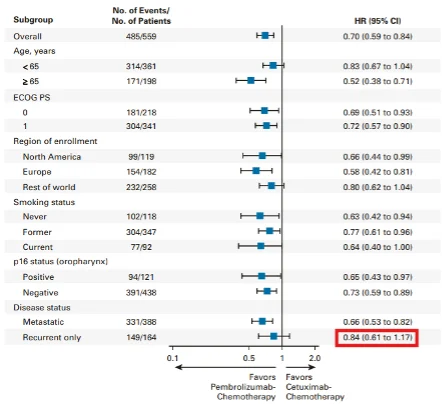
Figure: Pembrolizumab with chemotherapy versus cetuximab with chemotherapy in the total population[A1] in the KEYNOTE-048 trial
Importantly, this benefit was not observed uniformly across all patient groups. In patients with recurrent disease, pembrolizumab monotherapy did not demonstrate a statistically significant overall survival advantage compared with standard therapy in the overall population (HR 1.05; 95% CI, 0.77–1.43). The addition of chemotherapy to pembrolizumab showed a trend toward improved overall survival in this setting (HR 0.84; 95% CI, 0.61–1.17), although the difference did not reach statistical significance.
Another important milestone in recurrent and metastatic HNSCC was the phase 3 CheckMate 141 trial, which evaluated nivolumab versus investigator’s choice of methotrexate, docetaxel, or cetuximab in patients with platinum-refractory disease. All enrolled patients had previously received platinum-based chemotherapy. Nivolumab significantly improved overall survival, with a median OS of 7.5 months compared with 5.1 months for standard therapy. Similar to KEYNOTE-048, the survival curves separated over time, with a clear divergence emerging around the fourth month of treatment, highlighting the delayed but durable benefit characteristic of immune checkpoint blockade. In contrast, progression-free survival was not significantly improved (HR 0.89; 95% CI, 0.70–1.13), underscoring the unique response kinetics of immunotherapy and the limitations of conventional endpoints in capturing long-term clinical benefit.
The phase 3 CheckMate 141 trial established nivolumab as a standard treatment option for patients with recurrent or metastatic HNSCC whose disease had progressed after platinum-based chemotherapy. The study compared nivolumab with investigator’s choice of methotrexate, docetaxel, or cetuximab in a population that had previously received systemic chemotherapy.
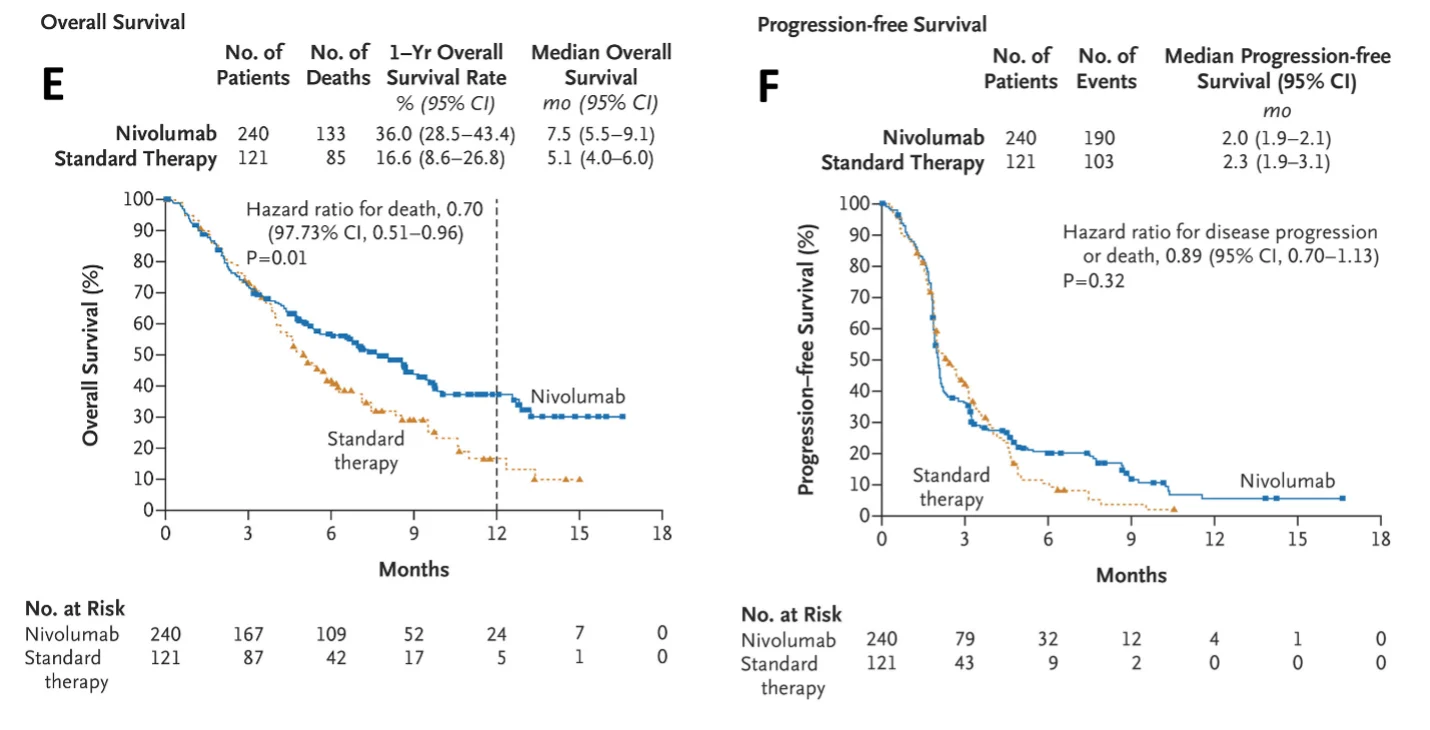
Figure E and F: Overall Survival and Progression-free Survival in the CheckMate 141 trial
Nivolumab significantly improved overall survival, with a median OS of 7.5 months compared with 5.1 months for standard therapy. Notably, the survival curves began to separate as early as the fourth month of treatment, suggesting an earlier clinical benefit than that observed with pembrolizumab in KEYNOTE-048. As seen in other immunotherapy studies, the survival advantage was driven primarily by durable long-term benefit rather than early disease control.
In contrast, progression-free survival was not significantly improved (HR 0.89; 95% CI, 0.70–1.13), highlighting the unique response kinetics of immune checkpoint inhibitors, where overall survival may improve despite limited differences in conventional measures of disease progression.
Current ESMO guidelines do not require PD-L1 CPS testing when considering nivolumab in the platinum-refractory setting. Nevertheless, exploratory analyses suggested that PD-L1 expression may influence the magnitude of benefit. Patients with PD-L1 CPS ≥1% demonstrated earlier separation of the survival curves and a greater numerical improvement in overall survival compared with standard therapy, whereas the benefit appeared less pronounced among patients with PD-L1 CPS <1%. These findings suggest that although PD-L1 is not required for treatment selection in this setting, it may still provide valuable prognostic and predictive information.
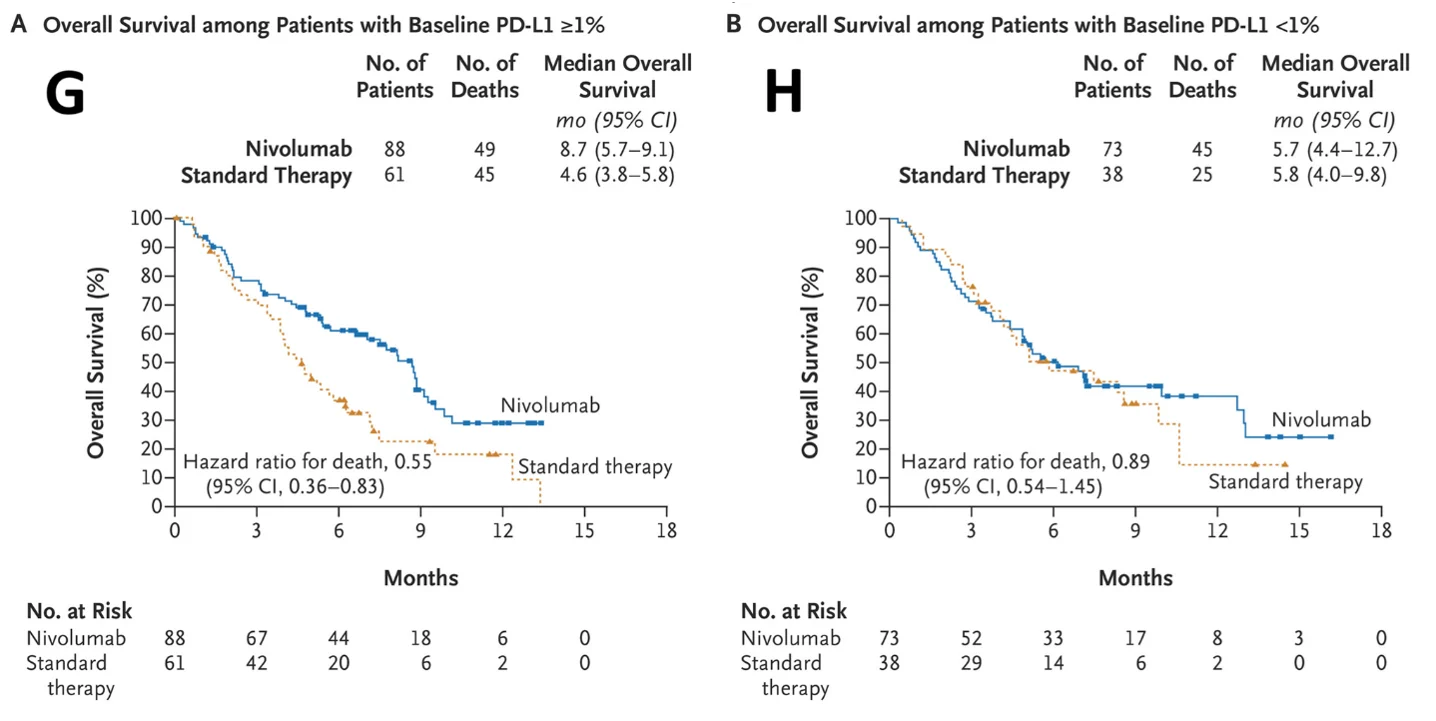
Figures G and H: Overall survival among patients with baseline PD-L1 ≥1% and <1%
Additional exploratory analyses suggested that the benefit of nivolumab may vary according to HPV-associated disease status. Among patients with p16-positive tumors, nivolumab was associated with a substantial improvement in overall survival, with a median OS of 9.1 months compared with 4.4 months for standard therapy (HR 0.56; 95% CI, 0.32–0.99). In contrast, patients with p16-negative tumors experienced a more modest numerical benefit, with median overall survival of 7.5 months versus 5.8 months, respectively (HR 0.73; 95% CI, 0.42–1.25).
Although these analyses were exploratory and not powered for definitive subgroup comparisons, they raised the possibility that HPV-associated, p16-positive tumors may derive greater benefit from PD-1 blockade. This observation is biologically plausible, as HPV-driven tumors are characterized by a distinct immune microenvironment and are generally considered more immunogenic than their p16-negative counterparts. Nevertheless, the absence of a statistically significant interaction between p16 status and treatment effect indicates that nivolumab remains an effective treatment option regardless of HPV status, while further highlighting the need for predictive biomarkers beyond PD-L1 expression.
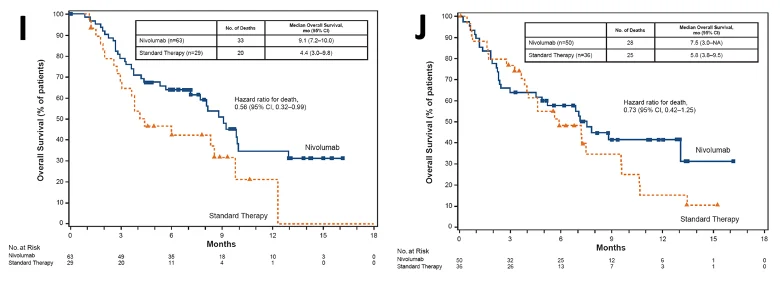
Figures I and J: Overall survival in patients with baseline p16-positive and p16-negative status
Locally Advanced Squamous Cell Carcinoma of the Head and Neck
The success of immune checkpoint inhibitors in recurrent and metastatic HNSCC has naturally prompted interest in moving immunotherapy into earlier stages of disease. The phase 3 KEYNOTE-689 trial was the first large randomized study to demonstrate that perioperative PD-1 blockade can improve outcomes in patients with resectable, locally advanced head and neck squamous cell carcinoma.
The trial enrolled 714 patients with stage III–IV disease arising from the oral cavity, larynx, or hypopharynx. Patients were randomized to receive either standard-of-care surgery followed by risk-adapted (chemo)radiotherapy alone or a perioperative pembrolizumab strategy consisting of two neoadjuvant cycles before surgery and fifteen adjuvant cycles after definitive treatment. Stratification factors included primary tumor site, PD-L1 expression, and disease stage.
KEYNOTE-689 met its primary endpoint, demonstrating a significant improvement in event-free survival across multiple patient populations. The magnitude of benefit appeared greatest among patients with PD-L1 CPS ≥10, where 36-month event-free survival reached 59.8% compared with 45.9% in the control arm (HR 0.66). Benefit was also observed in the CPS ≥1 population (HR 0.70) and in the overall study population (HR 0.73), establishing perioperative pembrolizumab as a new therapeutic option for selected patients with resectable locally advanced disease.
These findings have already influenced clinical practice. Current NCCN recommendations support perioperative pembrolizumab for patients with stage III–IVA oral cavity cancer and for stage III–IVA p16-negative oropharyngeal, hypopharyngeal, and laryngeal cancers with PD-L1 CPS ≥1.
Despite these positive results, several important questions remain unanswered. Subsequent analyses have raised concerns regarding the optimal PD-L1 threshold for patient selection. Interestingly, major pathological responses were observed predominantly among patients with higher PD-L1 expression, with nearly all major responders falling into the CPS ≥10 subgroup. This observation suggests that CPS ≥1 may not represent the most clinically meaningful predictive cutoff and that patients with strongly PD-L1–positive tumors may derive the greatest benefit from perioperative immunotherapy.
Another area of debate relates to the potential risks associated with neoadjuvant treatment. Disease progression during the preoperative phase remains a concern, particularly when surgery is delayed to allow administration of systemic therapy. In KEYNOTE-689, progression events were observed before surgery in a proportion of patients, and approximately 10% ultimately did not undergo resection. In addition, treatment-related toxicity was higher in the pembrolizumab arm, emphasizing the need for careful patient selection and multidisciplinary management.
The integration of perioperative immunotherapy also introduces new challenges regarding treatment sequencing. As PD-1 blockade moves into earlier stages of disease, an increasing number of patients may eventually experience recurrence after prior exposure to checkpoint inhibition. At present, there is limited evidence supporting routine PD-1/PD-L1 rechallenge, and sequential checkpoint inhibitor therapy is generally not recommended outside selected clinical scenarios or clinical trials. Consequently, determining the optimal management strategy for patients who relapse after perioperative immunotherapy is likely to become one of the most important questions in the evolving treatment landscape of head and neck cancer.
Conclusion
Head and neck squamous cell carcinoma remains one of the most complex malignancies in oncology, with a substantial risk of both locoregional recurrence and distant metastatic progression despite multimodality treatment. The introduction of immune checkpoint inhibitors has significantly altered the therapeutic landscape, improving survival outcomes in both recurrent/metastatic and, more recently, locally advanced disease.
However, the benefits of immunotherapy are not uniform across all patients. Optimal treatment selection requires careful consideration of multiple clinical and biological factors, including PD-L1 expression, HPV status, disease burden, primary tumor site, prior platinum exposure, comorbidities, and the need for rapid tumor control. As demonstrated by KEYNOTE-048, CheckMate 141, and KEYNOTE-689, the greatest challenge is no longer whether immunotherapy should be used, but rather identifying which patients are most likely to benefit and at what stage of their disease course.
The future of head and neck cancer treatment will likely be driven by a deeper understanding of tumor biology and the immune microenvironment. Beyond PD-L1 expression, emerging biomarkers incorporating genomic, transcriptomic, and immune-related features may help refine patient selection and guide treatment sequencing. At the same time, ongoing clinical trials are exploring novel combinations, perioperative strategies, and approaches to overcome primary and acquired resistance.
As the field continues to evolve, the goal is shifting from a one-size-fits-all approach toward truly personalized immunotherapy, where treatment decisions are guided not only by tumor characteristics but also by the unique biological context of each patient.
Written by Alexandra Tsvetkova, MD