
The ESMO Congress 2026 is set to feature several potentially important immunotherapy readouts across solid tumors. From reduced-frequency checkpoint inhibition to combinations with radiotherapy, chemotherapy, and targeted therapy, these studies address how to improve disease control while balancing toxicity and treatment burden.
This overview highlights five phase III trials to watch at ESMO 2026: MOIO, UNION, KEYNOTE-975, STARBOARD, and NRG-GY020. Together, they explore treatment strategies across metastatic disease, definitive chemoradiotherapy, and perioperative care, with potential implications for how immunotherapy is selected and delivered.
MOIO: Can Immunotherapy Be Given Less Often After a Response?
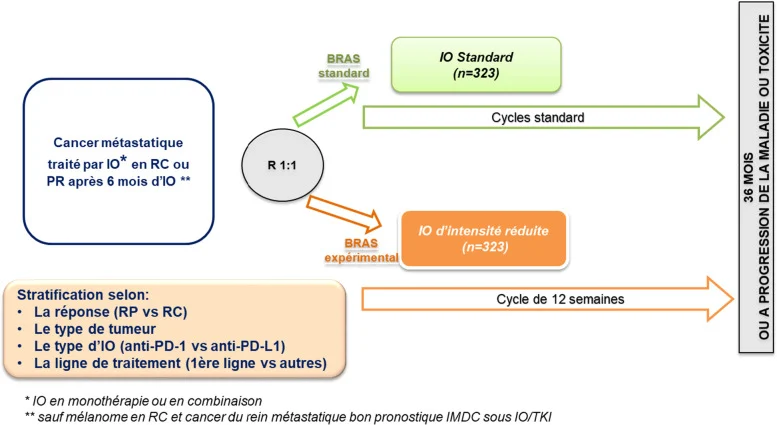
LBA10 — MOIO asks a practical question: once a patient has responded to immunotherapy, can treatment be given every three months without an unacceptable loss of efficacy? Gwenaëlle Gravis will present interim analyses of this randomized phase III trial during Presidential Symposium III at ESMO 2026 on October 26.
According to the published protocol, MOIO (NCT05078047) plans to enroll 646 patients with metastatic solid tumors who have achieved a partial or complete response after six months of standard immunotherapy. Patients are randomized to continue their usual treatment schedule or receive the same dose at each infusion, with the interval extended to three months. Patients with melanoma in complete response are excluded.
The primary endpoint is progression-free survival from randomization. The trial uses a non-inferiority design to assess whether the less frequent schedule preserves efficacy within a predefined margin.
The rationale is that checkpoint inhibitors may continue to exert biological effects beyond their usual dosing intervals. MOIO tests whether this can translate into sustained disease control with fewer infusions. It also evaluates toxicity, overall survival, quality of life, cost-effectiveness, and patients’ anxiety and fear of recurrence.
These measures matter because reducing treatment frequency could ease the burden of repeated hospital visits. However, fewer infusions cannot automatically be assumed to reduce toxicity or improve quality of life; these are outcomes the trial is designed to assess.
The ESMO presentation will need to be interpreted in light of its interim status and the maturity of the data. Its relevance is specific to patients already responding after six months of treatment. MOIO could help clarify whether continued immunotherapy can be delivered less intensively in this selected population while maintaining disease control.
UNION: Integrating Immunotherapy Into Neoadjuvant Treatment for Rectal Cancer
3530O — UNION (NCT04928807) is a multicenter, randomized phase III trial evaluating short-course radiotherapy followed by camrelizumab and chemotherapy in locally advanced rectal cancer. Zhen Yu Lin will present the study during the Proffered Paper: Gastrointestinal Tumours, Lower Digestive session at ESMO 2026 on October 25.
The trial enrolled 231 patients and compares two treatment strategies. The experimental arm receives short-course radiotherapy, delivering 25 Gy in five fractions, followed by two cycles of the PD-1 inhibitor camrelizumab plus CAPOX, comprising capecitabine and oxaliplatin. The control arm receives long-course chemoradiotherapy with concurrent capecitabine, followed by CAPOX. Both strategies include surgery with total mesorectal excision and postoperative treatment; camrelizumab is continued with adjuvant CAPOX in the experimental arm.
The primary endpoint is pathological complete response, assessed by a blinded independent review committee and defined as the absence of viable tumor in the resected primary lesion and sampled regional lymph nodes, or ypT0N0.
UNION addresses whether incorporating PD-1 blockade into a radiotherapy and chemotherapy strategy can deepen tumor response before surgery. A central consideration is that the trial changes both the radiotherapy schedule and the use of immunotherapy. It therefore compares complete treatment strategies and cannot isolate the contribution of camrelizumab alone.
The clinical interpretation also extends beyond pathological response. Longer-term disease control, treatment toxicity, and surgical outcomes are needed to assess the overall value of the approach. Because surgery is planned in both arms, pathological complete response should not be interpreted as evidence supporting omission of surgery.
The ESMO presentation will be relevant to the broader question of how immunotherapy should be integrated with established treatment for locally advanced rectal cancer. The programme title does not specify which analysis will be presented, so the scope of the update should be confirmed from the congress abstract.
KEYNOTE-975: Adding Pembrolizumab to Definitive Chemoradiotherapy in Esophageal Cancer
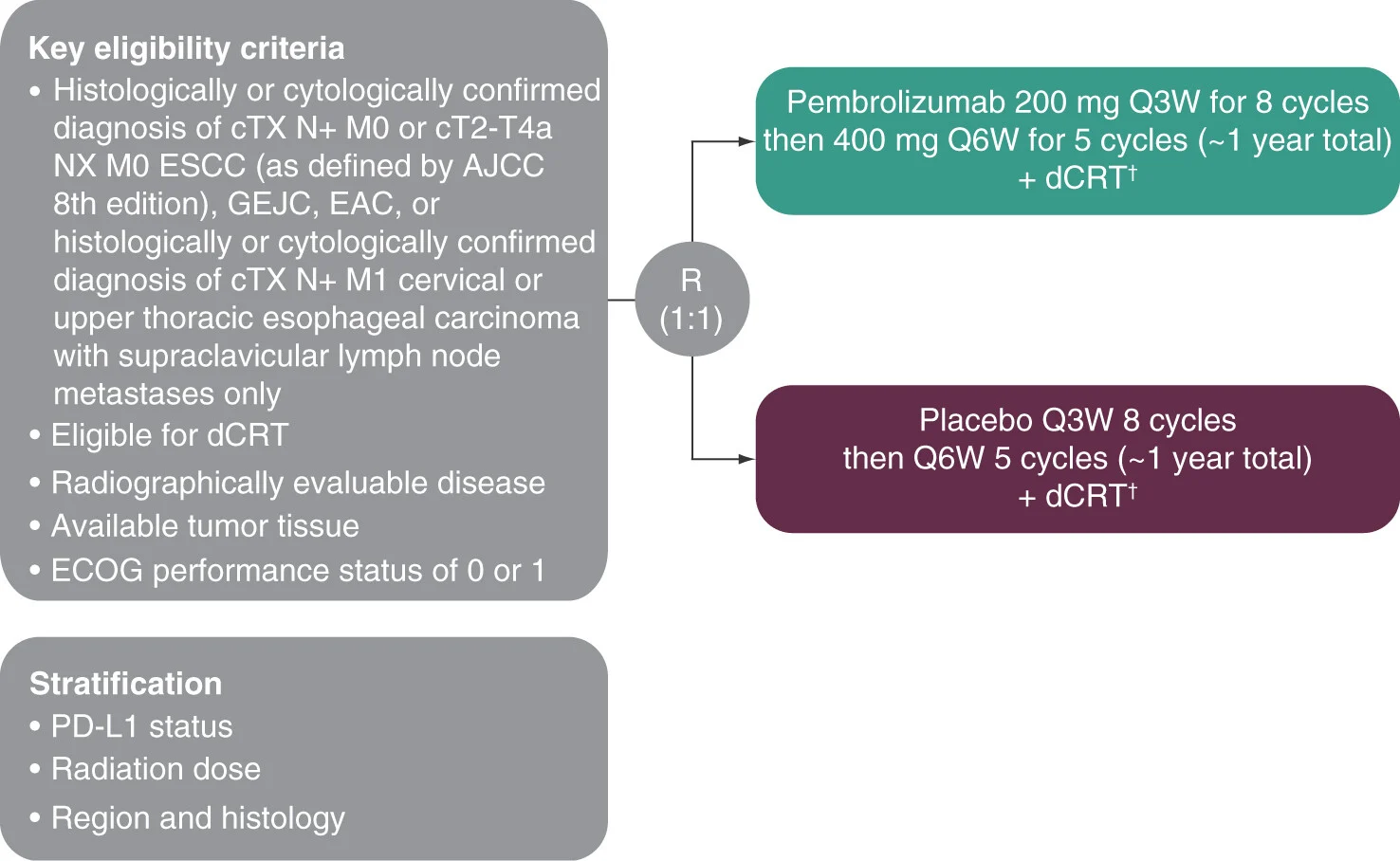
KEYNOTE-975 (NCT04210115) is a randomized, double-blind phase III trial evaluating pembrolizumab versus placebo alongside definitive chemoradiotherapy in patients with locally advanced, unresectable esophageal or gastroesophageal junction cancer. Manish A. Shah will present the study during the Proffered Paper 1: Gastrointestinal Tumour, Upper Digestive session at ESMO 2026 on October 23.
The study addresses whether adding PD-1 blockade can improve outcomes in patients receiving chemoradiotherapy as their definitive treatment. The published design includes esophageal squamous cell carcinoma and adenocarcinoma, as well as gastroesophageal junction cancer.
Patients are randomized 1:1 to pembrolizumab or placebo, beginning concurrently with chemoradiotherapy and continuing afterward for approximately one year in total. Chemoradiotherapy consists of cisplatin and fluorouracil with 50 or 60 Gy of radiotherapy, or FOLFOX with 50 Gy. Each participating center selects one of these regimens for use in all its enrolled patients.
According to the published design, overall survival and event-free survival are the dual primary endpoints. Enrollment includes patients with PD-L1 combined positive scores both below and above 10, with PD-L1 status incorporated into randomization stratification.
The scientific rationale is that chemotherapy and radiotherapy may alter the tumor immune environment in ways that enhance the activity of PD-1 blockade. KEYNOTE-975 tests whether this rationale translates into a meaningful clinical benefit within a definitive treatment strategy.
Because pembrolizumab is administered both during and after chemoradiotherapy, the trial evaluates the contribution of the combined concurrent and maintenance approach. It cannot independently determine which treatment phase accounts for any benefit.
The ESMO presentation will be relevant to the question of how immunotherapy can improve disease control and survival without compromising delivery of chemoradiotherapy. Outcomes by histology and PD-L1 expression, together with toxicity and treatment completion, will be important for understanding the clinical implications.
STARBOARD: Combining BRAF/MEK Inhibition With Pembrolizumab in Advanced Melanoma
2071O — STARBOARD is a randomized, double-blind phase III study comparing encorafenib, binimetinib, and pembrolizumab with pembrolizumab plus placebo as first-line treatment for unresectable locally advanced or metastatic BRAF V600-mutant melanoma. Dirk Schadendorf will present the study during the Proffered Paper: Melanoma and Other Skin Tumours session at ESMO 2026 on October 23.
The trial investigates whether adding BRAF and MEK inhibition to PD-1 blockade can improve disease control over pembrolizumab alone. Encorafenib and binimetinib target the MAPK signaling pathway, while pembrolizumab blocks PD-1. The biological rationale is that BRAF/MEK inhibition may also alter the tumor immune environment in ways that enhance sensitivity to checkpoint blockade.
The published trial design specifies enrollment of patients with BRAF V600E or V600K-mutant cutaneous melanoma, measurable disease, and an ECOG performance status of 0–1. Previous systemic treatment for advanced disease is excluded, although prior adjuvant targeted therapy or checkpoint inhibition is permitted. A safety lead-in was designed to establish the triplet regimen before the randomized phase III comparison.
Progression-free survival is the primary phase III endpoint, with overall survival as the key secondary endpoint. Additional assessments include response rate, duration of response, quality of life, and adverse events.
STARBOARD addresses the value of combining targeted therapy and immunotherapy from the start of treatment. Its comparator is pembrolizumab alone, so the study does not directly compare the triplet with BRAF/MEK inhibition alone, dual checkpoint blockade, or a planned sequence of targeted therapy and immunotherapy.
The clinical interpretation will depend on whether any improvement in disease control is durable and sufficient to justify the additional treatment burden. Survival, toxicity, treatment discontinuation, and quality of life will therefore be central to assessing the triplet’s potential role.
NRG-GY020: Adding Pembrolizumab to Adjuvant Radiation in dMMR Endometrial Cancer
NRG-GY020 (NCT04214067) is a randomized phase III trial evaluating whether adding pembrolizumab to radiation therapy can reduce recurrence in patients with newly diagnosed stage I–II, high-intermediate-risk, mismatch repair-deficient (dMMR) endometrioid endometrial cancer. Floor Backes will present the study during the Proffered Paper: Gynaecological Cancers session at ESMO 2026 on October 24.
Patients are randomized to radiation alone or the same radiation treatment with pembrolizumab. In the experimental arm, pembrolizumab begins within seven days before radiotherapy and continues every six weeks for up to nine cycles, approximately one year. The primary objective is to compare three-year recurrence-free survival.
The central question is whether PD-1 blockade adds meaningful protection against recurrence in a population selected by both clinicopathological risk and mismatch repair status. By specifically enrolling patients with dMMR tumors, NRG-GY020 evaluates immunotherapy within a defined molecular subgroup in the early-stage adjuvant setting.
The benefit–risk balance is particularly important here. Any reduction in recurrence must be considered alongside immune-related toxicity and the burden of adding a year of systemic treatment. The study therefore evaluates safety, quality of life, gastrointestinal symptoms, and fatigue, as well as recurrence patterns and longer-term outcomes.
Correlative analyses will examine whether circulating tumor DNA can predict outcomes and whether baseline tumor genetics and immune microenvironment features are associated with benefit or resistance.
NRG-GY020 could help clarify whether dMMR status supports treatment intensification with pembrolizumab in high-intermediate-risk early-stage disease. The magnitude and durability of any recurrence reduction, together with patient-reported outcomes and toxicity, will be central to interpreting its clinical relevance.