The ESMO Congress 2026 is set to deliver several important phase III readouts that could shape the next steps in cancer immunotherapy. From neoadjuvant and response-adapted strategies to dual checkpoint blockade, targeted therapy combinations, T-cell engagers, and perioperative antibody–drug conjugate–immunotherapy approaches, this year’s program spans multiple tumor types and stages of disease.
This overview highlights five phase III immunotherapy trials to watch at ESMO 2026: NADINA, CheckMate 8HW, STARBOARD, DeLLphi-304, and VOLGA, with results addressing treatment sequencing, durability of benefit, patient selection, and the balance between efficacy and toxicity.
NADINA: Three-Year Distant Metastasis-Free Survival With Neoadjuvant Immunotherapy in Stage III Melanoma
Abstract 2076RO | Sonja Witteveen | October 25, 2026, 11:14–11:19
Session: Rapid oral: Melanoma and other skin tumours
Location: Granada Auditorium – Hall 4
Can a short course of neoadjuvant dual checkpoint blockade, followed by response-driven adjuvant treatment, provide sustained protection against distant metastases? The three-year follow-up of NADINA examines the durability of this strategy compared with surgery followed by adjuvant nivolumab in resectable, macroscopic stage III melanoma.
Beyond treatment timing, NADINA addresses whether pathologic response can guide postoperative treatment, allowing selected patients to omit adjuvant therapy.
Study Design
NADINA (NCT04949113) is an investigator-initiated, international, randomized phase III trial involving 423 patients with resectable, macroscopic nodal stage III cutaneous melanoma. Patients were naive to immune checkpoint inhibitors and BRAF/MEK inhibitors and were randomized 1:1 to:
Neoadjuvant immunotherapy followed by response-driven treatment: two cycles of ipilimumab 80 mg plus nivolumab 240 mg every three weeks, followed by therapeutic lymph node dissection. Patients achieving a major pathologic response received no adjuvant systemic therapy. Those without a major pathologic response received postoperative dabrafenib plus trametinib for BRAF V600-mutant disease or nivolumab for BRAF wild-type disease.
Surgery followed by adjuvant immunotherapy: therapeutic lymph node dissection followed by 12 cycles of nivolumab 480 mg every four weeks.
In the neoadjuvant arm, postoperative targeted therapy consisted of dabrafenib 150 mg twice daily plus trametinib 2 mg once daily for 46 weeks; postoperative nivolumab consisted of 11 cycles at 480 mg every four weeks.
This design evaluates a complete treatment strategy combining earlier immune checkpoint blockade with adaptation of adjuvant therapy according to the surgical specimen’s pathologic response.
Endpoints and Methods
The primary endpoint is event-free survival, measured from randomization to progression, recurrence, or death due to melanoma or treatment. The ESMO 2026 presentation focuses on three-year distant metastasis-free survival and also updates event-free survival.
Cox regression models are used to analyze both endpoints. The follow-up also examines outcomes by BRAF mutation status and pathologic response category, including complete response, near-complete response, partial response, and non-response. Updated safety assessments include severe systemic treatment-related adverse events.
Why Watch at ESMO 2026?
Longer follow-up will help assess whether the neoadjuvant strategy provides sustained control of distant disease and whether omission of adjuvant treatment after a major pathologic response remains supported over time. Outcomes across pathologic response categories will be particularly relevant to refining postoperative treatment decisions, alongside the consistency of findings in BRAF-mutant and BRAF wild-type melanoma.
CheckMate 8HW: Final Overall Survival Results in MSI-H/dMMR Metastatic Colorectal Cancer
Abstract LBA32 | Sara Lonardi | October 24, 2026, 15:42–15:47
Session: Rapid oral: Gastrointestinal tumours, lower digestive
Location: Alicante Auditorium – Hall 6
Does combining PD-1 and CTLA-4 blockade translate into longer overall survival than PD-1 inhibition alone or chemotherapy? The final overall survival analysis from CheckMate 8HW will address this question in patients with microsatellite instability-high or mismatch repair-deficient (MSI-H/dMMR) metastatic colorectal cancer.
Study Design
CheckMate 8HW (NCT04008030) is an international, randomized, open-label phase III trial conducted at 128 hospitals and cancer centres across 23 countries. Eligible patients were adults with unresectable or metastatic colorectal cancer, MSI-H/dMMR status established by local testing, measurable disease according to RECIST v1.1, and an ECOG performance status of 0–1. Previous treatment with immune checkpoint inhibitors was not permitted.
Enrollment occurred in two sequential parts: the first included patients across treatment lines, while the second enrolled patients who had not received systemic treatment for metastatic disease.
Patients with zero or one previous treatment for metastatic disease were randomized 2:2:1 to:
Nivolumab plus ipilimumab: nivolumab 240 mg plus ipilimumab 1 mg/kg every three weeks for four doses, followed by nivolumab 480 mg every four weeks.
Nivolumab alone: nivolumab 240 mg every two weeks for six doses, followed by nivolumab 480 mg every four weeks.
Investigator’s choice of chemotherapy, with or without targeted therapy.
Patients with two or more previous treatments were randomized 1:1 to the two immunotherapy arms. Randomization was stratified by tumor sidedness and, during the first enrollment part, the number of previous treatments. Immunotherapy was administered for a maximum of two years, with earlier discontinuation for disease progression, unacceptable toxicity, or withdrawal of consent. Patients assigned to chemotherapy could cross over to nivolumab plus ipilimumab after progression confirmed by blinded independent central review.
The trial’s two independent primary endpoints were progression-free survival by blinded independent central review in patients with centrally confirmed MSI-H/dMMR disease: nivolumab plus ipilimumab versus chemotherapy in the first-line setting, and nivolumab plus ipilimumab versus nivolumab across treatment lines. Overall survival is a key secondary endpoint and the focus of this ESMO presentation.
Why Watch at ESMO 2026?
The final overall survival analysis will help clarify the long-term impact of dual checkpoint blockade relative to nivolumab alone and chemotherapy. Key points to watch include the populations used for each survival comparison, the consistency of findings across clinically relevant subgroups, and the interpretation of survival outcomes in the context of permitted crossover from chemotherapy to immunotherapy. These data could further inform treatment selection and discussions about the benefits and toxicity of adding CTLA-4 blockade.
STARBOARD: Adding BRAF/MEK Inhibition to First-Line Pembrolizumab in BRAF-Mutant Melanoma
Abstract 2071O | Dirk Schadendorf | October 23, 2026, 16:15–16:25
Session: Proffered paper: Melanoma and other skin tumours
Location: Barcelona Auditorium – Hall 9
Can combining targeted therapy with PD-1 blockade improve disease control while preserving the potential for durable benefit in BRAF V600-mutant melanoma? STARBOARD evaluates the addition of the BRAF inhibitor encorafenib and the MEK inhibitor binimetinib to first-line pembrolizumab in unresectable locally advanced or metastatic disease.
The rationale is to combine the distinct activity of MAPK pathway inhibition and immune checkpoint blockade. A central question is whether concurrent treatment offers sufficient additional benefit to justify the toxicity and treatment burden of a three-drug regimen.
Study Design
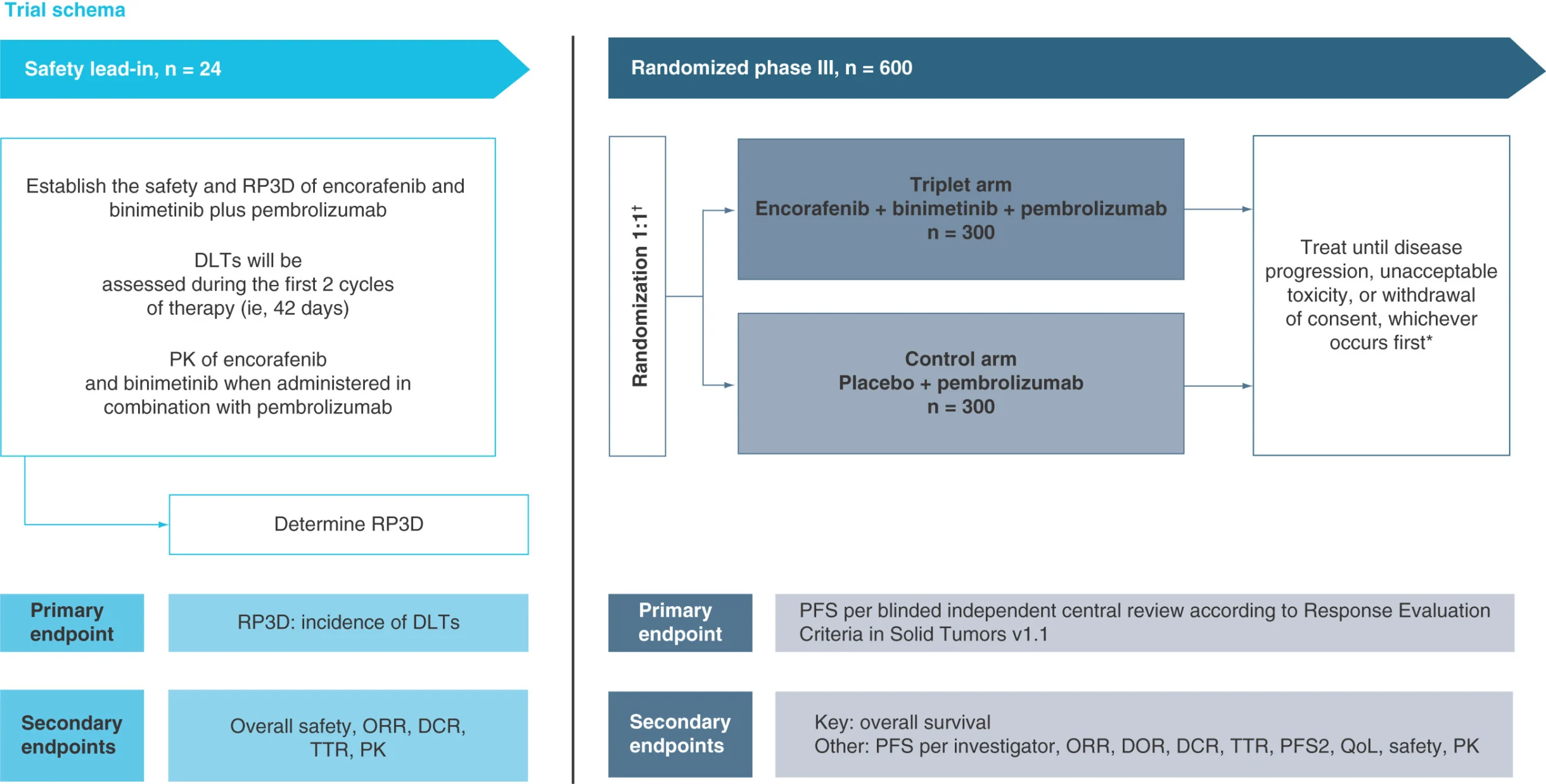
STARBOARD (NCT04657991) is a multicenter, randomized, double-blind, placebo-controlled phase III study preceded by an open-label safety lead-in. The published design planned approximately 24 patients for the safety lead-in and 600 patients for the randomized phase.
Eligible patients are adults with histologically confirmed, unresectable stage IIIB–IIID or metastatic stage IV cutaneous melanoma harboring a BRAF V600E/K mutation, with at least one measurable lesion. The study evaluates first-line treatment for advanced disease, while accounting for prior systemic adjuvant therapy.
The safety lead-in was designed to assess dose-limiting toxicities during the first two treatment cycles, characterize pharmacokinetics, and establish the recommended phase III dose. In the randomized phase, patients receive:
Encorafenib plus binimetinib plus pembrolizumab
Matching placebos plus pembrolizumab
Randomization is stratified by prior systemic adjuvant treatment and disease stage. Crossover from the control arm to the triplet arm is not permitted, helping preserve interpretation of the overall survival comparison.
Treatment continues until disease progression, unacceptable toxicity, or withdrawal of consent. Pembrolizumab is limited to 35 administrations, approximately two years; encorafenib and binimetinib may continue beyond this period according to protocol criteria.
Endpoints and Assessments
The primary endpoint is progression-free survival assessed by blinded independent central review, with overall survival as the key secondary endpoint. Other secondary endpoints include investigator-assessed progression-free survival, objective response rate, duration of response, disease control rate, time to response, progression-free survival through subsequent therapy (PFS2), patient-reported outcomes, safety, and pharmacokinetics.
The published protocol schedules tumor assessments every nine weeks during the first two years and every 12 weeks thereafter. Exploratory analyses examine tumor and blood biomarkers, including circulating tumor DNA and immune profiling, alongside time to development of brain metastases in patients without brain metastases at baseline.
Why Watch at ESMO 2026?
STARBOARD directly tests whether adding BRAF/MEK inhibition improves outcomes over a pembrolizumab backbone. Key points to watch include the durability of disease control, treatment discontinuations and dose modifications, and the effect of treatment on patient-reported quality of life. The balance between efficacy and tolerability will be central to interpreting the triplet’s potential role in first-line BRAF V600-mutant melanoma.
DeLLphi-304: Longer-Term Survival Follow-Up of Tarlatamab in Previously Treated SCLC
Abstract 3808O | Charles M. Rudin | October 26, 2026, 14:45–14:55
Session: Proffered paper: Non-metastatic NSCLC and other thoracic malignancies
Location: Alicante Auditorium – Hall 6
How durable are survival outcomes with DLL3-directed T-cell engagement in relapsed small-cell lung cancer (SCLC)? The extended overall survival follow-up from DeLLphi-304 will provide a more mature assessment of tarlatamab versus chemotherapy after progression during or after first-line platinum-based treatment.
Tarlatamab is a bispecific immunotherapy that binds DLL3 on tumor cells and CD3 on T cells, bringing them together to promote tumor-cell killing. This approach provides a distinct immune strategy from the PD-1/PD-L1 checkpoint inhibition used in first-line treatment.
Study Design
DeLLphi-304 (NCT05740566) is a multinational, randomized, open-label phase III trial comparing tarlatamab with investigator-selected chemotherapy in the second-line setting. A total of 509 patients were randomized 1:1 to tarlatamab or chemotherapy.
Eligible patients were adults with SCLC that had progressed during or after one previous line of platinum-based treatment, with or without a PD-1 or PD-L1 inhibitor, and an ECOG performance status of 0–1. Patients with brain metastases were eligible, whether previously treated or untreated, provided they were asymptomatic and clinically stable. Enrollment did not require DLL3 expression testing.
Treatment consisted of:
- Tarlatamab: a 1-mg intravenous step-up dose on cycle 1, day 1, followed by 10 mg on days 8 and 15, then 10 mg every two weeks.
- Chemotherapy: topotecan, lurbinectedin, or amrubicin, according to the options available in participating countries, administered in three-week cycles.
Randomization was stratified by previous PD-1/PD-L1 inhibitor exposure, chemotherapy-free interval, presence of brain metastases, and intended chemotherapy. Chemotherapy-free intervals were categorized as less than 90 days, 90 to less than 180 days, or at least 180 days, enabling evaluation across different patterns of relapse.
Treatment continued until disease progression, unacceptable toxicity, withdrawal of consent, or death. Treatment beyond radiologic progression was permitted when the investigator considered there to be ongoing clinical benefit. Crossover between treatment arms was not permitted.
Endpoints and Methods
The primary endpoint is overall survival, measured from randomization to death from any cause. Key secondary endpoints include investigator-assessed progression-free survival according to RECIST v1.1 and patient-reported outcomes covering dyspnea, cough, chest pain, physical functioning, and global health status.
Additional endpoints include objective response rate, duration of response, disease control, and safety. Efficacy analyses use the intention-to-treat population, while safety analyses include patients who received at least one treatment dose. The statistical testing strategy prioritizes overall survival, followed by progression-free survival and prespecified patient-reported outcomes.
Why Watch at ESMO 2026?
The extended follow-up will help clarify the longer-term survival pattern with tarlatamab and the proportion of patients experiencing sustained benefit. Points to watch include outcomes by chemotherapy-free interval, prior checkpoint inhibitor exposure, and baseline brain metastases, where reported. The presentation will add maturity to the survival assessment of a T-cell engager strategy in a disease where durable control after first-line progression remains a central treatment goal.
VOLGA: Perioperative Immunotherapy Plus Enfortumab Vedotin in Cisplatin-Ineligible MIBC
Abstract LBA2 | Thomas B. Powles | October 24, 2026, 16:54–17:06
Session: Presidential Symposium I
Location: Alicante Auditorium – Hall 6
Can an antibody–drug conjugate combined with checkpoint blockade improve outcomes around radical cystectomy in cisplatin-ineligible muscle-invasive bladder cancer (MIBC)? VOLGA evaluates neoadjuvant enfortumab vedotin plus durvalumab, with or without tremelimumab, followed by surgery and adjuvant immunotherapy.
The strategy combines Nectin-4-directed delivery of a cytotoxic agent with PD-L1 inhibition, with an additional arm incorporating CTLA-4 blockade. Beyond direct tumor-cell killing, enfortumab vedotin may promote immunogenic cell death, providing a rationale for combining it with immunotherapy before surgery.
Study Design
VOLGA (NCT04960709) is an international, multicenter, randomized, open-label phase III trial. The supplied trial-design report planned approximately 830 patients and included a safety run-in.
Eligible patients are adults with histologically or cytologically documented urothelial MIBC, including mixed transitional cell histology, clinical stage T2–T4a, N0–N1, M0 disease, and ineligibility for cisplatin-based chemotherapy.
Patients are randomized to three treatment strategies:
- Durvalumab, tremelimumab, and enfortumab vedotin: three neoadjuvant cycles given every three weeks, comprising durvalumab 1,500 mg and tremelimumab 75 mg on day 1, plus enfortumab vedotin 1.25 mg/kg on days 1 and 8. Following radical cystectomy, patients receive one additional tremelimumab dose and nine cycles of durvalumab every four weeks.
- Durvalumab and enfortumab vedotin: the same neoadjuvant durvalumab and enfortumab vedotin schedules, followed by radical cystectomy and nine cycles of adjuvant durvalumab every four weeks.
- Control: radical cystectomy without neoadjuvant treatment. The supplied design describes postoperative observation, with a planned amendment permitting adjuvant nivolumab for high-risk patients where approved and available.
This three-arm design evaluates perioperative treatment strategies incorporating an ADC and PD-L1 blockade, while also examining the contribution of adding CTLA-4 inhibition.
Endpoints
The dual primary endpoints are pathologic complete response and event-free survival, assessing both tumor eradication at surgery and longer-term disease outcomes.
Secondary endpoints include overall survival, disease-free survival, pathologic downstaging to below pT2, disease-specific survival, quality of life, immunogenicity, and pharmacokinetics.
Why Watch at ESMO 2026?
VOLGA addresses an important perioperative treatment question for patients unable to receive cisplatin. Key points to watch include whether pathologic responses translate into sustained event-free survival, the contribution of tremelimumab, and the balance between treatment activity and toxicity. Treatment completion, the ability to proceed to cystectomy, and the timing of surgery will also be important when assessing the clinical feasibility of these regimens.