
Precision oncology has established a familiar treatment principle in advanced non–small cell lung cancer (NSCLC): when an actionable oncogenic driver is identified, matched targeted therapy generally takes priority over immune checkpoint blockade. MET exon 14 skipping (METex14) is firmly within this molecularly defined landscape, with selective MET tyrosine kinase inhibitors (TKIs) such as tepotinib and capmatinib recommended as first-line treatment options.
Yet METex14-mutant NSCLC presents an unusual challenge to this paradigm. These tumors frequently show high PD-L1 expression, and retrospective studies have raised the possibility that some patients may derive substantial benefit from immune checkpoint inhibitor (ICI)-based therapy. What has been missing is a prospective randomized comparison of these competing first-line strategies.
The phase III JCOG2506 (DECIDE-MET) trial is designed to provide that comparison. Rather than assuming that the presence of an actionable MET alteration automatically determines treatment sequence, the study directly compares MET-targeted therapy with a PD-L1-adapted pembrolizumab-based strategy in previously untreated advanced METex14-mutant NSCLC.
Why Is METex14 Different?
METex14 skipping occurs in approximately 3%–4% of advanced NSCLC. Selective MET inhibition has demonstrated clinically meaningful activity in single-arm studies, including VISION with tepotinib and GEOMETRY mono-1 with capmatinib, establishing MET as a therapeutically actionable driver. However, as the DECIDE-MET investigators emphasize, MET-TKIs have not previously been compared with another systemic strategy in a randomized trial in this molecular population.
The immunological phenotype of METex14 disease makes that evidence gap particularly interesting. Approximately 60%–70% of patients have been reported to have PD-L1 TPS ≥50%, substantially raising the clinical relevance of checkpoint blockade in this population.
Retrospective evidence has added to the uncertainty. One multicenter analysis cited by the DECIDE-MET investigators found OS with ICI-based therapy comparable to MET-TKI treatment, with a trend toward improved survival among patients with PD-L1 TPS >80%. Another retrospective study suggested improved OS with ICI-based therapy irrespective of PD-L1 level. These observations are intriguing but cannot establish the optimal first-line strategy because of their retrospective nature and limited sample sizes.
DECIDE-MET therefore asks a question that is rarely tested prospectively in oncogene-driven NSCLC: could an immunotherapy-based strategy provide survival that is not inferior to matched targeted therapy despite the presence of an actionable driver?
A Direct Comparison of Two First-Line Strategies
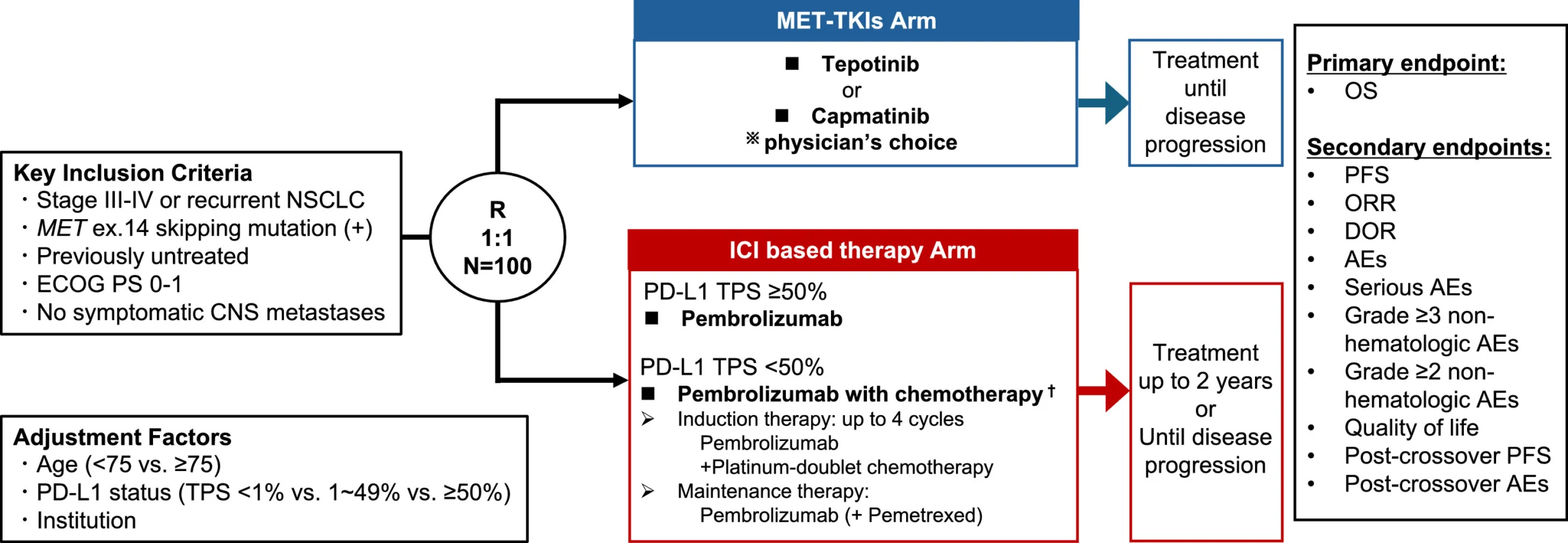
DECIDE-MET is an open-label, multicenter, randomized phase III trial planning to enroll 100 patients with previously untreated advanced NSCLC harboring METex14 skipping mutations. Patients are randomized 1:1, with allocation adjusted for age, PD-L1 TPS, and institution.
In the targeted-therapy arm, patients receive either tepotinib 500 mg once daily or capmatinib 400 mg twice daily, selected by the treating physician.
The comparator is not a single fixed immunotherapy regimen. Instead, treatment is determined by PD-L1 expression. Patients with PD-L1 TPS ≥50% receive pembrolizumab monotherapy, while those with PD-L1 TPS <50% receive pembrolizumab plus platinum-doublet chemotherapy according to histology. ICI-based therapy can continue for up to two years or until progression or unacceptable toxicity.
This design is important for interpreting the trial. DECIDE-MET is not simply a head-to-head comparison of pembrolizumab and a MET inhibitor. It compares a molecularly targeted strategy with a clinically adapted immunotherapy strategy, using PD-L1 to determine whether checkpoint blockade is given alone or with chemotherapy.
Why Overall Survival Matters More Than First-Line Tumor Control
The primary endpoint is overall survival (OS), with progression-free survival (PFS), objective response rate, duration of response, adverse events, and quality of life included as secondary endpoints.
Choosing OS is particularly relevant because patients can potentially receive both therapeutic approaches during the course of their disease. Post-progression treatment is not mandated, but crossover is recommended in both directions, and the study will evaluate post-crossover PFS and toxicity among patients who subsequently receive the alternative strategy.
This shifts the scientific question from immediate tumor control to treatment sequencing. If both MET inhibition and immunotherapy are active, the clinically important issue becomes whether beginning with one strategy influences long-term survival, tolerability, or the effectiveness of the therapy that follows.
A Noninferiority Trial With an Unusual Hypothesis
DECIDE-MET is designed to test whether ICI-based therapy is noninferior, rather than superior, to MET-TKI therapy for OS.
The investigators estimated a 3-year OS rate of 30% with MET-TKIs and 38% with ICI-based therapy, based on available trial and retrospective evidence. The protocol uses a noninferiority margin corresponding to an OS hazard ratio of 1.22 and plans to enroll 100 patients.
That distinction matters. A finding of noninferior survival would not establish immunotherapy as biologically superior to MET inhibition. It could, however, challenge the assumption that MET-targeted therapy must always be the first treatment used.
The investigators are also planning analyses based on restricted mean survival time (RMST), in part to account for the possibility of delayed separation or a long-term survival tail with ICI-based treatment. Safety and quality of life are incorporated into the broader assessment of treatment benefit.
High PD-L1 Meets an Actionable Driver
The most interesting immuno-oncology question raised by DECIDE-MET may be how to interpret high PD-L1 expression when it coexists with a targetable oncogenic alteration.
In NSCLC without actionable drivers, PD-L1 TPS ≥50% can support first-line pembrolizumab monotherapy. But the presence of high PD-L1 does not necessarily mean that the underlying tumor biology is equally dependent on an effective antitumor immune response across molecular subtypes.
DECIDE-MET places these two biomarkers in direct clinical competition: METex14 identifies a therapeutic molecular dependency, while PD-L1 may identify susceptibility to immune checkpoint blockade.
Patients are enrolled regardless of PD-L1 status, while PD-L1 is used both as a randomization factor and to determine treatment within the ICI arm. This should allow the study to explore whether PD-L1 retains meaningful treatment-selection value within METex14-mutant disease, although the modest sample size will limit definitive subgroup conclusions.
The ICI Arm Reflects Practice, but Complicates Interpretation
A notable feature—and limitation—of DECIDE-MET is the heterogeneity of its experimental strategy.
Patients with PD-L1 TPS ≥50% receive pembrolizumab alone, whereas those with lower expression receive chemoimmunotherapy. Any comparison between the overall ICI and MET-TKI groups therefore combines two different treatment regimens.
The investigators explicitly acknowledge this issue. Their rationale is pragmatic: the ICI arm is intended to reproduce how pembrolizumab-based first-line therapy is selected according to PD-L1 expression in routine NSCLC treatment rather than impose an artificial uniform regimen. The primary OS analysis is consequently stratified by PD-L1 status.
This approach makes DECIDE-MET particularly useful as a strategy trial, but potentially less straightforward as a study of the intrinsic efficacy of checkpoint blockade itself.
Tolerability May Matter as Much as Efficacy
The characteristics of the METex14 population add another dimension to the comparison. Patients with this alteration tend to be older, making chronic toxicity and treatment burden especially relevant.
In the MET-TKI trials cited by the investigators, grade ≥3 adverse events occurred in 64.9%–71% of patients, while treatment discontinuation due to adverse events occurred in 18.0%–24.9%. The toxicity profile of immunotherapy is fundamentally different, and chemoimmunotherapy carries its own substantial treatment burden.
For this reason, DECIDE-MET includes quality of life as a secondary endpoint and specifically evaluates clinically relevant nonhematologic toxicity. Age ≥75 years is also incorporated as a randomization factor.
If long-term survival proves similar between strategies, these outcomes could become important when choosing which treatment should come first.

ESMO 2026 Lung Cancer: 10 Abstracts to Watch
What DECIDE-MET Could Tell Us
The implications of DECIDE-MET extend beyond one rare molecular subgroup.
Modern NSCLC treatment increasingly depends on multiple biomarkers that do not always point in the same therapeutic direction. A patient with METex14 skipping and PD-L1 TPS of 90%, for example, simultaneously carries a validated molecular target and a biomarker ordinarily associated with sensitivity to checkpoint inhibition. Current treatment paradigms prioritize the actionable driver, but randomized evidence directly validating that sequencing assumption in METex14 disease has been lacking.
DECIDE-MET is designed to test that assumption rather than accept it.
The trial will also provide prospective information on a second question: whether the order in which targeted therapy and immunotherapy are delivered affects the overall therapeutic course. Because crossover is recommended and post-crossover outcomes will be assessed, the study may offer insight into sequencing that cannot be obtained from first-line response rates alone.
You Can Read Full Article Here