





The introduction of immune checkpoint inhibitors has significantly improved outcomes for patients with high-risk muscle-invasive urothelial carcinoma following radical cystectomy. However, a major challenge remains identifying which patients truly benefit from adjuvant immunotherapy and which patients may instead be exposed primarily to treatment-related toxicity.
Circulating tumor DNA (ctDNA) has already emerged as one of the most promising biomarkers for detecting minimal residual disease after surgery. Patients with detectable ctDNA generally have a substantially higher risk of recurrence and appear to derive greater benefit from adjuvant immune checkpoint inhibition. Whether ctDNA can also predict the risk of immune-related adverse events has remained largely unknown.
A recent study by Thomas Powles, K. Madjar, B.I. Balas, C. Carter, L. Essioux, A. Tehrani, S. Mariathasan, D. Heinzmann, F. Arellano, R. Mohindra, and G.S. Chandler, titled “Higher Rates of Immune-Related Adverse Events in Circulating Tumor DNA (ctDNA)-Negative Patients Following Adjuvant Checkpoint Inhibitor Therapy,”explored this important question using data from the phase III IMvigor010 trial.
Why Was This Study Important?
Most biomarker studies have focused on identifying patients who are most likely to benefit from immunotherapy. This analysis took a different approach.
The investigators asked whether ctDNA status could simultaneously identify patients with a lower probability of therapeutic benefit and a higher likelihood of developing immune-related toxicity. If confirmed, ctDNA could become an important tool not only for predicting efficacy but also for improving treatment selection and avoiding unnecessary exposure to checkpoint inhibitors.
Study Design
The investigators performed a post hoc biomarker analysis of the randomized phase III IMvigor010 trial.
The original study compared one year of adjuvant atezolizumab with observation in patients with high-risk muscle-invasive urothelial carcinoma following radical cystectomy.
For this analysis, patients were categorized according to their ctDNA status before treatment and during follow-up. The incidence of immune-related adverse events was then compared between ctDNA-positive and ctDNA-negative groups to determine whether molecular residual disease status influenced the toxicity profile of immunotherapy.
Why Could ctDNA Influence Toxicity?
The biological hypothesis behind this analysis is particularly interesting. Patients with detectable ctDNA have microscopic residual disease that continues to provide tumor antigens capable of stimulating the immune system. In these patients, activated immune cells may remain focused primarily on eliminating residual cancer cells.
By contrast, patients without detectable ctDNA may have little or no remaining tumor antigen. Following checkpoint blockade, the activated immune response may therefore be directed less toward tumor tissue and relatively more toward normal organs, potentially increasing the risk of immune-related adverse events.
Although this mechanism remains hypothetical, it provides a plausible biological explanation for the observed differences in toxicity between ctDNA-positive and ctDNA-negative patients.
Primary Analysis: Immune-Related Adverse Events
The primary objective of this biomarker analysis was to determine whether baseline ctDNA status was associated with the development of immune-related adverse events during adjuvant atezolizumab therapy.
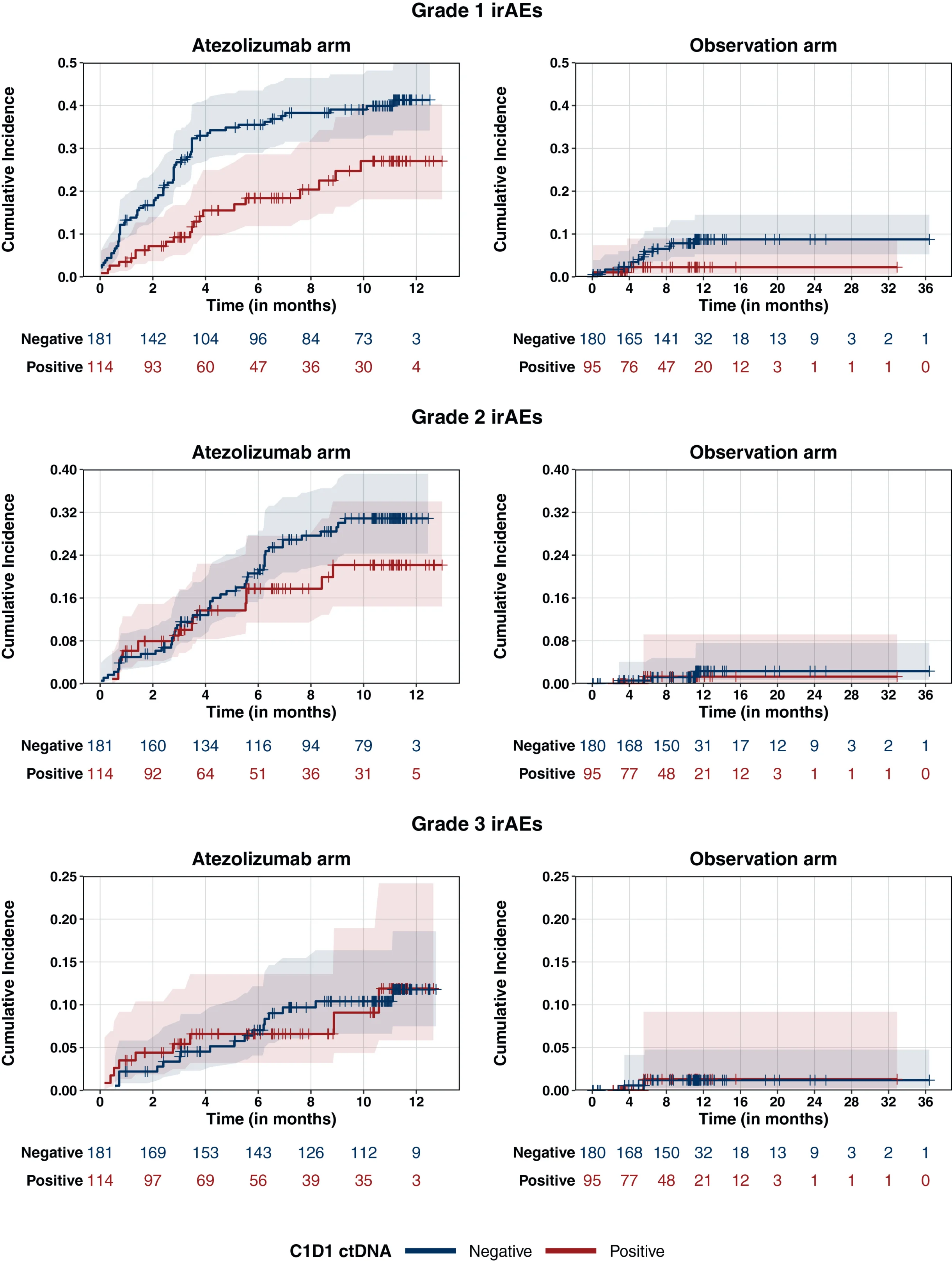
The investigators observed a clear difference between molecular subgroups. Patients who were ctDNA-negative consistently experienced immune-related adverse events more frequently than patients with detectable ctDNA, suggesting that the presence of minimal residual disease may influence the pattern of immune activation after checkpoint inhibition.
- ctDNA-negative patients experienced higher rates of immune-related adverse events than ctDNA-positive patients.
- The difference was observed despite ctDNA-negative patients generally having a lower risk of disease recurrence.
- The findings remained consistent across multiple analyses evaluating baseline and longitudinal ctDNA measurements.
Clinical Interpretation
These findings highlight an important principle in precision immuno-oncology.
Traditionally, biomarkers have been developed to predict which patients are most likely to respond to treatment. This study suggests that ctDNA may also identify patients who are less likely to benefit while simultaneously being more vulnerable to immune-related toxicity.
If validated in prospective clinical trials, ctDNA could therefore help clinicians balance both efficacy and safety when deciding whether to recommend adjuvant checkpoint inhibition after surgery. Rather than serving only as a prognostic marker for recurrence, ctDNA may become a biomarker for individualized risk-benefit assessment before immunotherapy is initiated.
Why These Findings Matter
The concept introduced by this study extends beyond urothelial carcinoma.
As ctDNA testing becomes increasingly integrated into clinical oncology, its role may expand from detecting minimal residual disease to guiding treatment intensity and minimizing unnecessary toxicity. Biomarkers that can predict both therapeutic benefit and treatment-related harm are essential for advancing truly personalized cancer care.
The authors emphasize that these findings are hypothesis-generating and require prospective validation. Nevertheless, the study provides one of the first demonstrations that molecular residual disease status may influence not only the efficacy of immunotherapy but also its safety profile, opening a new direction for biomarker-driven immunotherapy research.
Read Full Article Here