Locally advanced pancreatic cancer remains one of the most difficult gastrointestinal malignancies to treat. Many patients present with unresectable disease, and despite progress with combination chemotherapy, long-term outcomes remain limited. Expanding treatment options in this setting continues to be a major clinical priority, particularly strategies that could improve tumor control and increase the likelihood of surgical resection.
One therapeutic approach that has drawn attention is targeting the tumor microenvironment. Connective tissue growth factor (CTGF), a mediator involved in fibrosis and stromal remodeling, is overexpressed in pancreatic cancer and has been associated with aggressive disease biology. Pamrevlumab, a monoclonal antibody targeting CTGF, showed encouraging safety and activity in earlier studies, leading to evaluation in a larger randomized phase III trial.
The results of the LAPIS study were published online on May 22, 2026, in JCO Oncology Advances.
Title: LAPIS: A Phase III Randomized, Placebo-Controlled, Double-Blind Trial of Neoadjuvant Pamrevlumab With Chemotherapy for Patients With Locally Advanced Pancreatic Cancer
Authors: Vincent Picozzi, Khurum Khan, Pascal Hammel, Michele Reni, Daniel Lin, Woo Jin Lee, Roberto A. Pazo-Cid, Vaibhav Sahai, Andrés Muñoz, Jianjun Liu, Ende Zhao, Teresa Macarulla, and Ewa Carrier.
Read more about Pancreatic Cancer Cure Rate on OncoDaily.
Study Design and Treatment Approach
LAPIS was an international phase III randomized, placebo-controlled, double-blind trial conducted across 72 sites in North America, Europe, and Asia. The study enrolled 284 patients with previously untreated, unresectable locally advanced pancreatic cancer. Patients were randomly assigned 1:1 to receive investigator’s choice chemotherapy—either gemcitabine plus nab-paclitaxel or FOLFIRINOX—together with pamrevlumab or placebo.
Pamrevlumab was administered intravenously at 35 mg/kg every two weeks on days 1 and 15, with an additional dose on day 8 of cycle 1. Treatment continued for up to six cycles. A distinctive feature of LAPIS was its structured surgical evaluation. Eligibility for surgical exploration was assessed using a composite approach that included CA19-9 decline, FDG-PET metabolic response, RECIST v1.1 response, and resectability status, with guidance from an independent central review panel including radiologists, surgeons, and oncologists.
The primary endpoint was overall survival. Secondary endpoints included event-free survival, progression-free survival, objective response rate, surgical outcomes, and safety.
What Is Pamrevlumab?
Pamrevlumab, also known as FG-3019, is a fully human monoclonal antibody that targets connective tissue growth factor, or CTGF. CTGF is a secreted glycoprotein involved in tissue remodeling and fibrosis, and it has been shown to be overexpressed in pancreatic cancer. In locally advanced pancreatic cancer, elevated CTGF has been associated with worse survival outcomes.
The rationale for pamrevlumab is based on blocking CTGF activity within the tumor microenvironment. By inhibiting CTGF, pamrevlumab was evaluated as a way to target the tumor microenvironment in locally advanced pancreatic cancer, although the exact pathway by which CTGF inhibition exerts its effects remains unclear. Earlier phase I/II studies suggested favorable safety and encouraging activity, including increased eligibility for surgical resection, which led to the phase III LAPIS trial.
No Survival Benefit With Pamrevlumab
At the primary analysis, median overall survival was 17.3 months in the pamrevlumab arm compared with 17.9 months in the placebo arm. The primary endpoint was not met:
- HR 1.08 (95% CI 0.83–1.41; P=.5487).
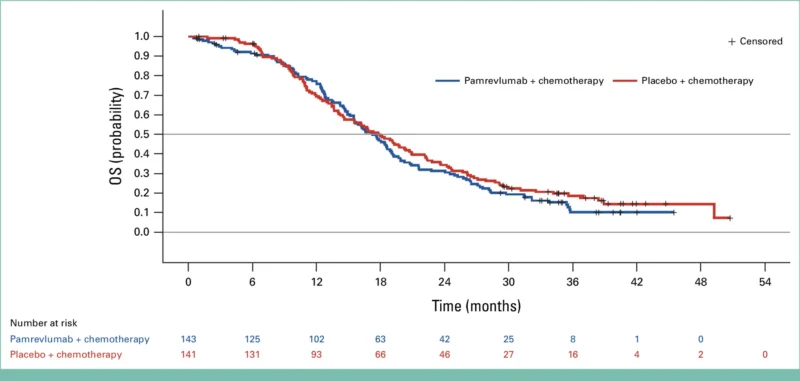
Subgroup analyses also did not identify any meaningful survival advantage with pamrevlumab, including across chemotherapy backbones. Median event-free survival was 5.7 months with pamrevlumab and 5.8 months with placebo:
- HR 1.05 (95% CI 0.78–1.39; P=.7738).
Median progression-free survival was 9.4 months in both treatment groups:
- HR 1.01 (95% CI 0.65–1.56; P=.9731).
These findings showed no improvement in overall survival, event-free survival, or progression-free survival when pamrevlumab was added to standard chemotherapy.
Response and Surgical Outcomes
Objective response rate was lower in the pamrevlumab arm than in the placebo arm. Partial responses were observed in 30.1% of patients receiving pamrevlumab compared with 45.4% in the placebo group:
- Odds ratio 0.50 (95% CI 0.31–0.82; P=.0054).
No complete responses were reported in either arm. Among the total study population, 188 patients (66.2%) completed six months of therapy and were considered for surgical exploration; 61 patients (21.5%) were recommended for surgery, 52 ultimately underwent surgery, and 38 patients (13.4%) achieved protocol-defined resection with R0 or R1 margins.
The study also reported 79.8% concordance between the central review panel and site surgeons, highlighting the complexity of surgical decision-making in locally advanced pancreatic cancer.
Safety Profile
The safety profile was generally consistent with expected chemotherapy-related toxicity. Nearly all patients experienced treatment-emergent adverse events:
- 100.0% in the pamrevlumab arm
- 99.3% in the placebo arm
Grade 3 or higher adverse events occurred in:
- 86.6% with pamrevlumab
- 83.7% with placebo
The most common treatment-related adverse events across both groups included fatigue, diarrhea, nausea, and anemia. Importantly, pamrevlumab did not appear to add significant overall toxicity compared with chemotherapy alone. Treatment-emergent adverse events leading to death occurred in seven patients (4.9%) in the pamrevlumab arm and five patients (3.5%) in the placebo arm. One death in the pamrevlumab arm—due to pneumonia—was considered related to pamrevlumab.
Takeaway
The LAPIS phase III trial did not show a benefit from adding pamrevlumab to standard chemotherapy for patients with locally advanced pancreatic cancer. Overall survival, event-free survival, progression-free survival, and response outcomes were not improved with pamrevlumab, while surgical outcomes did not suggest a clear added benefit.
At the same time, LAPIS represents one of the largest patient cohorts studied in a locally advanced pancreatic cancer trial to date and offers important guidance for future trial design. The incorporation of biological markers such as CA19-9, FDG-PET imaging, centralized radiology and surgical review, and multidimensional endpoints such as event-free survival may help refine how locally advanced pancreatic cancer is evaluated in future studies.
While pamrevlumab did not improve outcomes in this trial, LAPIS adds valuable evidence to the field and helps define a stronger framework for future research in locally advanced pancreatic cancer.
The full article is available in JCO Oncology Advances.

Read more about Tumor Vaccines for Pancreatic Cancer on OncoDaily.