The AGEO-NEO-MSI Trial was presented by Annalice Gandini, MD, during an oral presentation at the ESMO Gastrointestinal Cancers Congress 2026. The study examined real-world outcomes of neoadjuvant immune checkpoint inhibitors in patients with non-metastatic dMMR/MSI colorectal cancer.
Although prospective trials have reported major responses with preoperative immunotherapy in this molecular subgroup, evidence from routine clinical practice remains limited. AGEO-NEO-MSI evaluated 316 patients across 30 international centers, assessing complete response, pathological outcomes, event-free survival, non-operative management, and immune-related toxicity. It also explored how single-agent versus doublet immunotherapy strategies may influence response and safety.
Background
The AGEO-NEO-MSI study, presented at the ESMO Gastrointestinal Cancers Congress 2026, examined real-world outcomes of neoadjuvant immune checkpoint inhibitor therapy in patients with non-metastatic deficient mismatch repair/microsatellite instability-high (dMMR/MSI) colorectal cancer.
Neoadjuvant immunotherapy has produced striking responses in prospective studies of dMMR/MSI colorectal cancer. However, published trial populations are often highly selected, and questions remain about how treatment performs across routine clinical practice, which regimen should be used, and whether clinical complete response can reliably guide non-operative management.
AGEO-NEO-MSI was designed to address these questions in a large, international cohort. It evaluated response, surgical and pathological outcomes, event-free survival, treatment-related toxicity, and the potential influence of single-agent versus doublet immune checkpoint blockade.
Methods
AGEO-NEO-MSI is an ongoing ambispective international observational study conducted across 30 centers. It included patients with localized dMMR/MSI colorectal cancer treated with neoadjuvant immune checkpoint inhibitors before surgery or a non-operative management strategy.
The primary endpoint was complete response, defined as either pathological complete response after surgery or clinical complete response in patients managed without immediate surgery.
Secondary endpoints included event-free survival, safety, pathological response, surgical outcomes, and use of non-operative management.
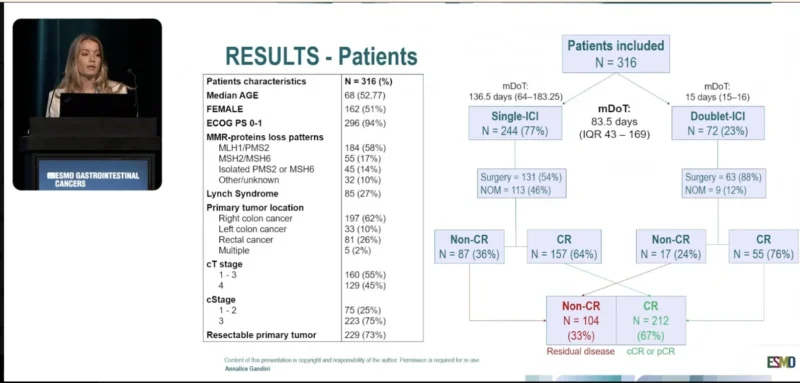
A total of 316 patients were included. Their median age was 68 years, 51% were female, and 94% had ECOG performance status 0–1. Most tumors were conventional adenocarcinomas, with colon primaries accounting for 74% of cases. Stage III disease was present in 73%, while 45% of patients had cT4 tumors, reflecting a clinically high-risk population.
Most patients received single-agent immunotherapy:
- Single-agent ICI: 244 patients (77%)
- Doublet ICI: 72 patients (23%)
The median treatment duration across the cohort was 83.5 days. The meeting slides showed a clear difference in treatment exposure between groups: single-agent treatment was generally administered over a longer period, while doublet treatment was commonly delivered as a short-course strategy.
This difference is important when interpreting treatment outcomes, because response may reflect not only the type of immune checkpoint inhibitor regimen but also the duration and timing of treatment.
Neoadjuvant immunotherapy produced substantial tumor regression across the cohort. Overall, 212 of 316 patients (67%) achieved a complete response.
Best response assessment showed:
- Clinical complete response: 101 patients (34%)
- Partial response: 126 patients (42%)
- Stable disease: 60 patients (20%)
- Progressive disease: 10 patients (3%)
The complete response rate differed by treatment strategy. Among patients receiving single-agent immunotherapy, 157 of 244 patients (64%) achieved complete response. In the doublet-ICI group, 55 of 72 patients (76%) achieved complete response.
In an exploratory adjusted analysis, a short-course doublet-ICI strategy of less than one month was associated with a higher likelihood of complete response compared with long-course single-agent therapy. The adjusted odds ratio was 2.46 (95% CI, 1.21–5.38; p=0.017).
Although this result is notable, it should be interpreted carefully. AGEO-NEO-MSI was observational rather than randomized, and treatment selection may have been influenced by patient characteristics, tumor features, clinical practice patterns, or institutional preference.
Surgery, Pathology, and Organ Preservation
A major finding of the study was the high rate of deep pathological response among patients who underwent surgery.
Among resected patients, 75% achieved a major pathological response, including 64% with pathological complete response. Slides presented during the session reported pathological complete response in 124 patients (66%), major pathological response without pCR in 21 patients (11%), and no major pathological response in 44 patients (23%).
Clinical complete response was strongly associated with pathological response. The positive predictive value of clinical complete response for pathological complete response or major pathological response was 93% to 96%.
This means that when a clinical complete response was observed, it was highly likely to correspond to a deep pathological response in patients who proceeded to surgery. However, the sensitivity was only approximately 20%, meaning that many patients with pathological complete response may not be identified through clinical response assessment alone.
This finding has direct implications for organ preservation. Non-operative management was used in 25% of colon cancers and 77% of rectal cancers, driven by clinical complete response. The higher use of surveillance-based management in rectal cancer reflects the importance of avoiding surgery, permanent stoma, or long-term functional impairment when a sustained clinical complete response is achieved.
Survival Outcomes
- At a median follow-up of 16 months, event-free survival outcomes were encouraging.
- The 12-month event-free survival rate was 92%, while the 24-month event-free survival rate was 86%.
These findings indicate that the high complete response rates were accompanied by favorable short-term disease control. However, longer follow-up remains essential, particularly for patients managed without surgery, to determine the durability of response, local regrowth patterns, and long-term survival outcomes.
Safety
Immune-related adverse events occurred in 35.1% of patients. Grade 3 or higher immune-related adverse events were reported in 6.3%, and toxicity-related treatment discontinuation occurred in 8.9%. There was one treatment-related death, representing 0.3% of the study population.
The most commonly reported immune-related toxicities were:
- Skin toxicity: 12.0%
- Thyroiditis: 10.4%
- Rheumatological events: 7.3%
- Colitis: 4.8%
- Hepatitis: 3.5%
Any-grade immune-related toxicity was similar between treatment approaches, occurring in 34.4% of patients receiving single-agent ICI and 37.5% of those receiving doublet treatment.
Severe toxicity was more common with doublet therapy. Grade 3 or higher immune-related adverse events occurred in 12.5% of doublet-treated patients compared with 4.5% in the single-agent group (p=0.024). Grade 3 or higher hepatitis was also more frequent with doublet therapy, reported in 4.2% versus 0.4% of patients receiving single-agent treatment (p=0.039).
Conclusion
AGEO-NEO-MSI represents the largest real-world dataset reported to date for neoadjuvant immunotherapy in localized dMMR/MSI colorectal cancer. The study showed a 67% complete response rate, frequent pathological complete responses, and favorable early event-free survival.
The findings support the integration of neoadjuvant immune checkpoint inhibition into clinical practice for this molecularly defined population. They also reinforce the potential for organ preservation, particularly in rectal cancer, where many patients with clinical complete response were managed without immediate surgery.
Short-course doublet immunotherapy may increase complete response rates, but this possible benefit must be balanced against a higher rate of severe immune-related toxicity. Longer follow-up and prospective comparative trials will be needed to define the optimal regimen, treatment duration, and criteria for safely selecting patients for non-operative management.