International expertise and hands-on training bring image-guided cancer care into focus in Athens.
At one workshop station, participants practised ultrasound-guided needle techniques on training models. At another, a virtual-reality simulator offered a different way to approach procedural training. These were fitting scenes for the 4th Athenian Days of Interventional Oncology (ADIO 2026) (Dimitrios Kelekis), a meeting concerned not only with what image-guided cancer treatment can achieve, but also with how physicians learn to deliver it.
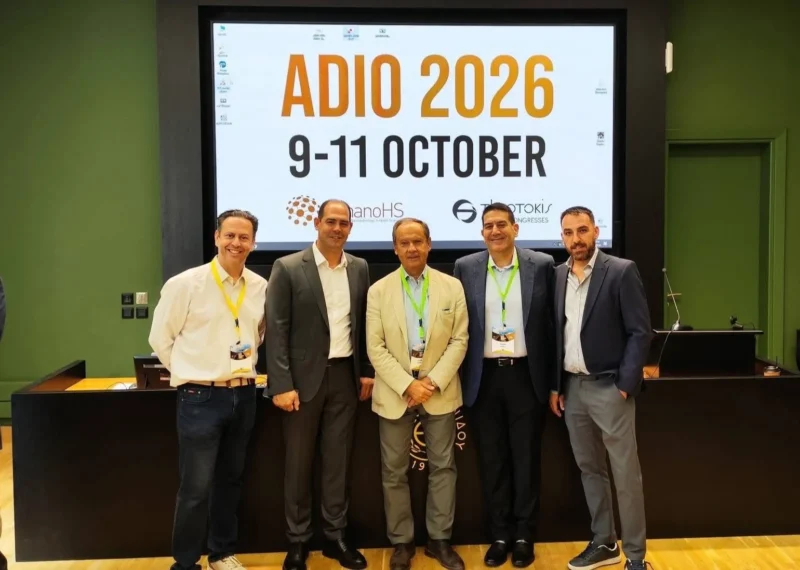
Held at the Eugenides Foundation in Athens from 9 to 11 October, the congress brought together interventional radiologists, oncologists and researchers from Greece and abroad. Professor Alexis Kelekis chaired the meeting, with Professors Efstathios Efstathopoulos and Achilleas Chatzioannou as co-chairpersons.
A broader role in cancer care
Interventional oncology now encompasses much more than isolated procedures. Ablation, transarterial treatments and image-guided interventions for painful bone disease can be considered at different points in a patient’s cancer journey — sometimes with local tumor control as the aim, sometimes to relieve symptoms or address treatment-related complications.
That range was evident in sessions on hepatocellular carcinoma, lung cancer, musculoskeletal tumors, sarcomas and palliation. The discussions brought clinical decision-making into the same room as technical innovation: when to intervene, which patients are likely to benefit and how outcomes should be assessed.
International faculty, practical questions
The faculty included Constantinos T. Sofocleous of Memorial Sloan Kettering Cancer Center, who addressed the role of ablation therapy, and Sean Tutton, whose contribution focused on robotics in musculoskeletal interventions. Professor Laura Crocetti and Mardis Karlsdottir contributed to the discussion of IASIOS accreditation and its development in Greece, alongside Greek experts including Miltiadis Krokidis.
Quality was a particularly relevant theme. As the specialty expands, consistent standards for patient selection, safety, documentation and follow-up matter as much as access to new devices. The attention given to accreditation made clear that interventional oncology is developing not only its techniques, but also the systems through which those techniques are delivered.
Outside the lecture program, hands-on sessions and equipment demonstrations brought these ideas closer to daily practice. Ultrasound-guided techniques, simulation tools and cryoablation technology were among the approaches on display. For early- career physicians, the opportunity to see and handle these technologies is a useful complement to the evidence discussed in the auditorium.
Where specialties meet
One exchange during the congress offered a concise answer to a familiar question in multidisciplinary oncology: what happens when two specialties appear to share the same therapeutic territory?
Asked about possible competition between interventional oncology and radiation oncology, Professor Kelekis suggested that what looks like a point of division may instead be where the two disciplines come together, to the patient’s benefit.
The distinction matters. As local treatments become more precise, physicians will increasingly need to discuss not only which technique is available, but which option or sequence of options best suits the individual patient. That requires collaboration rather than a contest over professional boundaries.
A meeting with a legacy
ADIO bears the name of Professor Dimitrios Kelekis, a pioneer of interventional radiology in Greece. The tribute also gives the congress a sense of continuity: the field’s early development is acknowledged while its current practitioners examine new evidence, technologies and training methods.
Under Professor Alexis Kelekis’ scientific leadership, this year’s meeting offered a forum where established experts and younger clinicians could exchange views across institutions and disciplines. Its value lay in that combination of rigorous clinical discussion, practical education and international contact.
For interventional oncology, the next challenge is not simply to do more procedures. It is to define more clearly when they help, measure their results and ensure that patients can benefit from them safely. ADIO 2026 placed those questions firmly on the agenda.
Written by Eftychia Tataridou, MD