
Breast cancer has repeatedly served as a proving ground for new forms of targeted therapy, from endocrine manipulation and HER2 blockade to antibody–drug conjugates. In 2026, the field reached another important milestone with the first regulatory approval of a PROTAC, establishing targeted protein degradation as a clinically viable therapeutic strategy rather than a purely experimental concept.
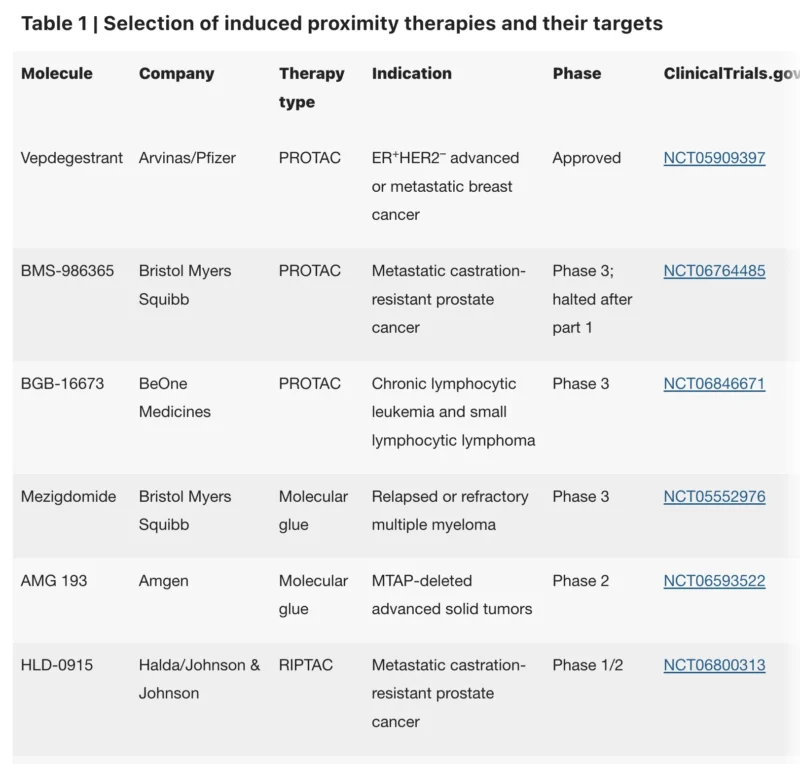
A Nature Medicine feature published on September 3, 2026, places this development within the broader field of induced proximity, a therapeutic approach in which small molecules are designed to bring proteins together and create biological interactions that would not normally occur. The immediate relevance for breast oncology is vepdegestrant, an oral estrogen receptor degrader approved for ER-positive, HER2-negative, ESR1-mutated advanced breast cancer. Its approval validates a fundamentally different way of manipulating estrogen receptor biology and may have implications well beyond a single endocrine therapy.
For breast oncologists, the key development is not simply that another ER-directed agent has entered the treatment landscape. It is that a platform capable of removing a disease-relevant protein rather than merely inhibiting it has now demonstrated sufficient efficacy, safety, and pharmacologic feasibility to reach routine clinical use.
Why Vepdegestrant Is More Than Another Endocrine Therapy
Endocrine therapy has long depended on reducing estrogen availability, blocking estrogen receptor signaling, or degrading the receptor itself. The emergence of ESR1 mutations has complicated this strategy because these alterations can promote ligand-independent estrogen receptor signaling and contribute to resistance after prolonged endocrine pressure.
Vepdegestrant approaches the estrogen receptor through a different pharmacologic mechanism. As a PROTAC, it uses a bifunctional molecule with one region binding the target protein and another recruiting the cell’s endogenous protein-degradation machinery. The resulting ternary complex directs the target toward destruction, potentially eliminating rather than simply suppressing its biological function.
That mechanism distinguishes targeted protein degradation from conventional receptor antagonism. Instead of requiring continuous inhibition of a receptor’s functional site, a degrader can reduce the amount of target protein available within the cell. In principle, this may offer advantages in tumors in which persistent target expression remains central to disease biology despite acquired resistance.
The significance of this approach was confirmed clinically when vepdegestrant became the first PROTAC to receive FDA approval. In phase III testing in ESR1-mutated ER-positive, HER2-negative advanced breast cancer, the treatment improved progression-free survival compared with fulvestrant and reduced the risk of disease progression or death by 43%.
ESR1-Mutant Disease Was an Appropriate First Test of the Platform
The estrogen receptor is an especially logical target for the first successful PROTAC in oncology. ER dependence remains central to the biology of most HR-positive breast cancers, while acquired ESR1 mutations represent one of the best-characterized mechanisms of endocrine resistance.
From a drug-development perspective, this creates an ideal setting in which to validate a new therapeutic technology. The target is already known to be clinically important, the resistance biology is well established, and there is a clear need for more effective strategies after endocrine escape.
This is precisely why the first clinical success of a novel platform often occurs against a familiar target rather than an entirely new one. The Nature Medicine article notes that many early proximity-based programs have deliberately focused on validated targets such as estrogen and androgen receptors because proving the technology against established biology reduces one layer of uncertainty.
For breast cancer, that makes vepdegestrant both a therapeutic advance and a platform-validation experiment. Its success demonstrates that targeted protein degradation can work in patients, but the broader question is whether the same technology can eventually address proteins that conventional breast cancer therapies cannot effectively target.
From Target Inhibition to Target Removal
The distinction between inhibition and degradation may become increasingly important as resistance mechanisms become more complex.
Traditional targeted therapies often depend on precise interaction with a functional binding pocket. Changes in protein conformation or target mutation can reduce drug affinity while leaving the protein biologically active. A degrader does not necessarily need to inhibit the same functional site. Instead, it must bind the target sufficiently to recruit degradation machinery and trigger protein elimination.
This creates the possibility that future degraders could remain active in biological contexts where classical inhibitors lose efficacy.
The principle may be especially relevant in hormone-driven disease. Estrogen receptor signaling can remain biologically important even after multiple lines of endocrine therapy, and resistant tumors may continue to depend on ER despite developing mutations that weaken the activity of earlier endocrine agents. A degradation strategy therefore offers a mechanistically different way of maintaining pressure on a persistent oncogenic dependency.
That does not mean PROTACs will automatically overcome every form of endocrine resistance. Tumors may eventually escape through target loss, altered degradation machinery, pathway switching, or completely ER-independent biology. Nevertheless, the platform expands the pharmacologic options available for manipulating a familiar breast cancer target.
Breast Cancer Could Become an Important Testing Ground for Induced Proximity
The relevance of induced proximity to breast cancer is not limited to vepdegestrant.
The broader technology includes several different approaches. PROTACs recruit proteins to degradation machinery. Molecular glues induce or stabilize new interactions between proteins, often creating degradation or functional consequences through smaller molecular structures. RIPTACs, or regulated induced proximity-targeting chimeras, take the concept further by using a tumor-enriched protein to recruit and disrupt an essential cellular regulator.
For breast oncology, these technologies raise a potentially important future question: could proteins that are highly expressed in particular breast cancer subtypes become therapeutic anchors even if they are not classical oncogenic drivers?
That would represent a meaningful expansion of precision medicine. Current biomarker-driven treatment generally asks whether an alteration directly drives tumor growth or predicts sensitivity to a specific drug. Induced proximity could potentially allow a different strategy, in which a tumor-associated protein is exploited because of where and how strongly it is expressed rather than because its own enzymatic activity must be inhibited.
The Nature Medicine report notes that a second RIPTAC program directed toward ER-positive breast cancer is already entering clinical development, suggesting that hormone receptor–positive disease may remain an important proving ground for next-generation proximity therapeutics.
Molecular Glues May Broaden the Concept Further
Molecular glues provide another path toward therapeutic proximity. Unlike PROTACs, which typically contain separate binding regions for the target and the recruited protein, molecular glues can stabilize a new interaction directly between two proteins.
Some successful drugs were later discovered to operate through this mechanism, including thalidomide and related immunomodulatory agents. The challenge now is to move from serendipitous discovery toward rationally designed molecular glues capable of producing predefined biological effects.
For breast cancer, the long-term potential is considerable. Many important proteins involved in transcription, chromatin regulation, DNA repair, and lineage identity remain difficult to target with conventional small molecules. If molecular-glue or degrader approaches can manipulate those proteins indirectly, the range of actionable breast cancer biology could expand beyond currently druggable receptors and kinases.
This remains largely a future possibility rather than an established clinical reality. Vepdegestrant is therefore important partly because it provides the first evidence that the pharmacologic principles underlying this field can survive the transition from medicinal chemistry into patient care.
Could Proximity-Based Therapy Alter Resistance Patterns?
One of the most interesting questions is how tumors will develop resistance to induced-proximity drugs.
Traditional targeted therapies frequently fail through point mutations that interfere with drug binding, amplification of bypass pathways, or complete shifts in cellular lineage. Proximity-based medicines may face some of the same mechanisms, but the resistance landscape could also differ because their activity depends on formation of larger multi-protein complexes.
The Nature Medicine article notes the hypothesis that RIPTACs, in particular, may be more difficult to escape through a single mutation because they depend on broader protein–protein interfaces rather than a small catalytic pocket. However, the authors and developers also acknowledge that resistance will almost certainly emerge and that its mechanisms remain poorly characterized.
This is highly relevant to breast cancer, where sequential treatment inevitably reshapes tumor biology. The future value of induced-proximity therapies may therefore depend not only on initial response but also on whether they generate resistance mechanisms that remain targetable with existing endocrine therapy, ADCs, kinase inhibitors, or other degraders.
If resistance pathways are complementary rather than overlapping, combination or sequential strategies could become particularly attractive.
The Platform Could Expand the Definition of a Drug Target
Perhaps the most important long-term implication is that induced proximity challenges the conventional definition of “druggable.”
Classic small-molecule development usually depends on identifying a suitable pocket within a protein that can be occupied by a compound with sufficient affinity and selectivity. Many proteins central to cancer biology lack such structures and have consequently been considered difficult or impossible to target.
Proximity-based therapy changes that requirement. A molecule may not need to inhibit the protein directly if it can simply bind to it strongly enough to recruit another cellular component. Advances in screening technologies are increasingly identifying such binding ligands, creating a potentially much larger toolkit for future drug design.
For breast cancer, this could eventually open therapeutic opportunities involving transcription factors, chromatin regulators, resistance-associated proteins, and lineage-specific dependencies that remain beyond the reach of current drugs.
That prospect should remain distinct from present-day clinical practice, but it explains why the first PROTAC approval is being watched so closely beyond the endocrine therapy community.
Clinical Success Will Depend on More Than Elegant Biology
The mechanistic appeal of induced proximity does not guarantee clinical success.
PROTACs must achieve adequate oral or systemic exposure, enter the relevant cells, bind both intended partners, generate a productive ternary complex, and induce degradation at concentrations that remain tolerable. Molecular glues face similar challenges in controlling specificity, while RIPTACs require sufficient differential expression of the selected tumor protein to create a therapeutic window between malignant and normal tissue.
The field has already seen programs that did not progress despite compelling biological rationale. The Nature Medicine article emphasizes that not every proximity-based drug will succeed simply because the platform itself has now been validated.
Breast oncology should therefore avoid viewing PROTACs as a universal replacement for existing endocrine therapy. Their role will need to be defined through comparative efficacy, resistance biology, toxicity, sequencing, quality of life, and patient selection, just as with every other new therapeutic class.
Why Vepdegestrant Matters for the Broader Breast Cancer Landscape
The arrival of vepdegestrant comes at a time when HR-positive/HER2-negative metastatic breast cancer is becoming increasingly molecularly stratified. ESR1, PIK3CA, AKT-pathway alterations, germline BRCA status, HER2 expression, and other biomarkers can now influence treatment selection across successive lines.
PROTAC technology adds another dimension to this evolution. It is not simply another biomarker-directed drug class; it changes how the target itself is pharmacologically manipulated.
That distinction may become increasingly relevant as precision oncology moves from selecting drugs according to tumor genotype toward selecting among different therapeutic mechanisms directed against the same biological dependency.
For an ESR1-mutant tumor, the future question may therefore not simply be whether estrogen receptor remains targetable. It may be which method of ER control—antagonism, conventional degradation, PROTAC-mediated degradation, or another proximity-based strategy—offers the greatest depth and durability of disease control in a particular clinical context.
The Bottom Line
The first FDA approval of a PROTAC represents an important milestone for breast cancer and for oncology drug development more broadly. Vepdegestrant has demonstrated that targeted protein degradation can translate into clinically meaningful benefit in ESR1-mutated ER-positive, HER2-negative advanced breast cancer, reducing the risk of progression or death by 43% versus fulvestrant in phase III testing.
Its significance, however, extends beyond a single endocrine therapy. The approval validates the principle that medicines can be designed to manipulate protein relationships rather than merely block protein function. PROTACs can eliminate a target, molecular glues can create new protein interactions, and RIPTACs may eventually exploit tumor-enriched proteins to generate selective lethal complexes.
For breast oncology, this opens a new therapeutic direction. The estrogen receptor has provided the first successful clinical test, but the larger opportunity is whether induced proximity can ultimately make previously inaccessible breast cancer biology therapeutically actionable.
The next phase of targeted therapy may therefore be defined not only by which protein a tumor depends on, but by what can be made to happen when that protein is deliberately brought into proximity with another cellular partner.
That is why the approval of the first PROTAC should be viewed as more than a new drug for ESR1-mutant disease. It may represent the beginning of an entirely new pharmacologic language for breast cancer.
Reference
- Healey N. Induced proximity comes of age. Nature Medicine. Published September 3, 2026. doi:10.1038/d41591-026-00045-z. The article reviews the first regulatory approval of a PROTAC and the expanding development of PROTACs, molecular glues, and RIPTACs.