
TQB2102 HER2 ADC represents an emerging approach in the evolving landscape of HER2-targeted antibody-drug conjugates (ADCs), combining biparatopic HER2 targeting with payload optimisation strategies designed to improve therapeutic delivery and clinical activity in HER2-positive and HER2-low breast cancer.
The clinical success of trastuzumab deruxtecan established the effectiveness of a HER2-targeted ADC platform with a topoisomerase I inhibitor payload and demonstrated meaningful activity across a broader spectrum of HER2 expression levels. However, as multiple HER2-directed ADCs enter clinical development, the field is increasingly focused on identifying which molecular features determine superior efficacy, durability, and safety.
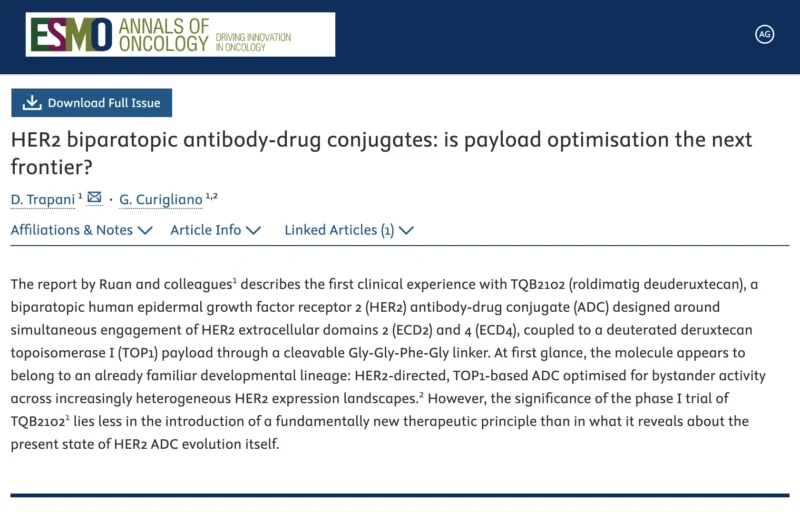
A recent editorial in Annals of Oncology by Dario Trapani and Giuseppe Curigliano discussed the emerging development of HER2 biparatopic ADCs and the potential importance of payload optimisation, highlighting TQB2102 (roldimatig deuderuxtecan) as an example of this evolving strategy.
The central question is shifting from whether HER2 can serve as an effective ADC target to how ADC architecture can be optimized to improve therapeutic outcomes.
HER2 ADCs: From Receptor Targeting to Precision Drug Delivery
The development of HER2 ADCs has progressively moved beyond the traditional concept of HER2 inhibition.
While monoclonal antibodies such as trastuzumab exert antitumor activity through receptor blockade and immune-mediated mechanisms, ADCs use HER2 expression primarily as a mechanism for targeted intracellular drug delivery.
ADC efficacy depends on several interconnected properties:
- Antibody binding characteristics
- HER2 internalisation
- Linker stability
- Intracellular payload release
- Cytotoxic potency
- Bystander effect
The success of trastuzumab deruxtecan demonstrated that improvements in ADC design can expand therapeutic activity beyond tumors with high HER2 amplification. This has stimulated development of new ADC platforms designed to further optimize receptor engagement and payload performance.
TQB2102 Introduces a Biparatopic HER2 Targeting Strategy
TQB2102 represents a biparatopic HER2 ADC approach, designed to bind two distinct extracellular domains of HER2.
By simultaneously targeting extracellular domains 2 and 4, the molecule aims to enhance HER2 receptor clustering and internalisation, potentially improving intracellular delivery of the cytotoxic payload.
However, receptor targeting alone may not determine ADC performance.
Previous experience with HER2 biparatopic approaches has demonstrated that increased receptor engagement must be balanced with appropriate pharmacokinetic properties and toxicity considerations.
Therefore, the significance of TQB2102 lies not only in its antibody design but also in its payload optimisation strategy.
Payload Optimisation as a Key Area of ADC Development
A major feature of TQB2102 is the incorporation of a deuterated deruxtecan-derived topoisomerase I inhibitor payload.
Payload selection has become an increasingly important determinant of ADC activity.
The rationale behind deuteration is based on the possibility that replacing hydrogen atoms with deuterium may modify metabolic stability and influence intracellular exposure.
This approach reflects a broader evolution in ADC development, where optimisation is occurring at multiple levels:
- Target selection
- Antibody engineering
- Linker chemistry
- Payload characteristics
Rather than simply increasing cytotoxic potency, modern ADC development aims to improve the therapeutic index by maximizing tumor exposure while limiting systemic toxicity.
Early Clinical Experience With TQB2102
The phase I study of TQB2102 included patients with advanced solid tumors and evaluated preliminary safety and antitumor activity.
Among 180 evaluable patients, the reported objective response rate was 40.0%, with a median progression-free survival of 8.1 months.
In metastatic breast cancer subgroups:
HER2-positive disease demonstrated:
- Objective response rate: 52.4%
- Median progression-free survival: 16.8 months
HER2-low disease demonstrated:
- Objective response rate: 47.2%
- Median progression-free survival: 7.1 months
These findings suggest that TQB2102 has clinical activity across different levels of HER2 expression, consistent with the broader expansion of HER2 ADC strategies beyond traditionally HER2-amplified disease.
However, these results remain exploratory and require confirmation in randomized clinical trials.
Safety Profile and the Question of Therapeutic Index
One of the most important considerations in HER2 ADC development is achieving an optimal balance between efficacy and toxicity.
Interstitial lung disease (ILD) remains a key safety concern in the HER2 ADC class, particularly with trastuzumab deruxtecan.
In the early clinical experience reported for TQB2102, ILD was observed in one patient, corresponding to an incidence of 0.5%. Treatment discontinuation occurred in 5.7% of patients, while dose reductions were reported in 14.4%.
Although these findings are encouraging, longer follow-up and larger patient populations will be necessary to determine whether TQB2102 provides a clinically meaningful safety advantage.
Differentiating New HER2 ADCs After Trastuzumab Deruxtecan
The development of new HER2 ADCs occurs in an environment where trastuzumab deruxtecan has already established a high therapeutic benchmark.
Therefore, demonstrating activity in treatment-naive populations may not be sufficient.
A major challenge will be defining the role of new ADCs after prior exposure to established HER2-directed ADC therapy.
In patients previously treated with trastuzumab deruxtecan, TQB2102 demonstrated limited activity:
- Objective response rate: 16.7%
- Median progression-free survival: 2.7 months
These findings raise important questions regarding shared resistance mechanisms among HER2-directed topoisomerase I ADCs.
Understanding mechanisms of resistance, including altered internalisation, intracellular processing, payload sensitivity, and DNA damage response pathways, will be essential for determining optimal sequencing strategies.
CNS Activity Remains an Important Area of Investigation
Brain metastases remain a significant clinical challenge in HER2-positive breast cancer.
Early observations with TQB2102 suggest potential activity in patients with CNS involvement; however, dedicated prospective evaluation will be required to determine the extent of intracranial efficacy.
As HER2 ADC development progresses, CNS penetration and activity will likely become important differentiating factors between competing agents.
The Future Direction of HER2 ADC Development
The evolution of HER2 ADCs is increasingly focused on refinement rather than replacement of existing concepts.
Future improvements may depend on:
- More selective receptor engagement
- Optimized payload properties
- Improved therapeutic index
- Better understanding of resistance biology
- Rational combination strategies
TQB2102 represents an example of this approach, combining biparatopic HER2 targeting with payload modification.
The ultimate clinical value of these innovations will depend on whether they translate into improved outcomes compared with current HER2 ADC standards.
Conclusion
The development of TQB2102 highlights the continuing evolution of HER2-directed ADC therapy in breast cancer.
While trastuzumab deruxtecan established the clinical impact of HER2 ADCs, emerging strategies are exploring whether modifications in antibody structure and payload chemistry can further improve treatment efficacy and safety.
Early clinical findings with TQB2102 demonstrate encouraging activity across HER2-positive and HER2-low breast cancer populations, while also emphasizing the challenges of resistance, sequencing, and comparative effectiveness.
The next phase of HER2 ADC development will likely be determined not only by the ability to deliver potent cytotoxic agents, but by achieving increasingly precise control over tumor targeting, payload delivery, and patient selection.