
A blood-based circulating tumor DNA assay that does not require sequencing of the primary tumor identified molecular residual disease months before clinical recurrence in patients with early triple-negative breast cancer, while achieving lead times similar to a highly sensitive tumor-informed approach.
In a prognostic analysis published in JAMA Oncology, researchers evaluated 1,026 plasma samples from 159 patients with moderate- to high-risk triple-negative breast cancer who had completed curative-intent treatment and entered ctDNA surveillance in the c-TRAK TN study.
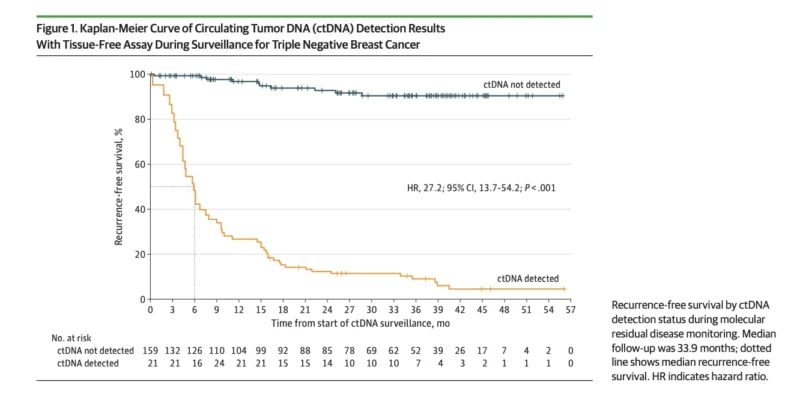
The tissue-free assay detected circulating tumor DNA in 34.0% of patients, and detection was strongly associated with subsequent recurrence:
- HR 27.2; 95% CI, 13.7–54.2; P < .001.
Among patients in whom ctDNA was detected before recurrence, the median lead time between molecular detection and clinical relapse was 7.9 months (Cunningham et al., 2026).
Importantly, the assay did not require sequencing of each patient’s original tumor. Instead, it used cancer-associated DNA methylation patterns in circulating cell-free DNA.
The findings raise an important question for the evolving molecular residual disease field: could tissue-free ctDNA surveillance provide a practical alternative when tumor tissue is unavailable, insufficient, or difficult to incorporate into routine testing workflows?
Why Is Molecular Residual Disease Important in Early Breast Cancer?
After apparently successful treatment for early breast cancer, conventional imaging and clinical assessment may show no evidence of disease while microscopic cancer persists.
Detection of tumor-derived DNA in plasma after definitive treatment is commonly described as molecular residual disease, or MRD.
Previous breast cancer studies have shown that ctDNA detection after treatment is strongly associated with subsequent relapse and can precede clinically apparent recurrence by months (Garcia-Murillas et al., 2015; Garcia-Murillas et al., 2019).
This creates a potential therapeutic window.
If molecular recurrence can be identified before metastatic disease becomes clinically visible, treatment might theoretically be introduced at an earlier stage.
But an important distinction remains: detecting recurrence earlier is not the same as proving that treating at the moment of ctDNA detection improves survival.
That clinical utility remains under investigation.
What Is the Difference Between Tissue-Free and Tumor-Informed ctDNA Testing?
Most highly sensitive MRD assays have historically been tumor-informed.
With this approach, tissue from the patient’s primary tumor is sequenced first. Specific genomic variants identified in that tumor are then incorporated into a personalized assay designed to search for those same variants in plasma.
This can provide extremely high analytical sensitivity, but the approach has practical limitations.
Tumor tissue may be unavailable or contain insufficient cancer cells. Sequencing can fail. Personalized assay development requires additional time and resources, and large-scale implementation during surveillance may become logistically complex (Cunningham et al., 2026).
A tissue-free assay attempts to avoid this step.
Rather than requiring sequencing of the original tumor, the assay used in the present study identifies patterns of differential DNA methylation associated with cancer directly from plasma.
That potentially allows MRD testing even when an adequate archival tumor sample does not exist.
How Was the Study Conducted?
The analysis used samples collected during the ctDNA surveillance component of c-TRAK TN, a multicenter Phase II study of patients with triple-negative breast cancer at moderate to high risk of recurrence.
Patients entered surveillance after completing adjuvant treatment.
Blood samples were collected:
- Every 3 months for up to 2 years.
The investigators retrospectively analyzed plasma using the tissue-free Guardant Reveal assay on the Infinity targeted next-generation sequencing platform.
Results were then compared with two tumor-informed approaches:
- Personalized digital polymerase chain reaction, or dPCR, tracking one or two tumor-specific variants
- A more sensitive whole-exome sequencing-powered multivariant tumor-informed assay, capable of tracking multiple tumor-specific variants
The main objective was to determine whether tissue-free ctDNA detection was associated with recurrence and how its performance compared with the tumor-informed methods (Cunningham et al., 2026).
What Did the Study Include?
The analysis included:
- 159 patients
- 1,026 plasma samples
The patients had a mean age of 51.4 years, with an age range from 25 to 78 years.
Median follow-up from the start of ctDNA surveillance was 33.9 months.
The tissue-free approach successfully generated results from 98.6% of plasma samples, or 1,012 of 1,026 samples.
Most unsuccessful samples were associated with insufficient cell-free DNA yield.
At the patient level, ctDNA was detected at least once in:
- 54 of 159 patients — 34.0% (Cunningham et al., 2026).
How Strongly Was ctDNA Detection Associated With Recurrence?
The association was substantial.
Patients with ctDNA detected during serial tissue-free surveillance had a markedly higher risk of recurrence than patients whose ctDNA remained undetected:
- HR 27.2
- 95% CI, 13.7–54.2; P < .001
Median recurrence-free survival from the beginning of surveillance was:
- 5.9 months among patients with ctDNA detected
versus
- Not reached among patients without ctDNA detection.
The Kaplan-Meier analysis in the study shows a striking separation between the two groups, with recurrence-free survival falling rapidly after ctDNA detection while remaining high among patients without detected ctDNA (Cunningham et al., 2026).
How Early Did Tissue-Free ctDNA Detect Recurrence?
Among patients whose ctDNA became detectable before clinical relapse, the median interval from molecular detection to recurrence was:
- 7.9 months
- 95% CI, 6.1–10.5 months
This means that, on average, the blood-based molecular signal preceded clinical recurrence by several months.
Most ctDNA detections occurred within the first year of surveillance, consistent with the recurrence biology of higher-risk TNBC described by the investigators.
The result supports the concept that MRD surveillance can identify relapse before conventional clinical recurrence becomes evident.
It does not yet establish that intervention during this window improves patient outcomes.
How Accurate Was the Tissue-Free Assay at 24 Months?
The investigators specifically evaluated whether the tissue-free assay could identify patients who experienced recurrence within 24 months of surveillance.
Among evaluable patients, the assay demonstrated:
- Sensitivity: 84.4%
- Specificity: 87.8%
- Positive predictive value: 79.2%
- Negative predictive value: 91.1%
Among patients who developed a distant recurrence within 24 months, sensitivity was:
- 85.7%
with ctDNA detected in 24 of 28 patients who subsequently developed distant recurrence (Cunningham et al., 2026).
These results indicate strong prognostic performance, although the assay did not detect every recurrence.
How Did Tissue-Free Testing Compare With dPCR?
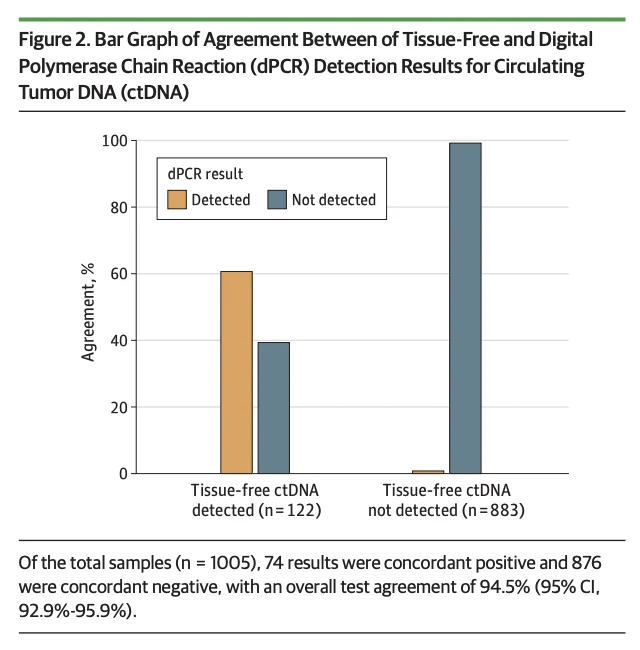
The study compared the tissue-free assay and personalized dPCR across 1,005 paired time points from 159 patients.
Overall agreement was:
- 94.5%
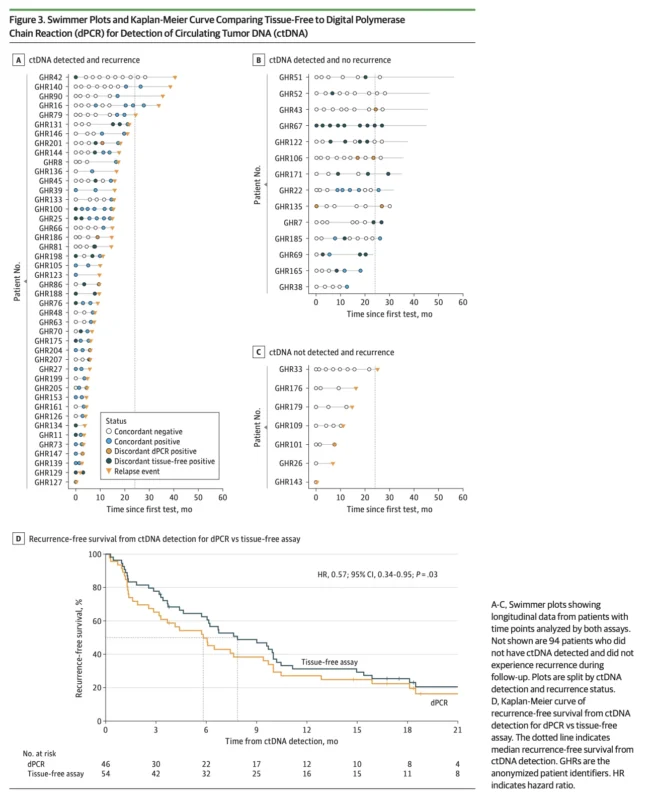
At the patient level, agreement was:
- 89.9%
Both assays detected ctDNA in 42 patients.
Among these patients:
- 28 of 42 — 66.7% were detected at the same surveillance time point.
However:
- 14 of 42 — 33.3% were detected earlier by the tissue-free assay.
There were no patients in whom dPCR detected ctDNA earlier than the tissue-free assay among those positive by both approaches (Cunningham et al., 2026).
Did Tissue-Free ctDNA Provide More Lead Time Than dPCR?
Yes, in this comparison.
Median lead time from ctDNA detection to recurrence was:
- Tissue-free assay 7.9 months
versus
- dPCR 5.8 months
The difference favored the tissue-free assay:
- HR 0.57; 95% CI, 0.34–0.95; P = .03 (Cunningham et al., 2026).
The result suggests that the methylation-based tissue-free approach was more sensitive for earlier molecular detection than the relatively limited dPCR method used prospectively in c-TRAK TN.
However, the more clinically relevant comparison may be against modern multivariant tumor-informed testing.
How Did It Compare With a Multivariant Tumor-Informed Assay?
This comparison produced a more nuanced result.
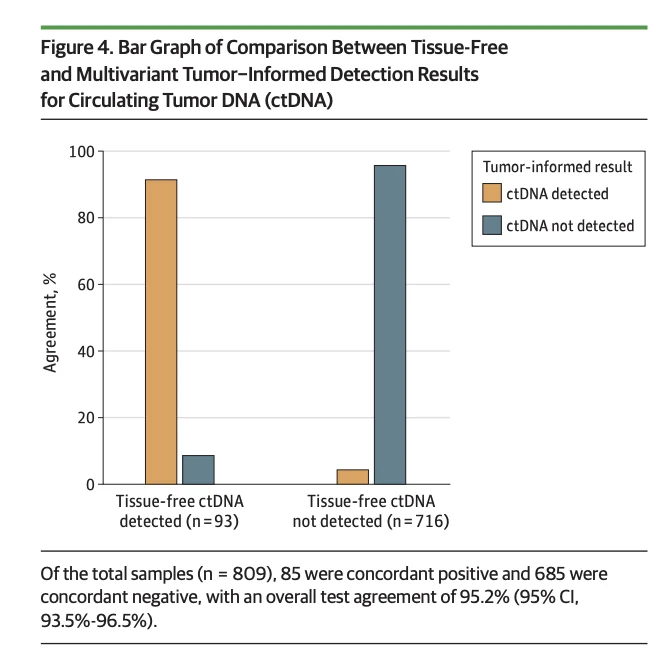
Both tissue-free and multivariant tumor-informed results were available for 133 patients across 809 paired time points.
Overall sample-level agreement reached:
- 95.2%
Patient-level agreement reached:
- 92.5%
Among 41 patients in whom both assays detected ctDNA:
- 28 patients — 68.3% were detected at the same time point.
- 12 patients — 29.3% were detected earlier by the multivariant tumor-informed assay.
Only:
- 1 patient — 2.4%
was detected earlier by the tissue-free assay (Cunningham et al., 2026).
This suggests that the multivariant tumor-informed approach retained greater analytical sensitivity for very early ctDNA detection.
Did Earlier Tumor-Informed Detection Translate Into a Longer Clinical Lead Time?
Interestingly, not clearly.
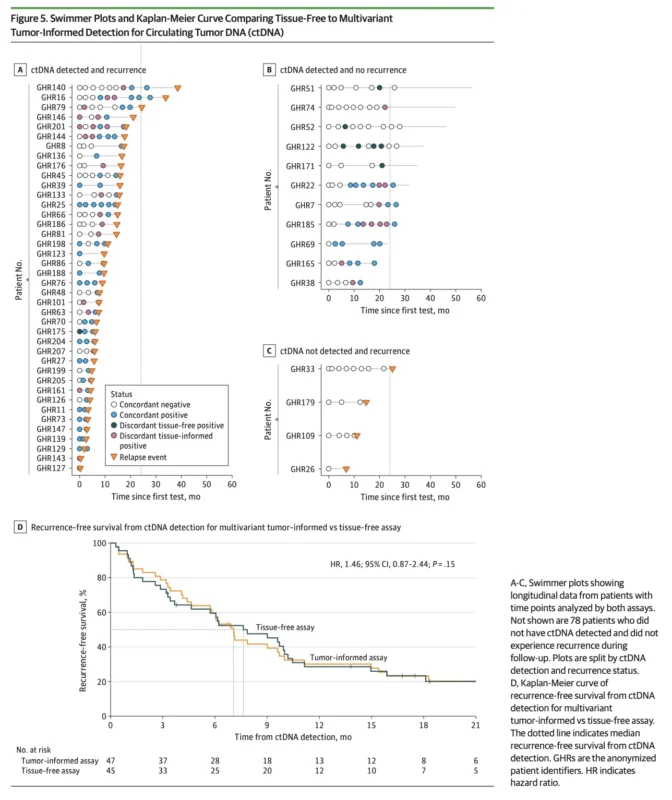
Median time between ctDNA detection and clinical recurrence was:
- Tissue-free assay 7.6 months
versus
- Multivariant tumor-informed assay 7.1 months
The difference was not statistically significant:
- HR 1.46; 95% CI, 0.87–2.44; P = .15 (Cunningham et al., 2026).
This is an important distinction.
Although the tumor-informed assay detected ctDNA earlier in a greater proportion of patients, that greater analytical sensitivity did not translate into a significantly longer median interval before clinical recurrence in this study.
Did the Tumor-Informed Assay Still Detect Some Disease That Tissue-Free Testing Missed?
Yes.
Among the 10 patients with discordant results:
- Four had ctDNA detected only by the tissue-free assay.
- Six had ctDNA detected only by the multivariant tumor-informed assay.
- Five of the six patients identified only by the tumor-informed assay subsequently experienced clinical recurrence.
By contrast, none of the four patients detected only by the tissue-free assay had experienced relapse during available follow-up (Cunningham et al., 2026).
The authors therefore caution that the multivariant tumor-informed approach appears to have greater analytical sensitivity.
This becomes particularly important when considering treatment de-escalation, where a false-negative MRD result could potentially lead to withholding effective therapy from a patient who remains at substantial risk.
Why Could Tissue-Free Testing Still Matter?
The major advantage is logistical.
Tumor-informed testing requires adequate tumor tissue.
In this study, 26 of 159 patients, or 16.4%, did not have multivariant tumor-informed results available.
For 21 of those 26 patients, the reason was absence of adequate whole-exome sequencing data from archival tumor material because of insufficient tumor content, inadequate DNA, inability to identify appropriate variants, or sample contamination (Cunningham et al., 2026).
A tissue-free approach bypasses this requirement.
This could allow MRD testing when:
- Archival tumor tissue is unavailable
- Tumor DNA quantity or quality is inadequate
- Personalized assay construction fails
- Rapid testing is needed without waiting for tumor sequencing
The study therefore positions tissue-free testing primarily as a practical alternative, rather than demonstrating that it is analytically superior to the most sensitive tumor-informed platforms.
What Did c-TRAK TN Teach About Acting on ctDNA?
The original c-TRAK TN study was an important early attempt to move ctDNA from prognosis toward intervention.
Patients were monitored using personalized dPCR assays, and eligible patients with detected ctDNA could receive pembrolizumab.
However, the present JAMA Oncology analysis was not designed to demonstrate that treatment initiated according to tissue-free ctDNA improves outcomes.
Instead, it establishes prognostic validity and assay comparability.
The distinction is critical.
MRD detection can tell clinicians that recurrence risk is extremely high, but the field still needs prospective randomized evidence showing that acting on that result changes the natural history of the disease.
Is Tissue-Free ctDNA Ready to Guide Treatment Escalation?
Not yet based on this study alone.
The authors explicitly state that the clinical benefit of early MRD detection and intervention remains uncertain.
Tissue-free ctDNA identified patients at very high risk of recurrence and created a median molecular lead time approaching eight months.
But the study does not establish which treatment should be given during that interval, or whether treatment at molecular recurrence improves recurrence-free or overall survival compared with waiting until conventional recurrence.
Ongoing ctDNA-guided intervention studies are designed to address this broader question.
What About Treatment De-Escalation?
The investigators recommend particular caution.
Using a negative ctDNA result to withhold or reduce therapy requires exceptionally high sensitivity because missed microscopic disease could result in undertreatment.
The multivariant tumor-informed assay detected some very-low-level ctDNA signals missed by the tissue-free assay, including in patients who later experienced relapse.
For that reason, the authors suggest caution in applying tissue-free testing to de-escalation trials when a tumor-informed assay can be generated (Cunningham et al., 2026).
The threshold for using MRD to escalate therapy and the threshold for using it to de-escalate therapy may therefore be very different.
Could Some Positive ctDNA Results Occur Without Clinical Relapse?
Yes, and this remains another unresolved area.
Six patients had repeated ctDNA detection by both tissue-free and multivariant tumor-informed assays but had not developed clinical relapse by the data cutoff.
The investigators discuss several possible explanations, including longer-than-observed lead times, more indolent biology, or possible immune control of microscopic disease.
Additionally, four patients had positive results only with the tissue-free assay and had not relapsed during follow-up.
The study could not determine whether these represented true molecular disease that later cleared, another cancer signal, very long lead times, or false-positive results (Cunningham et al., 2026).
Longer follow-up will be important.
What Are the Main Limitations?
The authors identify several limitations.
The tissue-free approach was not compared directly with the newest whole-genome sequencing-powered tumor-informed assays, which may achieve even greater analytical sensitivity.
The multivariant comparator used in the study was, however, a highly sensitive WES-powered platform capable of tracking up to 48 variants.
Routine surveillance imaging was also not performed in asymptomatic patients, consistent with standard clinical follow-up.
Consequently, some patients with positive ctDNA may already have had radiographically occult metastatic disease at the time of molecular detection.
The analysis also remains fundamentally prognostic and exploratory.
It does not establish that tissue-free MRD-guided treatment improves outcomes.
What Could This Mean for the Future of TNBC Surveillance?
The study shifts part of the MRD discussion away from whether ctDNA can predict recurrence, the evidence for that association is increasingly strong, and toward how MRD testing can be implemented practically.
Tumor-informed assays offer exceptional sensitivity but depend on access to adequate tumor tissue and personalized assay development.
Tissue-free approaches could potentially simplify that pathway.
A future surveillance model could therefore involve blood collection after curative-intent treatment, molecular assessment every several months, and identification of patients whose cancers are beginning to recur molecularly before conventional clinical relapse.
But the next step cannot simply be earlier detection.
The decisive question is whether clinicians can successfully intervene during that molecular window.
The Bottom Line
The JAMA Oncology analysis provides some of the strongest comparative evidence to date supporting a tissue-free approach to molecular residual disease detection in early triple-negative breast cancer.
Among 159 patients, tissue-free ctDNA was detected in 34.0% and was associated with a more than 27-fold higher hazard of recurrence.
The assay anticipated clinical recurrence by a median of 7.9 months.
At 24 months, sensitivity for recurrence was 84.4%, specificity was 87.8%, and the negative predictive value was 91.1%.
Compared with dPCR, tissue-free testing detected ctDNA earlier and produced a significantly longer median lead time to relapse.
Compared with a highly sensitive multivariant tumor-informed assay, however, the picture was more balanced. The tumor-informed approach detected molecular disease earlier in more patients, yet median lead time to recurrence remained similar: 7.6 months with tissue-free testing versus 7.1 months with tumor-informed testing.
The practical advantage is clear: tissue-free testing does not require sequencing of the original tumor and could enable MRD testing when adequate tissue is unavailable.
What remains uncertain is even more important.
Can detecting molecular recurrence seven to eight months earlier be translated into treatment that prevents or delays metastatic relapse?
Until prospective intervention studies answer that question, tissue-free ctDNA should be viewed as a highly promising prognostic and clinical-trial tool rather than an established standard for directing adjuvant treatment.
References
- Cunningham N, Cutts RJ, Swift C, et al. Tissue-Free vs Tumor-Informed ctDNA Assays for Molecular Residual Disease Detection in Early Triple Negative Breast Cancer. JAMA Oncology. Published online August 13, 2026. doi:10.1001/jamaoncol.2026.2833.
- Turner NC, Swift C, Jenkins B, et al. Results of the c-TRAK TN trial: a clinical trial utilising ctDNA mutation tracking to detect molecular residual disease and trigger intervention in patients with moderate- and high-risk early-stage triple-negative breast cancer. Annals of Oncology. 2023;34:200-211.
- Coakley M, Villacampa G, Sritharan P, et al. Comparison of circulating tumor DNA assays for molecular residual disease detection in early-stage triple-negative breast cancer. Clinical Cancer Research. 2024;30:895-903.
- Garcia-Murillas I, Abbott CW, Cutts RJ, et al. Whole genome sequencing-powered ctDNA sequencing for breast cancer detection. Annals of Oncology. 2025;36:673-681.
- Ademuyiwa FO, Ma CX, Weilbaecher K, et al. Detection of circulating tumor DNA using a tissue-free epigenomic assay is a highly prognostic biomarker in early-stage triple-negative breast cancer. Clinical Cancer Research. 2025;31:2173-2182.