
Antibody–drug conjugates have changed metastatic breast cancer treatment, but their success has created a new clinical problem: what should come after the first ADC stops working?
Trastuzumab deruxtecan targets HER2, while sacituzumab govitecan targets TROP2. At first glance, moving from one to the other appears biologically logical because the antibody target changes. However, both ultimately deliver a topoisomerase I inhibitor payload. Emerging clinical and translational evidence suggests that this shared cytotoxic mechanism can matter substantially after resistance develops.
Several retrospective studies now report a consistent pattern: a second ADC can still produce responses, but its benefit is generally shorter than that obtained with the first ADC. At the same time, the phenomenon is not universal—some patients retain meaningful sensitivity to a second ADC. The challenge is identifying who those patients are and determining whether future sequencing decisions should prioritize the payload, the target, or both (Poumeaud et al., 2024; Huppert et al., 2025).
Why Has ADC Sequencing Become Such an Important Question?
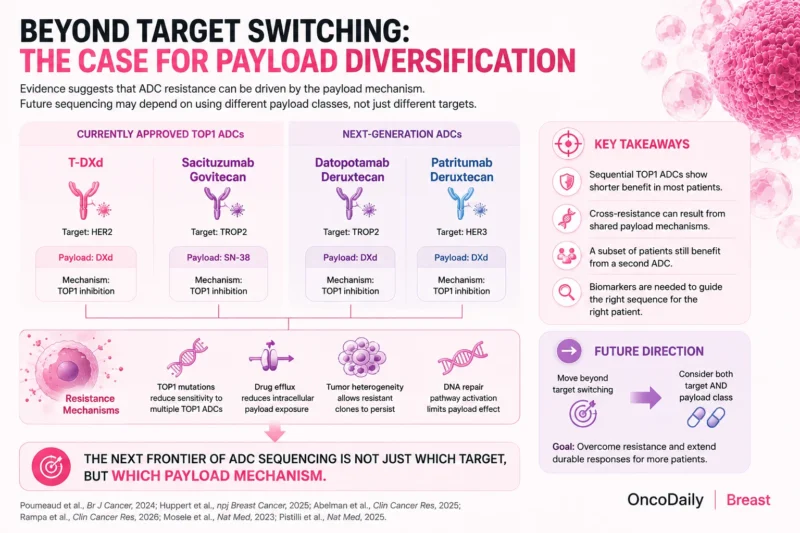
Multiple ADCs with different surface targets are now active in metastatic breast cancer. T-DXd directs a deruxtecan payload toward HER2, while sacituzumab govitecan delivers SN-38 through TROP2. Datopotamab deruxtecan also targets TROP2 but carries a deruxtecan payload. Despite their different antibodies, these agents share inhibition of topoisomerase I as the central cytotoxic mechanism (Huppert et al., 2025).
Historically, most pivotal ADC trials did not enroll substantial populations previously treated with another contemporary ADC. As a result, the efficacy demonstrated by an ADC in an ADC-naïve population cannot automatically be assumed to persist after progression on another topoisomerase I ADC.
That distinction is becoming increasingly important. The question is no longer simply whether T-DXd, sacituzumab govitecan, or another ADC is active. It is whether the same drug retains similar activity when it follows another ADC with a potentially overlapping resistance mechanism.
What Did the ADC-Low Study Show?
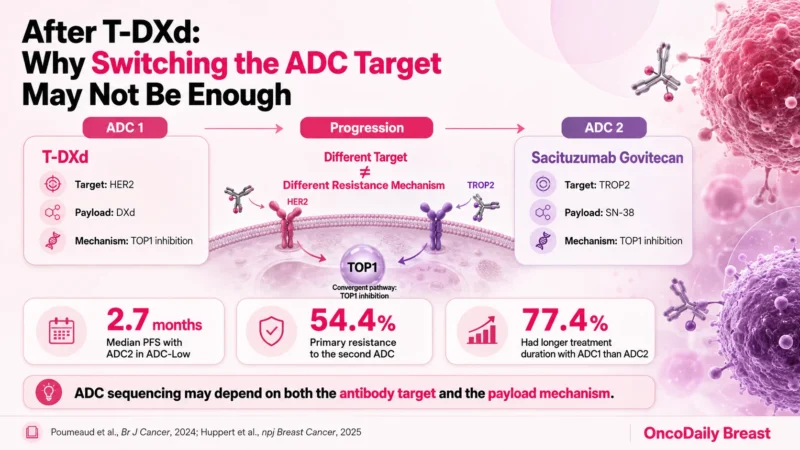
One of the most informative datasets came from the multicentre ADC-Low study, which included 179 patients with HER2-low metastatic breast cancer who received both sacituzumab govitecan and T-DXd, either directly one after another or with intervening chemotherapy.
The majority of patients with hormone receptor-negative disease received sacituzumab govitecan first, whereas most patients with hormone receptor-positive disease received T-DXd first.
The outcome with the second ADC was relatively short. Median progression-free survival on ADC2 was only 2.7 months across the entire population. It was 3.1 months when T-DXd was used second and 2.2 months when sacituzumab govitecan was used second.
More than half of patients—54.4%—had primary resistance to the second ADC.
Importantly, this was not an absolute rule. Some patients did respond to the second ADC, leading the investigators to conclude that sequential treatment had limited benefit for most patients but could still produce short-term benefit in a subset (Poumeaud et al., 2024).
A Second Multicentre Study Found the Same Pattern
Huppert and colleagues subsequently evaluated 84 patients with HER2-low metastatic breast cancer treated sequentially with T-DXd and sacituzumab govitecan across five institutions.
The study again found that treatment duration was generally longer with the first ADC than with the second, regardless of hormone receptor status, treatment sequence, age, visceral disease, or whether another therapy was administered between the two ADCs (Huppert et al., 2025).
Among patients with HR-positive/HER2-low disease who received T-DXd followed by sacituzumab govitecan, the real-world response rate fell from 46.9% with T-DXd to 17.2% with sacituzumab govitecan. Median time to treatment failure decreased from 5.3 months to 2.1 months.
The opposite sequence also showed attenuation. Among patients with HR-negative/HER2-low disease who predominantly received sacituzumab govitecan followed by T-DXd, the real-world response rate was 68.0% with the first ADC and 33.3% with the second.
Across all hormone receptor groups and treatment sequences, 77.4% of patients had a longer time to treatment failure with their first ADC than with their second.
Yet the remaining 22.6% experienced longer treatment duration with ADC2. In this subgroup, median time to treatment failure increased from 2.5 months with the first ADC to 6.9 months with the second (Huppert et al., 2025).
That minority is important. It argues against the conclusion that all patients progressing on one ADC have complete class resistance.
Other Real-World Data Strengthen the Signal
A separate retrospective analysis by Nezirevic and colleagues included 112 patients receiving ADCs and chemotherapy in different sequences.
Among patients who received the two ADCs sequentially, median progression-free survival was 4.5 months for sacituzumab govitecan followed by T-DXd and 3.1 months for T-DXd followed by sacituzumab govitecan.
Looking at each ADC according to where it appeared in the sequence was particularly informative. Median progression-free survival with T-DXd was 6.6 months when used as ADC1 but 3.4 months when used as ADC2. For sacituzumab govitecan, median PFS declined from 5.5 months as ADC1 to 2.7 months as ADC2 (Nezirevic et al., 2025).
Different cohorts, institutions, treatment sequences, and patient populations therefore point toward the same general observation: the second topoisomerase I ADC tends to have less durable activity than the first.
However, all of these studies are retrospective, making it impossible to determine how much of this decline reflects biological cross-resistance and how much reflects patients simply having more advanced and treatment-refractory disease by the time they reach ADC2.
Is Switching the ADC Target Enough?
This has become one of the most important biological questions in ADC sequencing.
T-DXd targets HER2. Sacituzumab govitecan targets TROP2. If resistance were driven primarily by loss or alteration of the surface antigen, switching from HER2 to TROP2 should theoretically help bypass resistance.
But the antibody is only one component of an ADC.
T-DXd delivers DXd, while sacituzumab govitecan delivers SN-38. These are chemically distinct payloads, but both inhibit topoisomerase I.
Therefore, switching from T-DXd to sacituzumab govitecan changes the surface target while preserving the broad cytotoxic mechanism.
The progressively shorter benefit observed with ADC2 has raised the possibility that payload-related resistance can follow the tumor from one ADC to the next, even when the antibody recognizes a different antigen (Huppert et al., 2025; Poumeaud et al., 2024).
TOP1 Mutations Provide Biological Evidence for Cross-Resistance
Translational evidence now provides a potential molecular explanation.
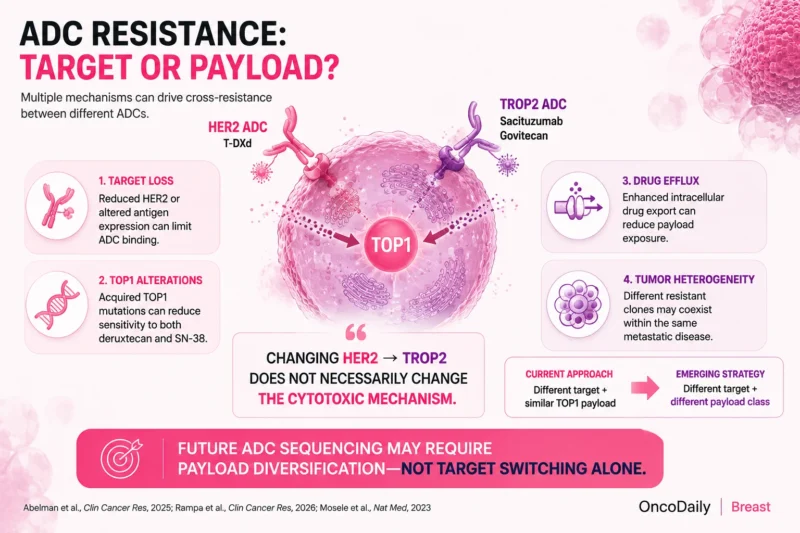
Abelman and colleagues investigated acquired TOP1 alterations in patients with metastatic breast cancer exposed to topoisomerase I ADCs. Distinct acquired missense mutations—including S57C, R364H, G359E, and W401C—were identified at progression.
TOP1 mutations were detected in 12.9% of patients assessed at progression on an ADC, compared with 0.7% in a cohort of metastatic breast cancers without previous ADC exposure.
Functional studies showed that selected mutant TOP1 proteins had reduced enzymatic activity and impaired covalent DNA binding and conferred resistance to both SN-38 and deruxtecan (Abelman et al., 2025).
This provides an important proof of principle. A tumor can develop resistance at the level of the payload target itself, creating cross-resistance across ADCs that carry different antibodies but depend on the same intracellular cytotoxic pathway.
TOP1 mutation is unlikely to explain every case of ADC resistance. Rather, it demonstrates that target switching alone cannot be expected to overcome all forms of resistance.
Payload Resistance May Extend Beyond TOP1 Mutations
A 2026 preclinical study by Rampa and colleagues provided additional evidence that payload biology can dominate ADC resistance.
The investigators generated breast cancer models resistant to T-DXd and sacituzumab govitecan and examined antigen expression, ADC internalization, drug efflux, and other resistance pathways.
Resistance was primarily associated with payload-specific mechanisms, particularly increased drug-efflux activity, rather than simple disappearance of the target antigen.
Most importantly, switching resistant models to ADCs carrying mechanistically different, non-topoisomerase I payloads—including microtubule-directed payloads—restored antitumor activity in vitro and in vivo (Rampa et al., 2026).
These are preclinical findings and cannot yet define treatment sequencing in patients. However, they provide a strong biological rationale for developing ADC sequences that rotate payload class, rather than only changing the antibody target.
Does Loss of HER2 Still Matter?
Yes, but it appears to be only part of the resistance story.
The phase 2 DAISY trial examined tumor samples before and after resistance to T-DXd. Among 20 patients with available samples, 65% showed decreased HER2 expression at resistance. Some HER2 IHC 3+ tumors became 2+ or 1+, while some IHC 2+ or 1+ tumors fell into lower-expression categories (Mosele et al., 2023).
However, HER2 loss did not completely explain resistance.
T-DXd was still detectable within cancer cells in four of six evaluable tumors at resistance. The investigators therefore concluded that there was not robust evidence that reduced T-DXd uptake was the dominant resistance mechanism. They proposed that resistance could occur at several levels, including reduced HER2 expression, alteration of the cytotoxic effect of DXd, and changes in the tumor microenvironment (Mosele et al., 2023).
For sequencing, this distinction matters. If the dominant mechanism is HER2 loss, changing to a different antibody target could make biological sense. If the dominant mechanism involves TOP1 or intracellular drug processing, switching from HER2 to TROP2 while retaining a TOP1 payload may provide much less benefit.
The same clinical phenotype, progression on T-DXd, could therefore represent several different biological states.
Can Chemotherapy Between ADCs Restore Sensitivity?
One practical strategy has been to insert conventional chemotherapy between ADCs in the hope that a treatment interval might partially restore sensitivity.
Available retrospective evidence has not demonstrated a convincing benefit from this approach.
In the Huppert cohort, 36 patients received one or more intervening therapies between ADC1 and ADC2. After adjustment for hormone receptor status, there was no statistically significant difference in time to treatment failure with ADC2 between patients who did and did not receive intervening therapy (HR 1.497; 95% CI, 0.921–2.434; p=0.104) (Huppert et al., 2025).
The ADC-Low study reached a similar conclusion: intervening chemotherapy did not improve the effectiveness of the second ADC (Poumeaud et al., 2024).
Nezirevic and colleagues also found limited activity after inserting chemotherapy. Median PFS was 2.1 months for sacituzumab govitecan following T-DXd and chemotherapy and 3.3 months for T-DXd following sacituzumab govitecan and chemotherapy (Nezirevic et al., 2025).
These studies do not prove that intervening chemotherapy can never be useful. They show that there is currently no convincing clinical evidence that a chemotherapy “washout” reliably resets sensitivity to another TOP1 ADC.
Is Cross-Resistance the Whole Explanation?
Probably not.
Patients receiving ADC2 generally have more advanced disease, have accumulated additional treatment exposure, and may have a more treatment-resistant tumor population than when ADC1 began.
A large real-world analysis by Tarantino and colleagues illustrates the broader difficulty of treating patients after T-DXd. The study included 793 patients who received another systemic therapy following T-DXd.
Median real-world PFS after T-DXd was only 4.6 months in HER2-positive disease, 3.4 months in HR-positive/HER2-negative disease, and 2.8 months in triple-negative breast cancer.
Sacituzumab govitecan immediately after T-DXd was associated with a median real-world PFS of 2.6 months in HER2-positive disease, 2.6 months in HR-positive/HER2-negative disease, and 3.0 months in triple-negative breast cancer (Tarantino et al., 2025).
Those results are compatible with ADC cross-resistance, but they also demonstrate that the post-T-DXd population is generally difficult to treat.
Progression on T-DXd May Be Different From Stopping T-DXd for Toxicity
A 2026 analysis of HER2-positive metastatic breast cancer provides an especially important clue.
Zelizer and colleagues evaluated 81 patients who received 199 subsequent treatment lines after T-DXd. Median progression-free survival across post-T-DXd therapies was only 3.7 months, while median overall survival after T-DXd discontinuation was 19 months (Zelizer et al., 2026).
But the reason for stopping T-DXd strongly influenced subsequent outcomes.
Patients who discontinued T-DXd because of toxicity achieved a median PFS of 9.1 months with subsequent therapy, compared with only 3.3 months among those who stopped because of disease progression. In multivariable analysis, reason for T-DXd discontinuation remained significantly associated with subsequent outcomes (Zelizer et al., 2026).
This suggests that exposure to T-DXd itself is not equivalent to biological resistance.
A patient who must stop an effective ADC because of toxicity may still have a treatment-sensitive tumor. By contrast, a tumor that actively progresses during T-DXd has undergone selection under continuous HER2-targeted TOP1 pressure and may carry substantially more resistant biology.
That distinction could become important in future sequencing studies.
Why Do Some Patients Still Benefit From a Second ADC?
The most important caution against oversimplifying ADC sequencing is that second ADCs clearly work in some patients.
In the Huppert study, 22.6% of patients actually remained on ADC2 longer than ADC1, with median time to treatment failure increasing from 2.5 to 6.9 months in that subgroup.
The ADC-Low investigators similarly documented responses to the second ADC despite an overall median PFS of only 2.7 months.
This suggests that “ADC resistance” is not a single state.
One patient’s resistance may result predominantly from antigen loss. Another may develop drug-efflux mechanisms. A third may acquire TOP1 alterations. Tumor heterogeneity can also allow resistant and sensitive subclones to coexist.
The central challenge is therefore not deciding whether ADC-after-ADC treatment universally works or fails. It is developing biomarkers capable of distinguishing which resistance mechanism is present in an individual patient.
Could HER3-DXd Solve the Target-Switching Problem?
Patritumab deruxtecan introduces another target into this discussion.
The phase 2 ICARUS-BREAST01 trial evaluated HER3-DXd in 99 patients with HR-positive/HER2-negative advanced breast cancer following CDK4/6 inhibition and one chemotherapy line.
HER3-DXd produced a confirmed objective response rate of 53.5% and median progression-free survival of 9.2 months, demonstrating substantial activity of HER3-directed ADC therapy in this population (Pistilli et al., 2025).
However, there is a critical limitation when these findings are considered in the context of ADC sequencing: ICARUS-BREAST01 excluded patients previously treated with ADCs.
HER3-DXd therefore demonstrates that HER3 is a clinically promising delivery target, but it does not establish that switching from HER2 or TROP2 to HER3 will overcome resistance after T-DXd or another TOP1 ADC.
This is particularly relevant because HER3-DXd also carries a deruxtecan topoisomerase I payload. If resistance is predominantly antigen-specific, changing to HER3 could help. If resistance is predominantly DXd- or TOP1-related, changing the antibody while retaining a similar payload may be insufficient.
The ICARUS-BREAST01 investigators themselves highlighted this unanswered question and described ICARUS-BREAST02 as a study designed to evaluate HER3-DXd-based treatment after progression on T-DXd (Pistilli et al., 2025).
Should Future ADC Sequencing Be Based on Payload Rather Than Target?
The emerging evidence suggests that both components matter.
Target expression determines whether the ADC can reach cancer cells. Antigen density, heterogeneity, internalization, linker behavior, intracellular trafficking, payload release, drug efflux, DNA repair, and the molecular target of the payload can all influence response.
The clinical sequencing problem therefore cannot be reduced to HER2 versus TROP2 versus HER3.
The preclinical findings from Rampa and colleagues are particularly provocative because they indicate that ADC-resistant models could regain sensitivity when the payload mechanism was changed, even without relying exclusively on a new antigen target.
If confirmed clinically, future sequencing might increasingly resemble conventional chemotherapy sequencing: not simply asking where the drug is delivered, but also what cytotoxic mechanism is being delivered.
This could increase interest in next-generation ADCs carrying payloads outside the TOP1 inhibitor class.
Could ctDNA or Re-Biopsy Guide ADC Sequencing?
The molecular findings provide a rationale for studying both tissue and circulating tumor DNA at ADC progression.
Acquired TOP1 mutations represent one potential marker of payload resistance, while changes in HER2 expression or other target-related alterations could identify patients in whom switching the antibody target is more rational (Abelman et al., 2025; Mosele et al., 2023).
However, these approaches remain investigational.
No validated molecular assay currently determines whether a patient should receive another TOP1 ADC, switch to a different payload class, receive conventional chemotherapy, or move to another targeted strategy after ADC progression.
The evidence is therefore biologically compelling but not yet sufficient to establish routine biomarker-directed ADC sequencing.
Why We Still Do Not Have an Optimal ADC Sequence
Perhaps the biggest limitation in this field is the absence of prospective randomized sequencing trials.
The most informative current studies are largely retrospective. Treatment order is influenced by drug availability, tumor subtype, previous therapies, clinical condition, physician preference, and the evolving treatment landscape.
Patients who receive ADC2 are, by definition, further along in their disease course. Their tumors have been exposed to additional selective pressure, and their performance status and disease burden can differ from those present when ADC1 was started.
For this reason, a shorter PFS with ADC2 cannot be interpreted as proof that payload cross-resistance is responsible for the entire difference.
The consistency across several independent datasets makes cross-resistance difficult to ignore, but prospective studies incorporating serial tissue, ctDNA, target-expression analysis, and detailed resistance profiling will be necessary to determine its true magnitude.
The Next Generation of ADC Trials Needs a Different Question
The next stage of ADC development will need to move beyond demonstrating that an individual drug is active in an ADC-naïve population.
Trials increasingly need to ask what happens after a specific previous ADC, and why.
That means recording the previous antibody target, payload class, duration of response, reason for discontinuation, target expression at progression, and molecular evidence of payload resistance.
Studies comparing a second TOP1 ADC with an ADC carrying a different payload could be particularly important. Translational analyses capable of identifying TOP1 alterations, efflux mechanisms, target loss, or other resistance pathways could then determine whether particular biological patterns predict benefit from one sequencing strategy over another.
Without such evidence, the growing number of ADCs could create more therapeutic options without necessarily creating a clear strategy for using them.
The Bottom Line
Sequential ADC therapy remains clinically relevant in metastatic breast cancer, but switching the antibody target does not guarantee that resistance has been overcome.
In the 179-patient ADC-Low study, median PFS with the second ADC was only 2.7 months, and 54.4% of patients had primary resistance. In the multicentre Huppert cohort, 77.4% of patients remained on their first ADC longer than their second. Similar reductions in efficacy with ADC2 were observed in another 2025 real-world analysis.
At the same time, approximately one in five patients in the Huppert cohort achieved longer treatment duration with their second ADC, demonstrating that clinically meaningful benefit remains possible for selected patients.
Translational evidence is now beginning to explain the problem. Acquired TOP1 mutations can confer resistance to both SN-38 and deruxtecan, while preclinical models suggest that drug-efflux and other payload-specific mechanisms can create cross-resistance despite switching the ADC target. Conversely, changing to a mechanistically different payload restored activity in resistant experimental models.
The emerging question in breast oncology is therefore shifting from “Which target comes next?” to “Which target and which payload come next?”
Until prospective sequencing trials provide the answer, ADC resistance should not be considered purely an antigen problem. The payload may be just as important.
References
- Poumeaud F, Morisseau M, Cabel L, et al. Efficacy of administration sequence: Sacituzumab Govitecan and Trastuzumab Deruxtecan in HER2-low metastatic breast cancer. British Journal of Cancer. 2024;131:702–708. doi:10.1038/s41416-024-02766-9.
- Huppert LA, Mahtani R, Fisch S, et al. Multicenter retrospective cohort study of the sequential use of the antibody-drug conjugates trastuzumab deruxtecan and sacituzumab govitecan in patients with HER2-low metastatic breast cancer. npj Breast Cancer. 2025;11:34. doi:10.1038/s41523-025-00748-5.
- Nezirevic S, Anders C, Dent S, et al. Evaluation of efficacy and safety of sequential antibody drug conjugates in HER2-negative metastatic breast cancer. Breast Cancer Research and Treatment. 2025;214:329–337. doi:10.1007/s10549-025-07818-z.
- Tarantino P, Lee D, Foldi J, et al. Outcomes of subsequent treatment regimens after trastuzumab deruxtecan in patients with metastatic breast cancer. Journal of the National Cancer Institute. 2025;117:2327–2335.
- Zelizer S, Gallagher GB, Gonen M, et al. Evaluating post-T-DXd treatment strategies in HER2-positive metastatic breast cancer. Breast Cancer Research and Treatment. 2026;215:19. doi:10.1007/s10549-025-07853-w.
- Abelman RO, Wu B, Barnes H, et al. TOP1 mutations and cross-resistance to antibody–drug conjugates in patients with metastatic breast cancer. Clinical Cancer Research. 2025;31:1966–1974. doi:10.1158/1078-0432.CCR-24-2771.
- Rampa DR, Seo M, Ogata N, et al. Payload diversification overcomes resistance and guides sequential antibody–drug conjugate therapy in breast cancer. Clinical Cancer Research. 2026;32:1454–1461. doi:10.1158/1078-0432.CCR-25-3321.
- Mosele F, Deluche E, Lusque A, et al. Trastuzumab deruxtecan in metastatic breast cancer with variable HER2 expression: the phase 2 DAISY trial. Nature Medicine. 2023;29:2110–2120. doi:10.1038/s41591-023-02478-2.
- Pistilli B, et al. Patritumab deruxtecan in HR-positive/HER2-negative advanced breast cancer: a phase 2 trial. Nature Medicine. 2025;31:3492–3503.