Breast cancer diagnosed during pregnancy or in the years following childbirth often presents with features associated with more aggressive disease. These may include larger tumors, lymph node involvement, higher tumor grade, and a greater likelihood of triple-negative breast cancer.
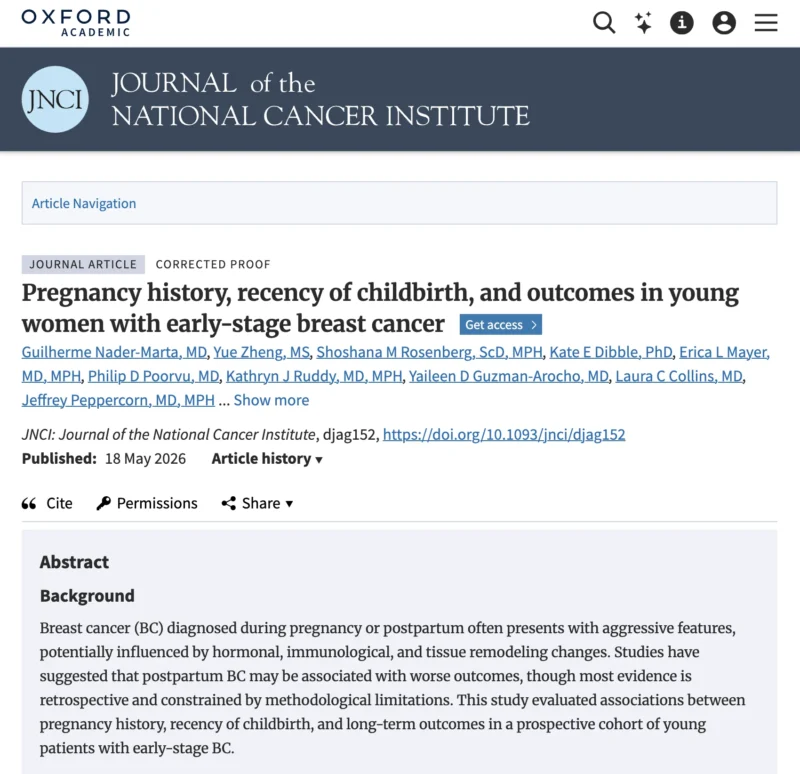
This has raised concern that pregnancy-associated and postpartum breast cancers may carry an inherently poorer prognosis. However, findings from a prospective cohort published in the Journal of the National Cancer Institute suggest that pregnancy history and the timing of childbirth may not independently affect long-term outcomes once tumor characteristics and treatment are considered (Nader-Marta et al., 2026).
Examining Breast Cancer Across Different Pregnancy Histories
The investigators analyzed patients enrolled in the prospective Young Women’s Breast Cancer Study, which included women aged 40 years or younger with stage I–III breast cancer.
A total of 859 patients were categorized according to their pregnancy history at the time of breast cancer diagnosis. The cohort included women who had never been pregnant, women who had been pregnant but had not given birth, patients diagnosed during pregnancy, and patients diagnosed within 10 years after childbirth.
Among the participants:
- 257 patients had never been pregnant.
- 50 had previously been pregnant but had not given birth.
- 37 were pregnant when breast cancer was diagnosed.
- 515 had previously given birth.
Patients in the postpartum group were further assessed according to whether breast cancer was diagnosed within five years or between five and 10 years after childbirth.
The primary endpoint was distant recurrence-free survival, defined as the length of time patients remained alive without breast cancer recurring in a distant organ.
More Aggressive Features During Pregnancy
Patients diagnosed during pregnancy were more likely to present with clinically unfavorable tumor characteristics.
Compared with other groups, pregnant patients had proportionally more triple-negative breast cancers, greater lymph node involvement, more T3 or T4 tumors, and a higher frequency of grade 3 disease.
These findings are consistent with longstanding concerns surrounding breast cancer diagnosed during pregnancy. Physiological breast changes may make tumors more difficult to detect, while hormonal, immune, and tissue-remodeling changes during pregnancy and after childbirth have also been proposed as possible contributors to aggressive tumor behavior.
However, the presence of more aggressive features at diagnosis does not necessarily mean that pregnancy itself independently worsens prognosis.
No Independent Effect on Distant Recurrence
After a median follow-up of 11.1 years, pregnancy history and the recency of childbirth were not independently associated with distant recurrence-free survival.
The researchers adjusted their analyses for factors that could influence outcomes, including patient age, tumor characteristics, breast cancer subtype, and treatment.
After these adjustments, patients diagnosed during pregnancy or after childbirth did not have significantly worse distant recurrence-free survival than patients with other pregnancy histories (Nader-Marta et al., 2026).
The findings remained consistent across the three major breast cancer subtypes examined:
- Estrogen receptor-positive/HER2-negative breast cancer
- HER2-positive breast cancer
- Triple-negative breast cancer
This suggests that the absence of an independent prognostic effect was not limited to a single biological subtype.
Recent Childbirth Did Not Change the Findings
The investigators also performed sensitivity analyses to examine whether breast cancer diagnosed very soon after childbirth was associated with poorer outcomes.
Postpartum diagnoses were further divided into those occurring less than two years after childbirth and those occurring between two and five years postpartum.
These additional analyses produced findings consistent with the primary results. A more recent childbirth was not independently associated with worse distant recurrence-free survival after adjustment for tumor and treatment-related factors.
This is clinically relevant because previous retrospective studies have suggested that the first several years after childbirth may represent a particularly vulnerable period. The prospective nature of the Young Women’s Breast Cancer Study and its long follow-up provide important additional evidence in this area.
What the Findings Mean for Patients
The results may offer reassurance to young patients diagnosed with breast cancer during pregnancy or after childbirth.
Although these cancers may be diagnosed with more advanced or aggressive features, pregnancy history itself does not appear to independently determine the likelihood of distant recurrence. Outcomes were comparable after accounting for the characteristics of the cancer and the treatment received.
This does not mean that breast cancer during pregnancy is clinically simple. Treatment decisions must still consider gestational age, breast cancer subtype, disease stage, maternal health, fetal safety, and the timing of surgery, chemotherapy, radiotherapy, endocrine therapy, and targeted treatment.
The findings instead suggest that prognosis should be based primarily on established tumor and treatment factors rather than pregnancy or postpartum status alone.
Why Prospective Data Matter
Much of the previous evidence surrounding postpartum breast cancer has come from retrospective studies. Such analyses may be affected by incomplete pregnancy histories, differences in follow-up, treatment variation, and challenges in separating the effect of recent childbirth from the effect of aggressive disease at diagnosis.
This study used a prospectively followed cohort of young patients and included more than 11 years of median follow-up. The researchers also adjusted for multiple clinical and tumor-related variables and conducted analyses across different breast cancer subtypes.
Nevertheless, the number of patients diagnosed during pregnancy was relatively small, with only 37 pregnant patients included. Therefore, the results should be interpreted in the context of subgroup size and confirmed through additional prospective research.
The Bottom Line
In this prospective study of 859 women aged 40 years or younger with stage I–III breast cancer, pregnancy history and the recency of childbirth were not independently associated with long-term distant recurrence-free survival.
Patients diagnosed during pregnancy were more likely to have aggressive clinical and pathological features. However, after adjustment for age, tumor characteristics, and treatment, their outcomes were comparable with those of other young patients.
The findings suggest that pregnancy and postpartum status should not be viewed as independent adverse prognostic factors. Instead, clinical counseling and treatment planning should remain guided by breast cancer stage, biological subtype, tumor characteristics, and appropriate multidisciplinary care.
Reference
- Nader-Marta, G., Zheng, Y., Rosenberg, S. M., Dibble, K. E., Mayer, E. L., Poorvu, P. D., Ruddy, K. J., Guzman-Arocho, Y. D., Collins, L. C., Peppercorn, J., et al. (2026). Pregnancy history, recency of childbirth, and outcomes in young women with early-stage breast cancer. JNCI: Journal of the National Cancer Institute, djag152. doi:10.1093/jnci/djag152.