
A randomized phase III trial has provided new evidence supporting the addition of carboplatin to standard chemotherapy for patients with early-stage triple-negative breast cancer.
The PEARLY trial, also known as KCSG BR 15-1, evaluated whether adding carboplatin to anthracycline-taxane chemotherapy could improve outcomes in patients with stage II–III triple-negative breast cancer treated in the neoadjuvant or adjuvant setting.
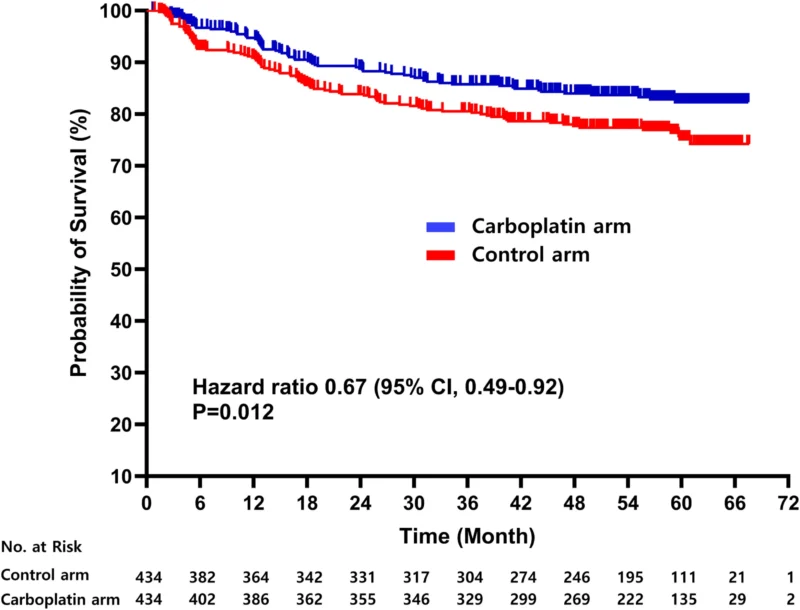
The study found that carboplatin significantly improved event-free survival compared with standard chemotherapy alone. At 5 years, event-free survival was 82.3% in the carboplatin arm compared with 75.1% in the control arm. This represented an absolute improvement of 7.2% and a hazard ratio of 0.67.
Why This Study Matters
Triple-negative breast cancer remains one of the most aggressive breast cancer subtypes. It is associated with a higher risk of early recurrence and has fewer targeted treatment options compared with hormone receptor-positive or HER2-positive disease.
Platinum-based chemotherapy has long been considered biologically relevant in TNBC because many tumors show genomic instability and DNA repair defects. Previous studies showed that adding carboplatin can increase pathologic complete response rates in the neoadjuvant setting. However, the independent survival benefit of carboplatin without immunotherapy, especially across both neoadjuvant and adjuvant treatment settings, had not been fully established in a single randomized phase III trial.
PEARLY helps address this gap.
The trial is especially important because modern early TNBC treatment has increasingly moved toward carboplatin-containing regimens, particularly after KEYNOTE-522. However, KEYNOTE-522 combined carboplatin with pembrolizumab, making it difficult to isolate the contribution of carboplatin itself.
PEARLY provides evidence that carboplatin can improve event-free survival independently of immunotherapy.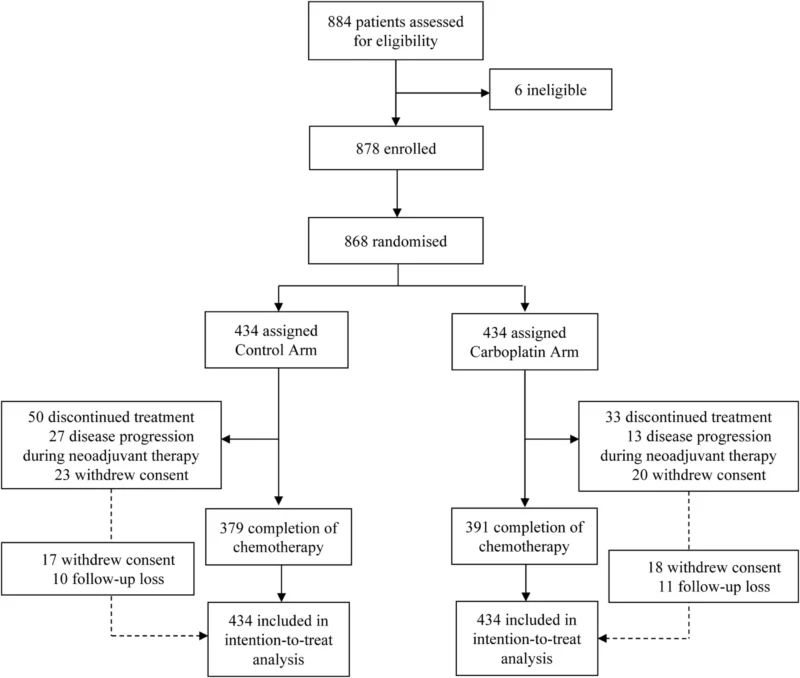
Study Design
PEARLY was a multicenter, randomized, open-label, phase III trial conducted across 22 institutions in the Republic of Korea.
The trial enrolled women aged 19 years or older with histologically confirmed stage II or stage III triple-negative breast cancer. Patients could be treated either in the neoadjuvant setting before surgery or in the adjuvant setting after surgery.
A total of 868 patients were randomized 1:1 to one of two treatment arms.
In the control arm, patients received doxorubicin and cyclophosphamide for four cycles, followed by taxane chemotherapy.
In the carboplatin arm, patients received the same doxorubicin and cyclophosphamide backbone, followed by taxane plus carboplatin. Carboplatin was given at AUC 5 for four cycles.
The primary endpoint was event-free survival. Secondary endpoints included overall survival, invasive disease-free survival, distant recurrence-free survival, pathologic complete response rate, safety, and quality-of-life outcomes.
Patient Population
The trial included a broad early TNBC population.
Among the 868 enrolled patients, 434 were assigned to the carboplatin arm and 434 to the control arm. Baseline characteristics were well balanced between the two groups.
The median age was 48 years in the carboplatin arm and 49 years in the control arm. Most patients had stage II disease, and approximately one fifth had stage III disease.
The trial included both treatment settings. Around 71% of patients received neoadjuvant therapy, while around 29% received adjuvant therapy.
Germline BRCA pathogenic or likely pathogenic variants were identified in 10.9% of patients overall.
This mixed neoadjuvant and adjuvant design is one of the trial’s most clinically relevant features, because it reflects real-world variation in how early TNBC is treated.
Carboplatin Improved Event-Free Survival
At the primary analysis, with a median follow-up of 57.2 months, carboplatin significantly improved event-free survival.
Events occurred in 68 patients in the carboplatin arm and 95 patients in the control arm. The hazard ratio for event-free survival was 0.67, with a 95% confidence interval of 0.49 to 0.92 and a P value of 0.012.
The estimated 5-year event-free survival rate was 82.3% in the carboplatin arm compared with 75.1% in the control arm.
This corresponds to a 7.2% absolute improvement in 5-year event-free survival.
The median event-free survival was not reached in either arm.
Distant recurrence was the most common event, followed by progression during neoadjuvant therapy and locoregional recurrence.
Benefit Was Consistent Across Subgroups
The event-free survival benefit with carboplatin was consistent across key prespecified subgroups.
The benefit was observed regardless of nodal status, treatment setting, age, taxane selection, and germline BRCA status.
This is clinically important because it suggests that the advantage of carboplatin was not restricted to one narrow patient subgroup.
In particular, the directionally consistent benefit across BRCA-mutated and BRCA wild-type patients supports the idea that carboplatin may provide benefit across a broader TNBC population, not only in those with known germline BRCA pathogenic variants.
The trial also showed benefit across both neoadjuvant and adjuvant settings, reinforcing the potential role of carboplatin beyond preoperative therapy alone.
Pathologic Complete Response
Among patients treated in the neoadjuvant setting, pathologic complete response was observed in 46.0% of patients in the carboplatin arm and 39.4% in the control arm.
This numerical difference did not reach statistical significance.
However, pathologic complete response was strongly associated with subsequent event-free survival regardless of treatment arm. Patients who achieved pCR had better event-free survival than those with residual disease.
This finding is consistent with the established prognostic role of pCR in early TNBC.
Overall Survival And Secondary Endpoints
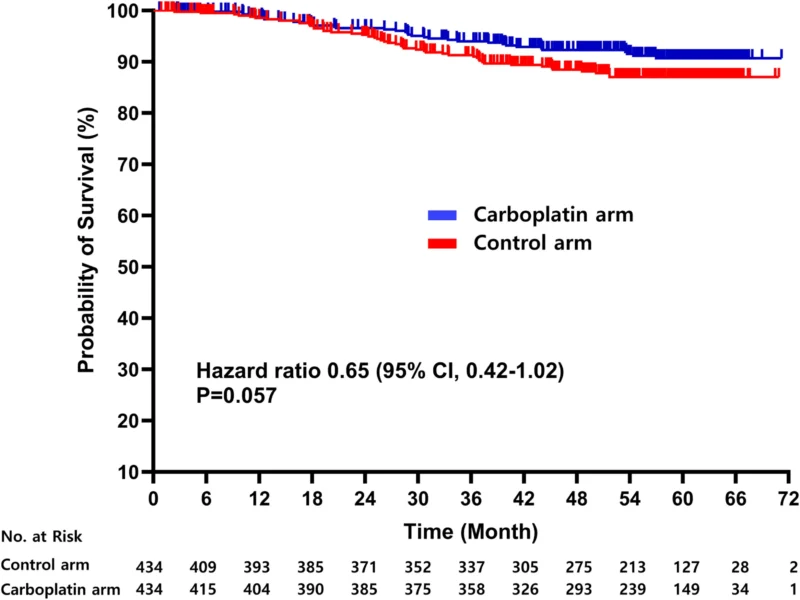
Overall survival was analyzed as a secondary endpoint, but the trial was not powered to detect an overall survival difference.
At the time of analysis, the hazard ratio for overall survival favored carboplatin at 0.65, with a 95% confidence interval of 0.42 to 1.02 and a P value of 0.057.
The estimated 5-year overall survival rate was 90.7% in the carboplatin arm and 87.0% in the control arm.
Invasive disease-free survival and distant recurrence-free survival also showed directionally consistent trends favoring carboplatin, although these endpoints did not reach statistical significance.
These results should be interpreted carefully. The strongest evidence from PEARLY is the statistically significant improvement in the primary endpoint of event-free survival.
Safety Profile
The addition of carboplatin increased toxicity, mainly hematologic adverse events.
Grade 3 or higher treatment-related adverse events occurred in 74.7% of patients in the carboplatin arm compared with 56.7% in the control arm.
The most common grade 3 or higher adverse events with carboplatin included neutropenia, febrile neutropenia, anemia, and thrombocytopenia.
Febrile neutropenia occurred in 24.7% of patients in the carboplatin arm compared with 17.1% in the control arm. Grade 3 or higher anemia occurred in 11.5% versus 2.1%, respectively.
Treatment discontinuation due to adverse events was uncommon but slightly higher with carboplatin.
There were three treatment-related deaths: one in the carboplatin arm due to pneumonia and two in the control arm due to septic shock and suicide.
Quality Of Life And Neuropathy
Despite increased hematologic toxicity, quality-of-life outcomes were reassuring.
Quality of life was assessed using EQ-5D and EORTC QLQ-CIPN20 scores at baseline, mid-treatment, and end of treatment.
The study found no statistically significant difference in quality-of-life changes between the two arms at assessed time points.
Patient-reported neuropathy scores also did not differ significantly between the carboplatin and control arms, despite the known neurotoxicity risk when platinum agents are combined with taxane therapy.
This is important because the clinical value of adding carboplatin depends not only on efficacy, but also on whether the added toxicity is manageable.
How PEARLY Fits Into The Early TNBC Landscape
The early TNBC treatment landscape has changed substantially in recent years.
KEYNOTE-522 established pembrolizumab plus chemotherapy, using a carboplatin-containing backbone, as a standard option for high-risk early TNBC. However, access to immunotherapy remains uneven globally, and some patients may be unable to receive pembrolizumab because of contraindications, regulatory barriers, or financial limitations.
PEARLY is relevant in this setting because it shows that carboplatin itself can improve event-free survival when added to anthracycline-taxane chemotherapy.
The study also matters for patients treated with upfront surgery. Nearly 30% of PEARLY participants were treated in the adjuvant setting, a population where treatment intensification remains clinically important.
Together with other emerging phase III data on adjuvant platinum therapy, PEARLY strengthens the evidence that platinum sensitivity is a generalizable feature of early TNBC.
Clinical Meaning
The PEARLY trial supports the incorporation of carboplatin into chemotherapy for patients with stage II–III triple-negative breast cancer.
The benefit appears clinically meaningful, with a 7.2% absolute improvement in 5-year event-free survival. The safety profile showed more grade 3 or higher adverse events, mainly hematologic, but without a significant deterioration in quality of life or patient-reported neuropathy outcomes.
For clinicians, the trial reinforces that carboplatin is not only a tool to increase pCR rates in the neoadjuvant setting. It may also improve longer-term outcomes, including event-free survival.
For patients who cannot receive immunotherapy, or for those managed in the adjuvant setting after surgery, PEARLY provides important evidence supporting carboplatin-based intensification.
Limitations
Several limitations should be considered.
The trial used standard every-3-week AC rather than a dose-dense anthracycline regimen. Whether the carboplatin benefit would be similar or larger with dose-dense chemotherapy remains uncertain.
The treatment landscape also changed during the study period, including the emergence of post-neoadjuvant capecitabine and adjuvant olaparib for selected patients. However, use of these therapies was low and balanced between arms.
The trial was not powered for overall survival or individual secondary endpoints, so those findings should be considered supportive rather than definitive.
Finally, the study was conducted in Korea, and further analyses may help determine how broadly the findings apply across different populations and healthcare systems.
Key Takeaway
The PEARLY phase III trial showed that adding carboplatin to doxorubicin and cyclophosphamide followed by taxane significantly improved event-free survival in patients with stage II–III triple-negative breast cancer.
At 5 years, event-free survival was 82.3% with carboplatin compared with 75.1% with standard chemotherapy alone.
The benefit was consistent across major subgroups, including nodal status, germline BRCA status, and both neoadjuvant and adjuvant settings.
Although carboplatin increased grade 3 or higher adverse events, mainly hematologic toxicity, quality of life and patient-reported neuropathy were not significantly worse.
The trial provides strong phase III evidence that carboplatin can improve event-free survival in early TNBC independent of immunotherapy, supporting its role as an important component of treatment intensification for this high-risk breast cancer subtype.