
Patient-reported outcomes revealed substantially greater gastrointestinal symptom burden than clinician assessments among patients receiving neratinib plus ado-trastuzumab emtansine for HER2-positive breast cancer brain metastases in the phase 2 TBCRC 022 study.
Among 44 patients, gastrointestinal symptoms worsened during the first treatment cycles despite mandated antidiarrheal prophylaxis. Patient-reported diarrhea scores deteriorated significantly as early as cycle 2 and peaked around cycle 3. Moderate-to-severe diarrhea was reported by 20.5% of patients, while 41.0% experienced moderate-to-severe constipation and 24.4% reported moderate-to-severe appetite loss.
Agreement between patient-reported and clinician-recorded gastrointestinal toxicities was consistently poor, with kappa values below 0.2 across most symptoms. Clinicians generally reported lower symptom burden than patients themselves.
The findings, published in The Breast, highlight how conventional clinician-assessed adverse-event grading can underestimate treatment burden and support incorporating patient-reported outcomes into trials of therapies associated with substantial gastrointestinal toxicity (Grinda et al., 2026).
Why Were Patient-Reported Outcomes Evaluated in TBCRC 022?
HER2-positive metastatic breast cancer carries a substantial risk of central nervous system involvement. Brain metastases can develop in up to half of patients over the disease course, creating a need for systemic treatments with intracranial activity.
TBCRC 022 was a multicentre, multicohort phase 2 study examining neratinib-based regimens in patients with HER2-positive breast cancer brain metastases. Cohort 4 evaluated neratinib combined with ado-trastuzumab emtansine, or T-DM1.
Previous results demonstrated intracranial activity, with CNS objective response rates of 33.3% in cohort 4A, 35.3% in cohort 4B, and 28.6% in cohort 4C. However, gastrointestinal toxicity, particularly diarrhea, was common despite prophylaxis.
Clinician-assessed CTCAE reporting had previously shown grade 2 diarrhea in 31.8% and grade 3 diarrhea in 22.7% of patients. Because clinician assessments can underestimate subjective symptoms, the investigators prospectively incorporated several patient-reported outcome instruments to better characterize the timing, severity, and daily impact of gastrointestinal toxicity (Grinda et al., 2026).
How Was the Patient-Reported Outcome Analysis Conducted?
All patients in cohort 4 received oral neratinib at 160 mg daily together with intravenous T-DM1 at 3.6 mg/kg every 21 days.
The study included patients with measurable HER2-positive brain metastases across three clinical settings. Cohort 4A included patients without previous CNS-directed treatment. Cohort 4B included patients with CNS progression after local therapy but no previous T-DM1 exposure, while cohort 4C included patients whose CNS disease had progressed after local treatment and previous T-DM1.
A total of 44 patients enrolled between November 2018 and November 2021. Median age was 48.5 years, and patients had received a median of two previous chemotherapy lines.
The analysis focused on gastrointestinal symptoms during the first four treatment cycles, when neratinib-related gastrointestinal toxicity was expected to be most prominent.
Three patient-reported instruments were used: the PROMIS GI Diarrhea scale, the Systemic Therapy-Induced Diarrhea Assessment Tool, known as STIDAT, and the gastrointestinal component of PRO-CTCAE.
The questionnaires were completed at the start of cycles 1 through 4, on the same days that clinicians performed conventional CTCAE toxicity assessments.
What Prophylaxis Did Patients Receive?
Antidiarrheal prophylaxis was mandated during the first cycle.
Patients received loperamide at 4 mg every 8 hours during days 1–14, followed by 4 mg every 12 hours during days 15–21. Colestipol was administered at 2 g twice daily.
Clinicians could discontinue prophylaxis early if patients developed complications such as constipation or continue treatment beyond the first cycle if needed.
Despite this strategy, patient-reported gastrointestinal burden increased during the early treatment period, illustrating the difficulty of balancing diarrhea prevention with other gastrointestinal adverse effects.
When Did Diarrhea Become Most Severe?
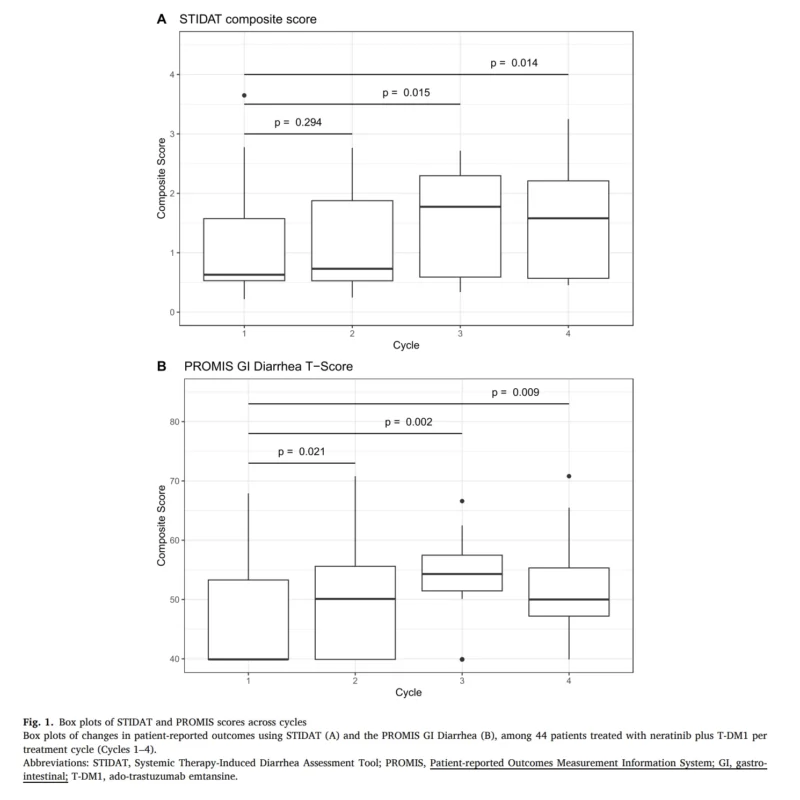
The PROMIS GI Diarrhea score showed statistically significant worsening as early as cycle 2.
Compared with cycle 1, the largest deterioration occurred at cycle 3, when the mean score had increased by:
- 6.62 points; 95% CI, 2.67–10.59; p=0.002
The investigators noted that a change of approximately 5–7 PROMIS T-score points is generally considered clinically meaningful. The cycle 3 deterioration therefore crossed the approximate threshold for a meaningful change in patients’ symptoms.
STIDAT findings followed a similar pattern, although deterioration became statistically significant later. By cycle 3, the mean STIDAT score had increased by:
- 0.50; 95% CI, 0.11–0.90; p=0.015
Figure 1 on page 4 of the publication shows the progressive increase in both PROMIS and STIDAT scores from cycle 1, with the greatest symptom burden around cycle 3.
What Did Patients Report About Diarrhea?
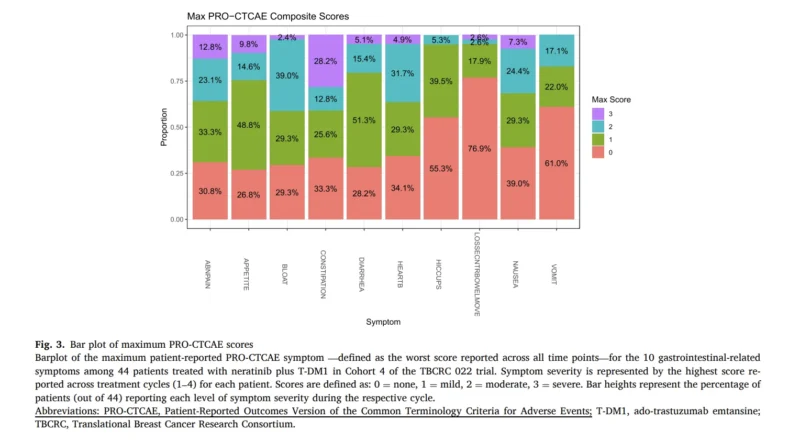
When the maximum PRO-CTCAE score across cycles 1–4 was considered, 20.5% of patients reported moderate-to-severe diarrhea.
This included 15.4% reporting grade 2 symptoms and 5.1% reporting grade 3 diarrhea.
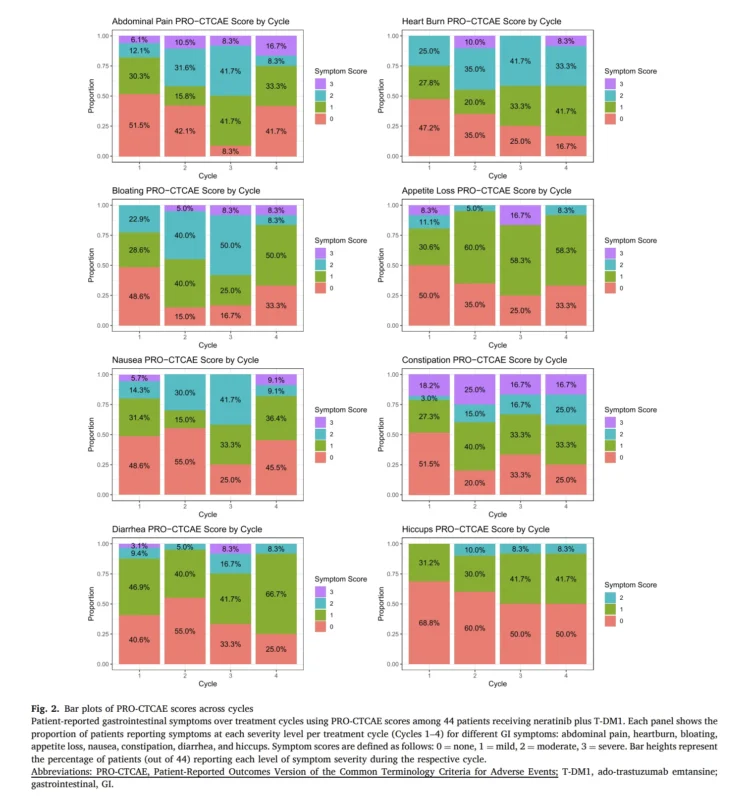
At cycle 3 specifically, diarrhea was among the most frequently reported gastrointestinal symptoms. Of patients completing the assessment at that time point, 41.7% reported mild diarrhea, 16.7% moderate diarrhea, and 8.3% severe diarrhea.
These findings illustrate a broader point: evaluating only the maximum clinician-recorded CTCAE grade does not necessarily capture the frequency, persistence, or day-to-day effect of treatment-related symptoms.
Constipation Was Also a Major Patient-Reported Problem
One of the most notable findings was the high burden of constipation.
Across cycles 1–4, 41.0% of patients reported moderate-to-severe constipation on PRO-CTCAE. This included 12.8% with grade 2 and 28.2% with grade 3 symptoms.
At cycle 3, two-thirds of patients completing the questionnaire reported some degree of constipation.
This finding is particularly relevant because antidiarrheal prophylaxis itself can contribute to constipation. The study protocol allowed clinicians to discontinue prophylactic medication when constipation developed, but adherence and detailed medication modifications were not consistently captured.
The data therefore emphasize that supportive care for neratinib-associated diarrhea requires balance. Aggressive prophylaxis can reduce diarrhea but can also introduce another clinically meaningful gastrointestinal burden.
What Other Symptoms Did Patients Experience?
Appetite loss was another important toxicity.
At cycle 3, 75% of patients completing the assessment reported some degree of appetite loss, and the maximum PRO-CTCAE analysis showed moderate-to-severe appetite loss in 24.4%.
Bloating, nausea, abdominal pain, heartburn, and other gastrointestinal symptoms were also recorded.
Figure 2 on page 5 provides a cycle-by-cycle visualization of gastrointestinal symptoms and shows that several toxicities increased around cycles 2 and 3 rather than being limited to diarrhea alone. Figure 3 on page 6 further demonstrates the maximum symptom severity recorded across the first four cycles.
How Quickly Did Severe Symptoms Develop?
Severe patient-reported gastrointestinal toxicity emerged relatively early.
The median time from treatment initiation to the first grade 3 PRO-CTCAE gastrointestinal symptom was:
- 6 weeks
This corresponds approximately to the beginning of cycle 3.
By week 9, only 39% of patients remained free from any patient-reported grade 3 gastrointestinal symptom, although the confidence interval was wide at 22%–68%.
The Kaplan–Meier curve on page 6 illustrates the progressive appearance of grade 3 symptoms over the initial treatment cycles.
Did Gastrointestinal Toxicity Lead to Treatment Discontinuation?
Five of the 44 patients, or 11.4%, discontinued treatment because of unacceptable toxicity.
Among these patients, the most frequent grade 3 or higher toxicities were diarrhea in three patients, increased aspartate aminotransferase in two, and increased alanine aminotransferase in one.
Most patients who discontinued because of toxicity did so early:
- 60% stopped after only one cycle.
However, patient-reported symptom severity among these individuals was heterogeneous. The authors noted that treatment discontinuation might reflect the cumulative treatment burden rather than the severity of a single gastrointestinal symptom.
How Different Were Patient and Clinician Assessments?
The discrepancy between patient-reported and clinician-reported toxicity was one of the central findings.
Agreement between PRO-CTCAE and clinician CTCAE assessments was consistently weak, with kappa values below 0.2 for most gastrointestinal symptoms.
For diarrhea, the kappa estimate was only 0.09. For nausea it was 0.08, constipation 0.18, abdominal pain 0.19, and bloating 0.15.
Agreement for vomiting was even lower at −0.19.
When investigators simplified the analysis to whether symptoms were present or absent rather than comparing severity grades, agreement remained poor. Constipation was the only symptom to improve to fair agreement, with a kappa of 0.33.
The direction of disagreement was also clinically important: clinicians generally documented less toxicity than patients reported themselves (Grinda et al., 2026).
Why Does the Difference Between PRO-CTCAE and CTCAE Matter?
Traditional CTCAE grading remains fundamental for assessing treatment safety, but it is clinician based.
Symptoms such as nausea, diarrhea, fatigue, constipation, pain, and appetite loss are subjective experiences. A clinician may grade the same symptom differently from the patient experiencing it.
In TBCRC 022, the discrepancy was not simply a disagreement over whether a symptom was grade 1 or grade 2. Low agreement persisted even after symptom reporting was reduced to a basic present-versus-absent comparison.
This suggests that some toxicities were not being fully captured during routine clinical assessment.
For regimens with substantial symptomatic toxicity, the authors argue that patient-reported outcomes provide information complementary to conventional adverse-event reporting rather than replacing it.
Did the Different Patient-Reported Diarrhea Tools Agree?
Unlike the poor agreement between patient and clinician assessments, PROMIS GI Diarrhea and STIDAT scores were strongly correlated.
Using all available repeated measurements, every one-unit increase in STIDAT was associated with a 7.09-point increase in the PROMIS Diarrhea score.
When the maximum scores for each patient were compared, each one-unit increase in STIDAT was associated with a 6.75-point PROMIS increase.
Both associations were highly statistically significant at p<0.001.
This consistency supports the validity of the patient-reported signal despite differences in how the two instruments characterize gastrointestinal toxicity.
What Could These Findings Change in Clinical Practice?
The results do not change the established efficacy findings from TBCRC 022. Instead, they provide a clearer understanding of the patient experience during treatment.
The authors emphasize particularly close monitoring during the first two to three cycles, when gastrointestinal symptoms were most likely to emerge.
Antidiarrheal prophylaxis remains important, but treatment needs to be individualized to avoid excessive constipation. Patient education and early communication of symptoms can also allow supportive care to be modified before toxicity becomes severe.
The investigators further noted that neratinib dose-escalation strategies developed in other studies can improve tolerability and are reflected in current US prescribing information and NCCN recommendations.
The central message is that supportive care decisions are likely to be stronger when clinicians combine conventional CTCAE assessments with information directly reported by patients.
What Are the Main Limitations?
The study was small, with only 44 patients, and patient-reported outcome completion declined considerably over time.
For example, PROMIS completion fell from 88.6% at cycle 1 to 45.5% at cycle 3. Full PRO-CTCAE symptom completion declined from 68.2% at cycle 1 to 27.3% at cycle 3 and 22.7% at cycle 4.
This creates the possibility that patients completing later assessments differed from those with missing data.
Patient-reported outcomes were also collected only during the first four cycles. Longer-term persistence of low-grade symptoms could therefore not be evaluated.
Patients with significant pre-existing diarrhea were excluded, potentially limiting generalizability to patients who already have gastrointestinal problems before treatment.
The analysis also did not capture treatment dose reductions alongside patient-reported outcomes, and adherence to antidiarrheal prophylaxis was incompletely documented. These limitations make it difficult to determine precisely how supportive interventions affected symptom trajectories.
The Bottom Line
The TBCRC 022 patient-reported outcome analysis shows that gastrointestinal toxicity with neratinib plus T-DM1 extends beyond what clinicians document through standard CTCAE grading.
Diarrhea worsened significantly during the first treatment cycles, with PROMIS scores showing a clinically meaningful 6.62-point deterioration by cycle 3.
Across the first four cycles, moderate-to-severe diarrhea occurred in 20.5%, moderate-to-severe appetite loss in 24.4%, and moderate-to-severe constipation in 41.0% of patients.
Median time to the first severe patient-reported gastrointestinal symptom was only 6 weeks.
Perhaps most importantly, agreement between patient and clinician assessments was consistently poor.
The findings support integrating patient-reported outcomes into trials and clinical management of treatments with substantial symptomatic toxicity, allowing supportive care to reflect what patients actually experience rather than relying on clinician grading alone.
References
- Grinda T, Heiling HM, Tayob N, et al. Patient-reported outcomes from the TBCRC 022 study of neratinib and ado-trastuzumab emtansine for HER2-positive breast cancer brain metastases. The Breast. 2026;89:104881. doi:10.1016/j.breast.2026.104881.
- Freedman RA, Heiling HM, Li T, et al. Neratinib and ado-trastuzumab emtansine for pretreated and untreated HER2-positive breast cancer brain metastases: Translational Breast Cancer Research Consortium trial 022. Annals of Oncology. 2024;35:993–1002.
- Barcenas CH, Hurvitz SA, Palma JAD, et al. Improved tolerability of neratinib in patients with HER2-positive early-stage breast cancer: the CONTROL trial. Annals of Oncology. 2020;31:1223–1230.