
Triple-negative breast cancer is not one biological disease.
Although it is defined clinically by the absence of estrogen receptor, progesterone receptor, and HER2 expression, TNBC includes tumors with very different molecular drivers, treatment sensitivities, and risks of recurrence. This heterogeneity is one reason why pathological complete response after neoadjuvant therapy remains such an important clinical endpoint.
For patients with early-stage TNBC, achieving pathological complete response is associated with substantially better long-term outcomes. Yet not every tumor responds equally to the same chemotherapy backbone.
A multicenter Italian study, the NeoCarbo study, examined a platinum-containing neoadjuvant regimen in stage I–III TNBC and asked a practical biomarker question: can homologous recombination deficiency identify tumors more likely to achieve pCR?
The study found a 60.2% pathological complete response rate with sequential carboplatin–paclitaxel followed by dose-dense epirubicin–cyclophosphamide. HRD-positive tumors were more likely to achieve pCR in the biomarker-evaluable analysis, while baseline DNA damage response phosphoprotein expression did not show independent predictive value.
The findings support the biological relevance of HRD in platinum sensitivity. However, the study was observational, included incomplete biomarker data, and did not include a non-platinum comparator arm.
Why Platinum Remains Important in TNBC
TNBC is often sensitive to DNA-damaging chemotherapy because a proportion of tumors have defects in homologous recombination repair.
Homologous recombination is a major pathway for repairing double-strand DNA breaks. When this pathway is impaired, cancer cells may be particularly vulnerable to platinum agents, which create DNA crosslinks and replication stress.
This rationale has supported the incorporation of carboplatin into neoadjuvant regimens for high-risk TNBC. In contemporary practice, carboplatin is also an important component of pembrolizumab-containing chemoimmunotherapy for many patients with stage II–III disease. [2–4]
However, platinum benefit is not identical for every patient. The need for biomarkers that identify tumors with greater platinum sensitivity remains clinically relevant, particularly as treatment escalation and de-escalation strategies are explored.
What Was the NeoCarbo Regimen?
NeoCarbo was a retro-prospective, multicenter cohort study conducted across three Italian cancer centers.
The study included 128 patients with stage I–III TNBC treated between 2014 and 2021.
All patients received neoadjuvant therapy in two sequential phases. The first phase included carboplatin at an area under the curve of 6 every three weeks for four cycles, together with weekly paclitaxel for 12 weeks. This was followed by dose-dense epirubicin plus cyclophosphamide every two weeks for four cycles, with growth-factor support.
The primary endpoint was pathological complete response, defined as ypT0/is ypN0, meaning no invasive cancer in the breast or axillary lymph nodes at surgery.
The cohort had a median age of 49 years. Most patients had stage II disease, while 10.2% had stage III disease. The majority of tumors were hormone receptor-negative below 1%, although 17.2% had low hormone receptor expression between 1% and 10%.
No patient received adjuvant olaparib, and the cohort was treated before pembrolizumab-based neoadjuvant therapy became established as standard care for high-risk early TNBC.
A 60% Pathological Complete Response Rate
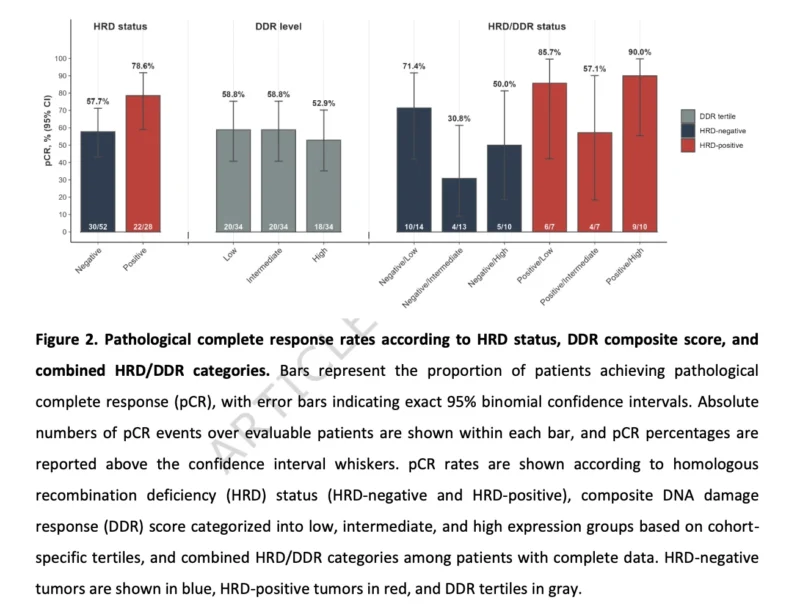
Pathological complete response was achieved in 77 of 128 patients, corresponding to a pCR rate of 60.2%.
This result is broadly consistent with prior studies showing that the addition of carboplatin can increase pathological response rates in TNBC.
The NeoCarbo regimen also produced a pCR rate within the range reported in major platinum-containing neoadjuvant trials. However, direct cross-trial comparisons should be made cautiously because patient populations, disease stages, treatment schedules, and use of immunotherapy differed across studies.
The key question was not simply whether carboplatin-based therapy could induce pCR. It was whether biomarkers could identify which tumors were especially likely to respond.
HRD-Positive Tumors Had Higher pCR Rates
Germline HRD status was available for 80 patients.
Among them, 28 patients were classified as HRD-positive based on pathogenic or likely pathogenic germline variants in BRCA1, BRCA2, PALB2, RAD51D, or other assessed homologous recombination-related genes.
The pCR rate was 78.6% in HRD-positive tumors, compared with 57.7% in HRD-negative tumors.
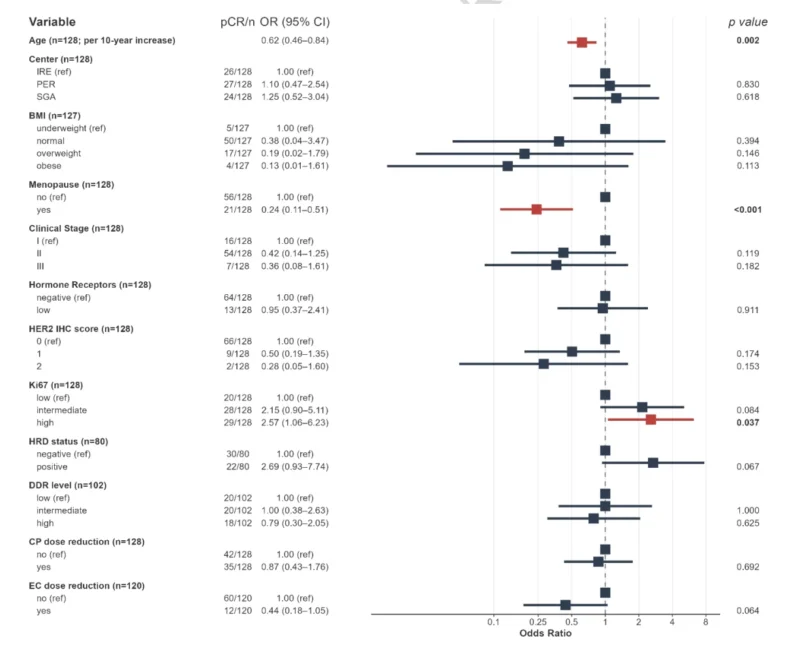
The unadjusted difference did not reach conventional statistical significance:
- Odds ratio: 2.66
- 95% CI: 0.85–9.39
- p=0.086
However, in the 61-patient subset with complete HRD, DDR, and pCR data, HRD-positive status remained independently associated with a greater likelihood of pCR after adjustment for DDR score:
- Adjusted odds ratio: 2.68
- 95% CI: 1.16–6.85
- ‘p=0.027
This result supports the hypothesis that HRD may identify a subgroup with greater sensitivity to platinum-based neoadjuvant chemotherapy.
It does not prove that HRD-positive tumors derive a larger relative benefit from carboplatin than they would from a non-platinum regimen. That question requires a randomized comparison with formal interaction testing.
Why Baseline DDR Protein Expression Did Not Add Predictive Value
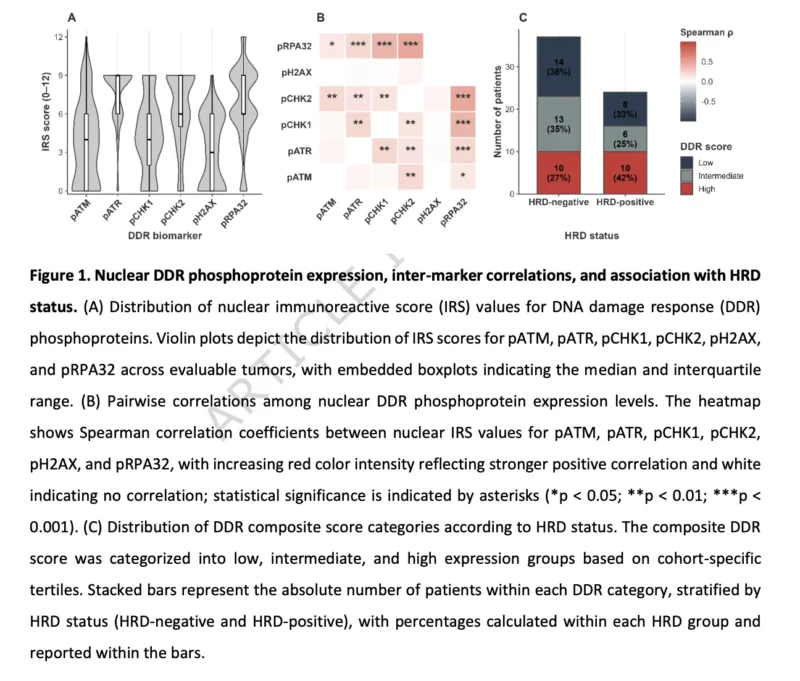
The study also assessed baseline tumor expression of six phosphorylated DNA damage response proteins:
pATM, pATR, pCHK1, pCHK2, pH2AX, and pRPA32.
These markers were combined into a composite DDR score and grouped into low, intermediate, and high expression categories.
Unlike HRD, the baseline composite DDR score was not associated with pathological complete response.
pCR occurred in:
- 58.8% of patients with low DDR expression
- 58.8% of patients with intermediate DDR expression
- 52.9% of patients with high DDR expression
There was no statistically significant association between DDR score and pCR.
This is an important negative finding.
The study suggests that static measurement of phosphorylated DNA damage-response proteins in pretreatment tumor tissue may not adequately reflect functional DNA repair vulnerability. A tumor with high baseline DDR activation may not necessarily be DNA repair-deficient. In some cases, active DDR signaling could instead reflect an intact ability to respond to DNA damage.
The authors suggest that dynamic or functional assays, such as RAD51 focus formation, may be more informative than a single pretreatment immunohistochemistry measurement.
pCR Remained Strongly Associated With Long-Term Outcomes
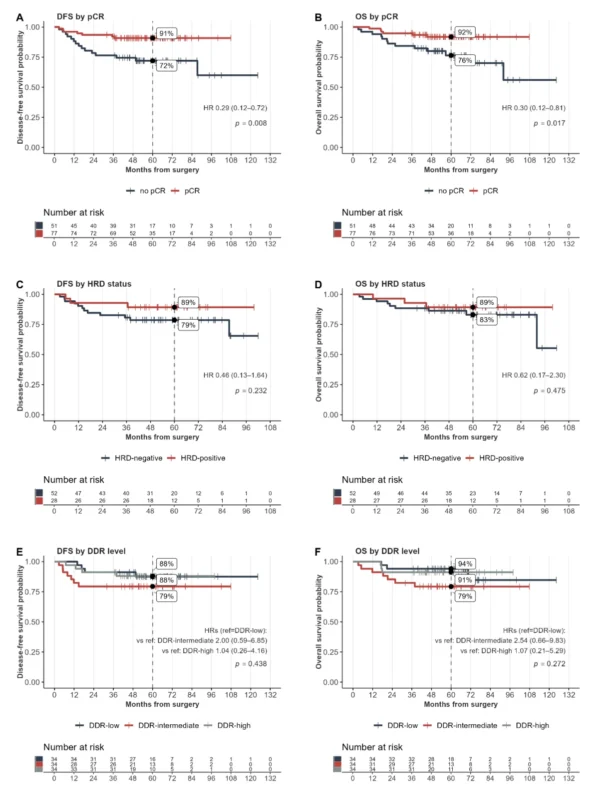
With a median follow-up of 60.4 months, pCR was strongly associated with disease-free and overall survival.
At 60 months, disease-free survival was:
- 91% among patients who achieved pCR
- 72% among patients with residual disease
The hazard ratio for recurrence or death was 0.29 (95% CI, 0.12–0.72; p=0.008).
Overall survival at 60 months was:
- 92% among patients with pCR
- 76% among patients without pCR
The hazard ratio for death was 0.30 (95% CI, 0.12–0.81; p=0.017).
These findings are consistent with prior evidence that pathological complete response is particularly meaningful in TNBC.
HRD-positive patients also had numerically better five-year disease-free survival than HRD-negative patients, at 89% versus 79%, but this difference was not statistically significant. The limited number of recurrence and death events restricted the survival analyses.
Toxicity Was Mainly Hematologic
The safety profile was consistent with a platinum-containing neoadjuvant regimen.
Grade 3 or higher toxicity occurred in 14.4% of patients during carboplatin–paclitaxel and 18.9% during epirubicin–cyclophosphamide.
Hematologic toxicity was the main issue.
During carboplatin–paclitaxel, grade 3 or higher neutropenia occurred in 14.2% of evaluable patients, while grade 3 or higher leukopenia occurred in 12.3%.
During epirubicin–cyclophosphamide, grade 3 or higher neutropenia occurred in 14.0%, leukopenia in 11.5%, and anemia in 6.9%.
Dose reductions were frequent during carboplatin–paclitaxel, occurring in 46.9% of patients. Treatment delays occurred in 29.7%.
No treatment-related deaths were reported.
Where Does NeoCarbo Fit in the Current TNBC Landscape?
The treatment landscape for early TNBC has changed substantially since the NeoCarbo cohort began enrollment.
For many patients with high-risk stage II–III TNBC, pembrolizumab combined with carboplatin-containing neoadjuvant chemotherapy followed by adjuvant pembrolizumab is now a key standard-of-care strategy. Patients with germline BRCA1 or BRCA2 pathogenic variants and high-risk disease may also be candidates for adjuvant olaparib according to clinical criteria.
This does not make the NeoCarbo findings irrelevant.
The study reinforces that carboplatin remains a central component of TNBC systemic therapy and provides real-world evidence that HRD-related alterations may identify tumors with a high likelihood of deep pathological response.
The results are also relevant in settings where access to immunotherapy is limited, where treatment needs to be individualized, or where future trials aim to refine chemotherapy intensity based on DNA repair biology.
Important Limitations
NeoCarbo was an observational study, not a randomized trial.
There was no non-platinum comparison arm. Therefore, the study cannot prove that carboplatin itself caused the observed benefit or that HRD specifically predicts additional benefit from platinum.
HRD status was available for only 80 of 128 patients, while complete HRD and DDR data were available for 61 patients. Germline testing strategies also changed over time, from more limited BRCA1/2 testing to broader multigene panels.
The static phosphoprotein assessments may have been affected by tissue handling, fixation timing, and the biological limitations of measuring dynamic signaling pathways at one pretreatment timepoint.
Finally, the number of DFS and OS events was limited, reducing the precision of survival analyses.
The Bottom Line
The NeoCarbo study reported a 60.2% pCR rate with neoadjuvant carboplatin–paclitaxel followed by dose-dense epirubicin–cyclophosphamide in stage I–III TNBC.
HRD-positive status was independently associated with a higher likelihood of pCR in patients with complete biomarker data. In contrast, baseline phospho-DDR protein expression did not predict pathological response.
The study supports HRD as a promising biomarker of platinum sensitivity in TNBC, but it does not establish HRD-guided treatment selection in routine practice.
The next step is prospective validation using standardized HRD assays, functional measures of DNA repair capacity, and treatment designs that can determine whether biomarker-defined groups can safely receive more or less intensive therapy.
References
- Krasniqi E, Di Benedetto A, Filomeno L, et al. Platinum-based neoadjuvant chemotherapy and the predictive role of DNA damage response biomarkers in TNBC: the NeoCarbo study. npj Breast Cancer. 2026. doi:10.1038/s41523-026-00977-2.
- von Minckwitz G, Schneeweiss A, Loibl S, et al. Neoadjuvant carboplatin in patients with triple-negative and HER2-positive early breast cancer: GeparSixto. Lancet Oncology. 2014;15:747–756.
- Sikov WM, Berry DA, Perou CM, et al. Impact of the addition of carboplatin and/or bevacizumab to neoadjuvant chemotherapy in stage II–III triple-negative breast cancer: CALGB 40603. Journal of Clinical Oncology. 2015;33:13–21.
- Loibl S, O’Shaughnessy J, Untch M, et al. Addition of veliparib plus carboplatin or carboplatin alone to standard neoadjuvant chemotherapy in triple-negative breast cancer: BrighTNess. Lancet Oncology. 2018;19:497–509.
- Schmid P, Cortés J, Dent R, et al. Overall survival with pembrolizumab in early-stage triple-negative breast cancer. New England Journal of Medicine. 2024;391:1981–1991.