Radiation therapy remains a central component of multidisciplinary care for leptomeningeal disease from breast cancer, particularly for symptomatic intracranial or spinal disease. Yet whether conventional radiation approaches improve survival remains uncertain.
A new multicenter analysis of 232 women with breast cancer and leptomeningeal disease (LMD) found a median overall survival of only 4.7 months. Approximately two-thirds of patients received radiation therapy, most commonly whole-brain radiation therapy, but RT was not associated with improved overall survival after accounting for treatment timing and other clinical factors (Ehret et al., 2026).
The study does not suggest that radiation therapy lacks clinical value. Rather, it highlights an important distinction between survival benefit and symptom-directed benefit. Conventional RT remains important for palliation and management of bulky or symptomatic disease, while emerging evidence for proton craniospinal irradiation suggests that broader neuraxis treatment may represent a different therapeutic strategy requiring prospective evaluation.
Why Is Leptomeningeal Disease Such a Difficult Complication of Breast Cancer?
Leptomeningeal disease develops when malignant cells spread into the cerebrospinal fluid and leptomeninges surrounding the brain and spinal cord.
Among patients with breast cancer brain metastases, approximately 10%–25% can develop LMD, and historical median overall survival after diagnosis has generally ranged from 2 to 4 months (Ehret et al., 2026; Lamba et al., 2021).
Management is particularly difficult because disease can involve multiple parts of the neuraxis simultaneously, neurological symptoms can progress quickly, and treatment selection depends heavily on performance status, disease distribution, extracranial disease, systemic treatment options and goals of care.
Current multidisciplinary approaches can include systemic therapy, intrathecal therapy, focal radiation, whole-brain radiation therapy and, in selected patients, craniospinal irradiation (Wilcox et al., 2024; Le Rhun et al., 2023).
The new analysis by Ehret and colleagues focused specifically on how radiation therapy has been used in real-world multidisciplinary management and whether its use was associated with longer survival.
Who Was Included in the Multicenter Analysis?
The retrospective study included 232 women with breast cancer-associated LMD treated at three tertiary academic centers in the United States between 2005 and 2020.
Median age at primary breast cancer diagnosis was 47.2 years, while median age at LMD diagnosis was 54.5 years. LMD developed a median of 4.8 years after the initial breast cancer diagnosis.
Median Karnofsky Performance Status at LMD diagnosis was 80%.
Only 10.7% of patients were asymptomatic when LMD was diagnosed. Headache was the most common presenting symptom, affecting 40.5%, followed by nausea or vomiting in 26.7% and cranial nerve deficits in 25.8% (Ehret et al., 2026).
The patient characteristics summarized in Table 1 on page 23 also show substantial heterogeneity in breast cancer subtype, disease extent and clinical presentation.
Where Was Leptomeningeal Disease Located?
Intracranial-only disease was the most common presentation.
53.8% had LMD confined to the brain, 8.6% had spine-only involvement, and 37.5% had disease involving both the brain and spine.
Classical or linear LMD was identified in 68.1%, while nodular or mixed disease was present in 31.8%.
Approximately 37% of patients had previously developed brain metastases, and almost one-third had already received CNS-directed radiation before their LMD diagnosis (Ehret et al., 2026).
This heterogeneity is important when interpreting outcomes because radiation therapy was not assigned randomly. Patients selected for RT could have differed substantially from patients who did not receive RT in disease burden, symptoms and expected prognosis.
How Often Was Radiation Therapy Used?
Radiation therapy was given to 154 of 232 patients, or 66.3%.
Together, these patients received 205 radiation courses, and nearly one-quarter of irradiated patients underwent more than one course.
Treatment was usually initiated quickly. Median time from LMD diagnosis to radiation therapy was 7 days, and 71.4% of first RT courses began within 30 days of diagnosis (Ehret et al., 2026).
Whole-brain radiation therapy was by far the most common approach.
A total of 114 patients received WBRT, corresponding to 49.1% of the entire cohort. Across all radiation courses, WBRT represented 58.5% of treatments.
Median WBRT dose was 30 Gy, delivered in a median of 10 fractions.
What Other Radiation Strategies Were Used?
Only three patients underwent craniospinal irradiation, reflecting how rarely CSI was used during the historical study period.
The median CSI dose was 36 Gy.
Focal approaches included stereotactic radiosurgery, fractionated radiation and focal spine irradiation.
Fourteen SRS courses were delivered, with a median dose of 18 Gy in a single fraction. Fourteen fractionated intracranial RT courses were given, with a median dose of 30 Gy, while 52 focal spine RT courses were delivered at a median dose of 25.5 Gy.
Importantly, 12.3% of irradiated patients did not complete at least one planned RT course, including 12 WBRT courses and one CSI course (Ehret et al., 2026).
That finding illustrates one of the practical challenges of radiotherapy in a population with rapidly progressive disease and short life expectancy.
What Was Overall Survival After LMD Diagnosis?
Prognosis remained poor.
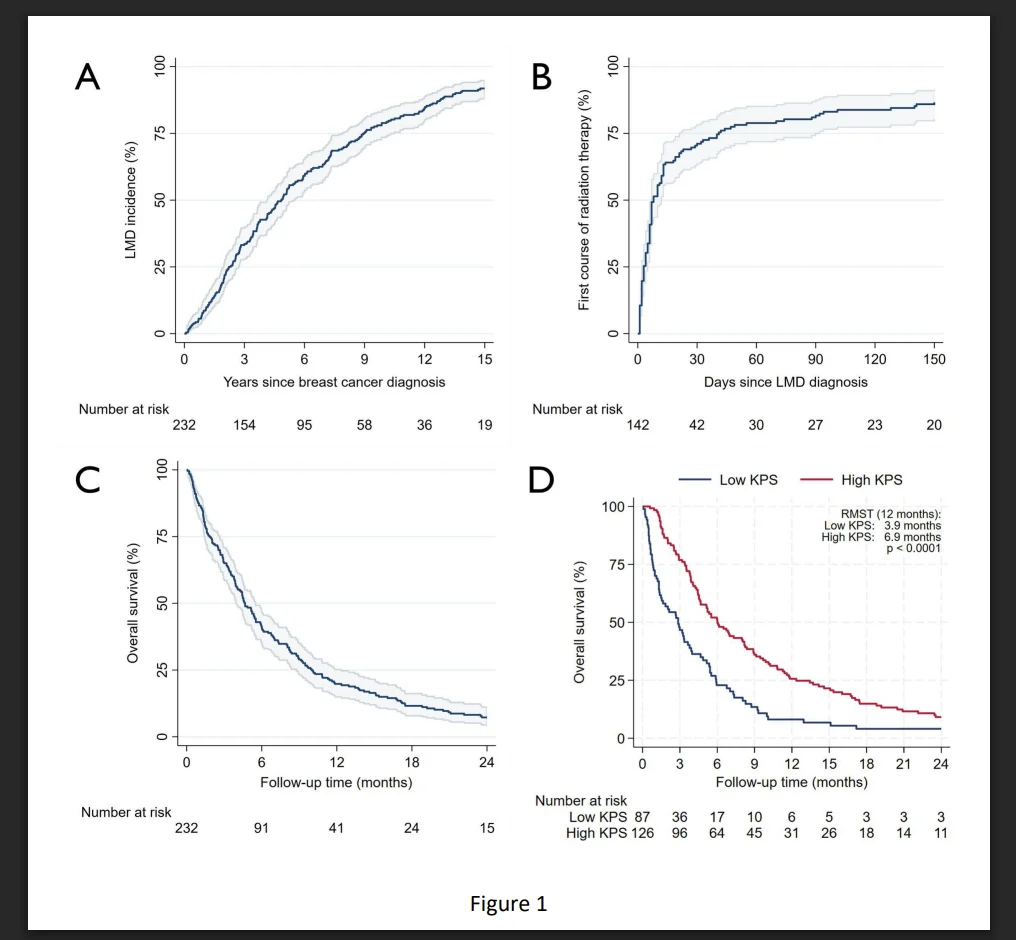
After a median follow-up of 4.5 months, 220 of the 232 patients had died.
Median overall survival was:
- 4.7 months
- 95% CI, 3.9–5.5 months
Six-month overall survival was 41.1%.
At 12 months, only 19.7% of patients remained alive. Survival declined further to 11.5% at 18 months and 7.2% at 24 months (Ehret et al., 2026).
The survival curve in Figure 1C on page 31 shows the steep decline in survival during the first months following LMD diagnosis.
Did Radiation Therapy Improve Overall Survival?
In this retrospective cohort, no overall survival benefit from radiation therapy was identified.
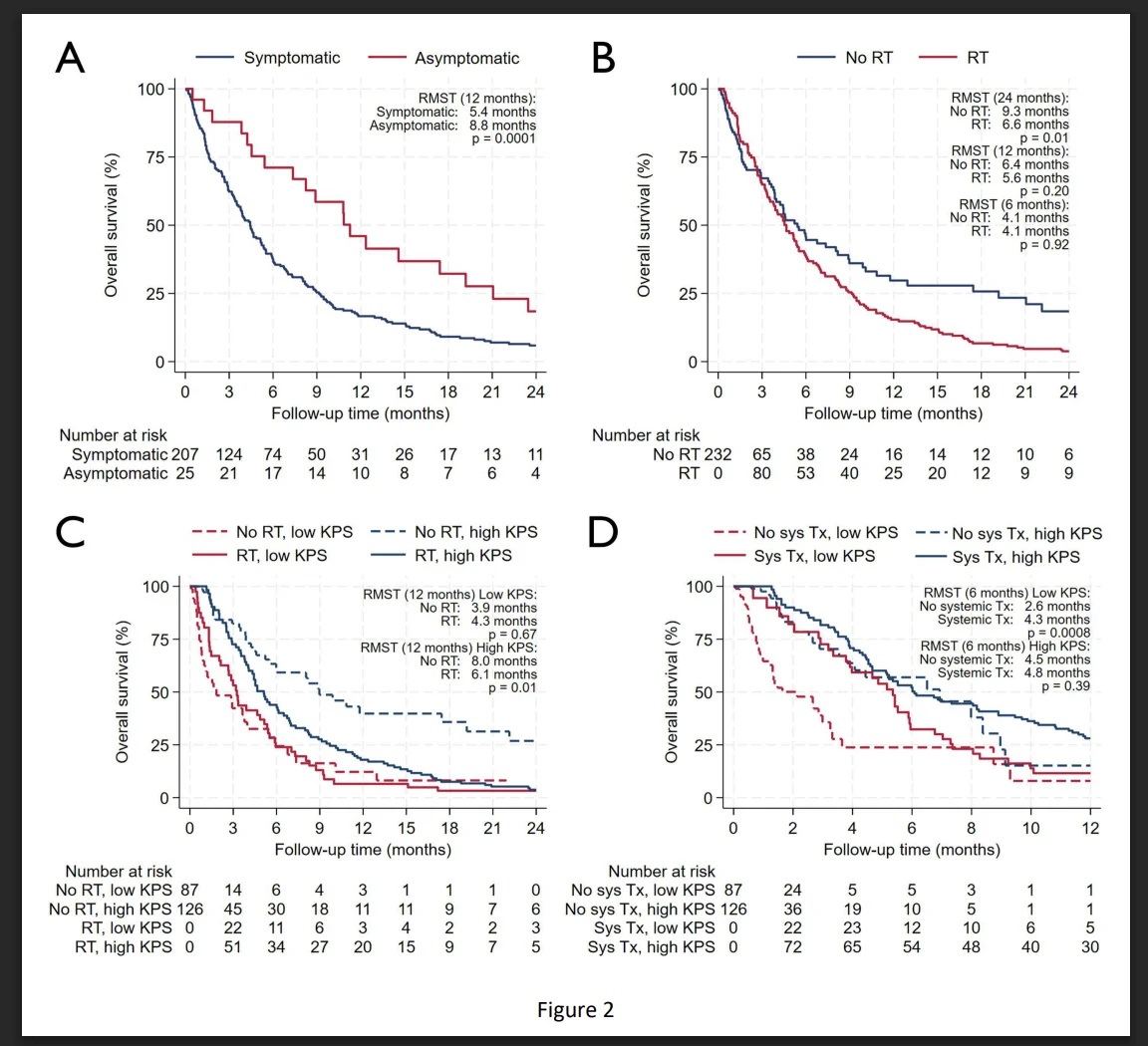
Restricted mean survival time at 12 months was:
- 5.6 months with RT versus 6.4 months without RT
- with p=0.20.
At six months, RMST was identical at 4.1 months in both groups.
By 24 months, RMST was actually lower among patients who received RT, 6.6 months versus 9.3 months without RT, but this finding cannot be interpreted as evidence that radiation causes worse survival because treatment selection was nonrandomized (Ehret et al., 2026).
The authors emphasize confounding by indication as a likely explanation: patients sent for radiation may have had more symptomatic, bulky or clinically threatening CNS disease than those who were not irradiated.
Did Performance Status Change the Relationship With RT?
Performance status was one of the strongest prognostic factors.
Patients with a KPS of at least 80% had substantially better outcomes than patients with KPS below 80%.
Restricted mean survival time was:
- 6.9 months with KPS ≥80% versus 3.9 months with KPS <80%
- with p<0.0001 (Ehret et al., 2026).
The separation is clearly visible in Figure 1D on page 31, where the survival curve for patients with higher KPS remains substantially above that of patients with poorer functional status.
Surprisingly, radiation therapy was associated with worse observed survival among patients with good performance status.
Among patients with high KPS, 12-month RMST was 6.1 months with RT versus 8.0 months without RT; p=0.01.
Among patients with low KPS, there was no significant difference: 4.3 versus 3.9 months; p=0.67.
Again, these findings should not be interpreted as evidence that RT harms patients with good performance status. The retrospective design makes treatment-selection bias particularly important.
Did Disease Location Identify a Group That Benefited From RT?
No clear survival-benefiting subgroup was identified according to LMD location.
For patients with spine-only or combined brain-and-spine disease, 12-month RMST was 6.3 months with RT versus 7.6 months without RT, a nonsignificant difference.
Among patients with brain involvement, 12-month RMST was 4.8 months with RT versus 5.7 months without RT, also without a significant difference.
Multivariable analysis similarly failed to demonstrate a survival benefit attributable to radiation across these disease-location groups (Ehret et al., 2026).
What Did the Multivariable Analysis Show?
The investigators used time-varying treatment covariates to reduce immortal-time bias and better account for when patients actually received RT and systemic therapy.
The results are detailed in Table 2 on page 25.
Among patients with good performance status and brain involvement, RT was associated with an HR for death of 1.74.
Among patients with KPS ≥80% but without brain involvement, the HR was 3.59.
Radiation therapy was not significantly associated with survival among patients with poor KPS.
The authors therefore concluded that the apparent relationship between radiation and survival was heterogeneous across clinical contexts and could not establish a survival-modifying effect of RT.
Did Breast Cancer Subtype Change the Results?
The investigators also performed exploratory analyses according to biological breast cancer subtype, including triple-negative breast cancer.
They found no evidence that radiation therapy was associated with improved survival in any biological subgroup.
An exploratory comparison of radiation techniques similarly found no survival advantage for WBRT over focal approaches.
These analyses were exploratory, and detailed data were not reported in the publication. They therefore should not be used to make subtype-specific treatment recommendations (Ehret et al., 2026).
What About Systemic Therapy?
The findings for systemic therapy were notably different.
Overall, 61.6% of patients received systemic therapy after LMD diagnosis.
This included chemotherapy in 45.6%, targeted therapy in 22.4%, hormone therapy in 10.7%, and immunotherapy in 4.7%.
Systemic treatment was associated with improved survival, particularly among patients with poorer performance status.
Among patients with KPS below 80%, six-month RMST was:
- 4.3 months with systemic therapy versus 2.6 months without systemic therapy
- with p=0.0008 (Ehret et al., 2026).
In the multivariable model, systemic therapy among patients with poor performance status was associated with an HR for death of 0.49; 95% CI, 0.30–0.80; p=0.004.
Was Systemic Therapy Beneficial Across Disease Locations?
The association with better survival was seen across LMD distribution.
Among patients with spine-only or combined brain-and-spine disease, six-month RMST was 5.1 months with systemic therapy versus 4.3 months without.
For isolated intracranial LMD, the corresponding values were 4.3 months versus 3.2 months.
The findings support the increasingly important role of systemic therapies capable of producing clinically meaningful CNS activity in selected breast cancer populations.
However, because this was a retrospective observational study, the association cannot establish that systemic treatment itself caused the survival improvement.
Why Does RT Remain Important If It Did Not Improve Survival?
Overall survival is not the only objective of radiation therapy in leptomeningeal disease.
Radiation can be used to relieve neurologic symptoms, treat bulky nodular deposits, manage painful spinal disease, restore or maintain cerebrospinal fluid pathways, and control clinically threatening focal disease.
Ehret and colleagues specifically caution that their study focused primarily on survival and therefore could not fully capture other meaningful outcomes such as neurologic symptom relief and quality-of-life improvement.
The authors emphasize that RT continues to have an important palliative role despite the absence of a demonstrated survival benefit in this cohort.
Current SNO/ASCO and EANO-ESMO recommendations similarly support focal irradiation of symptomatic or bulky intracranial and spinal disease while discouraging routine WBRT based solely on an LMD diagnosis (Wilcox et al., 2024; Le Rhun et al., 2023).
Why Is Whole-Brain RT Particularly Difficult to Evaluate?
Whole-brain radiation was the dominant treatment in this historical cohort, but the patients receiving it were unlikely to be interchangeable with those not receiving radiation.
WBRT is often selected when intracranial disease is extensive, symptomatic or otherwise difficult to manage focally.
Those same characteristics can independently predict worse survival.
This is why a retrospective comparison can produce apparently poorer survival after RT even when radiation is helping with neurological symptoms or local disease control.
Ehret and colleagues therefore argue that survival effects cannot be reliably separated from patient selection without prospective randomized studies.
Could Craniospinal Irradiation Be Different?
This is where the radiation discussion becomes particularly important.
Traditional involved-field approaches such as WBRT or focal spine irradiation treat selected sites of disease. LMD, however, is a disease of the cerebrospinal fluid space and can involve the entire neuraxis.
Craniospinal irradiation addresses the brain and spinal leptomeningeal compartments together.
The current study itself cannot meaningfully evaluate CSI because only three patients received it.
However, Ehret and colleagues highlight a randomized phase II study by Yang and colleagues comparing proton craniospinal irradiation with photon involved-field RT in patients with breast cancer or NSCLC and leptomeningeal metastases.
Median CNS progression-free survival was:
- 8.2 months with proton CSI versus 2.3 months with involved-field RT
and median overall survival was:
- 11.3 months versus 4.9 months respectively (Yang et al., 2025).
That randomized evidence represents a fundamentally different signal from retrospective analyses of conventional WBRT and focal irradiation.
Why Might Proton CSI Matter?
The rationale is related to disease distribution.
Instead of treating only clinically apparent sites of LMD, craniospinal irradiation targets the entire cerebrospinal fluid compartment.
Proton therapy can also reduce dose to tissues anterior to the spinal canal compared with conventional photon craniospinal approaches, potentially improving the feasibility of treating the entire neuraxis.
The phase II results do not mean that every patient with breast cancer LMD should receive pCSI.
Patient selection remains critical, and access to proton therapy is limited.
But the randomized survival signal has shifted the radiation discussion away from the broad question “Does RT work in LMD?” toward a more precise question:
Which radiation technique, for which patient, and at what point in the disease course?
What Is NRG-BN014 Trying to Answer?
The next major step is NRG-BN014, a randomized phase III trial highlighted by Ehret and colleagues.
The study is comparing proton craniospinal irradiation with photon-based involved-field radiation therapy in patients with breast cancer or NSCLC leptomeningeal disease.
Overall survival is the primary endpoint.
The trial is particularly important because prospective randomized evidence remains scarce, while retrospective datasets are heavily affected by patient selection, treatment timing and disease heterogeneity.
If the phase II benefit of pCSI is confirmed in a larger phase III setting, it could substantially redefine the role of radiation therapy in selected patients with LMD.
Could Modern Photon CSI Expand Access?
Protons are not universally available.
The authors therefore also highlight volumetric modulated arc therapy craniospinal irradiation with vertebral-body sparing as a potential photon-based strategy intended to improve accessibility and reduce toxicity.
This remains an evolving area rather than an established replacement for proton CSI.
Future studies will need to determine how technique, patient selection, systemic therapy and treatment timing interact.
The key question is unlikely to be whether “radiation” as a single category improves survival. WBRT, focal RT and CSI represent biologically and clinically different strategies.
What Did Previous Breast Cancer Studies Show?
Ehret and colleagues reviewed 19 previous studies examining LMD outcomes in breast cancer.
The literature was highly heterogeneous in patient selection and treatment approaches.
Across studies reporting median survival, values ranged from 1.6 to 7.5 months. Fourteen of 17 studies reporting median OS, 82.4%, reported survival between 3 and 6 months.
The extensive literature summary in Table 3 on pages 26–27 demonstrates why firm conclusions about conventional RT remain difficult.
Some retrospective series associated radiation with better survival, while others found symptom improvement without survival benefit. Many patients simultaneously received systemic or intrathecal treatments, making it difficult to isolate the effect of radiation.
The consistency of poor overall survival across decades nevertheless underscores the need for more effective strategies.
What Are the Main Limitations?
The central limitation is the retrospective design.
Radiation therapy was not randomly assigned, and treatment decisions could have been influenced by disease burden, neurological symptoms, physician judgment and other factors not fully captured in the dataset.
This creates substantial potential for confounding by indication.
The study also covered patients treated between 2005 and 2020, a period during which systemic breast cancer therapy changed substantially. Contemporary HER2-directed and other CNS-active systemic therapies were therefore not uniformly represented.
Treatment regimens were heterogeneous, and standardized radiation algorithms were not used.
Most importantly, the analysis focused on overall survival. It could not adequately quantify several outcomes that are highly relevant to palliative radiation, including neurological symptom control and quality of life.
For these reasons, the finding that RT was not associated with better OS must not be interpreted as evidence that RT has no role in LMD management (Ehret et al., 2026).
The Bottom Line
Leptomeningeal disease remains one of the most challenging complications of metastatic breast cancer.
In this multicenter cohort of 232 patients, median overall survival after LMD diagnosis was only 4.7 months.
Radiation therapy was used in 66.3%, with WBRT accounting for most treatment courses, but conventional RT was not associated with improved overall survival.
Systemic therapy, in contrast, was associated with better survival, particularly among patients with poor performance status.
Yet the study does not establish that radiation therapy is ineffective. Conventional RT remains important for symptom palliation and treatment of bulky or clinically threatening disease, while retrospective survival comparisons are heavily influenced by patient selection.
At the same time, randomized phase II evidence showing 8.2 versus 2.3 months CNS PFS and 11.3 versus 4.9 months median OS with proton CSI versus involved-field RT suggests that the future of radiotherapy in LMD may depend less on whether radiation is used and more on how extensively the neuraxis is treated and which patients are selected.
The phase III NRG-BN014 study is positioned to address that question prospectively.
For breast cancer LMD, the evidence is increasingly pointing toward a more individualized radiation strategy rather than routine use of one radiation approach for every patient.
References
- Ehret F, Aitelli A, Niemierko A, Yuan AM, Milligan MG, Neibart SS, Aizer AA, Lin NU, Sammons SL, Shih HA. The role of radiation therapy in leptomeningeal disease from breast cancer – a multicenter analysis. 2026. doi:10.1016/j.ctro.2026.101259. Journal pre-proof.
- Wilcox JA, Chukwueke UN, Ahn MJ, et al. Leptomeningeal metastases from solid tumors: a SNO and ASCO consensus review on clinical management and future directions. Neuro-Oncology. 2024.
- Le Rhun E, Weller M, van den Bent M, et al. Leptomeningeal metastasis from solid tumours: EANO-ESMO Clinical Practice Guideline for diagnosis, treatment and follow-up. ESMO Open. 2023;8:101624.
- Yang JT, Yerramilli D, Pentsova E, et al. Proton craniospinal irradiation for patients with leptomeningeal metastasis: a randomized clinical trial. JAMA Oncology. 2025;11:1293–1301.
- Alder L, Trapani D, Bradbury C, et al. Durable responses in patients with HER2-positive breast cancer and leptomeningeal metastases treated with trastuzumab deruxtecan. npj Breast Cancer. 2023;9:19.
- Niikura N, Yamanaka T, Nomura H, et al. Treatment with trastuzumab deruxtecan in patients with HER2-positive breast cancer and brain metastases and/or leptomeningeal disease: ROSET-BM. npj Breast Cancer. 2023;9:82.