
The final analysis of the phase III IMpassion050 trial provides an important long-term perspective on the role of immune checkpoint inhibition in HER2-positive early breast cancer. Despite a compelling biological rationale for combining anti–PD-L1 therapy with HER2-directed treatment, adding atezolizumab to pertuzumab, trastuzumab, and chemotherapy did not significantly improve event-free survival or disease-free survival in patients with high-risk HER2-positive early breast cancer.
The findings, published in ESMO Open follow the previously reported primary analysis, in which atezolizumab also failed to improve pathologic complete response. In the intention-to-treat population, pCR rates were 62.4% with atezolizumab and 62.7% with placebo; among patients with PD-L1–positive tumors, pCR was 64.2% versus 72.5%, respectively.
The final results therefore reinforce a central message: the addition of checkpoint blockade to established HER2-targeted therapy has not yet demonstrated a clear clinical benefit in this setting.
IMpassion050 Tested Immunotherapy Across the Perioperative Treatment Course
IMpassion050 was the first randomized, double-blind, placebo-controlled phase III trial specifically designed to test neoadjuvant and adjuvant immune checkpoint inhibition in high-risk HER2-positive early breast cancer.
Eligible patients had HER2-positive tumors larger than 2 cm with histologically confirmed nodal involvement, corresponding to T2–4, N1–3, M0 disease. HER2, hormone receptor, and PD-L1 status were centrally assessed. Patients were randomized 1:1 to receive atezolizumab or placebo with anthracycline-based chemotherapy, followed by atezolizumab or placebo combined with pertuzumab, trastuzumab, and paclitaxel.
After surgery, patients continued atezolizumab or placebo with trastuzumab and pertuzumab for up to one year. Those with residual invasive disease could switch to T-DM1 plus atezolizumab or placebo for 14 cycles, while endocrine therapy was permitted for hormone receptor–positive tumors.
The study therefore evaluated immunotherapy not simply as a short neoadjuvant intervention but as a component of an extended perioperative strategy.
No Improvement in Pathologic Complete Response
The first indication that the strategy might not provide the expected benefit came from the trial’s primary endpoint. Atezolizumab did not improve pCR in either the overall population or the prespecified PD-L1–positive population.
In the intention-to-treat population:
- pCR: 62.4% with atezolizumab vs 62.7% with placebo.
In PD-L1–positive disease:
- pCR: 64.2% vs 72.5%. PIIS2059702926024865
Additional biomarker analyses examining HER2 IHC pattern, HER2 amplification, hormone receptor status, and PIK3CA alterations also failed to identify a subgroup with a convincing differential pCR benefit from atezolizumab.
These results contrasted with the success of checkpoint inhibition in early triple-negative breast cancer and raised an important biological question: is HER2-positive disease sufficiently immunogenic to benefit from checkpoint blockade when potent HER2-directed antibodies and chemotherapy are already providing substantial antitumor activity?
Three-Year Event-Free Survival Was Numerically Higher but Not Significantly Improved
At the final data cutoff of August 24, 2023, median follow-up was approximately 44 months.
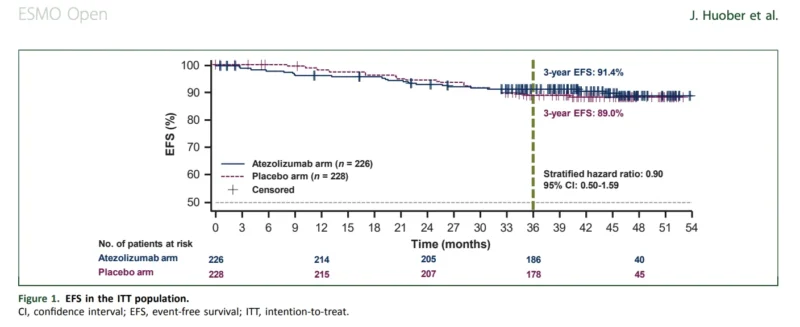
Three-year event-free survival was:
- 91.4% with atezolizumab
versus
- 89.0% with placebo.
The stratified hazard ratio was 0.90 (95% CI, 0.50–1.59). The EFS curves shown in Figure 1 on page 4 remain close throughout follow-up, reflecting the absence of a clear separation between treatment strategies. Although the point estimate numerically favored atezolizumab, the confidence interval was wide and crossed 1 substantially. The final analysis therefore does not establish an EFS benefit.
This distinction is important because numerical differences in a relatively small number of events can be misleading when interpreted outside the statistical design of the trial.
Disease-Free Survival Showed a Numerical Difference but Remained Inconclusive
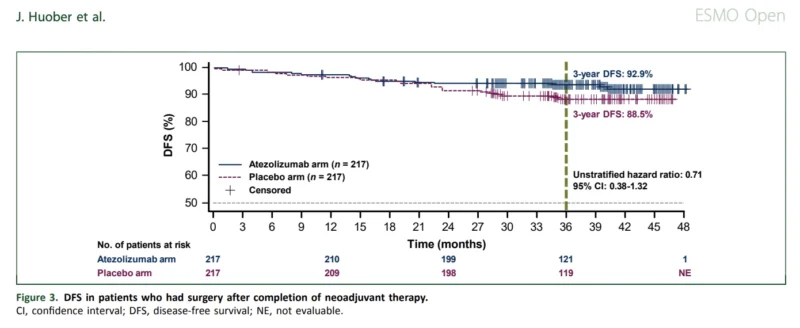
Among the 434 patients who underwent surgery and received post-neoadjuvant therapy, three-year DFS was:
- 92.9% with atezolizumab
versus
- 88.5% with placebo.
The unstratified HR was 0.71 (95% CI, 0.38–1.32). The DFS curves presented in Figure 3 on page 5 show a numerical separation favoring atezolizumab, but again the confidence interval includes the possibility of no treatment effect. The authors therefore appropriately describe the long-term efficacy findings as descriptive rather than definitive.
Importantly, the trial was originally powered around pCR rather than EFS or DFS. The relatively small number of events limits the ability to determine whether the numerical DFS difference represents a true treatment effect or statistical variation.
Overall Survival Remains Too Immature for Meaningful Interpretation
Only 24 deaths had occurred among the 454 randomized patients at the time of final analysis:
- 11 in the atezolizumab arm and 13 in the placebo arm.
Because of the small number of events, no landmark overall-survival analyses were performed. This means the trial cannot provide a reliable assessment of whether atezolizumab affects overall survival. However, in the context of negative pCR and non-significant EFS and DFS results, the available evidence does not currently support routine incorporation of atezolizumab into perioperative HER2-positive treatment.
PD-L1 Did Not Behave as an Effective Predictive Biomarker
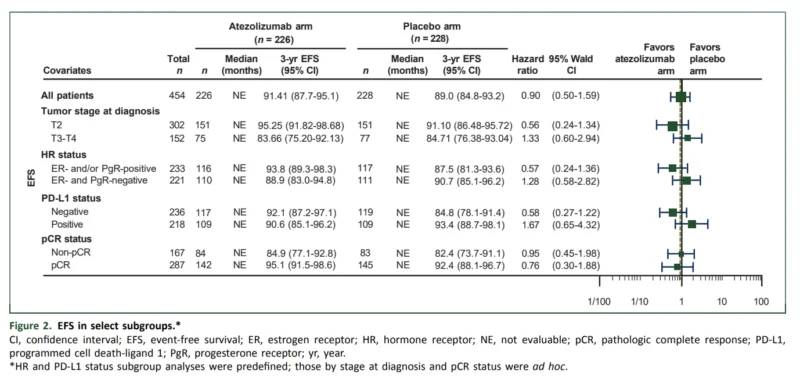
One of the most interesting, and unexpected, findings involved PD-L1. Among patients with PD-L1–positive tumors, three-year EFS was:
- 90.6% with atezolizumab vs 93.4% with placebo.
Among patients with PD-L1–negative tumors:
- 92.1% vs 84.8%.
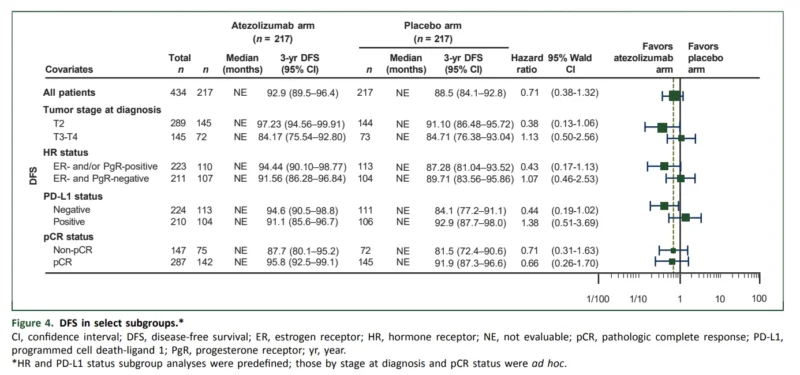
A similar pattern was observed for DFS. In PD-L1–positive disease, three-year DFS was 91.1% versus 92.9%. In PD-L1–negative disease, the rates were 94.6% versus 84.1%.
These apparently greater numerical effects in PD-L1–negative tumors were contrary to the biological hypothesis of the study and should not be interpreted as evidence that PD-L1–negative patients preferentially benefit from atezolizumab.
The subgroup analyses involved relatively few events, confidence intervals were wide, and the trial was not designed to establish this unexpected interaction. The authors explicitly caution that the result may reflect small subgroup sizes and event numbers rather than a true treatment effect.
The finding instead highlights the limitations of PD-L1 as a predictive biomarker in HER2-positive early breast cancer, including its spatial and temporal heterogeneity.
Hormone Receptor-Positive Disease Also Showed a Numerical Signal
Another numerical trend appeared according to hormone receptor status. Among HR-positive patients, three-year EFS was 93.8% with atezolizumab versus 87.5% with placebo, corresponding to an HR of 0.57. In HR-negative disease, the respective rates were 88.9% and 90.7%, with an HR of 1.28. The DFS analysis followed a similar direction, with an HR of 0.43 in HR-positive disease and 1.07 in HR-negative disease.
Again, these subgroup findings are hypothesis-generating rather than treatment-defining. They do, however, reinforce the possibility that immune biology within HER2-positive breast cancer may not follow the same patterns observed in triple-negative disease.
pCR Remained Strongly Associated With Better Prognosis
Although atezolizumab did not improve the overall probability of achieving pCR, pathological response remained prognostically important. Among patients achieving pCR, three-year EFS was 95.1% with atezolizumab and 92.4% with placebo.
Among those with residual disease, the corresponding rates were 84.9% and 82.4%. The DFS analysis showed the same pattern:
- 95.8% vs 91.9% among patients with pCR
- 87.7% vs 81.5% among those without pCR
The prognostic value of pCR therefore remains clear. What IMpassion050 raises, however, is a different question: is pCR always sufficient as an early surrogate for long-term immunotherapy benefit? The authors emphasize that future neoadjuvant immunotherapy trials should incorporate adequately powered long-term endpoints such as invasive DFS, distant DFS, and OS rather than relying principally on pCR.
Stromal TILs Were Prognostic but Did Not Provide a Clear Selection Threshold
HER2-positive breast cancers are frequently characterized by substantial immune infiltration, providing one of the biological rationales for investigating checkpoint blockade. In IMpassion050, increasing baseline stromal tumor-infiltrating lymphocyte levels were associated with numerically better EFS and DFS.
However, the investigators did not identify a clear threshold that could be considered biologically or clinically useful for patient selection. This adds to the broader biomarker challenge. HER2-positive tumors may be immunologically active, but conventional measures such as PD-L1 and TIL percentage have not yet reliably identified the subgroup in which checkpoint inhibition meaningfully improves outcomes.
Adding Atezolizumab Increased Toxicity
The absence of clear efficacy improvement must also be interpreted against the additional treatment burden. During the adjuvant phase, grade 3–4 adverse events occurred in:
- 28.6% with atezolizumab
versus
- 19.4% with placebo.
Serious adverse events occurred in 13.4% versus 8.8%, while adverse events leading to modification or interruption of treatment occurred in 36.4% versus 28.6%. Adverse events of special interest were also more frequent with atezolizumab:
- 59.4% versus 47.0% for any-grade events
and
- 7.4% versus 2.3% for grade 3–4 events. PIIS2059702926024865
Immune-mediated hepatitis occurred in 22.1% versus 17.1%, and immune-mediated pneumonitis in 4.1% versus 1.4%. Five deaths from adverse events occurred in the atezolizumab arm during the overall study, including two events, septic shock and alveolitis, that investigators considered related to atezolizumab.
The safety findings are particularly relevant in curative-intent early breast cancer, where treatment intensification must produce a sufficiently meaningful absolute benefit to justify additional immune-related toxicity.
The Trial Was Stopped Early on Benefit-Risk Grounds
An important aspect of IMpassion050 is that the Independent Data Monitoring Committee recommended stopping study treatment in January 2021 after reviewing unblinded efficacy and safety data. The decision was based on an unfavorable benefit–risk profile, after which patients continued standard-of-care adjuvant therapy according to protocol.
Following unblinding, nearly one-third of patients in both groups discontinued study treatment prematurely, although average treatment exposure remained relatively similar between arms. This is an important limitation when interpreting the long-term results because the study ultimately did not deliver the complete planned immunotherapy exposure to all participants.
Why Has Immunotherapy Been More Difficult in HER2-Positive Disease?
The negative IMpassion050 result does not necessarily imply that HER2-positive breast cancer is intrinsically resistant to immunotherapy. HER2-positive tumors can contain substantial TIL populations and exhibit immunologically active characteristics. Anti-HER2 antibodies themselves may also stimulate antibody-dependent cellular cytotoxicity and interact with the immune microenvironment.
The challenge may instead be demonstrating incremental benefit on top of already highly effective HER2-directed therapy. Modern HER2-positive early breast cancer treatment produces high pCR and survival rates, leaving relatively little room for additional therapies to improve outcomes without substantially increasing sample sizes.
The paper also notes that other checkpoint-inhibitor programs have produced mixed results. The phase II Neo-PATH study reported encouraging outcomes, while the randomized phase II neoHIP trial showed a 15.3% increase in pCR with pembrolizumab added to trastuzumab, pertuzumab, and paclitaxel.
However, the broader evidence remains insufficient to establish checkpoint inhibition as standard therapy in HER2-positive early breast cancer.
APTneo and ASTEFANIA May Clarify the Remaining Questions
Two studies are particularly relevant to the future of checkpoint inhibition in this setting. The phase III APTneo trial is evaluating atezolizumab with pertuzumab, trastuzumab, carboplatin, and paclitaxel-based neoadjuvant therapy. An early analysis did not show a statistically significant improvement in pCR, but APTneo is powered around EFS rather than pCR, making the eventual long-term results especially important.
The phase III ASTEFANIA trial is evaluating adjuvant atezolizumab with T-DM1 specifically in patients with residual HER2-positive disease following neoadjuvant HER2-targeted therapy and chemotherapy. Its primary endpoint is invasive DFS.
These studies test an important alternative hypothesis: rather than exposing all high-risk HER2-positive patients to immunotherapy, checkpoint blockade may ultimately be more useful in a biologically or clinically selected population with substantial residual risk.
The HER2-Positive Landscape Is Also Moving Beyond Immunotherapy
Another reason IMpassion050 must be interpreted within a rapidly changing context is the emergence of increasingly active HER2-directed treatments. The authors highlight phase III DESTINY-Breast11, in which strategies incorporating trastuzumab deruxtecan with paclitaxel, trastuzumab, and pertuzumab increased pCR rates in high-risk disease.
The competition for treatment escalation is therefore no longer simply between chemotherapy and immunotherapy. Future strategies will need to determine whether patients are better served by additional immune activation, more potent HER2-directed therapy, ADCs, or response-adapted combinations.
In this context, a treatment that increases toxicity without a clearly demonstrated survival benefit will face an increasingly high evidentiary threshold.
The Bottom Line
The final IMpassion050 results do not establish a role for routine addition of atezolizumab to perioperative trastuzumab, pertuzumab, and chemotherapy in high-risk HER2-positive early breast cancer. The trial was negative for its original pCR endpoint, and after approximately 44 months of follow-up there was no statistically significant improvement in either three-year EFS or DFS:
- 3-year EFS: 91.4% vs 89.0%; HR 0.90
- 3-year DFS: 92.9% vs 88.5%; HR 0.71. PIIS2059702926024865
Several numerical subgroup signals, particularly in PD-L1–negative and HR-positive disease, remain exploratory and should not guide treatment selection. The study instead provides a broader lesson for immunotherapy development in early HER2-positive breast cancer: biological immunogenicity alone is not sufficient to establish clinical value, and pCR alone may not capture the full effect of immune-based treatment.
Future studies will need to identify more informative predictive biomarkers and demonstrate benefit through adequately powered long-term endpoints. For now, IMpassion050 suggests that simply adding checkpoint blockade to an already effective HER2-directed platform does not necessarily translate into better outcomes.
Reference
- Huober J, Barrios CH, Niikura N, Jarząb M, Chang Y-C, Huggins-Puhalla SL, Pedrini J, Zhukova L, Curran M, Eiger D, Lambertini C, Yan I, Krishnan V, Restuccia E, Zhang H. Atezolizumab plus pertuzumab, trastuzumab, and chemotherapy in HER2-positive early breast cancer: final results of the phase III IMpassion050 trial. ESMO Open. 2026;11(10):108541. doi:10.1016/j.esmoop.2026.108541.