
Immunotherapy has become an important component of treatment for selected patients with high-risk early breast cancer, particularly in triple-negative breast cancer (TNBC), where immune activation appears to play a greater biological role.
However, a major unanswered question remains: can deeper immune modulation further improve responses when checkpoint inhibition is combined with standard neoadjuvant chemotherapy?
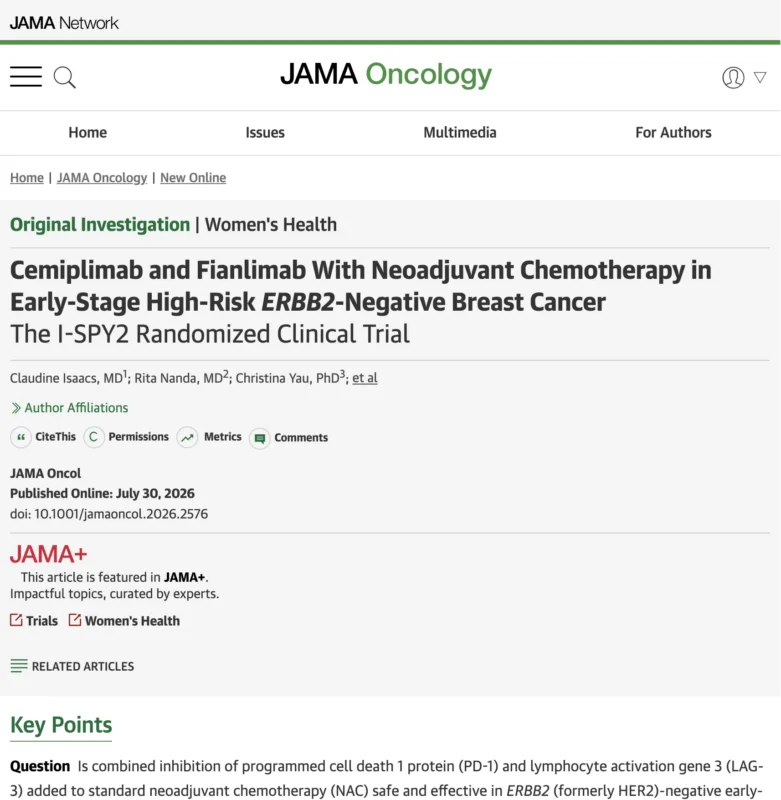
The phase II I-SPY2 randomized clinical trial evaluated whether adding dual immune checkpoint blockade targeting PD-1 and LAG-3 could enhance response rates in patients with high-risk ERBB2-negative early-stage breast cancer.
The study investigated the combination of cemiplimab, an anti–PD-1 antibody, and fianlimab, an anti–LAG-3 antibody, together with paclitaxel-based neoadjuvant chemotherapy.
The findings suggest that dual checkpoint inhibition may increase pathologic complete response (pCR) rates across clinically defined subgroups, including both triple-negative and hormone receptor-positive/ERBB2-negative breast cancer. Importantly, the study identified the ImPrint immune signature as a potential biomarker for predicting response.
Why Target PD-1 and LAG-3 Together?
Immune checkpoint inhibitors have changed the therapeutic landscape of breast cancer, particularly in TNBC.
PD-1 and PD-L1 blockade can restore antitumor immune activity by preventing immune suppression within the tumor microenvironment. However, resistance mechanisms frequently limit the depth and durability of immune responses.
One emerging mechanism involves alternative immune checkpoints, including lymphocyte activation gene 3 (LAG-3).
LAG-3 is an inhibitory immune receptor expressed on activated immune cells and has been associated with T-cell dysfunction and immune escape.
The rationale behind dual PD-1/LAG-3 inhibition is that simultaneous blockade of these pathways may produce stronger immune activation than targeting either pathway alone.
This strategy has already demonstrated clinical activity in other malignancies, raising interest in evaluating whether it can improve outcomes in breast cancer.
I-SPY2 Trial Evaluates Dual Checkpoint Blockade Before Surgery
The I-SPY2 trial is an adaptive phase II platform study designed to rapidly evaluate promising neoadjuvant treatment strategies in high-risk early breast cancer.
The trial enrolled patients with:
- Stage II or III breast cancer
- ERBB2-negative disease
High-risk molecular profiles based on hormone receptor status and MammaPrint genomic risk classification
Patients receiving the experimental regimen received:
- Weekly paclitaxel for 12 weeks
- Followed by doxorubicin and cyclophosphamide
- Surgery afterward
The experimental group additionally received:
- Cemiplimab
- Fianlimab
during the paclitaxel phase.
The primary endpoint was pathologic complete response (pCR).
Dual PD-1/LAG-3 Blockade Increased Pathologic Complete Response Rates
The study included 78 participants treated with cemiplimab plus fianlimab and compared outcomes with a historical control population of 350 patients.
The combination achieved higher pCR rates compared with control across ERBB2-negative disease groups.
Among all ERBB2-negative participants:
- pCR with cemiplimab plus fianlimab: 44%
- Control: 21%
Among patients with triple-negative breast cancer:
- pCR: 53%
- Control: 29%
Among hormone receptor-positive/ERBB2-negative disease:
- pCR: 36%
- Control: 14%
The regimen successfully graduated across all clinical signatures within the I-SPY2 platform, supporting further investigation in definitive randomized trials.
ImPrint Immune Signature May Identify Responders
One of the most important findings from the study was the identification of a potential biomarker for immune sensitivity.
Patients with a positive ImPrint immune signature appeared highly sensitive to the cemiplimab and fianlimab combination.
This finding is particularly important because immunotherapy benefit in breast cancer remains heterogeneous.
While checkpoint inhibitors can produce substantial benefit in selected patients, many patients receive limited benefit despite treatment.
A biomarker capable of identifying tumors with greater immune responsiveness could help move immunotherapy toward a more precise approach.
The future of immunotherapy in early breast cancer may depend not only on adding more immune therapies, but also on selecting the patients most likely to benefit.
Safety Considerations: Immune-Related Toxicities Remain Important
The addition of dual immune checkpoint blockade was associated with immune-related adverse events.
Among treated participants:
- 21% experienced adrenal insufficiency, including hypophysitis.
- Grade 3 or 4 hypophysitis occurred in approximately 11% of patients.
Most events occurred after completion of immunotherapy.
These findings highlight an important consideration for expanding dual checkpoint blockade into early-stage disease, where many patients may already have curative treatment options.
In the neoadjuvant setting, improving response rates must be balanced against long-term toxicity, especially endocrine immune-related complications that may require lifelong management.
Implications for Triple-Negative and Hormone Receptor-Positive Breast Cancer
The results are notable because the benefit was not limited exclusively to triple-negative disease.
Historically, immunotherapy development in breast cancer has focused primarily on TNBC because of its higher mutation burden, immune infiltration, and greater immunogenicity.
However, the observed pCR improvement in hormone receptor-positive/ERBB2-negative disease suggests that immune-responsive biology may extend beyond TNBC.
The challenge now is determining which patients with hormone receptor-positive disease should receive immunotherapy and which biomarkers can reliably identify benefit.
The ImPrint immune signature represents one potential approach.
What Comes Next for Dual Checkpoint Blockade?
Although the results are encouraging, the study remains phase II and requires confirmation in larger randomized trials.
Important future questions include:
- Does increased pCR translate into improved event-free survival?
- Which immune biomarkers best predict benefit?
- How should dual checkpoint blockade be integrated with existing neoadjuvant strategies?
- Can toxicity be reduced while maintaining efficacy?
The answers will determine whether PD-1/LAG-3 inhibition becomes part of routine early breast cancer treatment.
Conclusion
The I-SPY2 randomized clinical trial provides important evidence that dual immune checkpoint blockade with cemiplimab and fianlimab can enhance pathologic response rates when combined with neoadjuvant chemotherapy in high-risk ERBB2-negative early breast cancer.
The greatest potential impact may come from identifying biomarkers such as the ImPrint immune signature that can define patients most likely to benefit.
As immunotherapy continues to expand in breast cancer, the next stage of development will focus not only on stronger immune combinations but also on more precise patient selection.
The future of early breast cancer immunotherapy will likely depend on matching the right immune strategy with the right tumor biology.