
For patients with hormone receptor–positive metastatic breast cancer, the therapeutic landscape has expanded dramatically.
CDK4/6 inhibitors transformed first-line treatment. Molecularly selected therapies targeting ESR1, PIK3CA and the AKT pathway have created additional endocrine-based options. And perhaps most importantly for HER2-low disease, antibody-drug conjugates have changed the meaning of HER2 expression itself.
Yet real-world treatment often follows a more complicated path.
A large US retrospective study published in Breast Cancer Research and Treatment in 2026 provides an important picture of what happened to patients with HR-positive, HER2-low metastatic breast cancer across up to five lines of therapy.
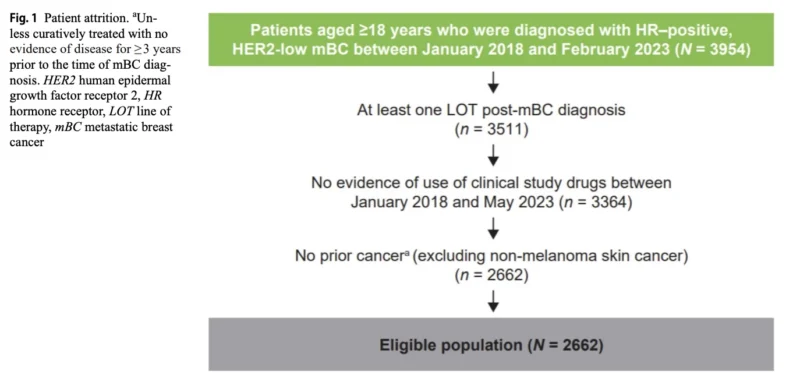
The analysis included 2,662 patients diagnosed with metastatic disease between 2018 and 2023 using the Flatiron Health Research Database. The investigators examined treatment patterns, real-world progression-free survival and overall survival.
The results illustrate a recurring problem in metastatic breast cancer:
as endocrine options are exhausted, treatment becomes increasingly heterogeneous, chemotherapy use rises, and disease control becomes progressively shorter.
Here are five findings that deserve attention.
Endocrine Therapy Dominated the First Line, but Its Use Declined With Every Subsequent Line
The first-line pattern was predictable.
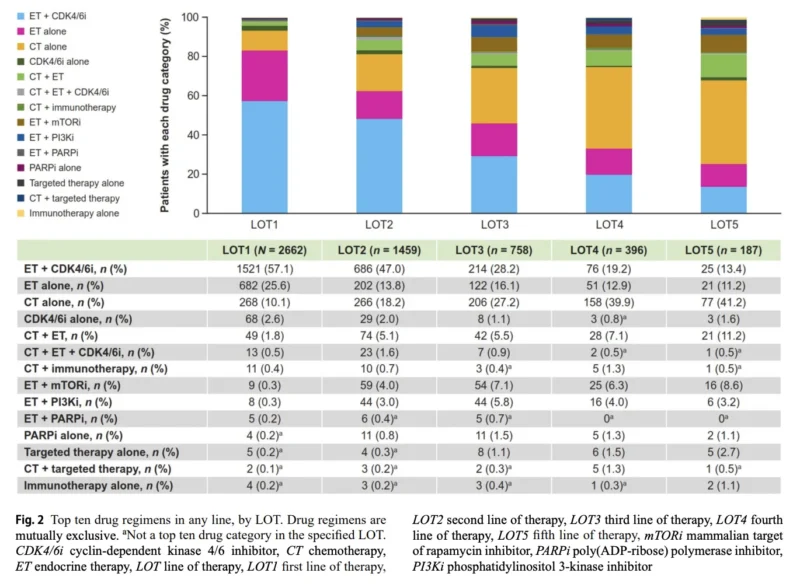
Overall, 86.2% of patients received an endocrine therapy, containing regimen, and ET plus a CDK4/6 inhibitor was the most frequently used first-line approach.
ET + CDK4/6 inhibition accounted for 57.1% of first-line treatment, while endocrine monotherapy accounted for another 25.6%. Chemotherapy alone was used in 10.1%. The adoption of CDK4/6 inhibitors also increased over time.
First-line ET + CDK4/6 inhibitor use rose from 51.9% in 2017–2019 to 60.7% in 2020–2023, while both endocrine monotherapy and chemotherapy-alone use decreased. But the more interesting story begins after first-line progression.
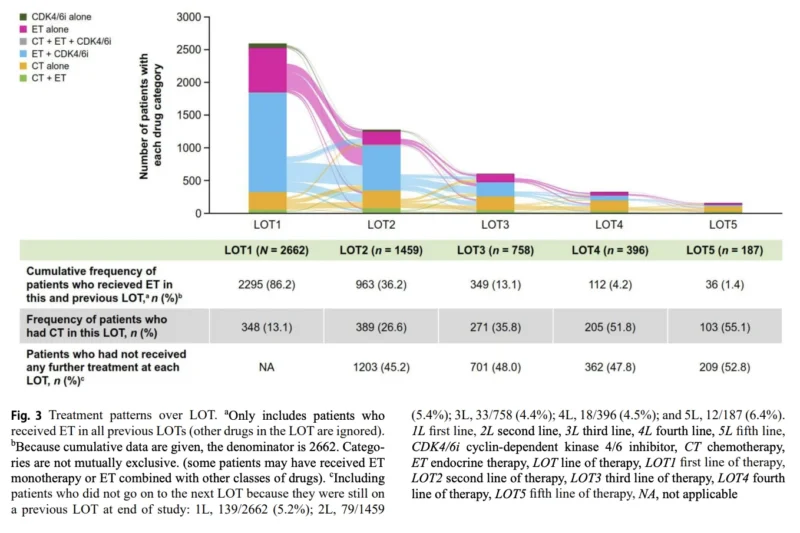
The proportion receiving ET-containing regimens progressively decreased across lines:
86.2% in LOT1 → 76.7% in LOT2 → 67.2% in LOT3 → 52.0% in LOT4 → 50.3% in LOT5.
That decline reflects what the authors describe as progressive endocrine exhaustion. It is one of the central clinical challenges of HR-positive metastatic breast cancer.
The first endocrine-sensitive phase can sometimes be controlled for years. But after repeated endocrine exposure, acquired resistance increasingly narrows the therapeutic window. The challenge after CDK4/6 inhibitor progression is therefore not simply finding another endocrine drug.
It is determining which tumor remains sufficiently endocrine-dependent to benefit from continued endocrine-based treatment. And that is where modern molecular profiling increasingly matters.
Treatment Became Dramatically More Heterogeneous After the First Few Lines
First-line treatment showed relative consensus. Later-line treatment did not. ET + CDK4/6 inhibition remained the most common treatment in the second and third lines, accounting for 47.0% and 28.2%, respectively.
By the fourth and fifth lines, however, chemotherapy alone became the most frequently used strategy, representing 39.9% of LOT4 and 41.2% of LOT5.
The figure on page 5 illustrates this transition particularly well: the dominant ET + CDK4/6 component contracts substantially from LOT1 through LOT5 while chemotherapy occupies an increasing proportion of later-line treatment.
This is clinically important because later-line HR-positive metastatic breast cancer is not one biological entity. After CDK4/6 inhibitor progression, several mechanisms may drive resistance.
Some tumors remain estrogen-receptor dependent. Others acquire ESR1 alterations. Some harbor actionable alterations in the PI3K/AKT pathway. Others become sufficiently endocrine-resistant that chemotherapy or an antibody-drug conjugate becomes the more appropriate strategy.
The heterogeneity seen in this real-world dataset is therefore not merely prescribing inconsistency. It partly reflects the biology of a disease that becomes increasingly diverse under therapeutic selection pressure.
The modern response to that heterogeneity should increasingly be biomarker-guided sequencing rather than empirical switching between therapies.
Many Patients Reached Chemotherapy After Surprisingly Little Prior Endocrine Therapy
This may be one of the most thought-provoking findings. Among 830 patients who received chemotherapy, only 55.7% had received at least one previous ET-containing line. The median number of endocrine-containing lines before chemotherapy was only one, with an interquartile range of zero to two.
The authors point out that more than 40% of chemotherapy-treated patients had not received an earlier ET-containing regimen, despite recommendations generally favoring sequential endocrine-based therapy before chemotherapy unless endocrine resistance or clinically urgent disease makes that strategy inappropriate.
That observation should be interpreted carefully. It does not demonstrate that chemotherapy was inappropriate. The database did not contain several clinical variables that could explain early chemotherapy use, including:
- visceral crisis or visceral disease burden
- endocrine sensitivity or resistance
- symptom burden
- performance status
Some of these patients may therefore have required chemotherapy because of aggressive or rapidly progressive disease. Still, the finding highlights a broader issue in real-world oncology:
clinical trial algorithms and actual treatment sequences frequently diverge. And as the therapeutic landscape becomes more biomarker-driven, this gap becomes even more important.
Progression-Free Survival Collapsed With Every Additional Line of Therapy
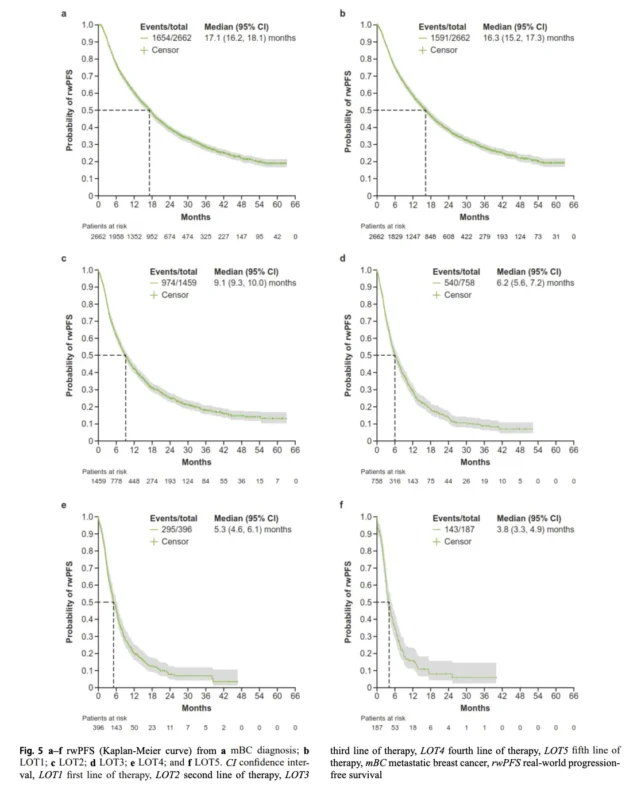
The most visually striking result appears in the Kaplan-Meier curves.
Median real-world PFS was:
- LOT1: 16.3 months
- LOT2: 9.1 months
- LOT3: 6.2 months
- LOT4: 5.3 months
- LOT5: 3.8 months
The Kaplan-Meier curves on page 8 make the therapeutic attrition particularly clear: each successive line produces shorter disease control, with the LOT5 curve falling rapidly and median rwPFS reaching only 3.8 months.
This progressive shortening is clinically familiar. But seeing it quantified across thousands of patients is still sobering. The decline from 16.3 months in the first line to 3.8 months in the fifth line means that median disease control is reduced by more than three-quarters as patients move through successive therapies.
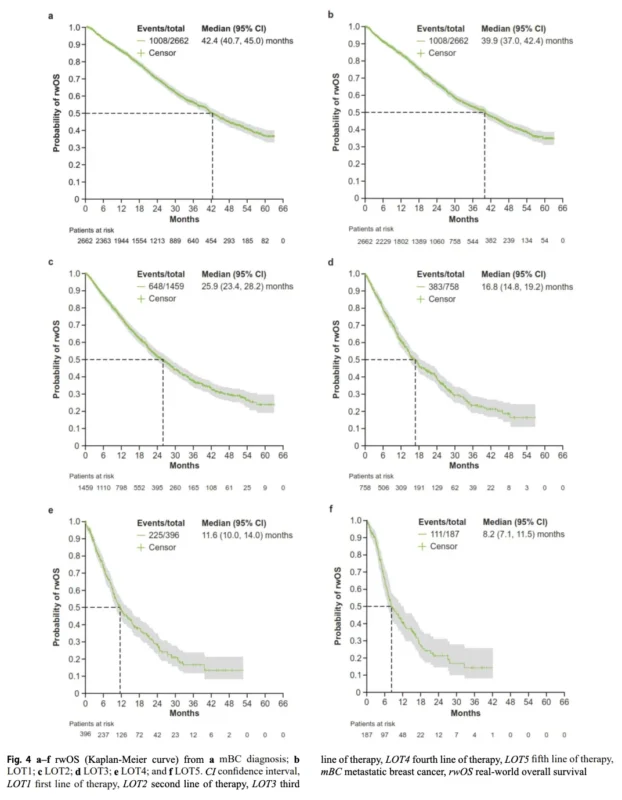
The same pattern appears in overall survival. Median rwOS from metastatic breast cancer diagnosis was 42.4 months, while median rwOS measured from initiation of LOT5 was only 8.2 months. This provides an important argument for optimizing therapy earlier.
A highly effective treatment administered only after several lower-efficacy lines may reach a population with lower performance status, greater disease burden, accumulated toxicity and less time available to benefit.
In other words, line of therapy matters. The efficacy of an agent cannot be considered entirely independently from when the patient receives it.
Fewer Than 4 in 10 Patients Were Alive at Five Years
Perhaps the most important outcome is also the simplest. Median real-world overall survival from metastatic diagnosis was 42.4 months. The estimated five-year survival rate was only 36.9%.
The overall-survival curves on page 7 show the same progressive attrition across treatment lines, with median rwOS falling from 39.9 months at initiation of LOT1 to 25.9 months from LOT2, 16.8 months from LOT3, 11.6 months from LOT4 and 8.2 months from LOT5.
For a disease sometimes described as increasingly chronic, these data provide an important counterbalance. HR-positive metastatic breast cancer may have a relatively favorable prognosis compared with some other metastatic breast cancer phenotypes.
But it remains incurable for most patients. And once endocrine resistance develops and successive treatment lines accumulate, outcomes deteriorate rapidly.
But There Is a Crucial Caveat: This Is Not the 2026 Treatment Landscape
This point is essential when interpreting the study. The cohort reflects treatment delivered mainly between 2018 and 2023.
That means many therapies that now influence HR-positive metastatic breast cancer sequencing were either unavailable, newly introduced or minimally represented. The authors themselves emphasize this limitation.
Trastuzumab deruxtecan’s original HER2-low metastatic breast cancer indication arrived in 2022, and its HR-positive HER2-low/HER2-ultralow indication was subsequently broadened in 2025.
Sacituzumab govitecan entered HR-positive/HER2-negative disease during the study era, while datopotamab deruxtecan was approved later. The authors explicitly note that delayed uptake of ADCs means these therapies were poorly represented in the dataset and that this limits direct applicability to contemporary practice.
The same applies to newer endocrine and targeted options. The paper notes that agents such as imlunestrant, capivasertib and inavolisib were either approved after the study period or not administered to this cohort, reinforcing how rapidly treatment has evolved.
Therefore, the study should not be interpreted as a blueprint for how we should treat HR-positive/HER2-low disease in 2026. It is more useful as something else, a map of the therapeutic attrition that modern therapies are trying to prevent.
HER2-Low Is Particularly Important in This Story
The HER2-low classification became clinically relevant because antibody-drug conjugates demonstrated that tumors without conventional HER2 amplification could still be therapeutically targeted.
In this study, HER2-low was defined as IHC 1+ or IHC 2+/ISH-negative, with no previous evidence of HER2-positive disease. This represents a major conceptual shift.
HER2 expression is no longer merely a binary biomarker separating HER2-positive from HER2-negative disease. It can also function as a drug-delivery biomarker for ADC therapy. And that creates an important question for current practice:
When endocrine therapy begins losing effectiveness, how long should clinicians continue trying successive endocrine-based strategies before moving to an ADC?
The dataset cannot answer that question because the relevant drugs were insufficiently represented. But it demonstrates precisely why the question matters. By LOT4 and LOT5, median PFS had already fallen to approximately five and four months.
A treatment capable of producing more meaningful disease control may therefore have substantially greater clinical value if introduced before profound therapeutic exhaustion.
The Study Also Shows Why Biomarker Testing After CDK4/6 Progression Matters
One striking limitation was the absence of information about important molecular variables, including ESR1 and PIK3CA alterations. In contemporary HR-positive metastatic breast cancer, those variables can substantially alter treatment selection.
This is an important difference between the historical landscape captured in the study and present-day clinical decision-making. The emerging model after CDK4/6 progression is increasingly:
re-biopsy or ctDNA → identify resistance biology → preserve endocrine therapy when biologically appropriate → use mutation-directed treatment when available → transition to ADC or chemotherapy when endocrine benefit is exhausted. That is fundamentally different from simply asking:
“Which chemotherapy should come next?”
The important question is increasingly:
“What is driving resistance now?”
An Important Real-World Strength, and Important Limitations
The study’s size and data source are major strengths.
Flatiron includes data from more than 800 US sites, approximately 75% community practices and 25% academic centers, making the cohort relevant to routine oncology practice rather than only tertiary referral centers.
But several limitations should temper interpretation. The database could miss treatments delivered outside participating systems. Reasons for treatment discontinuation or failure to reach another line were incompletely captured. Visceral disease burden, endocrine resistance, CNS involvement and important genomic alterations were unavailable.
Furthermore, rwPFS relied on physician assessments rather than RECIST, and each treatment-line PFS estimate combined heterogeneous regimens rather than evaluating one specific therapy.
Most importantly, the investigators acknowledge that treatment has evolved so rapidly since 2023 that the results may no longer precisely reflect current standards of care.
There is also an important disclosure: the study was sponsored by AstraZeneca, which also funded medical writing support; several authors were AstraZeneca employees and held company stock or stock options.
That does not invalidate the findings, but it is relevant context—particularly because AstraZeneca co-develops trastuzumab deruxtecan.
The Bottom Line
This real-world analysis tells a straightforward but important story.
Patients with HR-positive, HER2-low metastatic breast cancer generally began treatment with endocrine-based therapy, most commonly combined with a CDK4/6 inhibitor.
But with each successive line:
- endocrine therapy became less dominant
- treatment became more heterogeneous
- chemotherapy use increased
- progression-free survival shortened
- fewer patients remained alive long enough to receive later therapies
Median rwPFS declined from 16.3 months in LOT1 to only 3.8 months in LOT5, and only 36.9% of patients were alive five years after metastatic diagnosis.
The study therefore captures what might be called the therapeutic exhaustion problem of HR-positive metastatic breast cancer. But it also provides a historical benchmark against which the modern era can be judged.
Today, ADCs, next-generation endocrine therapies and biomarker-directed treatments offer opportunities to interrupt this pattern. The challenge is no longer simply extending the number of available lines.
It is making each line more biologically informed, more effective and better sequenced. And in HER2-low metastatic breast cancer, that may ultimately determine whether the steep decline in outcomes seen in this real-world cohort can be meaningfully changed.
Reference
- Mayer EL, Collin SM, Hillman S, Berrocal-Almanza LC, Sparano J, Lam C. Real-world treatment patterns and outcomes in hormone receptor–positive, HER2-low metastatic breast cancer, 2018–2023: a retrospective, observational, US cohort study. Breast Cancer Research and Treatment. 2026;218:15. Published online July 20, 2026.