
The phase III HER2CLIMB-05 trial introduces an important evolution in the first-line treatment strategy for HER2-positive metastatic breast cancer: rather than changing induction therapy, it intensifies the maintenance phase after initial disease control.
In the randomized, double-blind international study, adding the HER2-selective tyrosine kinase inhibitor tucatinib to trastuzumab and pertuzumab significantly prolonged progression-free survival compared with trastuzumab and pertuzumab alone after first-line induction chemotherapy. Median investigator-assessed PFS reached 24.9 months with tucatinib versus 16.3 months with placebo, corresponding to a 36% reduction in the risk of disease progression or death.
The result is clinically relevant because contemporary first-line HER2-positive metastatic breast cancer has traditionally focused on maximizing the efficacy of induction therapy. HER2CLIMB-05 asks a different question: once the disease has responded or stabilized, can deeper HER2 blockade during maintenance prolong control without continuing chemotherapy?
create second
The answer for PFS is clearly yes.
HER2CLIMB-05 Targets the Maintenance Phase
The established first-line framework for HER2-positive metastatic breast cancer has historically consisted of a taxane combined with trastuzumab and pertuzumab, followed by maintenance HER2-directed therapy after chemotherapy is discontinued. HER2CLIMB-05 was designed to intensify this maintenance phase by targeting HER2 both extracellularly and intracellularly.
Trastuzumab and pertuzumab inhibit HER2 signaling at the receptor level, whereas tucatinib is a highly selective HER2-directed tyrosine kinase inhibitor acting intracellularly. The biological premise was therefore straightforward: continued dual antibody blockade plus intracellular HER2 inhibition might delay the development of treatment resistance more effectively than antibody maintenance alone.
The strategy also avoids extending cytotoxic chemotherapy indefinitely. That makes the trial particularly relevant to the long-term management of patients who have already achieved disease control after initial therapy.
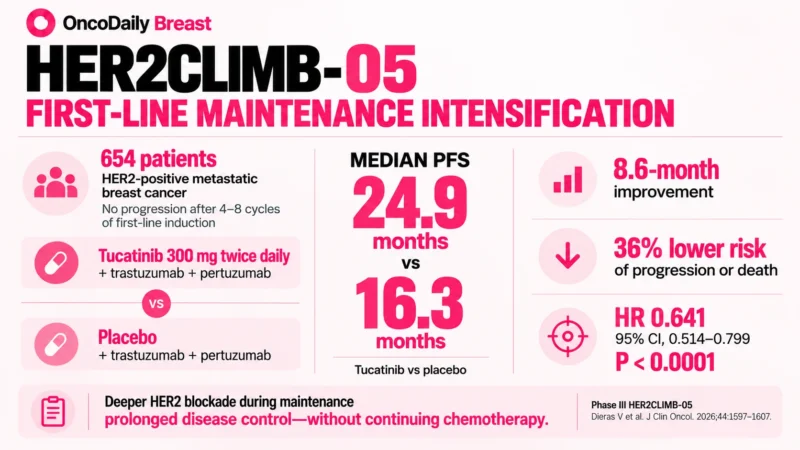
A Global Phase III Trial of 654 Patients
HER2CLIMB-05 enrolled 654 patients with centrally confirmed HER2-positive metastatic breast cancer who had no evidence of disease progression after four to eight cycles of first-line induction therapy. Patients were required to have ECOG performance status 0 or 1. Patients with no brain metastases or with asymptomatic brain metastases confirmed by contrast-enhanced MRI could participate.
Participants were randomized 1:1 to:
- tucatinib 300 mg twice daily + trastuzumab + pertuzumab
or
- placebo + trastuzumab + pertuzumab.
Endocrine therapy was permitted for patients with hormone receptor–positive disease. Randomization was stratified by de novo versus recurrent disease, presence or history of brain metastases, and hormone receptor status.
The primary endpoint was investigator-assessed PFS. Key secondary outcomes included overall survival, blinded independent central review PFS, CNS-PFS, and safety.
Median PFS Improved by 8.6 Months
At the primary analysis, median investigator-assessed PFS was:
- 24.9 months with tucatinib
versu
- 16.3 months with placebo.
The hazard ratio was 0.641 (95% CI, 0.514–0.799; P<0.0001).
This translates into an 8.6-month improvement in median PFS and a 36% relative reduction in the risk of progression or death. The Kaplan–Meier curve presented in the summary on page 3 shows early and sustained separation between the treatment arms, with the tucatinib curve remaining consistently above the control arm during follow-up.
Blinded independent central review produced findings consistent with the investigator-assessed primary analysis. This consistency strengthens the reliability of the primary PFS result.
Benefit Was Seen Across Prespecified Patient Groups
One of the reassuring features of HER2CLIMB-05 was the consistency of the PFS effect across clinically relevant subgroups. The study summary reports benefit irrespective of disease diagnosis, hormone receptor status, baseline brain metastases, previous anti-HER2 treatment, best response to induction therapy, ECOG performance status, geographical region, age, race, and disease type.
This is particularly important because HER2-positive metastatic breast cancer is not a homogeneous disease. Patients may present de novo or after recurrence, may have hormone receptor–positive or hormone receptor–negative tumors, and may enter maintenance after complete response, partial response, or stable disease.
The broadly consistent treatment effect suggests that maintenance intensification with tucatinib may have relevance across several of these clinical contexts.
Hormone Receptor Status Did Not Eliminate the Benefit
The exploratory analyses according to hormone receptor status provide additional context. For patients with HR-negative disease, the PFS hazard ratio was approximately 0.55, indicating a pronounced treatment effect. For those with HR-positive disease, the hazard ratio was approximately 0.73, again favoring tucatinib.
Endocrine therapy was permitted during maintenance for hormone receptor–positive disease, and approximately 44% of patients in the tucatinib arm and 46% in the control arm received endocrine therapy. These findings are clinically relevant because maintenance therapy in HR-positive/HER2-positive disease is becoming increasingly complex.
Recent strategies have evaluated the incorporation of endocrine therapy, CDK4/6 inhibition, and now HER2-directed TKIs into maintenance. HER2CLIMB-05 therefore contributes to a broader shift in which the maintenance phase is becoming an active therapeutic decision rather than simply continuation of HER2 antibodies.
The CNS Question Is Especially Important
Tucatinib has particular clinical interest because of its established CNS activity in previously treated HER2-positive metastatic breast cancer. HER2CLIMB-05 therefore incorporated CNS outcomes into its design and required contrast-enhanced MRI at screening.
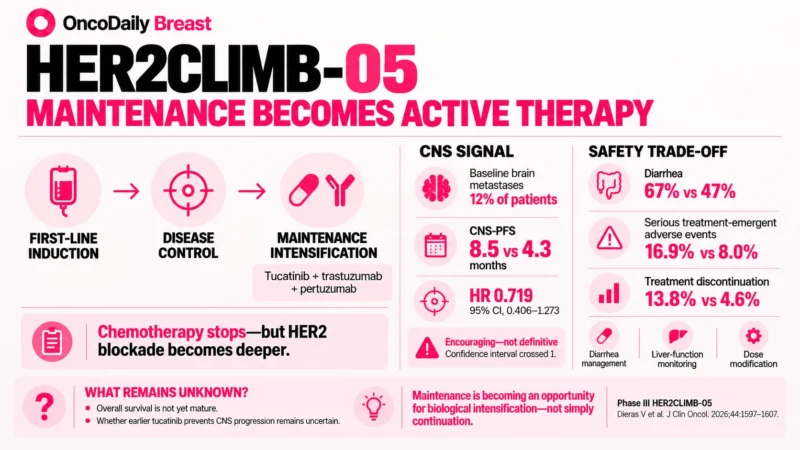
Approximately 12% of patients in each treatment group had a presence or history of brain metastases at baseline. Among patients with brain metastases at baseline, median investigator-assessed CNS-PFS was:
- 8.5 months with tucatinib
versus
- 4.3 months with placebo
with an HR of 0.719 (95% CI, 0.406–1.273).
The direction favored tucatinib, but the confidence interval was wide and crossed 1. The study also reported that median CNS-PFS was not reached in the overall population of either treatment group at the time of analysis. The CNS data should therefore be regarded as encouraging but not definitive at this stage.
Maintenance Is Becoming a Strategy to Delay CNS Progression
The CNS component of HER2CLIMB-05 is conceptually important even before mature CNS results are available. Historically, systemic therapy for HER2-positive disease often addressed brain metastases after they emerged. Tucatinib raises the possibility of using a CNS-active HER2-directed drug earlier in the disease course to delay or prevent intracranial progression.
That distinction is important. Preventing a brain metastasis is clinically different from treating an established lesion. CNS progression can result in neurological symptoms, corticosteroid exposure, radiation therapy, hospitalization, and substantial impairment in quality of life.
The study was explicitly designed in part to examine whether adding tucatinib during first-line maintenance could delay or prevent CNS progression. Longer follow-up will be particularly important in determining whether the observed systemic PFS advantage is accompanied by meaningful protection against CNS events.
Overall Survival Is Not Yet Mature
Despite the positive PFS result, overall survival remains immature at the primary analysis. This is an important limitation when considering the ultimate position of the regimen. HER2-positive metastatic breast cancer now has multiple highly active therapies available across sequential lines. Overall survival can therefore be strongly influenced by what treatments patients receive after progression.
A maintenance therapy that delays progression by nearly nine months may still provide substantial clinical value even before an OS difference emerges, but the mature survival analysis will help determine whether earlier exposure to tucatinib changes long-term outcomes or primarily shifts disease control earlier in the treatment sequence.
The Trial Raises an Important Sequencing Question
HER2CLIMB-05 arrives during a rapidly changing first-line landscape. Maintenance trastuzumab plus pertuzumab has long been a standard approach after induction chemotherapy. But several newer strategies are challenging the concept of passive maintenance. The central question is becoming after successful induction, how much additional biological pressure should be applied to HER2-positive disease before progression occurs?
Tucatinib offers one answer by extending HER2 blockade intracellularly Other approaches incorporate endocrine therapy, CDK4/6 inhibition, or antibody–drug conjugates earlier in the treatment course. As these options expand, the clinical problem shifts from identifying whether a therapy is active to defining the optimal lifetime sequence. HER2CLIMB-05 provides strong evidence that intensifying first-line maintenance can substantially prolong PFS, but it does not by itself establish the ideal sequence relative to every emerging first-line strategy.
Toxicity Increased, but Treatment Was Generally Manageable
Adding tucatinib increased treatment-related toxicity, as expected. The most common treatment-emergent adverse event was diarrhea, occurring in approximately 67% of patients receiving tucatinib versus 47% in the control group. Nausea was also more frequent with tucatinib, while elevations in ALT and AST reflected the known hepatic toxicity profile of the drug.
The summary states that adverse events were generally manageable with antidiarrheal medication, supportive treatment, and dose modifications. Hepatic events tended to occur relatively early and were generally asymptomatic, transient, and reversible with dose modification.
Serious treatment-emergent adverse events occurred in 16.9% of patients in the tucatinib arm compared with 8.0% in the control arm. Treatment-emergent adverse events leading to discontinuation of any study therapy occurred in 13.8% versus 4.6%, respectively.
The efficacy gain therefore comes with a measurable increase in toxicity and treatment burden.
Hepatic Monitoring Remains Important
Drug-induced liver injury was reported in approximately 1.2% of patients receiving tucatinib and none in the control group.One grade 5 case of severe drug-induced liver injury was reported, although the event was confounded by concomitant medications with known hepatotoxic potential.
This reinforces the need for routine liver-function monitoring when tucatinib is incorporated into prolonged treatment. For a maintenance regimen intended to continue in patients whose disease is already controlled, tolerability is particularly important.
The clinical threshold for toxicity may be different than during short-course induction chemotherapy because patients may remain on treatment for many months or years.
HER2CLIMB-05 Changes the Meaning of Maintenance Therapy
Perhaps the broader contribution of HER2CLIMB-05 is conceptual. Maintenance therapy in metastatic breast cancer has traditionally meant reducing treatment intensity after induction while preserving disease control. The new generation of trials is changing that model. Maintenance is increasingly becoming an opportunity for biological intensification without continuing cytotoxic chemotherapy.
In HER2CLIMB-05, chemotherapy stops, but HER2 blockade becomes deeper. That approach may be particularly attractive in HER2-positive disease, where resistance can emerge through incomplete pathway suppression and where CNS relapse remains a significant concern.
The goal is not simply to maintain what induction achieved. It is to extend the duration of that response by preventing or delaying molecular escape.
Important Questions Remain
Several issues still require clarification. The study remains ongoing, and mature OS data are not yet available. CNS outcomes are also not sufficiently mature to determine whether tucatinib truly prevents brain metastases or meaningfully changes intracranial disease trajectory. The summary also notes that, at the time of publication, tucatinib combined with trastuzumab and pertuzumab was not approved specifically for first-line maintenance HER2-positive metastatic breast cancer.
Treatment decisions therefore need to account for local regulatory status, access, toxicity, competing first-line approaches, and the full evidence base rather than HER2CLIMB-05 alone. The study was sponsored by Seagen, subsequently acquired by Pfizer, and the research summary itself was funded by Pfizer. Several authors reported employment and stock ownership with the company.
These disclosures do not alter the randomized efficacy data but remain relevant context when interpreting industry-sponsored clinical research.
The Bottom Line
HER2CLIMB-05 demonstrates that adding tucatinib to trastuzumab and pertuzumab after successful first-line induction therapy significantly prolongs progression-free survival in HER2-positive metastatic breast cancer. Among 654 randomized patients:
- Median PFS: 24.9 vs 16.3 months
- HR: 0.641
- Relative reduction in progression or death: 36%
The benefit was observed across multiple prespecified subgroups, including both HR-positive and HR-negative disease. The regimen also produced an encouraging CNS signal among patients with baseline brain metastases, although the analysis remains immature. The major trade-off is increased toxicity, particularly diarrhea, hepatic abnormalities, and a higher incidence of serious treatment-emergent adverse events.
HER2CLIMB-05 therefore provides more than another positive HER2 trial. It reinforces a broader change in metastatic breast cancer management: the maintenance phase is becoming an active opportunity to intensify molecular control rather than simply continue what was started during induction.
As HER2-positive treatment becomes increasingly crowded, the next challenge will be determining which patients benefit most from maintenance intensification, how tucatinib compares with other emerging strategies, and whether earlier HER2 blockade ultimately improves survival and CNS outcomes across the full treatment sequence.
Reference
- Dieras V, Curigliano G, Martin M, Lerebours F, Tsurutani J, Savard M-F, Jerzak KJ, Hu X, O’Sullivan CC, Tokunaga E, Okines A, Huang C-S, Jacot W, Sohn J, Cronemberger Silva E, Mueller V, Yang S, Granata G, Shen Q, Hamilton EP, on behalf of the HER2CLIMB-05 Investigators. HER2CLIMB-05: A Phase III Study of Tucatinib Versus Placebo in Combination with Trastuzumab and Pertuzumab as First-Line Maintenance Therapy for HER2+ Metastatic Breast Cancer. J Clin Oncol. 2026;44(17):1597–1607. doi:10.1200/JCO-25-02600.