The final analysis of the phase 3 FeDeriCa study supports the long-term comparability of a fixed-dose subcutaneous combination of pertuzumab and trastuzumab with conventional intravenous administration in patients with HER2-positive early breast cancer.
After approximately four years of follow-up, invasive disease-free survival, event-free survival, distant recurrence-free interval, and overall survival rates remained similar between the two treatment strategies. No new safety signals emerged, including no new concerns related to cardiac safety.
The findings strengthen the evidence that subcutaneous pertuzumab and trastuzumab can offer a faster and less invasive alternative to separate intravenous infusions without an apparent loss of long-term efficacy (Jackisch et al., 2026).
Why Was a Subcutaneous Formulation Developed?
Pertuzumab and trastuzumab combined with chemotherapy are established components of treatment for HER2-positive breast cancer.
However, intravenous administration can involve prolonged infusion and observation periods. In the FeDeriCa publication, pertuzumab infusion was described as taking approximately 30 to 60 minutes, while trastuzumab could require 30 to 90 minutes. Additional post-treatment observation could further extend the time spent in the clinic.
The fixed-dose subcutaneous formulation combines pertuzumab and trastuzumab in a single injection. Administration takes approximately 5 to 8 minutes, followed by an observation period of 15 to 30 minutes.
The approach was developed to reduce treatment-chair time, avoid repeated intravenous access, and provide a more convenient administration route during a treatment course that can extend to 18 cycles (Jackisch et al., 2026).
How Was FeDeriCa Designed?
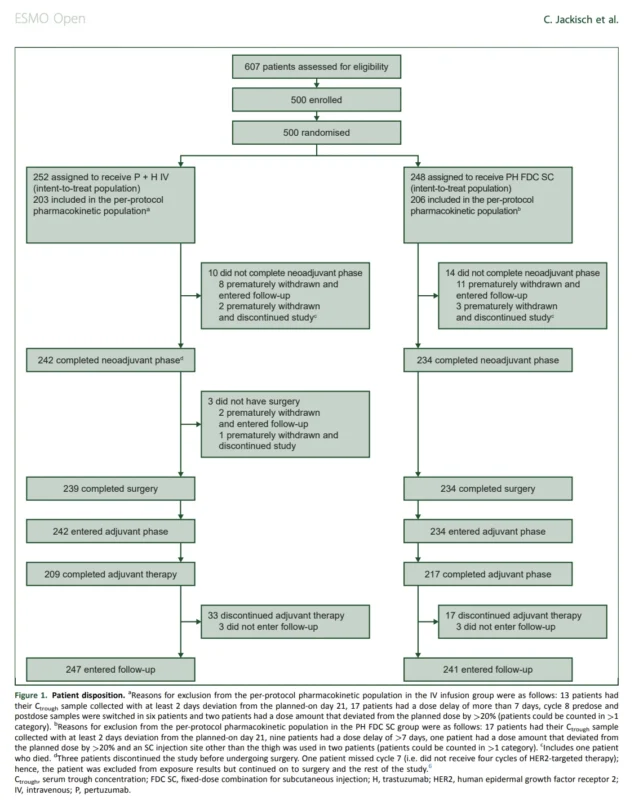
FeDeriCa was a randomized, open-label, multicentre phase 3 study that enrolled patients with operable, locally advanced, or inflammatory HER2-positive stage II to IIIC breast cancer.
Eligible patients had a primary tumour measuring more than 2 cm or node-positive disease. HER2 and hormone receptor status were centrally confirmed.
A total of 500 patients were randomly assigned:
- 252 patients to intravenous pertuzumab plus intravenous trastuzumab
- 248 patients to the fixed-dose subcutaneous pertuzumab–trastuzumab combination
Patients received eight cycles of neoadjuvant chemotherapy. HER2-directed treatment was administered during cycles 5 to 8 according to randomization.
After surgery, patients continued the assigned HER2-targeted treatment to complete a total of 18 cycles.
The primary FeDeriCa analysis had previously established noninferior serum trough concentrations with the subcutaneous formulation. Total pathological complete response rates and initial safety findings were also comparable between the treatment groups.
The final analysis evaluated whether this pharmacokinetic comparability was accompanied by sustained efficacy and safety over longer follow-up (Jackisch et al., 2026).
Four-Year Outcomes Remained Closely Aligned
The data cutoff was June 2, 2023.
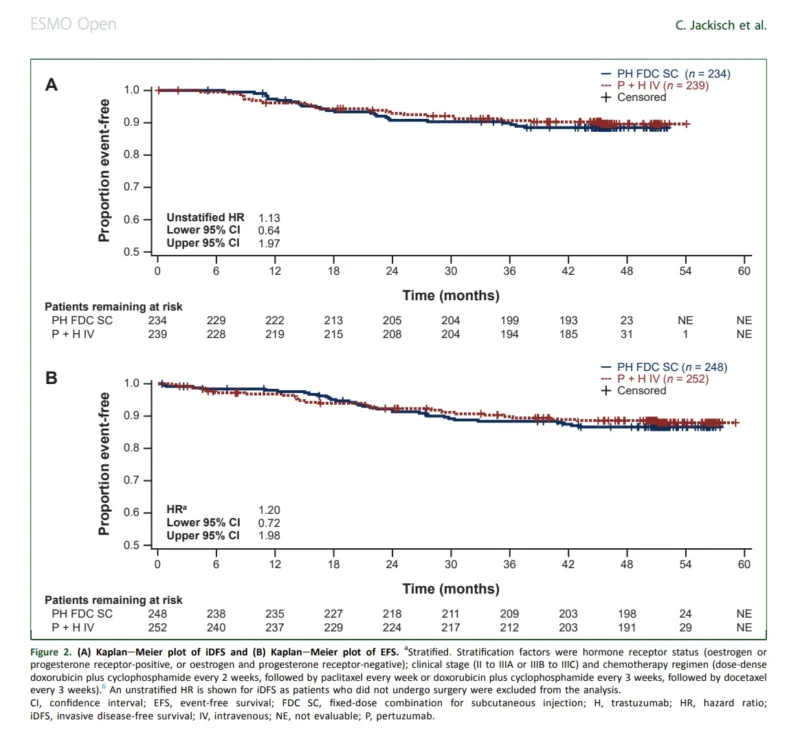
Median follow-up reached 51.4 months in the intravenous group and 51.2 months in the subcutaneous group.
The long-term efficacy table on page 5 of the publication shows closely aligned four-year outcomes across all evaluated endpoints.
Four-Year Invasive Disease-Free Survival
The four-year invasive disease-free survival rate was:
- 89.6% with intravenous pertuzumab and trastuzumab
- 88.5% with the subcutaneous fixed-dose combination
The unstratified hazard ratio was 1.13, with a 95% confidence interval of 0.64 to 1.97.
Four-Year Event-Free Survival
The four-year event-free survival rate was:
- 88.5% with intravenous treatment
- 86.6% with subcutaneous treatment
The hazard ratio was 1.20, with a 95% confidence interval of 0.72 to 1.98.
Four-Year Distant Recurrence-Free Interval
The four-year distant recurrence-free interval was:
- 92.5% with intravenous treatment
- 91.9% with subcutaneous treatment
The hazard ratio was 1.17, with a 95% confidence interval of 0.61 to 2.24.
Four-Year Overall Survival
The four-year overall survival rate was:
- 95.5% with intravenous treatment
- 94.1% with subcutaneous treatment
The hazard ratio was 1.26, with a 95% confidence interval of 0.58 to 2.72.
The Kaplan–Meier curves presented on page 6 also show similar invasive disease-free and event-free survival patterns between the treatment groups throughout follow-up.
How Should the Efficacy Results Be Interpreted?
The final analysis was not statistically powered to establish significant differences in the long-term efficacy endpoints.
The hazard ratios also had wide confidence intervals because relatively few events had occurred.
The findings therefore do not prove statistical equivalence between the two formulations for every long-term outcome. Instead, they show that event rates and four-year estimates remained comparable, with no evidence of a clinically meaningful loss of efficacy associated with subcutaneous administration.
This interpretation is consistent with the study’s earlier findings of noninferior drug exposure and comparable pathological complete response rates.
Did Safety Remain Similar With Longer Follow-Up?
No new safety signals were identified during long-term follow-up, including no new cardiac safety concerns.
Grade 3 or higher adverse events across the complete study period occurred in:
- 59.1% of patients in the intravenous group
- 53.2% of patients in the subcutaneous group
Serious adverse events were reported in 20.6% and 19.8%, respectively.
Adverse events led to discontinuation of any study treatment in:
- 12.7% of patients receiving intravenous treatment
- 8.9% receiving the subcutaneous combination
Discontinuation of HER2-targeted therapy because of adverse events occurred in 6.0% and 4.8%, respectively.
The overall adverse-event table on page 7 shows that the two strategies had broadly similar safety profiles, with differences largely reflecting their routes of administration.
Injection-Site Reactions Were More Frequent With Subcutaneous Treatment
As expected, local injection-site reactions occurred more frequently with the subcutaneous formulation.
Injection-site reactions were reported in:
- 13.3% of patients receiving the subcutaneous combination
- 0.4% receiving intravenous pertuzumab and trastuzumab
The most frequent adverse events reported during the adjuvant phase were generally similar between groups.
Arthralgia occurred in 22.2% of patients in the intravenous group and 19.4% in the subcutaneous group. Radiation skin injury occurred in 21.4% and 20.2%, while diarrhoea occurred in 20.6% and 17.3%, respectively.
The authors concluded that, apart from expected administration-related reactions, the long-term safety profile of the subcutaneous formulation remained similar to that of intravenous treatment.
What Did FeDeriCa Show About Cardiac Safety?
Cardiac safety remained an important component of the final analysis because both pertuzumab and trastuzumab require cardiac monitoring.
During the adjuvant phase, New York Heart Association class III or IV heart failure accompanied by a reduction in left ventricular ejection fraction occurred in:
- One patient, or 0.4%, in the intravenous group
- Two patients, or 0.8%, in the subcutaneous group
One additional event was reported in the intravenous group during follow-up.
The investigators reported no meaningful difference between groups across most cardiac safety parameters. No new cardiac signal emerged with longer exposure to the subcutaneous formulation (Jackisch et al., 2026).
Were Drug Concentrations Maintained?
The final analysis also assessed serum trough concentrations during the adjuvant phase.
At cycle 12, pertuzumab trough concentrations were numerically higher with the subcutaneous formulation than with intravenous pertuzumab. The geometric mean ratio was 1.25.
Trastuzumab trough concentrations were also numerically higher with the subcutaneous formulation, with a geometric mean ratio of 1.39.
These higher concentrations did not correspond with greater toxicity or reduced efficacy.
The findings support the pharmacological reliability of the fixed-dose, non-weight-based subcutaneous formulation across the treatment course.
Did Body Weight Affect Outcomes?
The fixed-dose subcutaneous combination does not use weight-based dosing, making consistency across different body weights clinically relevant.
The investigators examined efficacy, safety, and pharmacokinetic outcomes across body-weight quartiles.
Event rates were generally similar across weight categories, and no meaningful safety differences were identified between the treatment arms according to body weight.
Injection-site reactions remained more frequent with subcutaneous treatment across all weight quartiles, as expected from the administration route.
The authors concluded that the accumulated evidence does not indicate that the safety or efficacy of the subcutaneous formulation is adversely affected by body weight.
Why Does the Administration Route Matter?
The clinical value of a treatment is not defined only by efficacy and toxicity. Administration burden can also affect patients, healthcare professionals, infusion capacity, and resource use.
The FeDeriCa article places its final results within a wider evidence base showing that subcutaneous HER2-directed treatment can reduce administration and clinic time.
Previous published studies cited by the authors found that many patients and healthcare professionals preferred subcutaneous administration over intravenous treatment. Other analyses reported reduced treatment time, costs, and resource use.
The FeDeriCa final analysis did not independently test all of these outcomes. However, its long-term efficacy and safety findings support the continued use of the subcutaneous formulation as an alternative administration strategy.
What Are the Study’s Main Limitations?
The long-term efficacy endpoints were secondary or exploratory and were not statistically powered to detect differences between treatment groups.
Relatively few recurrence and survival events had occurred, resulting in wide confidence intervals around the hazard ratios.
Some subgroup analyses included small numbers of patients and should therefore be interpreted cautiously.
The trial was also open label, and the administration route could not be concealed from patients or investigators.
Despite these limitations, the consistency between the primary pharmacokinetic analysis, pathological response findings, long-term event rates, and safety results provides a coherent body of evidence supporting the subcutaneous formulation.
Funding and Study Support
FeDeriCa was funded by F. Hoffmann-La Roche and Genentech.
According to the publication, the funders participated in study design, drug provision, protocol development, regulatory and ethics processes, safety monitoring, data collection, analysis, interpretation, and preparation of the report in collaboration with the study authors.
The Bottom Line
The final FeDeriCa analysis supports the long-term comparability of fixed-dose subcutaneous pertuzumab and trastuzumab with conventional intravenous pertuzumab and trastuzumab in HER2-positive early breast cancer.
After approximately four years of follow-up, invasive disease-free survival was 89.6% with intravenous treatment and 88.5% with the subcutaneous formulation.
Four-year overall survival was 95.5% and 94.1%, respectively.
No new safety signals emerged, including no new cardiac concerns. Injection-site reactions were more frequent with subcutaneous administration, but the overall safety profiles remained similar.
The findings support the fixed-dose subcutaneous combination as a faster, less invasive alternative that can reduce administration time while maintaining comparable long-term clinical outcomes.
References
- Jackisch C, Im SA, Mattar A, et al. Final analysis of the FeDeriCa phase III study: long-term efficacy, safety and pharmacokinetics of the fixed-dose combination of pertuzumab and trastuzumab for subcutaneous injection, plus chemotherapy, in HER2-positive early breast cancer. ESMO Open. 2026;11(8):108328. doi:10.1016/j.esmoop.2026.108328.
- Tan AR, Im SA, Mattar A, et al. Fixed-dose combination of pertuzumab and trastuzumab for subcutaneous injection plus chemotherapy in HER2-positive early breast cancer: FeDeriCa. Lancet Oncology. 2021;22(1):85–97.
- O’Shaughnessy J, Sousa S, Cruz J, et al. Preference for fixed-dose combination of pertuzumab and trastuzumab for subcutaneous injection in HER2-positive early breast cancer: PHranceSCa. European Journal of Cancer. 2021;152:223–232.