
A new ancillary analysis from the phase III PADA-1 trial suggests that early on-treatment ctDNA dynamics may help predict outcomes in patients with advanced estrogen receptor-positive, HER2-negative breast cancer treated with endocrine therapy and a CDK4/6 inhibitor.
Published in Annals of Oncology, the study evaluated whether ctDNA features measured at baseline and after one cycle of treatment could serve as prognostic markers for progression-free survival and overall survival.
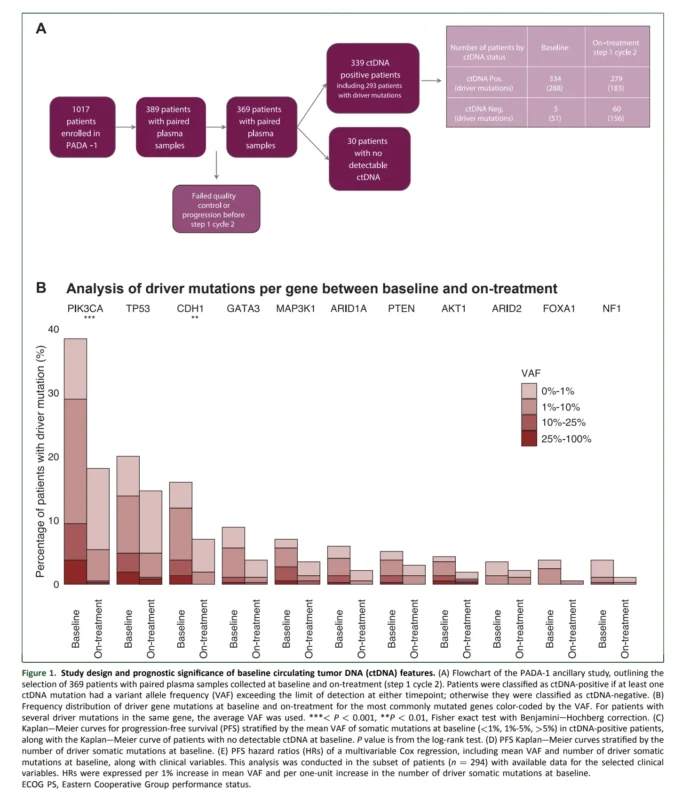
The analysis included 369 patients with paired plasma samples collected at baseline and early on-treatment, at a median of 28 days. Cell-free DNA was profiled using the Guardant360 LDT 497-gene panel.
The main finding was clear: both baseline ctDNA burden and early ctDNA evolution were strongly associated with patient outcomes. A ctDNA-based risk model incorporating baseline and dynamic ctDNA features improved prognostic performance beyond traditional RECIST and clinical parameters.
Why This Study Matters
ER-positive/HER2-negative advanced breast cancer is commonly treated with endocrine therapy and CDK4/6 inhibition. This strategy has improved outcomes, but resistance remains a major clinical problem.
In current practice, it is difficult to identify after the first cycle of treatment which patients are likely to have durable benefit and which patients are at risk of early progression.
Imaging remains central to response assessment. However, radiologic evaluation is usually performed after several treatment cycles and may not provide real-time insight into molecular response.
ctDNA monitoring offers a minimally invasive way to evaluate tumor evolution through blood-based testing. The present study supports the idea that early ctDNA changes may provide prognostic information before conventional imaging fully separates patient trajectories.
Study Design
This was a post hoc ancillary study of the PADA-1 trial.
PADA-1 was a randomized, open-label, multicenter phase III trial that evaluated the clinical utility of switching endocrine therapy from an aromatase inhibitor to fulvestrant at the time of rising ctDNA ESR1 mutation detection in patients with ER-positive/HER2-negative advanced breast cancer receiving first-line aromatase inhibitor plus palbociclib.
For this ancillary analysis, investigators studied patients with paired plasma samples available at baseline and on the first day of cycle 2.
After quality control, 369 patients were included.
The median age was 62 years. Most patients had grade II or III disease, and the median number of metastatic sites was 3. Median follow-up was 38 months.
ctDNA was analyzed using a 497-gene next-generation sequencing panel. Patients were classified as ctDNA-positive if at least one somatic mutation exceeded the limit of detection at either baseline or on-treatment.
ctDNA Was Frequently Detected
Most patients had detectable ctDNA.
Overall, 92% of patients were ctDNA-positive at at least one of the two timepoints. Likely driver somatic mutations were detected in 79% of patients at baseline or on-treatment.
At baseline, investigators detected 2003 likely somatic mutations across 339 genes in 334 patients. Among these, 767 mutations were classified as driver mutations.
The most commonly mutated driver genes were PIK3CA, TP53, CDH1, GATA3, MAP3K1, ARID1A, and PTEN.
PIK3CA was the most frequently altered gene, detected in 38% of patients at baseline. TP53 mutations were detected in 20%, CDH1 in 16%, GATA3 in 9%, MAP3K1 in 7%, ARID1A in 6%, and PTEN in 5%.
Baseline ctDNA Burden Was Prognostic
Baseline ctDNA levels were strongly associated with outcomes.
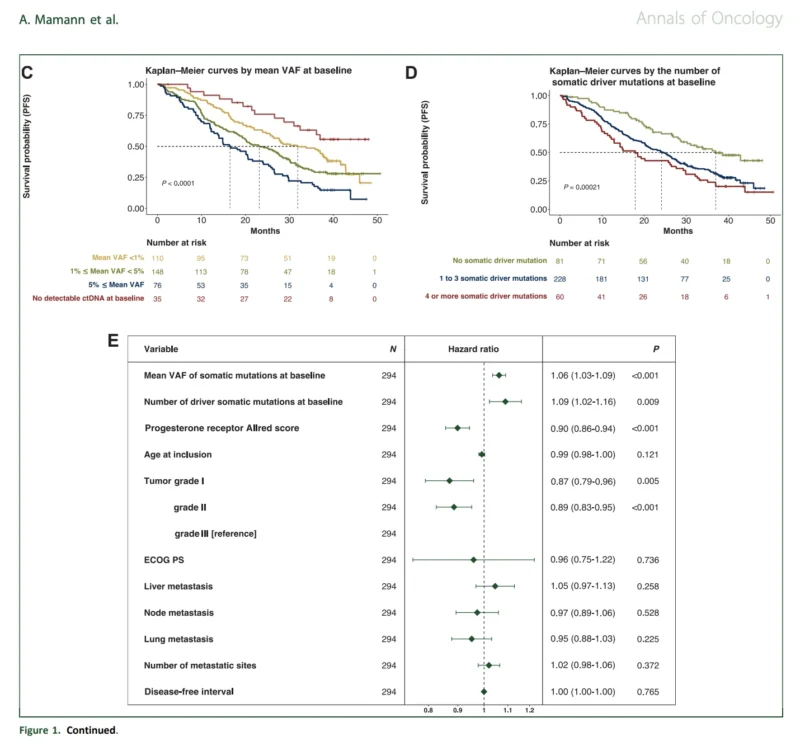
The mean variant allele frequency of somatic mutations at baseline was associated with both progression-free survival and overall survival. For each 1% increase in mean VAF, the hazard ratio was 1.07 for PFS and 1.08 for OS.
Patients were stratified by baseline mean VAF.
Patients with no detectable ctDNA at baseline had the most favorable outcome, with median PFS not reached. Among patients with detectable ctDNA, median PFS was 31.9 months for mean VAF below 1%, 23.1 months for mean VAF between 1% and 5%, and 16.5 months for mean VAF above 5%.
The number of baseline driver mutations was also prognostic. Median PFS was 37.0 months in patients with no driver mutations, 24.1 months in those with 1 to 3 driver mutations, and 17.9 months in those with 4 or more driver mutations.
These findings suggest that baseline ctDNA burden reflects both tumor load and molecular complexity.
Early ctDNA Dynamics Added Prognostic Information
The study also showed that ctDNA changed rapidly after treatment started.
ctDNA positivity decreased from 91% at baseline to 76% on-treatment. Driver mutation detection decreased from 78% at baseline to 50% on-treatment.
The mean VAF of somatic mutations fell significantly from baseline to on-treatment. Median mean VAF decreased from 1.78% to 0.41%.
The VAF of driver mutations also decreased significantly. Median driver mutation VAF fell from 1.66% at baseline to 0% on-treatment.
These early changes were clinically meaningful.
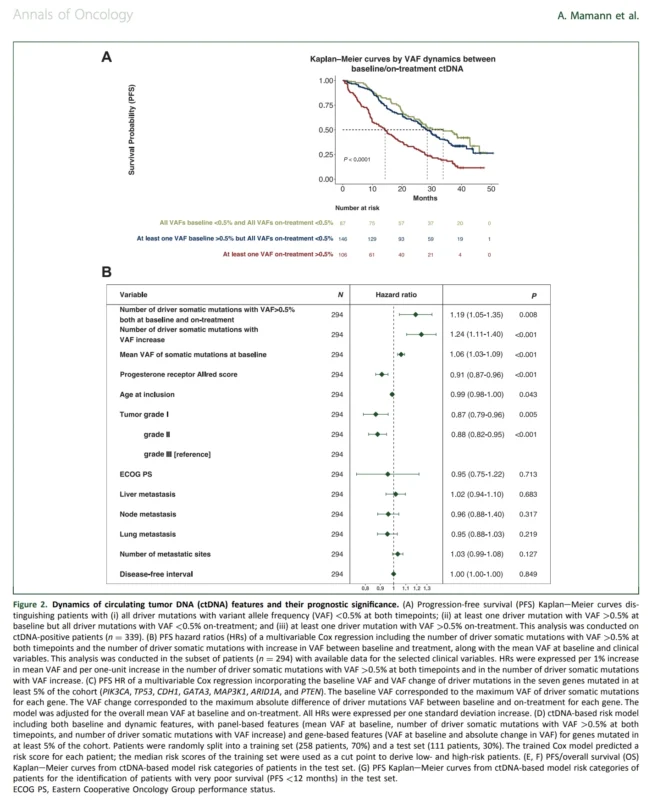
Patients were grouped according to driver mutation VAF dynamics. Those with low driver mutation VAF below 0.5% at both timepoints had a median PFS of 33.8 months.
Patients whose driver mutation VAF decreased from above 0.5% at baseline to below 0.5% on-treatment had a median PFS of 28.5 months. Patients with stable or increasing driver mutation VAF above 0.5% on-treatment had a median PFS of 14.3 months.
This difference was highly significant.
Rising Driver Mutations Identified Poorer Outcomes
The number of driver mutations with increasing VAF from baseline to on-treatment also carried prognostic information.
Overall, 26% of ctDNA-positive patients had at least one driver somatic mutation with an increase in VAF after one cycle of therapy.
Median PFS was 26.1 months in patients with no driver mutation VAF increase, 23.0 months in patients with one increasing driver mutation, and 15.0 months in patients with two or more increasing driver mutations.
Both the number of driver mutations with VAF above 0.5% at both timepoints and the number of driver mutations with increasing VAF were significantly associated with PFS and OS.
This supports the clinical value of measuring ctDNA not only once, but serially.
Gene-Specific Signals
The study also explored gene-level ctDNA dynamics.
PIK3CA and CDH1 mutation frequencies decreased significantly from baseline to on-treatment. PIK3CA driver mutations were observed in 38% of patients at baseline and 18% on-treatment. CDH1 driver mutations decreased from 16% to 7%.
TP53 mutations showed a different pattern. TP53 driver mutations were present in 20% at baseline and 15% on-treatment, and TP53 had the highest number of driver mutations with a VAF increase.
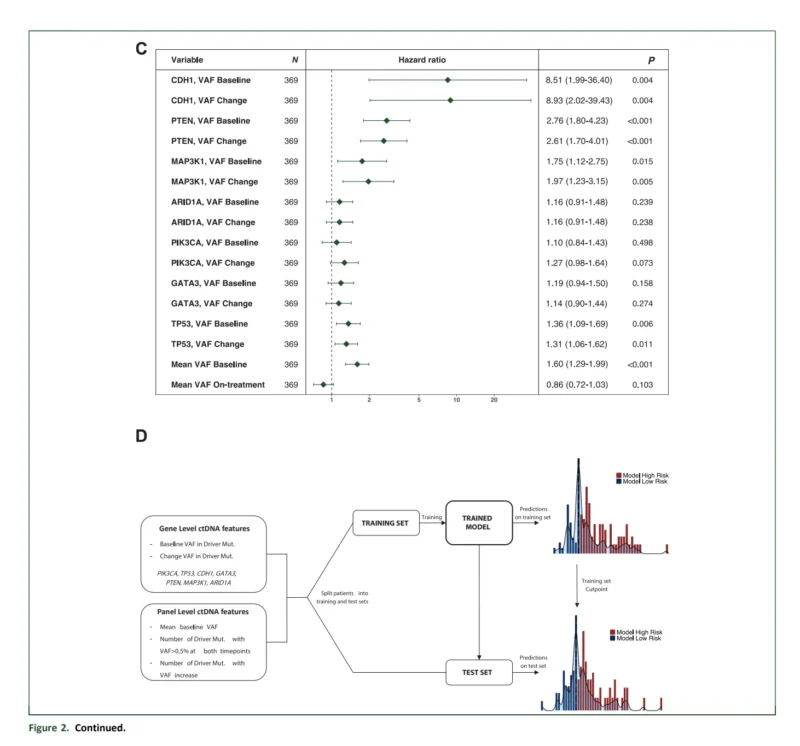
In multivariable analysis, higher baseline VAF and greater VAF change were associated with worsening PFS for TP53, CDH1, MAP3K1, and PTEN.
These results suggest that not all ctDNA changes carry the same meaning. The gene affected and the direction of molecular change may both matter.
A ctDNA-Based Risk Model Improved Prognosis
Investigators developed a ctDNA-based risk model using both baseline and dynamic features.
The model included panel-level features, such as baseline mean VAF, number of driver mutations with VAF above 0.5% at both timepoints, and number of driver mutations with VAF increase.
It also included gene-level features involving PIK3CA, TP53, CDH1, GATA3, MAP3K1, PTEN, and ARID1A.
Patients were randomly divided into a training set and a test set. The model generated a risk score and classified patients as low risk or high risk.
In the test set, median PFS was 34.4 months in low-risk patients and 14.1 months in high-risk patients. Median OS was not reached in low-risk patients and was 33.6 months in high-risk patients.
The model also identified a very-high-risk group for short PFS below 12 months, with 87% specificity and 52% sensitivity in the test set.
This could be clinically relevant for future trial design, particularly for identifying patients who may need alternative treatment strategies or early-phase clinical trial enrollment.
ctDNA Added Value Beyond RECIST
The study compared ctDNA-based risk prediction with traditional RECIST response assessment.
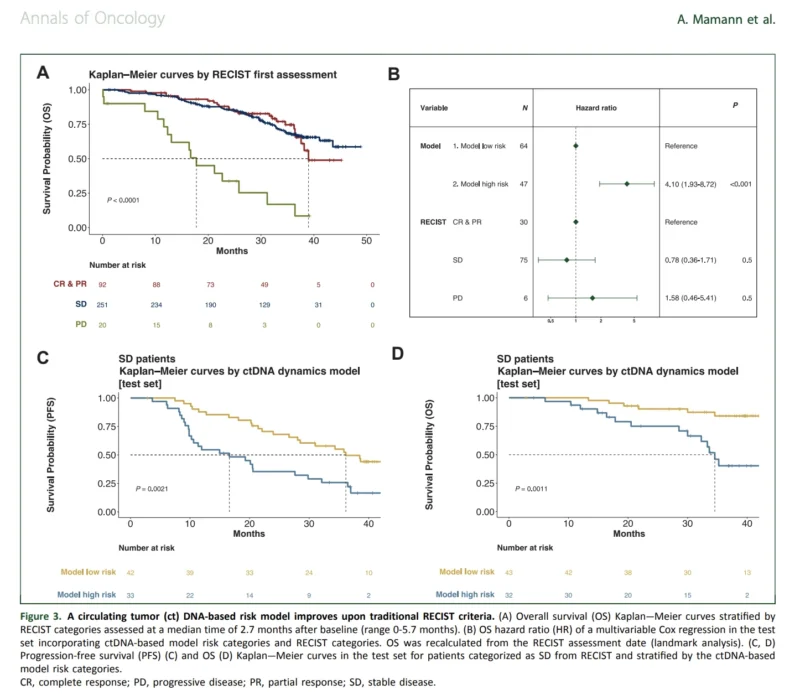
At the first RECIST evaluation, performed at a median of 2.7 months after baseline, most patients had stable disease or partial response. However, RECIST categories did not efficiently stratify outcomes between complete or partial response and stable disease.
The ctDNA-based risk model added independent prognostic value beyond RECIST.
In the test set, ctDNA-based risk categories were independently prognostic for both PFS and OS in multivariable models that included RECIST.
This was particularly important among patients classified as stable disease by RECIST. In this group, median PFS was 36.2 months for ctDNA low-risk patients and 16.6 months for ctDNA high-risk patients. Median OS was not reached in the low-risk group and was 34.6 months in the high-risk group.
This suggests that ctDNA may help refine risk even among patients who appear similar by imaging.
ctDNA Plus Clinical Features Performed Better
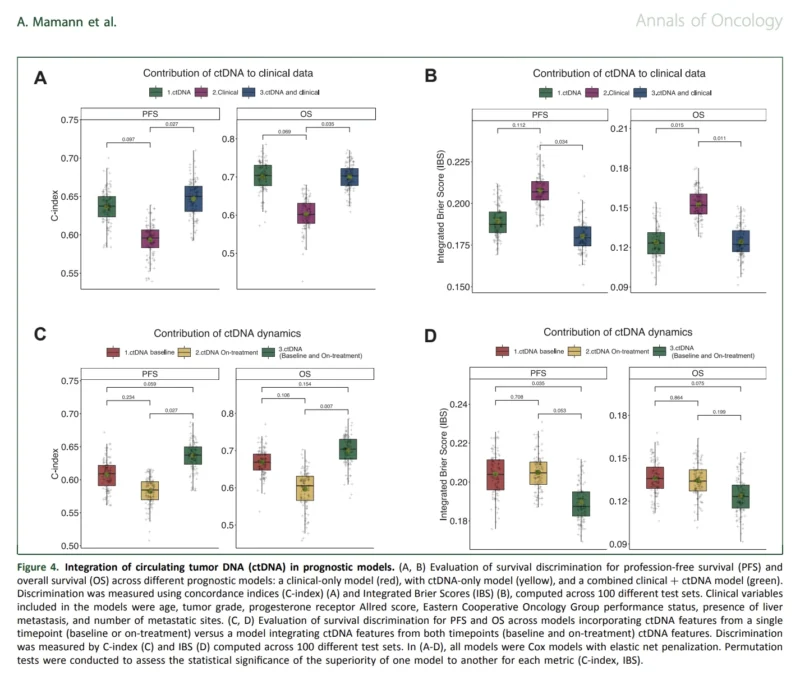
The investigators also tested whether ctDNA could improve prediction beyond clinical variables.
A combined clinical plus ctDNA model improved survival discrimination compared with a clinical-only model.
For PFS, the C-index improved from 59.3% with the clinical-only model to 64.7% with the combined clinical and ctDNA model.
For OS, the C-index improved from 60.3% to 70.0%.
This supports the value of integrating molecular response data with traditional clinical factors, rather than viewing them as competing tools.
Two Timepoints Were Better Than One
The study also compared baseline-only, on-treatment-only, and combined baseline plus on-treatment ctDNA models.
The combined two-timepoint ctDNA model showed better prognostic performance than either single-timepoint model.
This is a practical finding. It suggests that early ctDNA evolution provides information that cannot be fully captured by baseline testing alone.
For future studies, this supports the design of serial ctDNA monitoring strategies rather than single blood draws.
Clinical Meaning
This analysis strengthens the case for early ctDNA monitoring in ER-positive/HER2-negative advanced breast cancer.
The study does not suggest that treatment should be changed based on ctDNA alone. Instead, it shows that ctDNA dynamics may help identify risk earlier than imaging-based assessment alone.
For clinicians, early ctDNA evolution could become a useful layer of information when discussing prognosis, planning surveillance intensity, or designing future escalation trials.
For patients, this approach could eventually help personalize monitoring and treatment strategy more precisely.
Limitations
Several limitations should be considered.
This was a post hoc ancillary analysis of PADA-1. Although the cohort was large and derived from a phase III trial, the ctDNA-based risk model still requires external validation.
Paired sequencing of peripheral blood mononuclear cells or tumor tissue was not available. Germline and clonal hematopoiesis variants were removed algorithmically, but this approach is not perfect.
The risk model was evaluated in a test set of 111 patients, representing 30% of the cohort. Larger independent cohorts and real-world validation are needed before clinical implementation.
Key Takeaway
Early on-treatment ctDNA dynamics were prognostic for both progression-free survival and overall survival in patients with advanced ER-positive/HER2-negative breast cancer treated with endocrine therapy plus CDK4/6 inhibition.
Baseline ctDNA burden, persistent driver mutation VAF above 0.5%, and increasing driver mutation VAF after one cycle of therapy were all linked with poorer outcomes.
A ctDNA-based risk model improved prognosis beyond RECIST and clinical variables, and two-timepoint ctDNA monitoring performed better than single-timepoint testing.
These findings support ctDNA dynamics as a promising prognostic biomarker and provide a framework for future studies using early molecular response to guide risk-adapted treatment strategies.