
The growing interest in treatment de-escalation for early HER2-positive breast cancer reflects an important change in therapeutic strategy: achieving excellent long-term outcomes while reducing exposure to unnecessary chemotherapy. Although dual HER2 blockade has substantially improved the effectiveness of neoadjuvant treatment, identifying patients who can safely receive less intensive regimens remains a major clinical challenge.
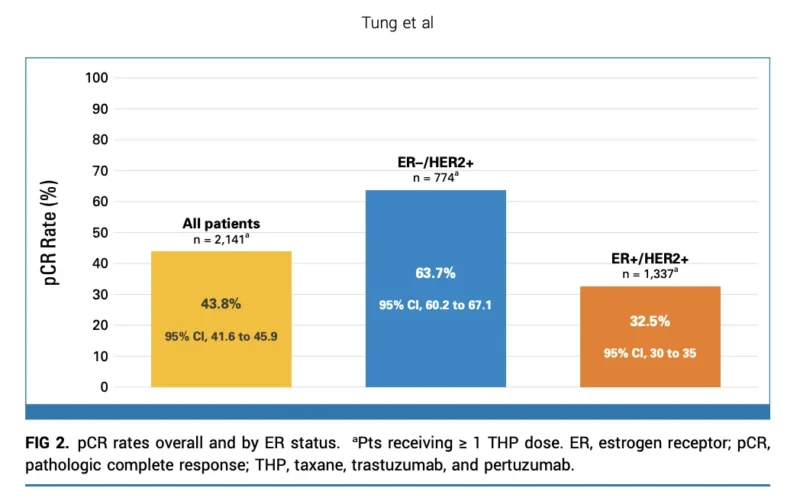
New secondary analyses from the phase II EA1181/CompassHER2 pCR trial, published in the Journal of Clinical Oncology provide important evidence toward addressing this question. In 2,141 patients with stage II–IIIA HER2-positive breast cancer who initiated neoadjuvant taxane, trastuzumab, and pertuzumab (THP), the overall pathologic complete response (pCR) rate was 43.8%. However, response varied considerably according to estrogen receptor expression, HER2 protein expression, taxane schedule, and the HER2DX molecular score.
The findings demonstrate that conventional clinicopathological features and molecular profiling can help identify patients more likely to achieve pCR with a shorter, less intensive chemotherapy regimen. Importantly, the trial’s primary endpoint, three year recurrence-free survival among patients achieving pCR—has not yet been reported. The current analysis therefore informs response prediction rather than establishing the long-term safety of treatment de-escalation.
CompassHER2 pCR: A Prospective Approach to Chemotherapy De-escalation
Neoadjuvant chemotherapy combined with trastuzumab and pertuzumab has become an established treatment approach for stage II–III HER2-positive early breast cancer. However, conventional multiagent chemotherapy is associated with substantial toxicity, prompting investigation into whether selected patients can achieve comparable outcomes with a single taxane and dual HER2 blockade.
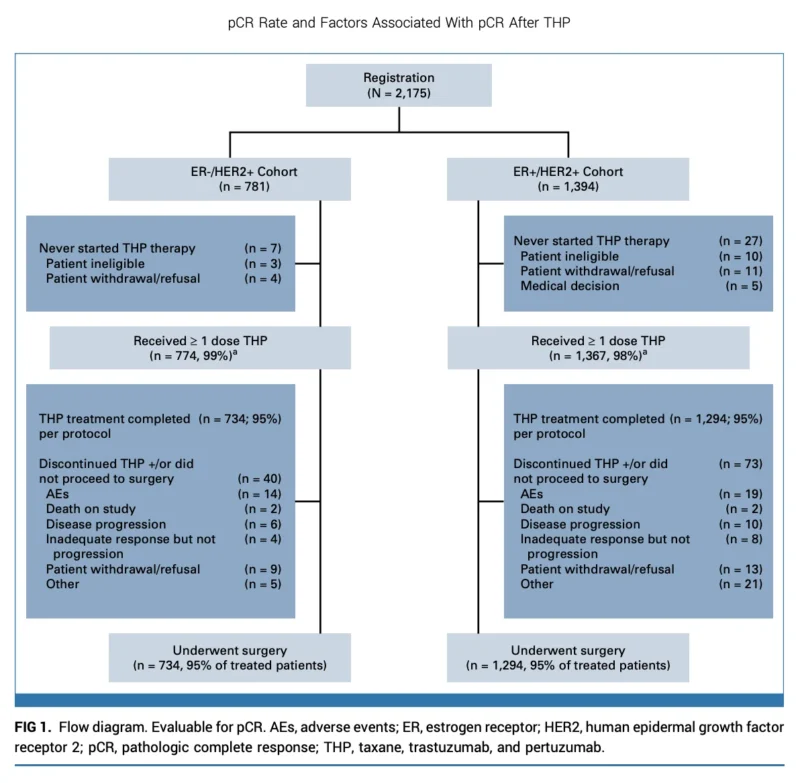
EA1181/CompassHER2 pCR is a prospective, National Cancer Institute–sponsored study coordinated by ECOG-ACRIN. It enrolled 2,175 patients with operable stage II–IIIA HER2-positive breast cancer, including 781 with ER-negative and 1,394 with ER-positive disease.
Patients received 12 weeks of trastuzumab and pertuzumab combined with weekly paclitaxel, docetaxel every three weeks, or weekly nab-paclitaxel, followed by surgery. Those achieving pCR continued trastuzumab and pertuzumab to complete one year of HER2-directed therapy without additional cytotoxic chemotherapy. Radiotherapy and endocrine therapy were administered when indicated, while postoperative treatment for patients with residual invasive disease was determined by the treating physician.
The trial is designed to determine whether patients achieving pCR after this less intensive regimen can maintain a three-year recurrence-free survival rate exceeding 92%. Its primary endpoint is independently powered for ER-negative and ER-positive disease, allowing the long-term effectiveness of the strategy to be evaluated in two biologically distinct populations.
The present analysis focuses on pCR rates and the baseline characteristics associated with response, providing a foundation for more individualized neoadjuvant treatment selection.
ER Expression Identifies Substantial Differences in Treatment Sensitivity
The overall pCR rate was 43.8%, but estrogen receptor status emerged as one of the strongest determinants of treatment response.
Among patients with HER2-positive/ER-negative disease, 63.7% achieved pCR, compared with approximately 32.5% of patients with HER2-positive/ER-positive tumors. This difference is consistent with previous observations that hormone receptor–negative HER2-positive cancers are generally more sensitive to neoadjuvant HER2-directed chemotherapy.
However, CompassHER2 pCR provides a more detailed assessment by examining ER expression as a continuous biological characteristic rather than relying exclusively on the traditional positive-versus-negative classification.
Patients with ER-low tumors, defined by ER expression of 1%–10%, achieved a pCR rate of 62.5%, nearly identical to the 63.7% observed in ER-negative tumors. Response decreased to 51.6% among patients with ER expression of 11%–70% and fell further to 22.5% when ER expression exceeded 70%. These findings suggest that the relationship between hormone receptor expression and sensitivity to neoadjuvant THP is more complex than a binary classification can capture.
Within the ER-positive population, patients with ER expression of 1%–10% or 11%–70% had significantly higher odds of pCR than those with expression above 70%, with adjusted odds ratios of 2.99 and 2.68, respectively.
This quantitative relationship may be particularly relevant when considering chemotherapy de-escalation in ER-positive/HER2-positive disease, where the probability of complete pathological response is substantially lower overall.
HER2 IHC 3+ Is Strongly Associated With Pathologic Complete Response
Beyond hormone receptor expression, the intensity of HER2 protein expression demonstrated a particularly strong association with treatment response.
In multivariable analysis, HER2 IHC 3+ status was associated with approximately sixfold higher odds of pCR compared with HER2 IHC 2+/ISH-positive disease. The association remained consistent across ER-negative and ER-positive subgroups, with adjusted odds ratios of 6.31 and 6.06, respectively. This finding illustrates the biological heterogeneity that exists even within tumors meeting established diagnostic criteria for HER2 positivity.
Although HER2 IHC 3+ and IHC 2+/ISH-positive tumors are both eligible for HER2-directed treatment, their dependence on HER2 signaling and sensitivity to individual treatment strategies may differ.
The results suggest that quantitative and qualitative HER2 assessment could contribute to more accurate prediction of neoadjuvant response. Nevertheless, HER2 IHC intensity alone cannot establish whether a patient can safely omit additional chemotherapy, particularly while long-term survival data from de-escalation trials remain immature.
Weekly Paclitaxel Was Associated With Higher Response Rates
The analysis also identified an association between taxane schedule and the probability of pCR. Patients receiving weekly paclitaxel were more likely to achieve pCR than those receiving docetaxel every three weeks. After adjustment for clinicopathological characteristics, weekly paclitaxel was associated with an odds ratio for pCR of 1.50 in the overall population.
The association was more pronounced among patients with ER-negative disease, where the adjusted odds ratio was 1.86. In ER-positive disease, the corresponding odds ratio was 1.30, with a confidence interval that included no difference.
The investigators found that the association was not explained by differences in the amount of taxane received. However, taxane selection was not randomized, and the possibility of unmeasured clinical factors influencing treatment allocation cannot be excluded. The findings therefore support further investigation of taxane scheduling but should not be interpreted as definitive evidence that weekly paclitaxel is superior to docetaxel in every patient receiving neoadjuvant THP.
HER2DX Adds Molecular Information Beyond Conventional Pathology
One of the most important components of CompassHER2 pCR is the evaluation of HER2DX, a 27-gene expression assay incorporating immune, proliferation, luminal, and HER2-related signatures together with tumor size and nodal status. The investigators assessed the HER2DX pCR likelihood score in diagnostic biopsy samples from 569 patients. Scores were classified as low, medium, or high according to prespecified thresholds.
The molecular analysis demonstrated substantial differences in treatment response. Patients with low HER2DX scores achieved pCR in 19% of cases, compared with 67% and 68% in the medium- and high-score groups, respectively.
Importantly, the relationship remained significant after adjustment for clinicopathological variables. Compared with patients with low scores, those with medium scores had an adjusted odds ratio for pCR of 4.17, while patients with high scores had an adjusted odds ratio of 2.75.
The similarity in observed pCR rates between the medium- and high-score groups differed from some earlier HER2DX studies, which demonstrated a more progressive relationship between the molecular score and response. The investigators suggest that the unexpectedly high response rate in the medium-score group may explain this finding.
The clinically relevant observation may therefore be the assay’s ability to identify patients with a particularly low likelihood of achieving pCR after four cycles of THP. This distinction was especially relevant in ER-positive/HER2-positive disease, where approximately 63% of tested tumors had a low HER2DX score. In contrast, only 6% of ER-negative tumors were classified in the low-score category.
HER2DX may consequently provide additional discriminatory information in ER-positive disease, where conventional clinicopathological characteristics alone may be insufficient to identify patients suitable for less intensive neoadjuvant treatment.
Integrating Molecular and Clinicopathological Predictors
The findings support an increasingly integrated approach to predicting neoadjuvant response in HER2-positive early breast cancer. Estrogen receptor expression provides important information about the endocrine characteristics of the tumor, while HER2 IHC intensity may reflect the degree of dependence on HER2 signaling. HER2DX adds molecular information related to proliferation, immune activity, luminal biology, and HER2-associated gene expression.
When HER2DX was incorporated into the multivariable model, its association with pCR remained significant alongside lower ER expression, HER2 IHC 3+ status, and weekly paclitaxel use. The association between PR expression and pCR was no longer statistically significant after including HER2DX. This may reflect overlapping biological information, since the molecular assay incorporates luminal gene-expression characteristics closely related to hormone receptor activity. However, reduced statistical power in the smaller biomarker-tested population may also have contributed.
The results demonstrate the potential value of combining routine pathology and molecular profiling rather than treating these approaches as alternatives.
The Clinical Implications for Neoadjuvant De-escalation
The major clinical question raised by CompassHER2 pCR is whether patients with a high probability of complete pathological response can be identified before treatment and subsequently managed with less intensive chemotherapy without compromising long-term outcomes.
The current analysis provides important information about response probability, but predicting pCR is not equivalent to demonstrating that a treatment strategy preserves recurrence-free or overall survival. This distinction is particularly relevant in HER2-positive disease, where achieving pCR is associated with favorable outcomes but does not eliminate recurrence risk. Moreover, the prognostic implications of pCR can vary according to hormone receptor status, baseline stage, tumor biology, and subsequent treatment.
The trial’s pending three-year recurrence-free survival analysis is therefore essential. If patients achieving pCR after THP demonstrate favorable long-term outcomes, the clinical and molecular predictors identified in this secondary analysis could become valuable tools for selecting candidates for less intensive neoadjuvant treatment.
Conversely, the relatively low response rate among patients with low HER2DX scores raises the possibility that these patients may require a longer duration of THP or an alternative regimen. However, the present analysis does not establish which escalation strategy would improve outcomes in this population.
Moving Toward Response-Adapted Neoadjuvant Treatment
CompassHER2 pCR also contributes to a broader movement toward integrating baseline biomarkers with early assessments of treatment response. Clinical characteristics and molecular assays such as HER2DX may help estimate the probability of pCR before treatment begins. Functional imaging, breast MRI, circulating tumor DNA, and other on-treatment biomarkers may subsequently provide information about whether the tumor is responding as expected.
The investigators highlight ongoing analyses within EA1181 and other prospective studies, including EA1211/DIRECT, that are examining imaging and molecular biomarkers to refine response prediction. Previous studies such as PHERGain and TRAIN-3 have also investigated the role of imaging in guiding treatment adaptation.
The objective of this evolving strategy is to integrate tumor biology and treatment response throughout the neoadjuvant pathway, allowing treatment intensity to be adjusted according to the characteristics of the individual patient rather than relying exclusively on baseline clinical stage.
Prospective validation will be necessary before such models can routinely guide omission or escalation of chemotherapy.
The Bottom Line
The EA1181/CompassHER2 pCR secondary analysis provides substantial prospective evidence regarding the predictors of complete pathological response after neoadjuvant taxane, trastuzumab, and pertuzumab in stage II–IIIA HER2-positive breast cancer.
The overall pCR rate was 43.8%, with a substantial difference between ER-negative and ER-positive tumors. Quantitative ER expression, HER2 IHC intensity, and taxane schedule were associated with response, while HER2DX provided additional predictive information beyond conventional clinicopathological characteristics.
The findings advance the identification of patients who may be suitable for less intensive neoadjuvant treatment, particularly by highlighting the strong relationship between tumor biology and response probability. However, the primary three-year recurrence-free survival results remain essential before this strategy can be considered sufficiently validated for broader implementation.
The central contribution of CompassHER2 pCR is therefore its support for moving HER2-positive early breast cancer toward biologically informed, response-adapted treatment, with the ultimate aim of maintaining long-term outcomes while minimizing unnecessary chemotherapy.
Reference
- Tung N, Zhao F, DeMichele A, Prat A, Winer EP, Wright JL, et al. Pathologic Complete Response (pCR) Rate and Predictors of Response to Taxane, Trastuzumab, and Pertuzumab in HER2-Positive Breast Cancer: Secondary Analyses of EA1181/CompassHER2 pCR. Journal of Clinical Oncology. Published August 20, 2026. doi:10.1200/JCO-25-02255 .