
Breast cancer has one of the most active clinical research landscapes in oncology, with increasingly complex trials evaluating targeted therapies, immunotherapy, antibody–drug conjugates, biomarker-selected populations, and novel trial designs. Yet this expansion has created a less visible challenge: a substantial number of studies never reach their planned completion.
A new analysis published in The Breast, provides one of the most comprehensive assessments to date of early termination in breast cancer clinical trials. Using ClinicalTrials.gov data spanning 25 years, the investigators analyzed 5,251 breast cancer trials initiated between 2001 and 2025, examining why studies stopped prematurely, which trial characteristics were associated with termination, and when during a study’s life cycle those failures were most likely to occur.
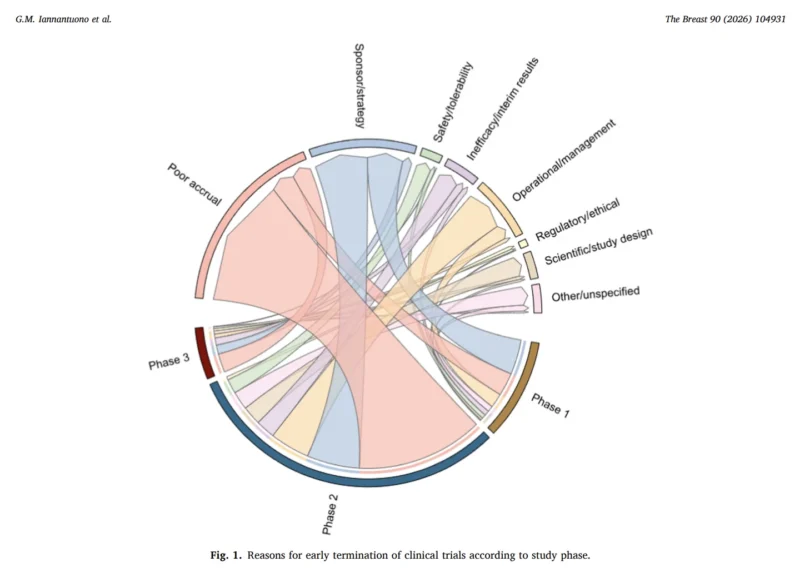
The central finding is striking in its simplicity: poor patient accrual was the most common reason breast cancer trials ended early, accounting for 39.2% of terminations. But the analysis also shows that trial failure is not a uniform phenomenon. The dominant reason for termination changes according to study phase, sponsor, geographic scope, and whether a trial is conducted at a single center or through a broader multicenter network.
The implication extends beyond trial operations. Early termination can waste resources, expose patients to research that ultimately cannot answer its intended question, and leave clinically important therapeutic hypotheses unresolved. In an era of increasingly fragmented molecular subgroups, improving trial feasibility may be as important to drug development as improving trial design itself.
More Than 5,000 Breast Cancer Trials Were Evaluated
The investigators conducted a cross-sectional study using the Aggregate Analysis of ClinicalTrials.gov database, identifying interventional breast cancer studies initiated between January 1, 2001, and December 31, 2025.
Trials were categorized according to study phase, number of recruiting centers, primary purpose, sponsor type, geographical region, number of participants, and reported reason for early termination. Termination reasons were grouped into eight predefined categories, including poor accrual, safety or tolerability, operational or management issues, sponsor or strategic decisions, regulatory or ethical issues, scientific or design problems, inefficacy or interim results, and other or unspecified causes.
Overall, 2,663 trials were completed, 1,054 were terminated, and 1,534 remained active at the database cutoff. That means approximately one in five of all included trials was already classified as terminated, underscoring the scale of the problem across the breast cancer research ecosystem.
Poor Accrual Was the Leading Cause of Early Termination
Across the entire 25-year period, 39.2% of early terminations were attributed to poor accrual.
The next most frequent causes were:
- Sponsor decision or strategic reasons: 22.4%
- Operational or management issues: 13.4%
This hierarchy is clinically and operationally important. Failures related to toxicity, lack of efficacy, or interim scientific findings are sometimes unavoidable, and in some circumstances represent appropriate ethical decision-making. Poor accrual is different. It often reflects weaknesses in trial feasibility, eligibility, site selection, competition, referral pathways, or access rather than failure of the scientific hypothesis itself.
The authors argue that recruitment problems may be becoming more important as breast cancer research becomes increasingly biologically fragmented. Biomarker-driven studies frequently compete for relatively small molecularly defined populations, while the number of active trials continues to increase. The result is an increasingly crowded research environment in which theoretically eligible patients may be divided among multiple competing studies.
Phase II Trials Were Particularly Vulnerable
Study phase strongly influenced termination risk. Among terminated trials, 67.2% were phase II studies, compared with 55.2% among completed trials. By contrast, phase III trials represented only 11.2% of terminated studies versus 20.4% of completed studies.
After adjustment for sponsor, geographic region, primary purpose, and study organization, phase II trials remained significantly more likely to terminate early than phase I trials:
- OR 1.48; 95% CI, 1.23–1.80; P<0.001.
The competing-risk analysis produced a similar finding, with an adjusted subdistribution HR of 1.39 for phase II studies. This vulnerability makes intuitive sense. Phase II represents a critical transition in oncology development. By this point, substantial resources have already been invested, but treatment activity is still being defined and the decision to proceed to definitive phase III development often depends on the results.
At the same time, phase II trials may be competing for narrower biomarker populations without the large recruitment infrastructure available to registrational studies.
The Reason for Failure Changes With Trial Phase
The analysis becomes particularly informative when termination reasons are separated by development stage. Among phase II trials, 43.2% of terminations were due to poor accrual, while the corresponding figure for phase III studies was 40.2%. In phase I studies, poor accrual accounted for only 25.6% of terminations. Instead, sponsor decisions or strategic reasons were the dominant explanation, accounting for 38.7% of phase I terminations.
The Figure 1 diagram on page 4 makes this contrast visually clear: the strongest connection from phase II and III studies runs toward poor accrual, whereas phase I studies show a much larger contribution from sponsor or strategic decisions. This suggests that early-phase and later-phase development face fundamentally different vulnerabilities.
Phase I programs may be stopped because companies reprioritize portfolios, competing therapies emerge, drug-development strategies change, or early results alter the perceived value of further investment. Later-phase academic and treatment-oriented trials are more likely to fail because they cannot recruit enough patients to answer the clinical question.
Academic Trials Face a Different Problem Than Industry Trials
Sponsor type produced another striking contrast. Among academic-sponsored trials, poor accrual accounted for 52.4% of early terminations. Among industry-sponsored trials, poor accrual accounted for only 16.0%. Instead, 51.2% of industry trial terminations were attributed to sponsor decisions or strategic reasons.
This distinction is important because it suggests that trial failure cannot be addressed through a single solution. Academic trials may require stronger recruitment networks, improved feasibility assessment, additional operational support, and broader access to eligible patients. Industry programs may instead be more vulnerable to rapid strategic reprioritization as competitive landscapes change.
The authors also observed fewer operational and management-related terminations among industry-sponsored trials, potentially reflecting greater access to centralized infrastructure, regulatory support, data-management resources, and dedicated trial personnel.
Multicenter Trials Were Less Likely to Terminate Early
Study organization also had a measurable effect. Poor accrual accounted for 49.3% of terminations in single-center trials compared with 33.7% in multicenter studies. After multivariable adjustment, multicenter studies had a 30% lower odds of premature termination than single-center studies:
- OR 0.70; 95% CI, 0.58–0.84; P<0.001.
The time-to-event model showed an even stronger association:
- sHR 0.66; 95% CI, 0.56–0.78; P<0.001.
The likely explanation is not simply that multicenter studies are larger. Broader research networks increase the number of potentially eligible patients, reduce dependence on a single institution’s referral patterns, and may provide better trial coordination and operational support. For increasingly narrow molecular breast cancer populations, this network effect may become even more important.
Terminated Trials Enrolled Far Fewer Patients
Another revealing difference concerned enrollment. Completed studies enrolled a median of 61 participants, compared with only 12 participants among terminated trials. That observation illustrates the practical consequence of early recruitment difficulty.
Once a trial begins missing recruitment targets, low enrollment can become self-reinforcing. Sites may become less engaged, recruitment timelines lengthen, competing studies open, sponsor priorities change, and the original clinical question may lose relevance before the required sample size is reached.
This helps explain why feasibility assessment before trial activation is so important.
Geography Was Also Associated With Termination Risk
Trials conducted in the United States had the highest proportion of terminated studies and the greatest cumulative incidence of early termination in the temporal analysis.
After adjustment, trials conducted in Asia, Europe, and globally all showed lower odds of premature termination compared with U.S.-only studies. For example:
- Asia: OR 0.53
- Europe: OR 0.69
- Global studies: OR 0.71.
The competing-risk analysis produced similar patterns, with Asia showing the lowest adjusted risk relative to the United States. However, these findings should not be interpreted as direct measures of research quality.
ClinicalTrials.gov does not capture every trial conducted worldwide, regional registration practices differ, and trial portfolios vary substantially between regions. The geographical results therefore describe patterns within this registry rather than establishing that one research system is intrinsically more efficient than another.
Trial Failure Often Happens Early
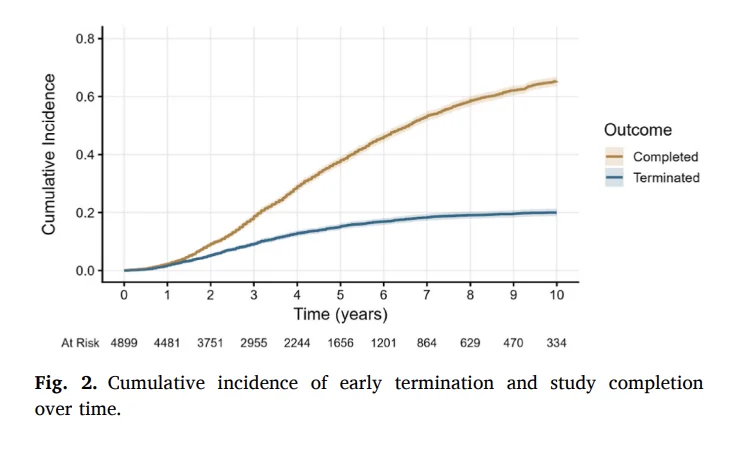
The temporal analysis revealed another actionable finding. The cumulative incidence of early termination increased most rapidly during the first years after study initiation and subsequently stabilized. This suggests that many threats to successful completion become apparent relatively early.
Recruitment projections may prove unrealistic soon after activation. Sites may fail to identify sufficient eligible patients. Operational difficulties may emerge before the study has built momentum. This creates an opportunity for intervention.
Rather than waiting until recruitment is clearly irrecoverable, trial sponsors and investigators could use early performance indicators to reassess feasibility, expand participating sites, modify recruitment strategies, or reconsider overly restrictive eligibility criteria before termination becomes unavoidable.
Increasing Molecular Precision Can Make Recruitment Harder
There is an important paradox behind these results. The more precisely breast cancer is classified, the more biologically rational clinical trials become. But precision can also make recruitment more difficult. A study that once enrolled all patients with metastatic triple-negative breast cancer may now require a particular biomarker, prior treatment sequence, molecular alteration, organ-function profile, and line of therapy.
Meanwhile, multiple trials may compete for the same relatively small population. The investigators explicitly connect poor accrual with the increasing biological fragmentation of breast cancer, biomarker-driven treatment strategies, and the growing number of active clinical trials.
This means precision oncology creates not only a molecular challenge but also a trial-design challenge. As eligible populations become narrower, traditional single-center recruitment models may simply become inadequate.
Broader Eligibility Could Improve Trial Sustainability
The authors propose several strategies to reduce preventable termination. For trials vulnerable to poor accrual, they emphasize more realistic feasibility assessments before activation, stronger referral networks, broader availability of trials through decentralized research infrastructure, and less restrictive eligibility criteria where scientifically appropriate.
This point is particularly relevant in oncology, where restrictive inclusion criteria frequently exclude patients who resemble the real-world population that will ultimately receive the treatment. Broader eligibility has two potential advantages: it can accelerate recruitment while also improving the external validity of trial results.
The authors additionally highlight the value of incorporating patient advocates during protocol development, potentially identifying practical barriers that investigators or sponsors may otherwise overlook.
Strategic Trial Termination Is Not Always a Failure
Not every early termination represents poor research conduct. A study may appropriately stop because of unexpected toxicity, clear futility, overwhelming early efficacy, or the emergence of a new standard that makes continuation ethically or scientifically inappropriate.
Sponsor-driven strategic termination is similarly heterogeneous. Rapid advances in breast cancer can make a development program less relevant even when the underlying agent remains active. A competing drug may demonstrate superior efficacy, a biomarker strategy may change, or a treatment sequence may become obsolete before a study completes enrollment.
The high proportion of strategically terminated phase I and industry trials therefore partly reflects the speed of contemporary oncology development rather than simply inefficiency.
The challenge is distinguishing appropriate strategic discontinuation from avoidable trial failure.
The Ethical Cost of Poor Accrual Is Different
Recruitment-related failure carries a particular ethical concern. Patients who enroll in clinical trials accept uncertainty and additional procedures partly because their participation is expected to contribute to scientifically interpretable knowledge.
When a trial closes because it cannot recruit enough participants, that scientific objective may never be achieved. The resources invested by patients, investigators, research teams, funders, and healthcare systems may therefore generate limited clinical evidence.
This does not mean poorly accruing trials should be kept open indefinitely. Rather, it strengthens the argument for ensuring that recruitment feasibility is rigorously assessed before patients begin enrolling.
The Study Has Important Limitations
The analysis relied entirely on ClinicalTrials.gov, which does not capture every breast cancer trial conducted internationally. Registry information is also self-reported by investigators and sponsors and may be incomplete or outdated. Most importantly, reasons for termination are entered as free text. Although the investigators used predefined categories and demonstrated strong inter-rater agreement, some degree of classification error is unavoidable.
The predictive models also showed only modest discrimination. The multivariable logistic model had an AUC of approximately 0.60, indicating that the measured trial characteristics alone cannot precisely predict which individual study will fail.
The findings are therefore more useful for understanding population-level patterns and identifying modifiable vulnerabilities than for predicting the fate of a specific trial.
The Broader Lesson for Breast Cancer Research
This analysis arrives at an important moment for breast oncology. Trials are becoming scientifically more sophisticated, but successful drug development requires more than identifying a compelling biological hypothesis. A clinically meaningful question also needs:
realistic access to the eligible population, adequate site infrastructure, sustainable funding, operational support, patient-centered eligibility criteria, and a recruitment strategy capable of surviving an increasingly competitive therapeutic landscape.
The findings suggest that these practical components should be considered part of scientific trial design, rather than administrative details addressed after a protocol has already been finalized. In particular, phase II trials appear to represent a critical point of vulnerability where improved feasibility planning could prevent substantial scientific and financial waste.
The Bottom Line
The analysis of 5,251 breast cancer trials conducted over 25 years demonstrates that early termination is not driven primarily by toxicity or treatment failure. It is driven most often by the inability to recruit enough patients. Poor accrual accounted for 39.2% of early terminations, followed by sponsor or strategic decisions at 22.4% and operational or management problems at 13.4%.
Phase II trials were particularly vulnerable, while multicenter studies were significantly less likely to terminate prematurely. Academic trials and single-center studies were disproportionately affected by poor recruitment, whereas industry-sponsored and phase I trials were more often discontinued for strategic reasons.
The authors’ proposed solution is not a universal intervention but a more tailored approach: realistic pretrial feasibility assessment, stronger multicenter and referral networks, broader scientifically justified eligibility, patient involvement, and continuous reassessment of recruitment and operational performance.
As breast cancer becomes increasingly divided into smaller molecularly defined populations, the ability to recruit the right patients may become one of the most important determinants of whether promising clinical questions are ever answered.
Reference
- Iannantuono GM, Daniele G, Mastrantoni L, Giannarelli D, Trapani D, Gyawali B, Sganga S, Giudice E, Riondino S, Krasniqi E, Capici S, Pepe FF, Torrisi R, Spinazzola A, Bassolino A, Meacci A, Yazdanpanahardakani K, Padula L, Rosenfeld R, Carbognin L, Lorusso D, Curigliano G, Gulley JL, Fabi A, Bria E, Roselli M, Floudas CS, Cazzaniga ME. Early termination of clinical trials enrolling patients with breast cancer: Reasons, determinants, and temporal patterns. The Breast. 2026;90:104931. doi:10.1016/j.breast.2026.104931.