
The neoadjuvant treatment of HER2-positive breast cancer has evolved around a central objective: achieve deep tumor eradication before surgery while limiting the toxicity required to reach that goal. Trastuzumab and pertuzumab combined with taxane-based chemotherapy remain a cornerstone for stage II–III disease, but the emergence of novel HER2-directed antibodies, antibody–drug conjugates, and alternative taxane formulations is creating new opportunities to improve efficacy without necessarily intensifying conventional chemotherapy.
A phase III randomized clinical trial published in JAMA Oncology on September 3, 2026, introduces a potentially important new approach. The study evaluated anbenitamab (KN026), a biparatopic HER2-directed antibody, together with HB1801, an albumin-bound formulation of docetaxel, as neoadjuvant treatment for stage II or III HER2-positive breast cancer. The combination significantly increased total pathological complete response compared with conventional trastuzumab, pertuzumab, and docetaxel, while producing a similar overall rate of grade 3–4 treatment-related adverse events.
The result is clinically interesting because the investigational regimen does not simply add another agent to an increasingly intensive treatment backbone. Instead, it attempts to redesign both components of the established HER2-directed strategy: replacing separate trastuzumab and pertuzumab with a single biparatopic antibody and replacing conventional solvent-based docetaxel with an albumin-bound formulation.
A Different Approach to Dual HER2 Targeting
The biological rationale for anbenitamab distinguishes it from conventional dual-antibody blockade. Anbenitamab is engineered to bind simultaneously to two nonoverlapping extracellular regions of HER2: domain II, corresponding to the pertuzumab recognition site, and domain IV, corresponding to the trastuzumab recognition site. This biparatopic architecture is designed to produce extensive HER2 receptor clustering, internalization, lysosomal degradation, and sustained inhibition of downstream signaling.
Rather than administering two separate monoclonal antibodies against different HER2 domains, the therapeutic concept is therefore to integrate both binding functions within a single molecule while potentially altering receptor biology through clustering.
HB1801 addresses a different component of treatment. It is an albumin-bound formulation of docetaxel that eliminates polysorbate 80 and ethanol, the solvents required for conventional docetaxel. According to the investigators, this avoids the requirement for high-dose glucocorticoid premedication and permits rapid infusion, with the potential to improve treatment convenience and tolerability.
The combination therefore represents more than a new HER2 antibody. It is an alternative formulation of the entire antibody–taxane backbone.
A Phase III Comparison Against an Established Neoadjuvant Strategy
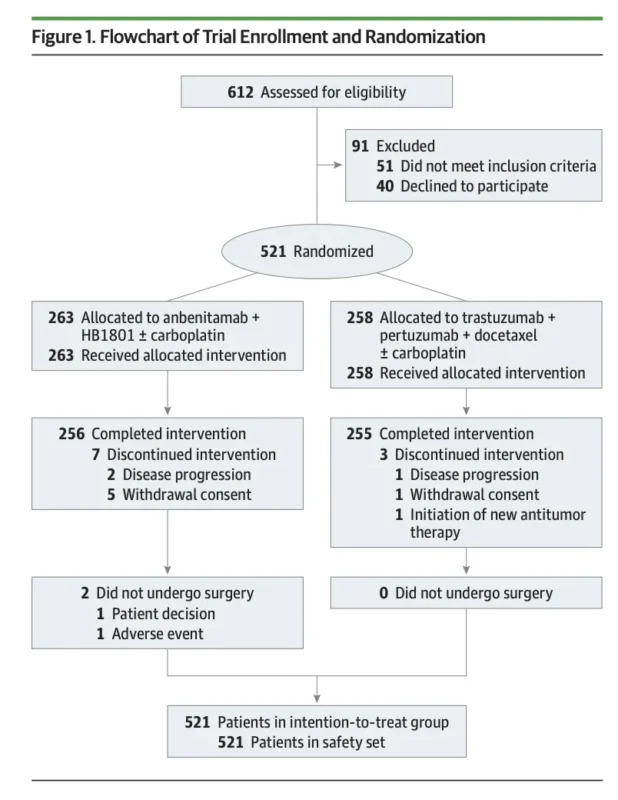
The Neo-Healer/BCTOP-HN01 trial was a multicenter, open-label, phase III registrational study conducted across 61 hospitals in China. It enrolled 521 previously untreated patients with HER2-positive stage II or III breast cancer and randomly assigned them 1:1 to six cycles of anbenitamab plus HB1801 or trastuzumab, pertuzumab, and docetaxel. Carboplatin could be incorporated into either regimen according to the investigator’s pretreatment decision, and randomization was stratified according to stage, hormone receptor status, and planned carboplatin use.
The study population included a clinically relevant spectrum of disease. Approximately 56% had hormone receptor–positive tumors, 34% had locally advanced disease, and 43% received carboplatin. Most tumors were strongly HER2-positive by immunohistochemistry, with 88.7% classified as IHC 3+.
The primary endpoint was total pathological complete response (tpCR), assessed by blinded independent central pathological review.
The Primary Endpoint Favored Anbenitamab Plus HB1801
The trial met its primary endpoint.
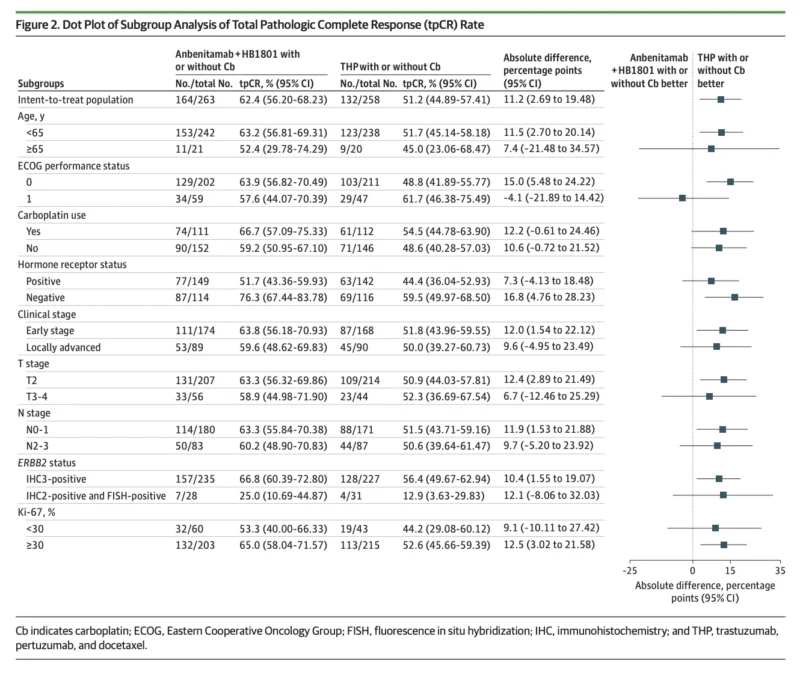
Total pathological complete response was achieved in 62.4% of patients receiving anbenitamab plus HB1801 compared with 51.2% receiving trastuzumab, pertuzumab, and docetaxel. The absolute improvement was 11.4 percentage points (95% CI, 3.2–19.6; P=.004).
This is a clinically meaningful increase in pathological response against an active contemporary HER2-directed comparator rather than against chemotherapy alone. The broader pathological and radiographic findings were directionally consistent. Investigator-assessed tpCR was 63.9% versus 51.2%, breast pCR was 65.8% versus 55.4%, and objective response rates were 94.3% versus 92.2%. The improvement in the primary endpoint was also generally maintained across the major prespecified clinical subgroups.
The result therefore suggests that replacing conventional THP with a biparatopic HER2 antibody and albumin-bound docetaxel can meaningfully increase eradication of invasive disease from both the breast and regional nodes before surgery.
Hormone Receptor Status Still Matters
As expected in HER2-positive early breast cancer, absolute pCR rates differed considerably according to hormone receptor status.
Among patients with HR-positive disease, tpCR was 51.7% with anbenitamab plus HB1801 compared with 44.4% in the control group. Among patients with HR-negative disease, rates were substantially higher at 76.3% versus 59.5%, respectively.
The higher absolute response in HR-negative/HER2-positive tumors is consistent with the established biology of HER2-driven disease, in which absence of parallel hormone receptor signaling is often associated with greater sensitivity to HER2-directed neoadjuvant treatment.
Importantly, however, the investigational strategy appeared to improve pathological response in both biological subsets. The relevant signal is therefore not simply that HR-negative disease achieved a high pCR rate, but that the advantage over THP was not confined to one hormone receptor population.
The Carboplatin Question Remains Open
One of the most interesting aspects of the trial is that carboplatin was not mandatory.
Among patients receiving carboplatin, tpCR was 66.7% with anbenitamab plus HB1801 versus 54.5% with THP. Among those treated without carboplatin, the corresponding rates were 59.2% versus 48.6%.
This suggests that the efficacy advantage of the investigational regimen was present both with and without platinum chemotherapy. The absolute differences reported by the investigators were approximately 12.3 percentage points with carboplatin and 10.7 percentage points without it. However, this should not be interpreted as evidence that carboplatin is unnecessary.
The decision to use carboplatin was made by investigators before randomization rather than being independently randomized. Patients selected for carboplatin generally had greater disease burden, including more N2–N3 and locally advanced disease. The study was therefore not designed to determine which patients benefit from adding carboplatin.
This distinction is important because chemotherapy de-escalation remains one of the major questions in HER2-positive early breast cancer. BCTOP-HN01 supports further investigation of a platinum-free strategy but does not establish which patients can safely omit carboplatin.
Efficacy Did Not Come With a Major Increase in Severe Toxicity
The safety result strengthens the clinical relevance of the pCR improvement.
Grade 3 or 4 treatment-related adverse events occurred in 29.3% of patients in the investigational group and 28.3% in the control group, and no treatment-related deaths occurred.
The most important severe hematologic toxicities were neutropenia, leukopenia, and anemia. Nonhematologic adverse events including rash, diarrhea, nausea, peripheral edema, and peripheral sensory neuropathy occurred more frequently with anbenitamab plus HB1801, but most were low grade.
Treatment completion was also high. Approximately 98% of patients completed all six planned cycles of anbenitamab and HB1801, and no symptomatic left ventricular systolic dysfunction was reported in either treatment group.
These findings do not establish that the investigational regimen is less toxic overall than THP, but they demonstrate that the improvement in pathological response was achieved without an obvious increase in high-grade treatment-related toxicity.
That benefit-risk balance is particularly relevant in curative-intent treatment, where the objective is not simply to maximize tumor response but to do so without creating unnecessary acute or long-term morbidity.
Where Does This Fit in the Rapidly Changing HER2-Positive Landscape?
The timing of this study is important because neoadjuvant HER2-positive breast cancer is changing rapidly.
The authors place their findings alongside recent chemotherapy-de-escalation studies and ADC-based approaches. In DESTINY-Breast11, sequential trastuzumab deruxtecan followed by THP produced a reported pCR rate of 67.3% in a high-risk population. The BCTOP-HN01 investigators note that six cycles of anbenitamab plus HB1801 produced a tpCR of 62.4% overall and 66.7% among patients receiving carboplatin.
These figures should not be compared directly because they come from different trials and different patient populations. Nevertheless, they illustrate the strategic competition emerging in early HER2-positive disease. One approach is to introduce highly active ADC therapy before surgery. Another is to improve the established antibody–taxane architecture using more sophisticated HER2 targeting and potentially more tolerable chemotherapy formulations.
The optimal strategy will ultimately depend on more than pCR. Event-free survival, residual-disease treatment, toxicity, treatment duration, cost, accessibility, and long-term outcomes will all be necessary to define where each regimen belongs.
pCR Is Important, but Survival Data Are Still Needed
The strongest caution in interpreting this trial is the maturity of follow-up.
At the reported analysis, median follow-up was less than eight months, and long-term outcomes were not yet available. Pathological complete response is an important prognostic marker in HER2-positive breast cancer and is widely used as an endpoint in neoadjuvant drug development. However, an improvement in pCR does not automatically establish superiority in event-free survival or overall survival.
The investigators appropriately state that long-term follow-up is needed. Event-free survival and invasive disease-free survival were included as secondary endpoints, but those results remain immature. For that reason, the current data support describing anbenitamab plus HB1801 as a promising new neoadjuvant strategy, rather than an established replacement for current standards of care.
Post-Neoadjuvant Treatment Adds Another Layer of Complexity
Modern HER2-positive treatment does not end at surgery. Pathological response increasingly determines what happens next.
Within BCTOP-HN01, trastuzumab plus pertuzumab was recommended after pCR, while T-DM1 was recommended for patients with residual disease. The authors acknowledge, however, that the post-neoadjuvant landscape is itself evolving and that optimal adjuvant treatment following anbenitamab-based therapy remains uncertain.
This is particularly relevant when evaluating a regimen specifically designed to increase pCR. If more patients achieve pCR, fewer may ultimately require escalation for residual disease. Conversely, patients who do not achieve pCR still need an evidence-based post-neoadjuvant strategy. Future trials therefore need to evaluate anbenitamab not merely as a six-cycle preoperative regimen but as one component of a complete response-adapted curative pathway.
Important Limitations Prevent Immediate Global Adoption
Several aspects of the study require caution. First, all 521 participants were enrolled in China. The investigators explicitly acknowledge that this may limit generalizability across populations with different demographic and genetic backgrounds.
Second, the trial evaluated anbenitamab and HB1801 simultaneously. It therefore cannot establish how much of the pCR improvement resulted from the biparatopic antibody and how much was attributable to the alternative taxane formulation. Third, carboplatin use was selected according to clinical characteristics rather than independently randomized, preventing a definitive assessment of chemotherapy de-escalation.
Most importantly, the primary analysis reports pathological response rather than mature event-free or overall survival. Longer follow-up will determine whether the 11.4-percentage-point improvement in tpCR ultimately translates into fewer invasive recurrences.
The study was supported by Shanghai JMT-Bio Technology, part of CSPC Pharmaceutical Group. The sponsor and Neo-Healer Steering Committee jointly participated in trial design, protocol development, and the statistical analysis plan. The publication reports no individual conflict-of-interest disclosures.
The Bottom Line
The phase III BCTOP-HN01 trial provides compelling evidence that a redesigned HER2-directed neoadjuvant backbone can improve pathological response in stage II–III HER2-positive breast cancer.
Among 521 patients, anbenitamab plus HB1801 increased tpCR from 51.2% with trastuzumab, pertuzumab, and docetaxel to 62.4%, an absolute improvement of 11.4 percentage points, while grade 3–4 treatment-related adverse events remained similar at 29.3% and 28.3%, respectively.
The consistency of the pCR signal across hormone receptor status, stage, and carboplatin use makes the result particularly interesting. Yet the trial does not answer whether carboplatin can safely be omitted, which investigational drug contributes most to the benefit, or whether improved pCR will translate into better event-free or overall survival.
For now, anbenitamab plus HB1801 should be viewed as a credible new challenger to the established neoadjuvant HER2-directed backbone, with the potential to broaden the options available before surgery if longer-term efficacy is confirmed.
The broader significance of the trial is equally important. HER2-positive early breast cancer is entering a phase in which treatment innovation is no longer synonymous with simply adding more therapy. The field is increasingly asking whether better-designed antibodies, more sophisticated drug delivery, and response-adapted treatment can produce deeper disease eradication without proportionally increasing toxicity.
That may ultimately be the more important direction of progress.
Reference
- Li J, Liu T, Yu K-D, et al; BCTOP Study Group. Neoadjuvant Anbenitamab and HB1801 in ERBB2-Positive Breast Cancer: A Phase 3 Randomized Clinical Trial. JAMA Oncology. Published online September 3, 2026. doi:10.1001/jamaoncol.2026.3329.