The 8th International Consensus Guidelines for the Management of Advanced Breast Cancer (ABC8) have been accepted for publication in The Breast, marking the latest major update to one of the most widely used international frameworks for advanced and metastatic breast cancer care.
The manuscript, led by Fatima Cardoso and an international multidisciplinary panel, is currently in press and incorporates updated therapeutic algorithms, biomarker recommendations, supportive-care principles, and consensus statements spanning all major breast cancer subtypes. The guideline development involved healthcare professionals and patients and provides a level of evidence, grade of recommendation, and consensus percentage for individual recommendations.
ABC8 Guidelines was developed following the international consensus conference held in Lisbon on November 6–8, 2025. The process involved 49 voting panel members, with recommendations subsequently revised when important new data emerged, including results from ASCENT-07, EPIK-B5, HER2CLIMB-05, and DESTINY-Breast11.
The significance of ABC8 Guidelines extends beyond incorporating recently approved drugs. The new guidelines increasingly frame advanced breast cancer as a continuously evolving biological disease, in which repeated biomarker assessment, treatment sequencing, toxicity, quality of life, access, and patient preference must all influence therapeutic decisions.
Precision Oncology Moves Further Into Routine Advanced Breast Cancer Care
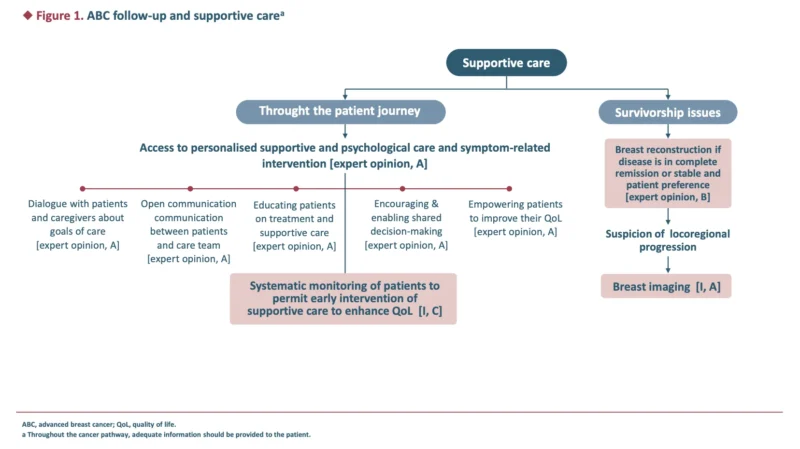
One of the clearest developments in ABC8 Guidelines is the expansion of molecular profiling from selected testing toward a treatment-linked precision oncology framework.
The diagnostic algorithm recommends consideration of germline BRCA1/2, germline PALB2, PD-L1, PIK3CA, ESR1, AKT1/PTEN, and HER2 mutations, alongside tumor-agnostic biomarkers such as MSI, NTRK fusions, and TMB in appropriate circumstances. Importantly, the guideline emphasizes that biomarkers should be requested when the result can realistically provide access to a targeted therapy.
ABC8 Guidelines also reinforces the importance of reassessing tumor biology during metastatic disease. ER and HER2 should be reassessed at least once when clinically feasible, while HER2 should be reconsidered later in the disease course when the initial result is HER2-zero. This is increasingly important because HER2 expression is no longer simply a binary distinction between HER2-positive and HER2-negative disease. The guidelines recognize HER2-low and HER2-ultralow biology, recommending detailed pathology reporting and distinguishing HER2-null from tumors with very low membrane staining.
ctDNA Is a Genotyping Tool, but Not Yet a Universal Progression Monitor
ABC8 takes a deliberately cautious position on circulating tumor DNA.
The guidelines support plasma ctDNA for detecting actionable genomic alterations when results can influence treatment selection, but do not recommend using ctDNA routinely to establish disease progression instead of standard clinicoradiological assessment. Tissue and plasma are viewed as complementary rather than competing sources of genomic information.
ESR1 represents one of the clearest examples.
For HR-positive/HER2-negative advanced breast cancer, ABC8 Guidelines recommends ESR1 mutation testing in blood ctDNA at progression when an appropriate targeted therapy is available. If plasma testing is negative, tissue assessment can be considered, and testing may be repeated during continued endocrine-based treatment when it would influence therapeutic decisions.
The guidelines also emphasize that an aromatase inhibitor is generally not the optimal endocrine strategy once an ESR1 mutation has emerged. This reflects a broader conceptual shift: molecular testing is increasingly being used not only to characterize the tumor at diagnosis but also to understand how endocrine resistance evolves during treatment.
Endocrine Resistance Is Reframed as a Biological Continuum
ABC8 Guidelines updates the definitions of endocrine sensitivity and resistance in collaboration with the AURORA Molecular Screening Initiative. Rather than treating endocrine resistance as a rigid binary state, the guidelines explicitly describe it as a continuum. The framework distinguishes primary resistance, early and late acquired resistance, and endocrine insensitivity while acknowledging that these categories are primarily prognostic guides rather than absolute clinical boundaries.
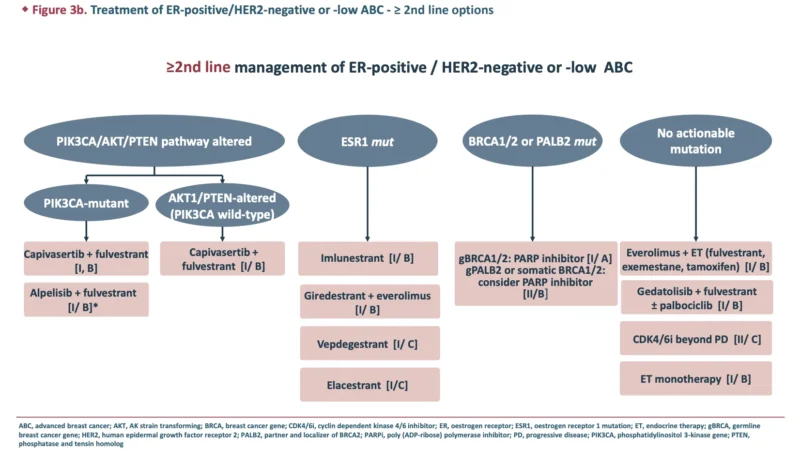
This distinction is increasingly relevant as the HR-positive/HER2-negative treatment landscape expands beyond a simple sequence of endocrine therapies. Following CDK4/6 inhibition, therapeutic decisions may now be determined by ESR1 status, PIK3CA alterations, AKT1/PTEN biology, BRCA/PALB2 status, prior endocrine exposure, duration of benefit, and HER2 expression.
HR-Positive/HER2-Negative Disease Becomes Increasingly Biomarker Directed
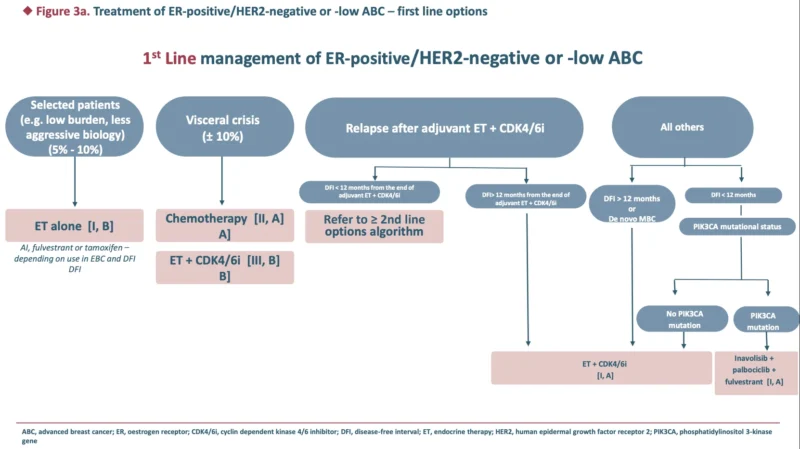
For most endocrine-sensitive first-line HR-positive/HER2-negative advanced breast cancers, endocrine therapy plus a CDK4/6 inhibitor remains central.
ABC8 Guidelines, however, incorporates a more differentiated approach to tumors recurring after adjuvant therapy and to PIK3CA-mutated disease. Inavolisib combined with palbociclib and fulvestrant is incorporated for selected PIK3CA-mutated disease, particularly in the clinical scenario of early endocrine relapse addressed in INAVO120.
After progression, the algorithm becomes increasingly genomic.
For PIK3CA-mutated disease, alpelisib plus fulvestrant remains an option; for AKT1/PTEN-altered disease, capivasertib plus fulvestrant is incorporated. ESR1-mutated disease now includes endocrine options such as imlunestrant, giredestrant plus everolimus, vepdegestrant, and elacestrant, while PARP inhibition remains central to eligible BRCA1/2- or PALB2-altered disease.
The guideline also incorporates newer evidence from EPIK-B5, confirming activity of alpelisib after CDK4/6 inhibition, and recognizes the growing number of therapies available after progression. Importantly, the panel states that the optimal sequence remains undefined and should therefore be guided by trial eligibility, tumor biomarkers, previous exposure, toxicity, and clinical context.
HER2-Low Disease Moves T-DXd Earlier
ABC8 Guidelines reflects the changing therapeutic implications of HER2-low expression.
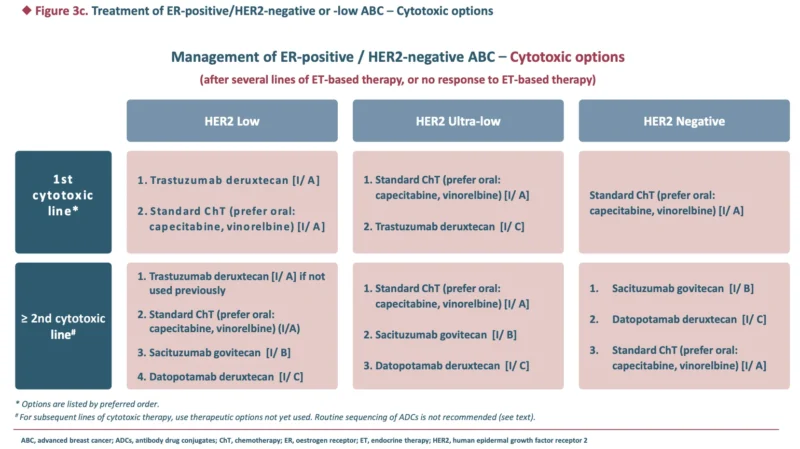
Based on DESTINY-Breast06, trastuzumab deruxtecan can be considered as the first cytotoxic treatment after endocrine-based therapy in appropriate patients with ER-positive/HER2-low advanced breast cancer. The guideline cites the 5.1-month median PFS improvement versus physician’s-choice chemotherapy while emphasizing the need to balance efficacy against ILD/pneumonitis, gastrointestinal toxicity, fatigue, disease burden, and patient preferences.
For HER2-ultralow disease, however, the panel remains more conservative, concluding that further evidence is required before establishing the same degree of recommendation. The distinction illustrates one of ABC8’s recurring principles: new biological categories should not automatically become therapeutic categories until the clinical evidence is sufficiently mature.
HER2-Positive Disease Now Has Multiple First-Line and Maintenance Strategies
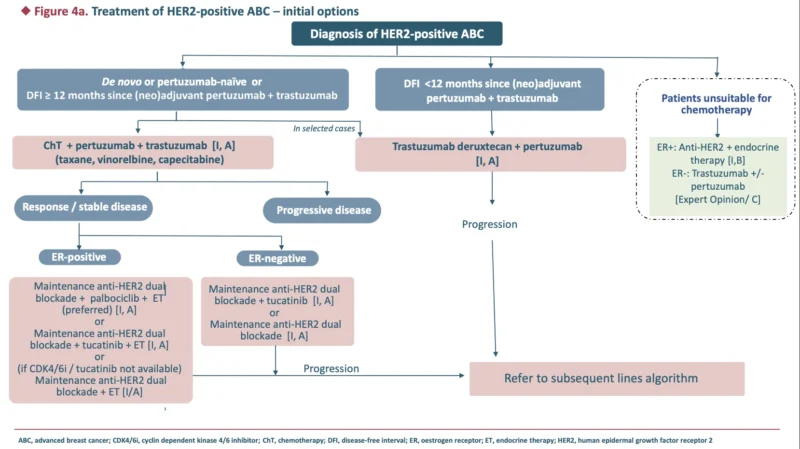
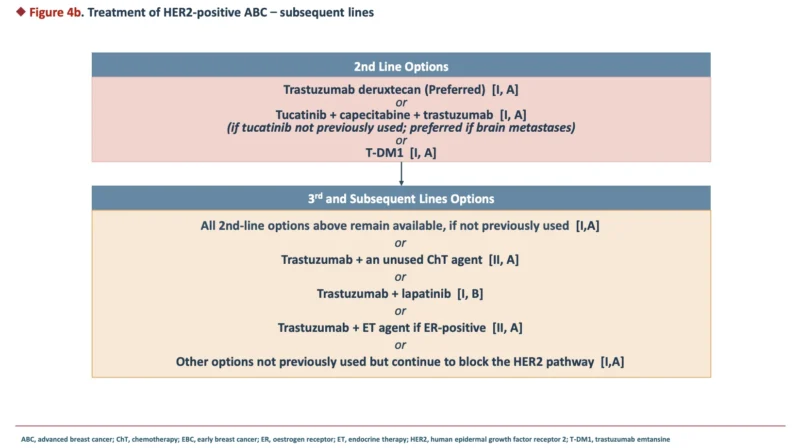
HER2-positive advanced breast cancer has undergone some of the most substantial changes in the new algorithms. Traditional induction with chemotherapy plus trastuzumab and pertuzumab remains a major first-line option. But ABC8 Guidelines now integrates several strategies that reshape what happens during and after induction.
In ER-positive/HER2-positive disease, the phase III PATINA trial supports maintenance with palbociclib plus anti-HER2 therapy and endocrine therapy, which ABC8 Guidelines identifies as the preferred maintenance strategy following clinical benefit from induction therapy. PATINA produced a 15.2-month improvement in median PFS.
The phase III HER2CLIMB-05 trial adds another option. Tucatinib added to trastuzumab and pertuzumab maintenance improved median PFS by 9.6 months overall. ABC8 Guidelines therefore identifies tucatinib plus dual HER2 blockade as the preferred maintenance approach for ER-negative/HER2-positive disease and as an option with endocrine therapy for ER-positive disease.
These changes make maintenance therapy an increasingly active component of first-line HER2-positive management rather than simply continuation of antibody blockade.
T-DXd Plus Pertuzumab Enters First Line, but ABC8 Keeps the Discussion Balanced
DESTINY-Breast09 introduced another major change. T-DXd plus pertuzumab produced a 13.8-month improvement in median PFS compared with taxane, trastuzumab, and pertuzumab, with an HR of 0.56. ABC8 Guidelines therefore recognizes T-DXd plus pertuzumab as a first-line option where approved.
Importantly, the guideline does not treat the result as a simple replacement of THP. The panel explicitly recommends balancing the PFS advantage against immature OS data, toxicity, prolonged exposure to cytotoxic payload therapy, and the established efficacy of T-DXd in subsequent lines.
This is one of the more sophisticated aspects of ABC8. The guideline increasingly evaluates therapies within the entire treatment sequence, rather than assuming that moving every effective treatment earlier necessarily produces the best lifetime outcome.
Triple-Negative Breast Cancer Moves Rapidly Toward First-Line ADC Strategies
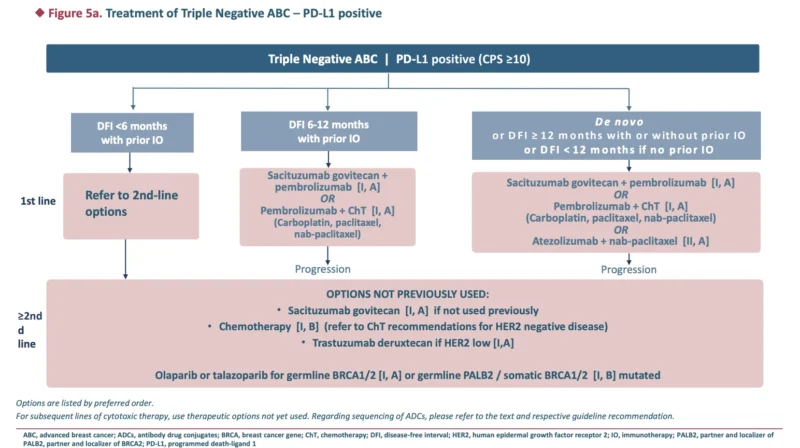
The TNBC algorithm has changed substantially. For PD-L1–positive advanced TNBC, pembrolizumab plus chemotherapy remains a preferred first-line strategy. However, ABC8 Guidelines also incorporates pembrolizumab plus sacituzumab govitecan as a first-line option where available, based on ASCENT-04/KEYNOTE-D19. That trial demonstrated a PFS improvement with the ADC–immunotherapy combination, although OS remains immature.
The evolution is equally significant for patients who are not candidates for checkpoint inhibition.
Both sacituzumab govitecan and datopotamab deruxtecan have now generated first-line phase III evidence. ABC8 Guidelines recognizes Dato-DXd as a first-line option for TNBC when immunotherapy is not appropriate, based on TROPION-Breast02, which showed improvements in both PFS and OS. In patients experiencing recurrence within six months of completion of curative-intent therapy, Dato-DXd is identified as the preferred first-line option because this particularly high-risk population was represented in TROPION-Breast02.
The manuscript nevertheless cautions against simplistic comparisons between first-line TROP2 ADCs. ASCENT-03 and TROPION-Breast02 differed in trial population, chemotherapy comparator, crossover design, toxicity, and subsequent treatment access. The optimal ADC remains uncertain for many patients.
ADC Sequencing Becomes a Major Unresolved Question
The increasing number of ADCs creates an issue that previous breast cancer guidelines rarely needed to address directly: what happens when one ADC is followed by another? ABC8 explicitly states that evidence supporting routine sequential ADC use remains insufficient.
In ER-positive/HER2-negative or HER2-low disease, the cytotoxic-treatment algorithm includes T-DXd, sacituzumab govitecan, and datopotamab deruxtecan but notes that routine ADC sequencing is not recommended because evidence on cross-resistance and optimal sequencing remains limited.
A similar caution appears in TNBC, where the manuscript emphasizes the lack of validated biomarkers capable of determining whether resistance to one topoisomerase-I ADC predicts resistance to another. This will likely become one of the defining research questions for ABC9.
Brain Imaging Becomes More Selective, but Potentially More Relevant
ABC8 maintains that routine brain MRI is not indicated for every patient with advanced breast cancer in the absence of neurological symptoms. However, the new diagnostic algorithm introduces a possible exception for HER2-positive and triple-negative disease when the identification of asymptomatic brain metastases would change systemic or local treatment selection.
This reflects the increasingly CNS-active nature of modern therapies. As treatment choices become influenced by intracranial efficacy, identifying clinically silent CNS disease may become relevant not simply for staging but for systemic treatment selection.
Exercise Is Now Explicitly Part of Comprehensive ABC Care
ABC8 also expands beyond drug treatment. The guidelines provide a strong recommendation that structured, individualized exercise should be incorporated into comprehensive advanced breast cancer care, supported by level I evidence and 100% panel consensus.
Regular supervised activity can improve physical function, fatigue, quality of life, pain, dyspnea, muscle mass, cardiovascular health, and sexual function. Programs should be adapted to disease burden, metastatic sites, and functional limitations, with particular attention to skeletal stability in patients with bone metastases.
The recommendation is supported in part by the PREFERABLE-EFFECT randomized trial and represents an important evolution in how supportive interventions are positioned: exercise is no longer framed simply as optional wellness advice but as an evidence-based component of cancer care.
ABC8 Establishes Guardrails for Artificial Intelligence
For the first time, ABC8 Guidelines also directly addresses artificial intelligence. The panel states that AI is not synonymous with evidence-based medicine and cannot replace it. AI systems should only be introduced clinically when they are evidence-based, quality controlled, validated, and approved.
The guidelines position AI as a potential information-enabling tool that may support, but should not replace, shared decision-making between clinicians and patients. The statement achieved 98% consensus. The inclusion of AI is notable because it broadens the guidelines beyond treatment selection toward the infrastructure through which future oncology care may increasingly be delivered.
Access and Equity Remain Central to the Guidelines
ABC8 Guidelines repeatedly acknowledges that an evidence-based recommendation has limited value if patients cannot access the diagnostic test or therapy required to implement it.
The manuscript emphasizes that inequalities in high-quality cancer care have increased both between and within countries. It therefore explicitly recognizes that guideline adaptation may be necessary in resource-constrained environments and that the level of evidence and grade of recommendation can help prioritize treatments with the greatest demonstrated clinical value.
This global perspective remains one of the defining characteristics of the ABC guidelines. The objective is not merely to catalogue every available drug but to provide a framework that connects clinical evidence, access, quality of life, multidisciplinary care, and patient participation.
The Broader Direction of ABC8
The most important feature of ABC8 is not any individual drug recommendation. The guidelines reflect a transition from relatively linear subtype-based treatment algorithms toward dynamic treatment pathways shaped by molecular evolution and previous therapeutic exposure.
HR-positive disease is increasingly subdivided by ESR1, PIK3CA, AKT/PTEN, BRCA/PALB2, and HER2 expression. HER2-positive disease now requires decisions not only about first-line therapy but also about maintenance intensification and timing of ADC exposure. TNBC is moving beyond a simple PD-L1/chemotherapy framework toward competing first-line ADC and immunotherapy strategies.
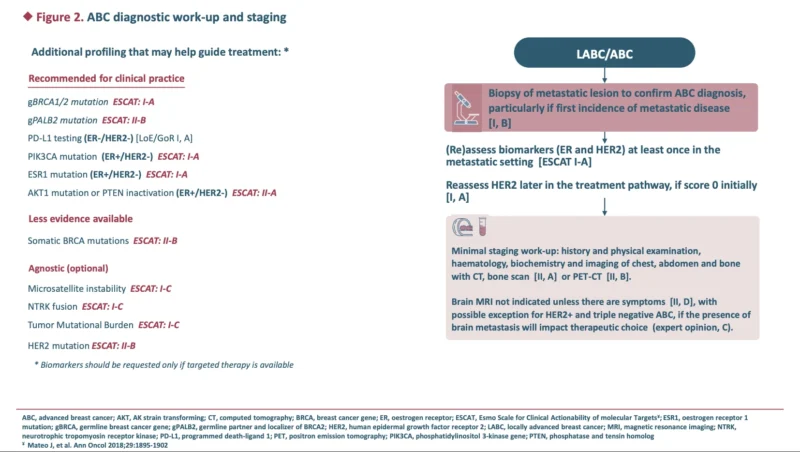
At the same time, ABC8 makes clear that increasingly sophisticated systemic treatment should not displace the fundamentals of high-quality cancer care: multidisciplinary management, supportive care, shared decision-making, exercise, symptom control, patient education, and attention to inequality.
That combination of molecular precision and patient-centered care may be the most important defining feature of the new guidelines.
The Bottom Line
The ABC8 International Consensus Guidelines, now accepted for publication in The Breast, provide a comprehensive update to the global management of advanced breast cancer.
The major direction is toward more treatment-linked molecular testing, increasingly individualized sequencing, earlier ADC use, active maintenance strategies, and greater recognition that treatment decisions must incorporate not only efficacy but toxicity, quality of life, subsequent treatment opportunities, and patient preference.
ABC8 also extends the definition of evidence-based advanced breast cancer care beyond anticancer drugs. Structured exercise receives a strong recommendation, artificial intelligence receives explicit clinical guardrails, and supportive and psychosocial care remain integral throughout the disease trajectory.
Perhaps the clearest message is that advanced breast cancer can no longer be managed effectively through a static sequence based only on ER, HER2, and PD-L1. The modern framework is increasingly:
define the subtype → characterize the molecular vulnerabilities → treat → reassess tumor biology → evaluate resistance → select the next mechanism → preserve quality of life throughout the sequence.
That is the clinical architecture ABC8 brings into 2026—and the starting point from which ABC9 will now evolve.
Reference
- Cardoso F, Ribeiro JM, Schumacher-Wulf E, Swain SM, Paluch-Shimon S, Penault-Llorca F, Lin NU, Francis PA, et al. 8th International Consensus Guidelines for the Management of Advanced Breast Cancer (ABC8 Guidelines). The Breast. 2026; in press. The manuscript identifies Fatima Cardoso as first and corresponding author and includes a broad international multidisciplinary author group