For years, microsatellite-stable (MSS) colon cancer has remained one of the most challenging settings for cancer immunotherapy. While checkpoint inhibitors have transformed treatment for mismatch repair-deficient tumors, most patients with colon cancer have mismatch repair-proficient disease, where conventional immunotherapy has demonstrated limited activity.
The Phase 2 UNICORN trial, published on November 2, 2026, in Nature Medicine, with Filippo Ghelardi as first author and Filippo Pietrantonio as senior author, provides clinical evidence that neoadjuvant Fc-enhanced CTLA-4 blockade, combined with PD-1 inhibition, may induce substantial pathological responses in resectable colon cancer, including pMMR/MSS tumors that have historically demonstrated limited sensitivity to conventional immune checkpoint inhibitors.
The multicenter study evaluated botensilimab, an Fc-enhanced anti-CTLA-4 antibody developed by Agenus, alone or combined with balstilimab, an anti-PD-1 antibody, in patients with locally advanced, resectable colon cancer.
Among patients with pMMR/MSS tumors receiving the combination, 36% achieved a major pathological response, including 29% with a pathological complete response, following just one dose of botensilimab and two doses of balstilimab.
Even more pronounced responses were observed in dMMR/MSI-H tumors, where all combination-treated patients achieved a major pathological response.
The findings raise an important question: could short-course immunotherapy before surgery change the treatment landscape for patients whose tumors have historically been considered resistant to checkpoint inhibition?
Why MSS Colon Cancer Has Been Difficult to Treat With Immunotherapy
Approximately 85% of early-stage colorectal cancers are microsatellite stable or mismatch repair proficient.
Unlike MSI-H/dMMR tumors, which typically generate numerous tumor-specific mutations and immunogenic neoantigens, MSS tumors often have lower immune-cell infiltration and an immune microenvironment less responsive to conventional PD-1 or CTLA-4 blockade.
This biological difference helps explain why checkpoint inhibitors have produced transformative outcomes in MSI-H colorectal cancer but have generally failed to demonstrate comparable activity in unselected MSS disease.
However, treating cancer before surgery may create a different immunological opportunity.
With the primary tumor and its surrounding immune environment still intact, neoadjuvant immunotherapy may facilitate tumor antigen recognition, immune-cell activation and the development of systemic antitumor immunity.
Botensilimab was designed to exploit this opportunity through a mechanism that differs from conventional CTLA-4 inhibition.
The antibody contains an engineered Fc region intended to enhance interactions with activating Fc-gamma receptors on immune cells. Beyond CTLA-4 blockade, this approach may strengthen antigen presentation, activate myeloid cells and promote depletion of immunosuppressive regulatory T cells within tumors.
Balstilimab complements this activity by blocking PD-1-mediated inhibition of activated T cells.
Together, the two agents are intended to stimulate both innate and adaptive antitumor immune responses.
Inside the UNICORN Trial: Four Cohorts, Two Molecular Subtypes
UNICORN (NCT05845450) is an ongoing, investigator-sponsored, multicenter, open-label Phase 2 platform trial conducted by Fondazione GONO GI.
The newly published analysis included 56 previously untreated patients with radiologically staged T3–T4, N0/N+ and M0 resectable colon cancer. Patients were enrolled sequentially into four nonrandomized cohorts according to their mismatch repair status and treatment regimen.
In the pMMR/MSS population, 14 patients received botensilimab monotherapy, while another 14 received botensilimab plus balstilimab. The same approach was followed in the dMMR/MSI-H population, with 14 patients receiving monotherapy and 14 receiving the combination.
Patients receiving monotherapy were administered botensilimab at 1 mg/kg on day 1. Those receiving combination treatment received botensilimab at 1 mg/kg on day 1 and balstilimab at 3 mg/kg on days 1 and 15.
Surgery was scheduled approximately five weeks after treatment initiation, on day 35 ± 5 days.
The primary endpoint was centrally assessed major pathological response, defined as 10% or less residual viable tumor at surgery. Pathological complete response was defined as the absence of viable tumor.
The Results: A Signal in MSS Disease, Exceptional Responses in MSI-H
The most clinically significant finding was the activity observed in pMMR/MSS colon cancer.
In patients receiving botensilimab alone, no major pathological responses were observed, although six of 14 patients (43%) demonstrated partial pathological tumor regression.
With the addition of balstilimab, the major pathological response rate increased to 36% (5 of 14 patients), including four patients (29%) who achieved a pathological complete response.
Overall, 10 of 14 patients (71%) in the pMMR/MSS combination cohort experienced at least 50% pathological tumor regression.
These findings are particularly relevant because pMMR/MSS disease has historically demonstrated limited sensitivity to conventional checkpoint inhibitors.
The dMMR/MSI-H results were even more pronounced.
Botensilimab monotherapy produced a 36% major pathological response rate, including 29% pathological complete responses. In contrast, combination treatment achieved a 100% major pathological response rate, with 13 of 14 patients (93%) achieving complete pathological response.
The trial met its prespecified primary response criterion in three of the four cohorts, with the exception of the pMMR botensilimab monotherapy cohort.
Although these results suggest deeper activity with dual checkpoint blockade, the small, sequentially enrolled cohorts do not establish a definitive comparative treatment effect.
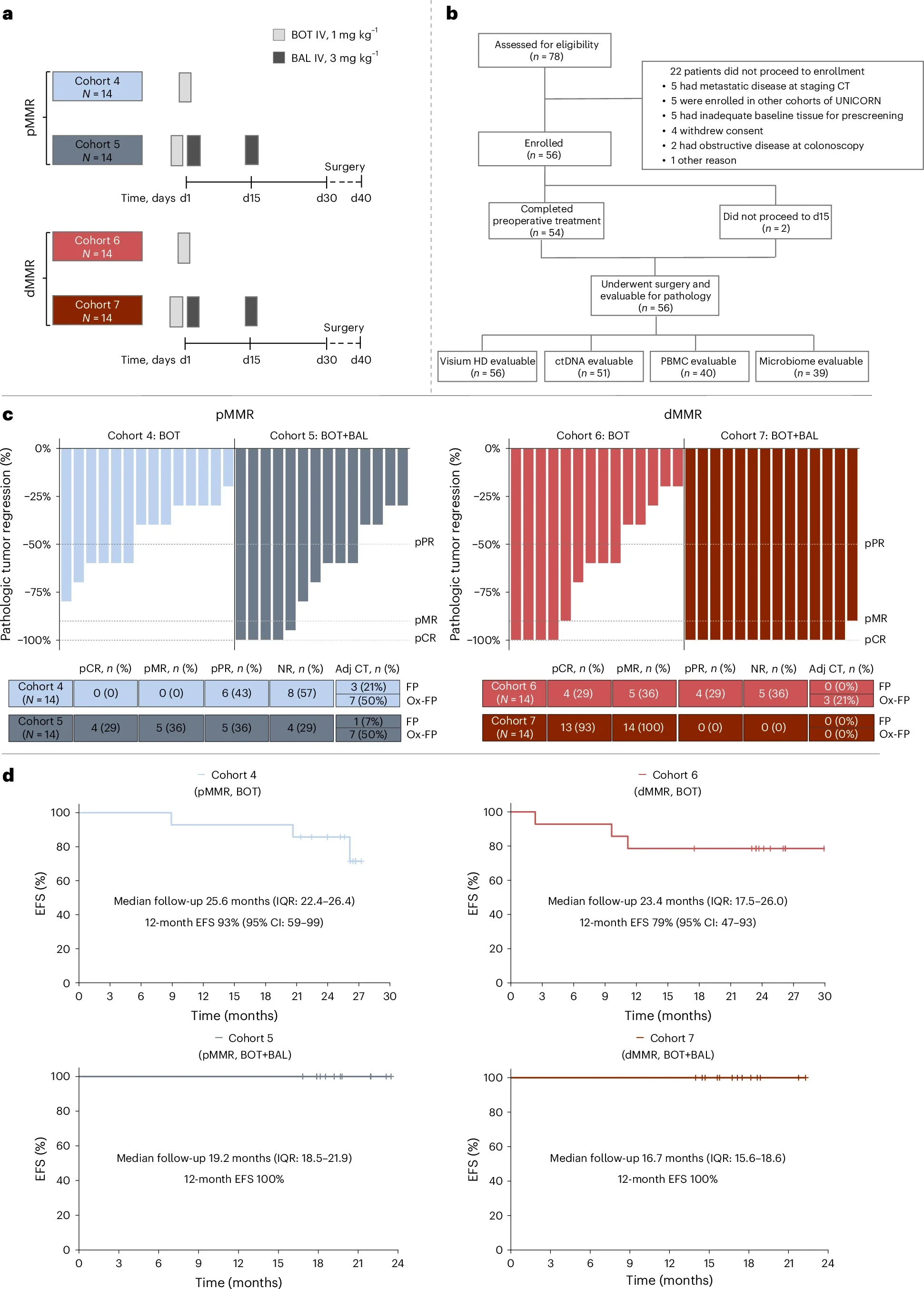
UNICORN study design, main clinical outcomes and time to surgery, including pathological tumor regression and event-free survival across the four treatment cohorts. Source: Ghelardi F, Ambrosini M, Raimondi A, et al. Neoadjuvant botensilimab with or without balstilimab in pMMR and dMMR colon cancer: the phase 2 UNICORN trial. Nature Medicine (2026), Figure 1. DOI: 10.1038/s41591-026-04710-1. © The Author(s) 2026. CC BY-NC-ND 4.0. Reproduced without modification.
Filippo Pietrantonio, senior author and principal investigator of the study and Head of the Gastrointestinal Oncology Unit at Fondazione IRCCS Istituto Nazionale dei Tumori in Milan, stated:
“The UNICORN study challenges that assumption in the curative-intent setting.”
Pietrantonio highlighted that the objective of neoadjuvant immunotherapy extends beyond reducing tumor burden before surgery. The ultimate goal is to prevent recurrence and increase the proportion of patients who can be cured. He emphasized that the deep pathological responses observed after a short treatment course, together with preserved surgical feasibility and the absence of recurrences in the combination cohorts at the data cutoff, provide a strong rationale for evaluating this approach in a larger randomized trial.
Beyond Tumor Regression: What ctDNA Revealed
One of the most interesting aspects of the UNICORN publication extends beyond conventional pathological response.
Researchers collected longitudinal blood samples to examine circulating tumor DNA (ctDNA), a potential marker of residual tumor burden and treatment response.
Among 27 patients with pMMR disease who had available ctDNA assessments, six achieved ctDNA clearance before surgery. All six had received botensilimab plus balstilimab.
Importantly, all five evaluable pMMR patients who achieved a major pathological response also cleared ctDNA before surgery.
The sixth patient who cleared ctDNA achieved a partial pathological response, with 30% residual viable tumor remaining.
Among patients with dMMR disease, ctDNA data were available for 24 of 28 patients. At the end of neoadjuvant treatment, ctDNA clearance was observed in 74% of evaluable pathological responders.
Across the study, ctDNA clearance was associated with pathological response and favorable disease-free outcomes.
At the February 9, 2026, data cutoff, no disease-free survival events had occurred among patients who cleared ctDNA.
These findings suggest that molecular response may provide information complementary to pathological assessment, potentially helping identify patients with particularly favorable responses to neoadjuvant immunotherapy.
However, the small sample size and exploratory nature of these analyses mean that ctDNA clearance cannot yet be used to determine whether patients can safely omit surgery or postoperative chemotherapy.
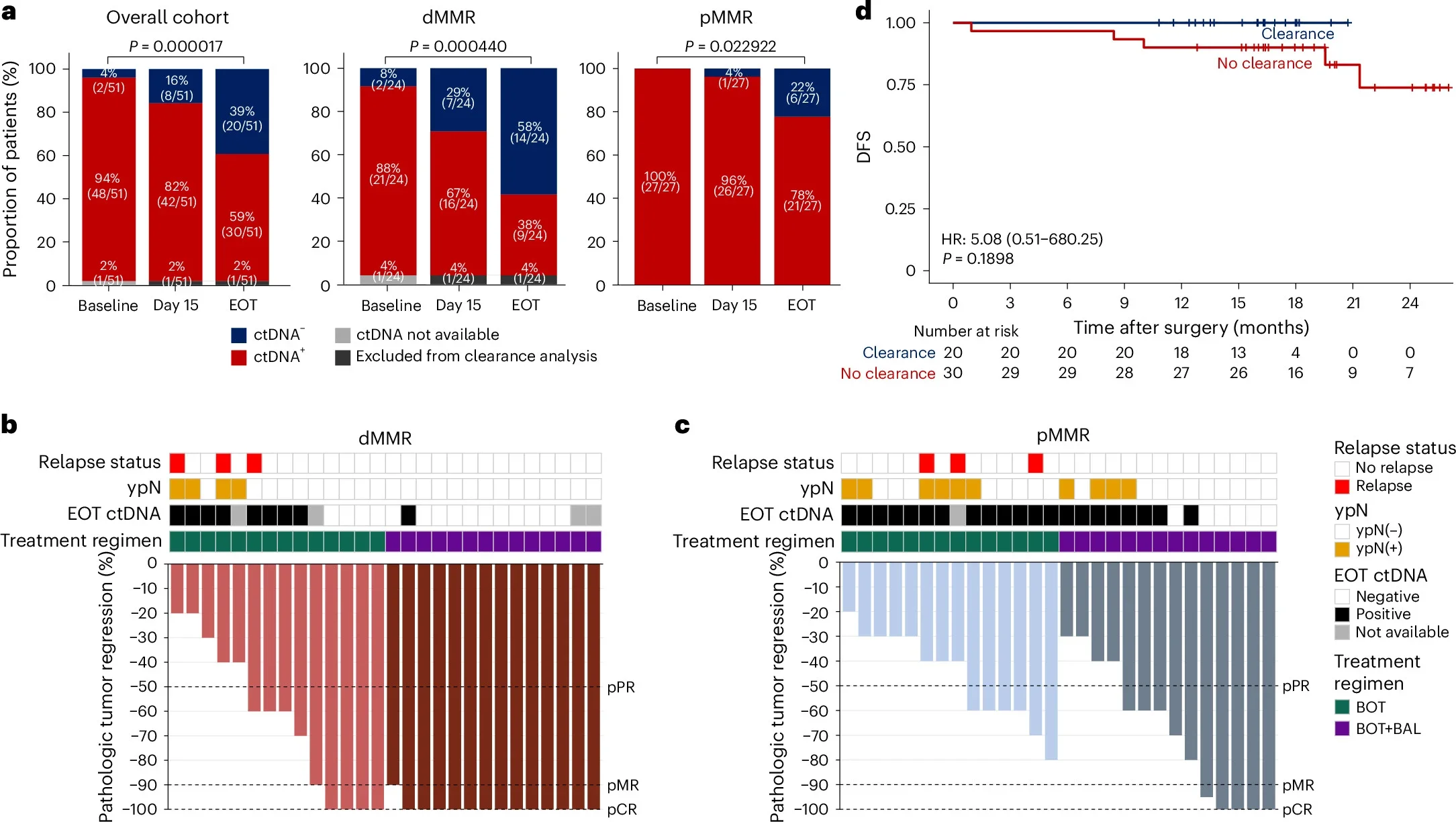
Longitudinal circulating tumor DNA dynamics in the UNICORN trial, illustrating changes during treatment and associations with pathological response, residual disease and disease-free survival. Source: Ghelardi F, Ambrosini M, Raimondi A, et al. Neoadjuvant botensilimab with or without balstilimab in pMMR and dMMR colon cancer: the phase 2 UNICORN trial. Nature Medicine (2026), original Figure 3. DOI: 10.1038/s41591-026-04710-1. © The Author(s) 2026. CC BY-NC-ND 4.0. Reproduced without modification.
Commenting on the translational findings, Filippo Ghelardi, Medical Oncology Fellow at Fondazione IRCCS Istituto Nazionale dei Tumori in Milan, emphasized the opportunity to “look beyond whether a tumor responded.”
He highlighted the relationship between pathological regression, ctDNA clearance and changes in the tumor immune microenvironment, noting that these observations provide further insight into the biological activity of neoadjuvant immunotherapy in MSS colon cancer.
What Happened Inside the Tumor?
To understand why certain tumors responded, investigators performed single-cell spatial transcriptomic analyses using paired pretreatment biopsies and post-treatment surgical samples from all 56 patients.
This allowed researchers to examine how immune and stromal cell populations changed during treatment and whether specific biological features were associated with pathological regression.
In pMMR tumors, response was associated with higher baseline PD-L1 expression in stromal compartments and lower regulatory T-cell signatures after treatment.
These findings are consistent with the proposed immunomodulatory effects of Fc-enhanced CTLA-4 blockade.
In dMMR responders, investigators identified higher baseline expression of FCGR2A and FCGR3A on intratumoral macrophages, providing additional evidence that Fc-gamma receptor interactions may be relevant to treatment activity.
Importantly, these findings remain hypothesis-generating rather than validated predictive biomarkers.
Together, the analyses suggest that the activity of botensilimab plus balstilimab may involve changes in immune-cell function and organization, rather than simply an increase in immune-cell numbers.
No Recurrences in the Combination Cohorts, but Follow-Up Remains Limited
At the February 2026 cutoff, no event-free survival events had been reported in either combination-treatment cohort.
The estimated 12-month event-free survival rate was 100% in both pMMR/MSS and dMMR/MSI-H patients receiving botensilimab plus balstilimab.
Median follow-up was 19.2 months in the pMMR/MSS combination cohort and 16.7 months in the dMMR/MSI-H combination cohort. In comparison, six event-free survival events occurred across the two botensilimab monotherapy cohorts.
These findings are encouraging, but longer follow-up will be essential to determine whether the observed pathological and molecular responses translate into sustained reductions in recurrence.
All 56 patients underwent surgery, and eight of 14 patients in the pMMR combination cohort subsequently received adjuvant chemotherapy. Therefore, the favorable event-free survival findings cannot be attributed exclusively to preoperative immunotherapy.
Safety and Surgical Feasibility
The short treatment window was generally feasible.
All 56 patients proceeded to surgical resection, with 98% meeting the trial’s definition of timely surgery.
Adverse events were reported in 30 patients (54%), while immune-related adverse events occurred in 23 patients (41%). The most commonly reported immune-related events included flu-like symptoms and diarrhea.
One patient developed grade 3 hyperthyroidism, resulting in a delay to surgery.
No treatment-related deaths or unresolved adverse-event sequelae were reported.
The investigators also observed a decline in patient-reported global quality-of-life scores during treatment in the pMMR combination cohort, highlighting the importance of evaluating tolerability alongside efficacy in patients receiving treatment with curative intent.
How Does UNICORN Compare With NEST?
The UNICORN findings follow another important Phase 2 investigation of botensilimab plus balstilimab: the NEST trial, published in Clinical Cancer Research in 2026.
NEST enrolled 24 patients with 26 colorectal tumors, including 22 pMMR tumors.
In the pMMR group, the combination achieved a major pathological response rate of 41%, providing another signal of activity in a population historically resistant to checkpoint inhibitors.
The NEST study also demonstrated increased CD8-positive T-cell infiltration and reduced intratumoral regulatory T cells in responding tumors, supporting the proposed immune-modulating activity of the combination.
While NEST was conducted at a single center, UNICORN provides additional evidence from a multicenter setting and includes separate monotherapy cohorts.
The two studies reinforce a consistent signal of pathological activity in pMMR colon cancer, although differences in eligibility, treatment schedules and study design prevent direct comparisons.
Neither trial was designed to establish superiority over standard perioperative management.

What Comes Next? The Phase 3 ROBBIN Trial
The next challenge is to determine whether these pathological responses can translate into meaningful long-term clinical benefit.
UNICORN has already been amended to investigate an extended eight-week neoadjuvant course of botensilimab plus balstilimab in an additional cohort of 29 patients with locally advanced pMMR colon cancer.
Meanwhile, Agenus is advancing ROBBIN, a planned global randomized Phase 3 trial in patients with previously untreated, high-risk stage II or stage III MSS/pMMR colon cancer.
The study is designed to compare neoadjuvant botensilimab plus balstilimab followed by standard care against standard care alone.
Event-free survival is the planned primary endpoint, providing a more definitive assessment of whether the combination can improve outcomes beyond conventional management.
The randomized design will also help address an important limitation of the early-phase findings: whether pathological tumor clearance can translate into durable clinical benefit across a larger and more representative patient population.
Steven O’Day, Chief Medical Officer of Agenus, described the UNICORN results as independent evidence supporting further development of botensilimab plus balstilimab in MSS colon cancer.
He noted that the absence of observed recurrences in the combination cohorts, together with the previously published NEST findings, strengthens the rationale for the planned Phase 3 ROBBIN trial evaluating the combination in patients receiving treatment with curative intent.

A Promising Signal, Not Yet a Change in Standard of Care
The UNICORN trial adds to growing evidence that immunotherapy resistance in MSS colon cancer may not be absolute, particularly in the neoadjuvant setting.
Its significance lies not only in the depth of pathological responses but also in the alignment between tumor regression, ctDNA clearance, and measurable changes within the tumor immune microenvironment.
Still, pathological response is not equivalent to cure. UNICORN enrolled only 14 patients per cohort, lacked randomized standard-of-care controls, and has relatively short follow-up in its combination groups.
Whether this approach can reduce recurrence, improve survival, or eventually support treatment de-escalation remains unanswered.
For now, the findings provide a scientifically compelling rationale for larger randomized studies.
The question is no longer simply whether some MSS colon cancers can respond to immunotherapy before surgery. It is whether those responses can ultimately change what happens to patients after surgery.
Read the full article: Ghelardi, F., Ambrosini, M., Raimondi, A. et al. Neoadjuvant botensilimab with or without balstilimab in pMMR and dMMR colon cancer: the phase 2 UNICORN trial. Nat Med (2026). https://doi.org/10.1038/s41591-026-04710-1