A recent JAMA paper has sparked an ongoing debate among oncologists about the evidence used to approve cancer medicines, and whether tumor response should carry more weight than survival outcomes and quality of life.
Cancer Medicine Approvals in the US
Authors: Brian Shkabari, Nicole I. Vorko, Wesley M. Geerlinks, Elizaveta Purh, Claire M. Diana-Gonsalves, Svasti Sutaria, Bishal Gyawali
The study, “Cancer Medicine Approvals in the US,” examined changes in FDA approvals for adult solid-tumor treatments over the past two decades, including regulatory pathways, trial designs, and efficacy endpoints. One of the findings highlighted by study senior author Bishal Gyawali, MD, PhD, FASCO, was the growing use of objective response rate, or ORR, as the surrogate endpoint supporting pivotal oncology trials.
Gyawali wrote:
“PFS was the King of pivotal oncology trials. Our study shows that this King is now dethroned and replaced.”
The replacement, he noted, was not overall survival or quality of life, but ORR.
“The commonest surrogate endpoint in pivotal cancer drug trials is now ORR. The new King, but an even worse King.”
Gyawali argued that tumor shrinkage should not automatically be considered proof that a treatment helps patients live longer or experience a better quality of life.
He also emphasized that not all responses carry the same clinical meaning. A complete response may be different from a partial response, while the duration of the response, treatment toxicity, disease setting, and number of patients included in the study can all influence how the result should be interpreted.
According to Gyawali, small studies may sometimes overestimate response rates, and several treatments with promising early responses have later failed in randomized trials or had their indications withdrawn.
Kurzrock questions what randomized trials reward
Razelle Kurzrock responded by challenging the idea that conventional randomized controlled trials necessarily produce better evidence or better treatments. She argued that randomized trials in solid tumors have often established therapies with relatively low response rates and only modest improvements in survival because the results reached statistical significance.
“RCTs favor mediocre therapies with significant P values.”
From Kurzrock’s perspective, the current system may be well designed to identify small differences between treatments in large patient populations, but less suited to recognizing therapies that produce dramatic responses in smaller, carefully selected groups.
She argues that this may be especially relevant in rare cancers or molecularly defined populations, where conducting a large randomized trial can be difficult. In such settings, an unusually high and durable response rate may provide important evidence that a treatment is delivering substantial benefit.
“You get what you incentivize.”
Her argument raises a broader concern about the incentives created by oncology drug development: if approval depends mainly on demonstrating statistically significant differences in large trials, companies may be encouraged to pursue treatments offering modest improvements across large markets rather than highly active therapies for smaller populations.
Gyawali: The problem is not the RCT
Gyawali disagreed that randomized trials themselves are responsible for marginal treatments. He said:
“RCT is a tool, an exceptional tool, that has been misused and hijacked to promote bad drugs.”
In his view, when a randomized trial demonstrates only a small benefit, the problem may be the medicine being tested, the comparator, the selected endpoint, or the acceptance of results that are statistically significant but not clinically meaningful.
He argued that a genuinely transformative treatment should still demonstrate a substantial effect in a well-designed randomized trial. When the expected difference between treatments is large, fewer participants may also be needed to show that effect.
“The solution is not to get rid of RCTs, but to do well-designed, better RCTs.”
The disagreement therefore extends beyond a simple choice between ORR and overall survival. It also concerns what randomized trials are designed to detect and what level of benefit should be considered meaningful enough to change clinical practice.
The role of accelerated approval
Gyawali later highlighted another finding from the study: many recent cancer-drug approvals based on surrogate endpoints were granted through regular approval rather than the accelerated approval pathway.
Accelerated approval allows promising treatments to reach patients earlier based on surrogate endpoints, while requiring confirmatory studies to verify clinical benefit afterward. Gyawali stated:
“The accelerated approval pathway provides a good balance between speed and evidence.”
His concern is that granting regular approval based on uncertain surrogate evidence may remove an important safety net. Under accelerated approval, a sponsor is expected to confirm that the early signal translates into meaningful benefit. When benefit is not confirmed, the indication can be reconsidered or withdrawn. Regular approval based on similarly uncertain evidence may not carry the same structured requirement for confirmation.
A debate that continues
Amol Akhade also joined the discussion and summarized both sides of the discussion in an infographic shared on X, leading to further discussions. Gyawali and Kurzrock welcomed the visuals. Gyawali noted that several points require further nuance, including the difference between complete and partial responses, the durability of response, study size, and the role of accelerated approval.
Kurzrock suggested that the discussion could develop into a joint publication:
“I think we should all get together and publish this debate. I have some more to add regarding biology.”
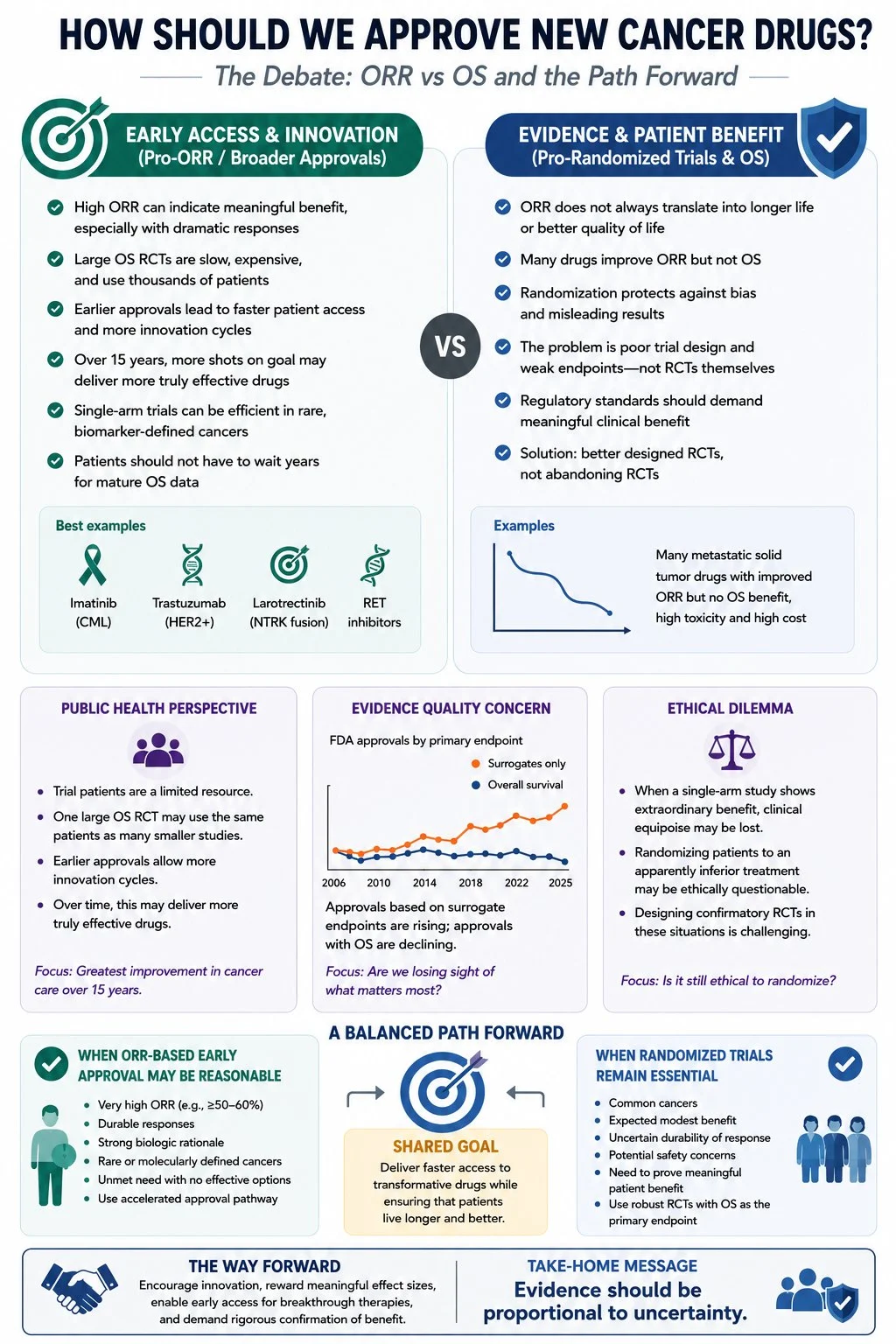
Amol Akhade/X
The possibility of turning the discussion into a formal publication was also welcomed by Paolo Tarantino:
“I absolutely love great Twitter debates that convert into great publications. Looking forward to reading both sides of this important debate.”
Other oncologists also joined the discussion. Here are some highlights from their responses on X:
“This should be assessed on a disease-by-disease basis. In today’s era of innovation, insisting on OS as the only endpoint in RCTs could delay effective treatments and put many lives at risk.”
“What is missing entirely in this is how patients are living. Quality of life and thriving with cancer, retaining function, wellbeing and identity, are probably among the most important endpoints from a patient point of view.”
“This is akin to the ‘Yin and Yang, Shiva and Shakthi, or Logos and Chaos’ debate. The big-tent idea is that both are needed, and both have a place.”
“Approvals based on soft endpoints like ORR are necessary not only for early patient access to new drugs, but also to fuel innovation cycles.”
What began as an exchange over ORR, OS, and randomized trials may therefore continue beyond X, with several participants now calling for a fuller scientific discussion of both perspectives.
Read further on OncoDaily: Amol Akhade received the 2026 Yvonne Award in the Voice of Oncology category, while Bishal Gyawali received the Challenging the Status Quo Award at the 2025 Yvonne Awards.