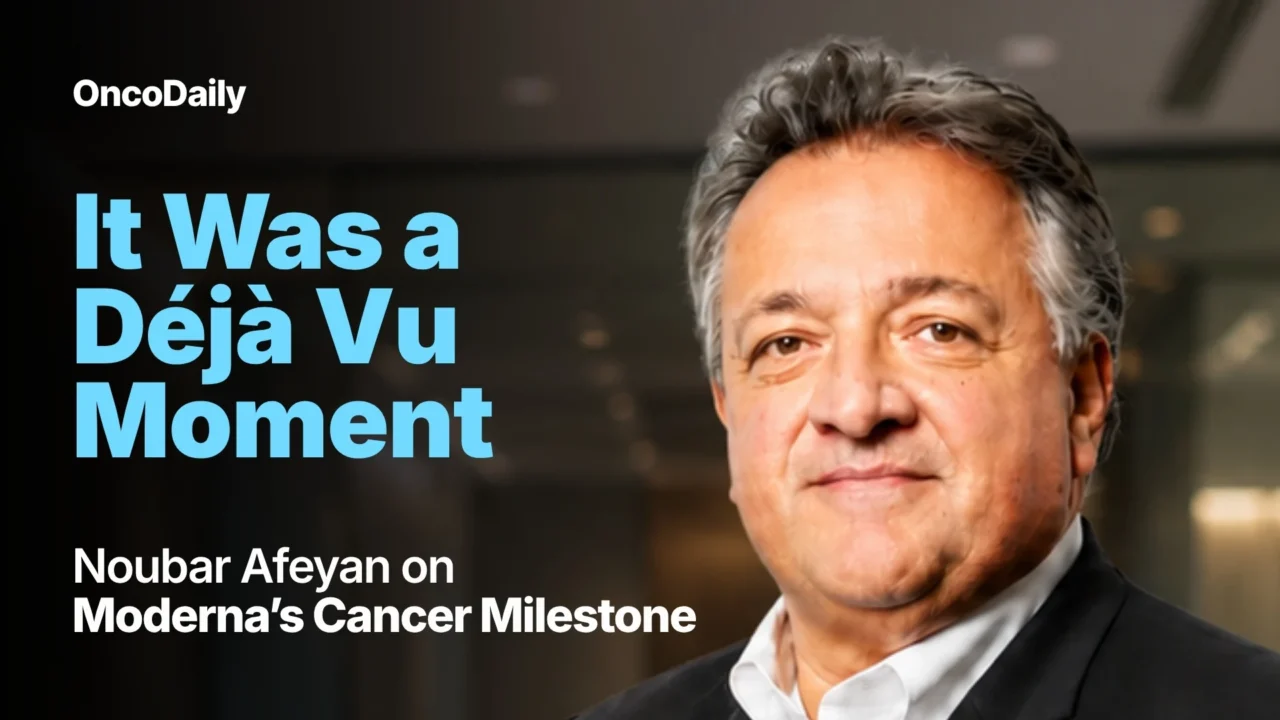
Noubar Afeyan, Co-founder and Chairman of Moderna, has reflected on the positive Phase 3 results for Moderna and Merck’s individualized mRNA-based cancer therapy in melanoma.
Speaking with Richard Quest on CNN’s Quest Means Business, Afeyan reflected on the significance of the results, the future of mRNA-based cancer treatment, questions around access, and what the milestone could mean for Moderna beyond infectious disease.
The interview followed the August 19 announcement that the Phase 3 INTerpath-001 trial evaluating intismeran autogene (V940/mRNA-4157) plus pembrolizumab (KEYTRUDA) had met both its primary endpoint of recurrence-free survival and a key secondary endpoint of distant metastasis-free survival in patients with completely resected stage IIB-IV melanoma.
“It Was a Déjà Vu Moment”
Afeyan said he learned about the positive results only shortly before they were announced publicly.
For him, the moment brought back memories of another major milestone for Moderna, the emergence of positive data from its COVID-19 vaccine program approximately six years earlier.
“I must say, it was a déjà vu moment.”
But this time, he said, the challenge being addressed was cancer. The comparison is particularly significant given Moderna’s history. Although the company became globally known through its COVID-19 vaccine, Afeyan pointed out that its work in cancer immunotherapy began well before the pandemic.
“Before COVID existed… we set out to use the body’s own immune system to combat cancer.”
He described Moderna’s trajectory as an unusual one: from an early focus on cancer, to becoming strongly associated with infectious diseases during the pandemic, and now returning to both areas.
What Do We Know About the Phase 3 Results?
INTerpath-001 is evaluating intismeran autogene together with pembrolizumab as adjuvant treatment following complete surgical resection of stage IIB-IV melanoma. At a prespecified interim analysis, the combination produced statistically significant and clinically meaningful improvements in recurrence-free survival (RFS) and distant metastasis-free survival (DMFS) compared with pembrolizumab alone.
Importantly, however, the detailed numerical results from the Phase 3 trial have not yet been released. Afeyan also pointed to the longer-term evidence from the earlier Phase 2b KEYNOTE-942 study, which has continued to show benefit with extended follow-up.
Merck and Moderna have said the detailed Phase 3 findings will be presented at an upcoming international medical meeting and plan to discuss potential regulatory submissions with health authorities.
INTerpath-001 Trial: Personalized mRNA Cancer Vaccine for Melanoma
Can an Individualized Cancer Treatment Be Widely Accessible?
Quest also raised one of the major questions surrounding personalized therapies: cost and access.
With every treatment individually designed and manufactured for a particular patient, he asked Afeyan how the companies could prevent the therapy from becoming available only to a privileged group of patients.
Afeyan said broad availability is the intention of the program and pointed to Merck’s experience in bringing immunotherapies to patients globally.
“Our intention is to get it available broadly.”
He acknowledged the individualized nature of the treatment but said the companies believe it can ultimately be made broadly accessible as the program develops.
How such individualized manufacturing translates into pricing, reimbursement, production capacity and equitable global access will likely become increasingly important questions if the therapy receives regulatory approval.
mRNA, AI and the Next Generation of Medicine
Looking further ahead, Afeyan connected advances in mRNA technology with the rapid development of artificial intelligence.
He argued that one lasting scientific consequence of the COVID-19 pandemic was the enormous amount researchers learned about how the human immune system responds across very large populations. Combined with AI’s ability to analyze increasingly complex biological data, he believes that knowledge could contribute to new approaches not only in cancer and infectious disease, but potentially autoimmune conditions as well.
“I do think that many infectious conditions, as well as cancer and even autoimmune disease, will be battled with our newfound understanding and our ability to direct our immune system.”
For Moderna, Afeyan suggested that the latest melanoma results are less an endpoint than the beginning of another phase for the mRNA platform.
“We’re very excited. We’re at the beginning stages of this.”
And despite the sharp market reaction following the Phase 3 announcement, Afeyan said Moderna’s focus remains on developing medicines rather than its day-to-day share price. The company’s job, he said, is to “put our heads down” and continue doing what its team knows how to do:
“Invent and take medicines to market.”