Merck will arrive at the ESMO Congress 2026 with more than 90 oncology abstracts spanning more than 20 tumor types, but the most closely watched presentations may offer a glimpse at what the company’s oncology portfolio looks like beyond its established pembrolizumab franchise.
On October 13, Merck announced that three pivotal Phase 3 trials will have their first full presentations in ESMO Presidential Symposia: INTerpath-001 in resected melanoma, TroFuse-005 in advanced or recurrent endometrial cancer, and KEYNOTE-C93 in mismatch repair-deficient (dMMR) advanced or recurrent endometrial cancer.
The program brings together three distinct strategies: an individualized mRNA-based neoantigen therapy, a TROP2-directed antibody-drug conjugate (ADC), and a more biomarker-selected use of PD-1 inhibition. Beyond the Presidential Symposia, Merck will present Phase 3 and late-breaking results in lung, breast and renal cancers, alongside additional studies in bladder, ovarian, pancreatic and other malignancies.
INTerpath-001 puts individualized mRNA therapy in the Phase 3 spotlight
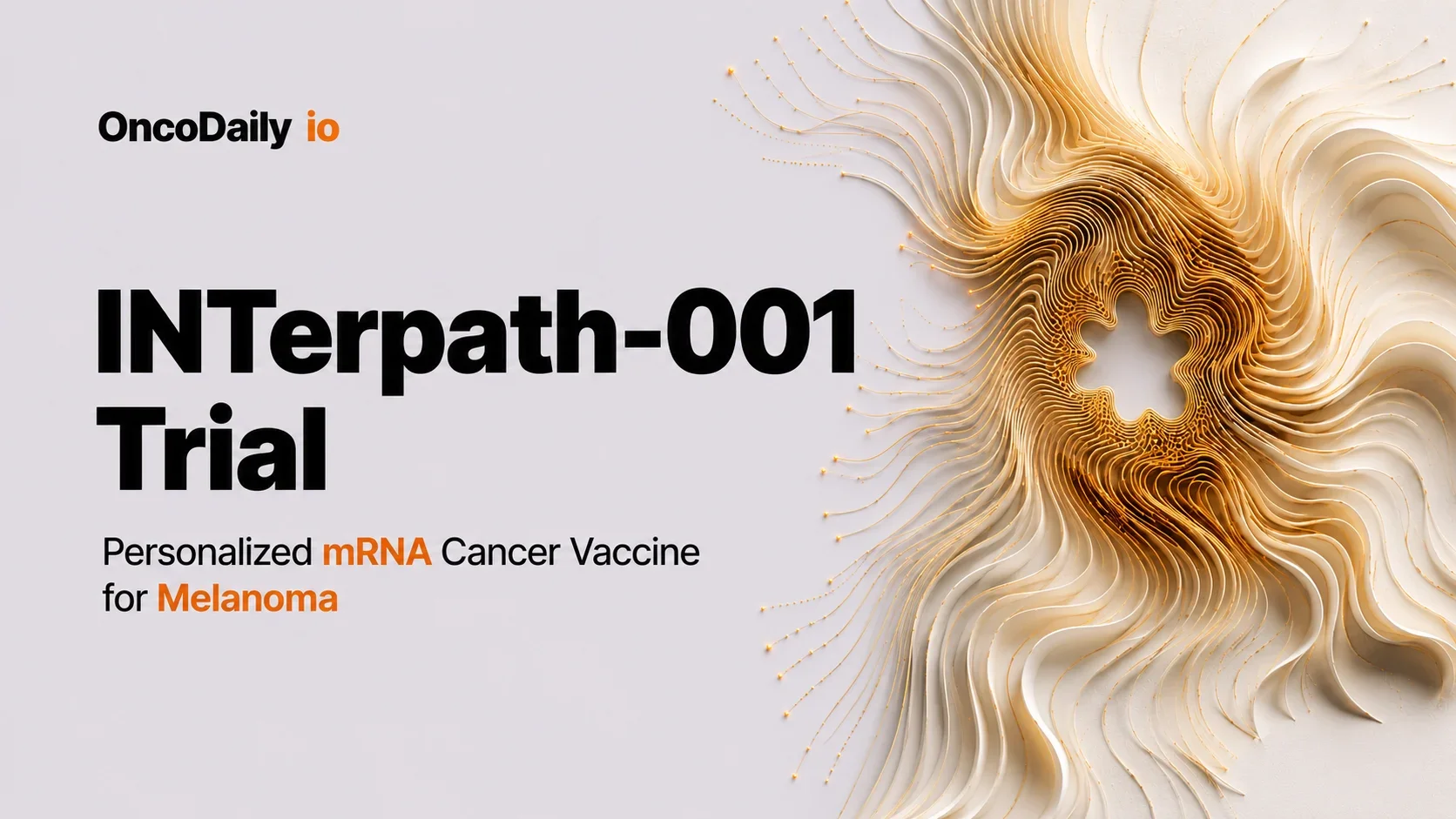
Perhaps the most anticipated Merck-associated presentation will be INTerpath-001, the first Phase 3 study of intismeran autogene plus pembrolizumab in patients with completely resected stage IIB-IV melanoma.
Intismeran autogene is an individualized mRNA-based neoantigen therapy jointly developed by Merck and Moderna. It is designed using the mutational profile of an individual patient’s tumor, with each therapy encoding up to 34 neoantigens intended to stimulate a tumor-specific immune response.
Merck and Moderna previously announced in August that INTerpath-001 met its primary endpoint of recurrence-free survival and its key secondary endpoint of distant metastasis-free survival, with statistically significant and clinically meaningful improvements for the combination compared with pembrolizumab alone. The companies described the result as the first positive Phase 3 readout for an individualized neoantigen therapy and an mRNA-based cancer therapy. Numerical results will now be a major focus of the ESMO presentation.
Georgina V. Long will present the study as LBA1 during Presidential Symposium I on October 24. The symposium is scheduled for 16:30-18:15 Madrid local time in the Alicante Auditorium, Hall 6.
Title: INTerpath-001: Phase 3 study of the mRNA-based individualized neoantigen therapy (INT) intismeran autogene plus pembrolizumab vs pembrolizumab alone for adjuvant treatment of resected stage IIB-IV melanoma
Presenter: Georgina V. Long
Session: Presidential Symposium I
Date: October 24, 2026
The intismeran program will also appear outside melanoma. David J. Pinato will present Phase 1 results evaluating adjuvant intismeran autogene plus FOLFIRINOX in resectable pancreatic ductal adenocarcinoma in a pancreatic cancer poster session, abstract 3151P.
Two pivotal endometrial cancer trials share Presidential Symposium III
Endometrial cancer will provide another major test of Merck’s evolving oncology strategy, with two Phase 3 studies appearing in the same Presidential Symposium.
The first, TroFuse-005/ENGOT-en23/GOG-3095, evaluates sacituzumab tirumotecan against physician’s choice of chemotherapy in patients with advanced or recurrent endometrial cancer previously treated with platinum-based chemotherapy and anti-PD-1/PD-L1 therapy.
Topline results announced in May showed that the trial met both primary endpoints, with statistically significant and clinically meaningful improvements in overall survival and progression-free survival. The trial also met its key secondary endpoint of objective response rate. Merck said this was the first global Phase 3 trial of a TROP2-directed ADC to improve both OS and PFS compared with chemotherapy in this population.
Domenica Lorusso will present the full results as LBA11.
Title: Sacituzumab tirumotecan in previously treated advanced or recurrent endometrial cancer: Results from the Phase 3 TroFuse-005/ENGOT-en23/GOG-3095 study
Presenter: Domenica Lorusso
Session: Presidential Symposium III
Date: October 26, 2026, 16:30-18:15
Immediately alongside it is KEYNOTE-C93/GOG-3064/ENGOT-en15, which asks a different clinical question: whether selected patients with dMMR advanced or recurrent endometrial cancer require conventional platinum-doublet chemotherapy as their first-line systemic treatment.
The Phase 3 study compares pembrolizumab monotherapy with carboplatin plus paclitaxel. Merck announced in July that pembrolizumab significantly improved progression-free survival, making it the first PD-1 inhibitor reported to demonstrate a statistically significant and clinically meaningful PFS improvement as monotherapy against platinum-doublet chemotherapy in this Phase 3 setting.
Title: KEYNOTE-C93/GOG-3064/ENGOT-en15: Phase 3, randomized, open-label study of first-line pembrolizumab vs carboplatin plus paclitaxel in dMMR advanced or recurrent endometrial carcinoma
Presenter: Brian M. Slomovitz
Session: Presidential Symposium III
Date: October 26, 2026, 16:30-18:15
Taken together, LBA11 and LBA12 approach endometrial cancer from opposite sides of the treatment pathway: one tests an ADC after platinum and immunotherapy have failed, while the other asks whether biomarker-selected patients can begin treatment with immunotherapy alone.
Sacituzumab tirumotecan expands into lung cancer
The TROP2 ADC program will extend well beyond endometrial cancer at ESMO.
Two Phase 3 OptiTROP studies will be presented in the metastatic NSCLC proffered paper session on October 25.
LBA66 – OptiTROP-Lung06 evaluates sacituzumab tirumotecan plus pembrolizumab against chemotherapy plus pembrolizumab as first-line therapy for patients with PD-L1-negative advanced non-squamous NSCLC.
Presenter: Caicun Zhou
Session: Proffered Paper Session 1: NSCLC, metastatic
Date/time: October 25, 10:15-11:45
The study is particularly notable because it tests whether a TROP2 ADC can replace the conventional chemotherapy component of an immunotherapy-based first-line regimen.
The same session includes LBA67 — OptiTROP-Lung04, reporting the final overall survival analysis of sacituzumab tirumotecan versus platinum-based chemotherapy in patients with EGFR-mutated NSCLC after progression on EGFR tyrosine kinase inhibitor therapy.
Presenter: Wenfeng Fang
Session: Proffered Paper Session 1: NSCLC, metastatic
Date/time: October 25, 10:15-11:45
Together with TroFuse-005, the studies will provide an important readout on whether sacituzumab tirumotecan can establish a role across several distinct treatment settings rather than in a single tumor type.
Kidney cancer: final LITESPARK-011 results
Merck and Eisai will also present the final Phase 3 LITESPARK-011 analysis, comparing belzutifan plus lenvatinib with cabozantinib in advanced renal cell carcinoma following PD-1/PD-L1 therapy.
Earlier results demonstrated a progression-free survival advantage for the combination, and in September 2026 the FDA approved belzutifan plus lenvatinib for certain previously treated adults with advanced clear cell RCC. At the final analysis used for the approval, overall survival did not reach statistical significance.
Title: Final analysis of the Phase 3 LITESPARK-011 study: Belzutifan plus lenvatinib versus cabozantinib for advanced renal cell carcinoma after anti-PD-(L)1 therapy
Presenter: Daniel Y. Heng
Session: Proffered Paper Session 2: Genitourinary tumours, renal and urothelial
Date/time: October 25, 08:30-10:00
The renal cancer program also includes the final protocol-prespecified analysis of KEYNOTE-564, with Toni K. Choueiri presenting longer-term data for adjuvant pembrolizumab versus placebo in clear cell RCC as abstract 3589RO.
Pembrolizumab reaches another major breast cancer question
Among Merck’s breast cancer presentations, KEYNOTE-B49 stands out as another late-breaking Phase 3 trial.
The study evaluates pembrolizumab versus placebo, each combined with chemotherapy, in HR-positive/HER2-negative advanced breast cancer—a disease setting where the role of immune checkpoint blockade remains substantially less established than in triple-negative breast cancer.
Title: Results from KEYNOTE-B49: A Phase 3, randomized, double-blind study of pembrolizumab vs placebo plus chemotherapy in participants with HR+/HER2− advanced breast cancer
Presenter: Hope S. Rugo
Session: Proffered Paper Session 2: Breast cancer, early and advanced stage
Date/time: October 24, 08:30-10:00
Merck’s breast cancer program also includes final overall survival results from OptiTROP-Breast01 in previously treated locally recurrent or metastatic triple-negative breast cancer and patient-reported outcome analyses from ASCENT-04/KEYNOTE-D19.

A broader oncology portfolio is taking shape
Merck’s ESMO 2026 program still has pembrolizumab at its center, with studies across breast, lung, renal, bladder, endometrial and other cancers. But the more consequential story may be the increasing number of programs being built around that foundation, or moving beyond it entirely.
Intismeran autogene is testing whether individualized mRNA-based immunotherapy can add benefit to PD-1 blockade in the curative-intent setting. Sacituzumab tirumotecan is being evaluated across endometrial, lung, breast, bladder, and other tumors. Belzutifan is extending Merck’s renal cancer portfolio into HIF-2α inhibition, while additional studies are examining HER3-directed and CDH6-directed ADCs, KRAS G12C inhibition and new perioperative combinations.
Marjorie Green, senior vice president and head of oncology global clinical development at Merck Research Laboratories
“We are proud to share Phase 3 data for the first time from intismeran and sac-TMT.”
She added that the broader ESMO program reflects continued development across a range of cancer types.
With three pivotal trials in Presidential Symposia and more than 90 additional abstracts across more than 20 tumor types, ESMO 2026 may therefore provide one of the clearest looks yet at how Merck intends to broaden its oncology strategy beyond a single immunotherapy platform.
Continuing the Conversation at ESMO 2026
As Merck and other pharmaceutical companies prepare to present new clinical trial data at ESMO 2026, the congress will also provide opportunities to discuss how emerging evidence may influence clinical practice across different cancer types.
Continuing these scientific discussions beyond the congress sessions, OncoDaily will host its Grand Rounds at ESMO 2026: Sarcoma Edition on October 23 in Madrid.
Co-chaired by Robin Jones and Javier Martín-Broto, the event will bring together international experts to discuss recent developments, evolving treatment strategies, and clinical challenges in sarcoma care.
Register here to join the discussion.